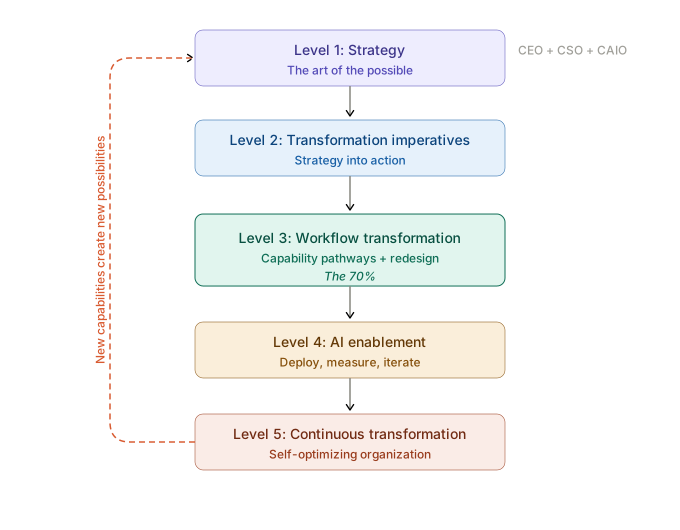
This article is part of a 27-article series on the AI Business Transformation Methodology. This piece focuses on the transition from Level 2 to Level 3, where strategy becomes operational reality.
You have just been handed something that looks like a mandate but feels like an open question.
The Level 1 triad (CEO, CSO, and CAIO) has set the enterprise AI strategy. The Level 2 portfolio of Business Transformation Imperatives has been built and prioritized. And now a specific imperative has been assigned to you: a charter that says your domain, your function, your part of the business is responsible for delivering a defined transformation outcome. The imperative is strategically derived, outcome-defined, and backed by a resource commitment. It connects directly to the enterprise strategy.
And you are wondering what to do next.
This is the moment where strategy meets operational reality. Everything that was discussed at the executive level now has to become real inside your organization. The quality of what happens next determines whether the enterprise AI investment produces transformation or produces another round of expensive experiments that do not connect to each other.
This article is for the C-suite domain owner or senior vice president who has received a Level 3 charter. It covers what ownership actually means, what the three phases of Level 3 require, how to work with the CAIO’s department, and how to structure the first 90 days after receiving your charter.
What does being a domain owner actually mean?
Being a domain owner means the charter holds you accountable for a business outcome, not a technology deployment — and this distinction matters more than anything else at Level 3. Your job is the result the transformation produces in your domain, not the AI systems used to get there.
If your imperative says “redesign the customer engagement process so that resolution quality increases by 30% while cost-per-interaction decreases by 40%,“ you are accountable for that business result. You are not accountable for deploying a chatbot, implementing an AI platform, or standing up a machine learning model. Those may be part of the solution, but they are Level 4 activities that follow after the Level 3 work is done. Your job is to ensure that the workflows in your domain are redesigned so effectively that when AI tools are eventually deployed into them, the business outcome materializes.
McKinsey’s research on domain leaders who successfully drive AI transformation found that they share a critical capability: the ability to reimagine their domain with AI rather than simply automate existing workflows. They develop transformation roadmaps by working with domain experts and functional specialists to rethink end-to-end processes. And critically, they do not delegate this job to IT or to lower levels of their organizations.1 They own it.
Harvard Business Review reached the same conclusion from the C-suite side in March 2026: the productive question is not “who owns AI?” but “who owns which AI-related decisions?”3 The charter is that question answered one level down: an explicit, documented allocation of decision rights below the C-suite, with a named owner, a defined outcome, and the authority to make the transformation decisions within the domain.
This does not mean you do the design work yourself. It means you are accountable for the quality, ambition, and strategic alignment of the design work that your organization produces. You set the vision for what the transformed domain looks like. Your VPs translate that vision into specific capability requirements. Your directors and senior managers ensure the workflow redesign teams produce designs that match what is now possible with AI rather than what was possible with last generation’s technology. The organizational chain beneath you does the work. You ensure it is the right work.
What are the three phases of Level 3?
Level 3 has three distinct phases that must happen in sequence, because skipping ahead or compressing the early phases produces the same technology-first failures the Methodology is designed to prevent. Each phase builds the foundation the next one depends on.
Phase 3A: Capability Decomposition. Your first task is to decompose the imperative into the specific capabilities your organization needs. What must your domain be able to do that it cannot do today? This is not a technology requirements list. It is a capability requirements list: the business abilities that the redesigned workflows need to deliver. Article 10 in this series covers this phase in depth, but the critical prerequisite is that you and your direct reports invest in understanding what AI makes possible before you decompose anything. You cannot identify transformative capability requirements if you are looking at the imperative through the lens of what was possible before AI.
Phase 3B: Education Cascade. Before your teams can design new workflows, everyone who will be involved in the design process needs substantive education on what AI can do in your specific domain. This is not a briefing deck. It is a working engagement where your directors, senior managers, managers, and the analysts who will do the design work experience what is achievable and develop enough fluency to make informed design decisions. The CAIO’s department runs these engagements, tailored to your domain’s specific context. Article 11 covers this phase.
Phase 3C: Workflow Redesign and Job Redesign. This is the core of the 70% effort. Your teams redesign how work should actually be done in an AI-enabled world, then the change management function assesses how jobs, roles, and organizational structure need to change based on the redesigned workflows. Articles 10 through 13 cover this phase in detail, including the practical methodology, the seven major pitfalls, and the organizational chain of who does what at each level.
How should a domain owner work with the CAIO’s department?
The domain owner should treat the CAIO’s department as a genuine partner, and learning how to use the access the charter grants is one of the most important things to do in the first weeks. That access is there to be drawn on early, not held in reserve as a support function.
The CAIO’s department provides two critical functions at Level 3. The first is education: they run the domain-specific engagements that build AI fluency across your organization. The second is workflow design advisory: as your teams redesign workflows, the CAIO’s team partners with them to ensure the designs leverage AI’s actual capabilities rather than under-designing (because the team does not know what AI can do) or over-designing (because the team assumes AI can do things it cannot yet do reliably).
The relationship is a partnership, not a handoff. The CAIO’s department does not do the transformation for you. They bring AI capability knowledge. You bring domain expertise, operational context, and organizational authority. Neither is sufficient without the other. According to BCG, roughly 70% of the value from AI comes from people, processes, and organizational change, not from the algorithms or technology.2 The CAIO’s department helps you get the technology side right. You are responsible for the 70% that determines whether it produces results.
The most effective domain owners schedule a working session with the CAIO’s team within the first two weeks of receiving their charter. The purpose is not to plan the entire transformation. It is to align on what education engagements the team needs, what the CAIO’s department has already learned from other domains going through similar transformations, and what the advisory support model will look like as your teams begin the design work.
How should a domain owner spend the first 90 days?
The first 90 days should be spent building the foundation that makes the action phase productive rather than scattered — not moving immediately to action. The temptation after receiving a charter is to act right away. Resist it.
Days 1-30: Understand and align. Read and internalize the charter. Understand not just what you are being asked to deliver, but why this imperative was prioritized, how it connects to the enterprise strategy, and what the Level 1 triad expects to learn from this wave. Meet with the CEO to confirm the resource commitment and the strategic context. Meet with the CAIO’s team to align on the support model. Brief your direct reports (VPs) on the charter’s scope, the three phases, and their roles. Identify who on your team will lead the capability decomposition and who will eventually lead the workflow redesign teams.
Days 30-60: Build fluency. This is where you and your VPs invest in understanding what AI makes possible in your domain. Work with the CAIO’s department on a tailored engagement that goes beyond concepts and into specific capabilities relevant to your operations. The goal is not to become technologists. It is to develop enough understanding that when your teams begin decomposing the imperative into capabilities, you can evaluate whether their thinking is bold enough. Begin planning the broader education cascade for your directors, senior managers, and the teams who will do the design work.
Days 60-90: Decompose and plan. With AI fluency established, begin the capability decomposition. What must your domain be able to do that it cannot do today? What are the gaps between current capabilities and what the imperative requires? Which gaps require workflow redesign, which require new technology, and which require new skills? Prioritize the capability build sequence. Identify data dependencies and flag them early. Develop the plan for the education cascade and the workflow redesign effort, including timelines, team assignments, and coordination requirements with adjacent domains.
At the end of 90 days, you should have a clear capability map, a planned education cascade, and a structured approach to the workflow redesign that will follow. You should not have started redesigning workflows yet. That comes after the education cascade ensures your teams are equipped to design ambitiously.
What does success versus failure look like for a domain owner?
The domain owner who succeeds at Level 3 stays close enough to the work to ensure quality without micromanaging the design teams. They invest in their own AI fluency and insist that their entire chain does the same. They treat the CAIO’s department as a genuine partner rather than a support function to be tolerated. They hold their directors and senior managers accountable not just for delivering redesigned workflows on time, but for delivering redesigned workflows that are genuinely transformative. And they protect the time and budget for the education cascade and the change management effort, understanding that these are not overhead costs but the investments that determine whether the transformation succeeds.
The domain owner who fails at Level 3 delegates too far down the chain and loses sight of whether the output is ambitious enough. They skip or compress the education phase because it feels slow. They treat the CAIO’s department as an optional resource rather than an essential partner. They allow their teams to default to incremental improvements on existing processes rather than genuine redesign. And they underbudget the change management effort, producing beautifully designed workflows that nobody adopts because the organization was not prepared for the change.
The difference between these two outcomes is not talent or resources. It is leadership attention applied at the right moments in the right way. The research gives that attention a number: BCG found that 88% of managers at future-built companies role model AI use and incorporate it into their daily decisions, compared with 25% at AI laggards.2 Domain-level ownership that is visible, fluent, and consistent is what separates the two populations.
How does the accountability chain work at Level 3?
At Level 3, accountability operates at multiple levels simultaneously — one final clarification that prevents confusion as the work begins. In our Methodology, the chain runs as follows:
The domain owner (you) is uppercase Accountable for the transformation outcome. You own the result. The CEO and the board hold you accountable for delivering it.
Your VPs are also uppercase Accountable for the portions of the transformation within their scope. They review, approve, and ensure quality. They are your primary delegates and your eyes on the work.
Your directors and senior managers are lowercase accountable for the quality of the design work coming out of their departments. They are the quality gatekeepers who ensure the redesigned workflows reflect what is possible with AI, not what was possible before AI. They review and sign off before anything moves up to the VP level.
Your managers oversee the day-to-day execution, QA the work, and report upward on progress and issues.
Your senior analysts and business process analysts do the actual design work.
Every level has a defined role. The charter activates all of them.
This structure is what current governance research prescribes. Deloitte’s 2026 study of AI agent governance recommends cross-functional governance spanning IT, legal, compliance, and the business units, built before scaling begins.4 The charter is the mechanism that makes that prescription operational. It is how the governance framework established at Level 2 reaches Level 3 execution: through named owners with explicit decision rights, not through policy documents waiting for someone to apply them.
Sources
- 1.McKinsey, “Building the AI Muscle of Your Business Leaders,“ December 2025. Domain leaders reimagine with AI rather than automate https://www.mckinsey.com/capabilities/tech-and-ai/our-insights/building-the-ai-muscle-of-your-business-leaders
- 2.BCG, “AI Transformation Is a Workforce Transformation,“ March 2026. 10-20-70 rule: 70% of value from people, processes, organizational change; 88% of managers at future-built companies role model AI use vs 25% at AI laggards https://www.bcg.com/publications/2026/ai-transformation-is-a-workforce-transformation
- 3.Harvard Business Review, “Who in the C-Suite Should Own AI?,” March 12, 2026. The productive question is who owns which AI-related decisions; decision rights allocated and coordinated across functions https://hbr.org/2026/03/who-in-the-c-suite-should-own-ai
- 4.Deloitte Insights, “Business and IT Leaders Report AI Agents Are Scaling Faster Than Their Guardrails,” 2026. Only 21% of organizations have a mature governance model for agentic AI; prescribes cross-functional governance (IT, legal, compliance, business units) built before scaling https://www.deloitte.com/us/en/insights/topics/emerging-technologies/ai-agents-scaling-faster.html
Frequently Asked Questions
I received my charter but I do not feel I have enough AI understanding to lead this. What should I do?
This is more common than you might think, and it is exactly what the first 30-60 days are designed to address. The CAIO’s department exists specifically to build your fluency. Schedule the working session within your first two weeks and be transparent about where your understanding is. The education engagement is tailored to your domain, which means it is designed to be relevant and practical rather than theoretical. You do not need to become a technologist. You need to understand what AI makes possible well enough to evaluate whether your teams are being bold enough in their designs.
How do I know if my teams are being ambitious enough in their capability decomposition?
The simplest test: if the capability list looks like a set of incremental improvements to how things work today, the thinking is not ambitious enough. The capabilities should reflect what becomes possible when you are no longer constrained by legacy technology limitations. Ask your teams: “If we were starting this function from scratch today, knowing what AI can do, what would we build?“ That question resets the frame from improvement to reimagination.
What if my charter requires coordination with other domain owners who received their own charters?
This is expected and healthy. Most enterprise transformations involve interdependencies between domains. The Level 1 triad should have identified these during the chartering process, but if they did not, raise them early. Schedule coordination sessions with the adjacent domain owners within your first 30 days. The CAIO’s department often serves as connective tissue across domains, so leverage that relationship. Article 14 in this series addresses cross-department coordination in depth.
How much of my time should this consume?
During the first 90 days, expect to spend 25-30% of your time on charter-related activities: meetings with the CAIO’s team, education engagements, capability decomposition sessions, and alignment conversations with your VPs. After the first 90 days, as the work shifts to the design teams, your time commitment decreases to weekly reviews and decision points, probably 10-15%. The moments that require your full attention are the quality gates: when redesigned workflows are presented for review and approval. Those are the moments where your domain expertise and AI fluency combine to determine whether the output is transformative or incremental.
What happens if the transformation reveals that my domain needs capabilities the organization does not have?
Flag it immediately to the Level 1 triad through the established governance cadence. Some capability gaps require new hires. Some require technology investments that were not anticipated. Some require a foundational data investment that must precede the workflow redesign. These are not failures of planning. They are discoveries that the decomposition process is designed to surface. The earlier they are flagged, the sooner they can be addressed, and the less they disrupt the transformation timeline.
This series addresses “what” to do, not “how” to do it. If you are a business executive and would like help thinking through the “how,” please feel comfortable reaching out.

About the author
Shawn Plaster
Founder & CEO, Plaster Group
Shawn is the author of Plaster Group's five-level AI Business Transformation Methodology and its 27-article Insights series, and leads the firm's enterprise AI transformation work.
Previous: Article 8: Change Management · Next: Article 10: Capability Decomposition
© 2026 Plaster Group, LLC. All rights reserved. This article may not be reproduced, distributed, or transmitted in any form without prior written permission from Plaster Group. Brief excerpts may be quoted for review or commentary purposes with attribution to the author and a link to the original article.
Ready to move forward?
Let's discuss how your organization can build with AI — securely, strategically, and starting from where you are today.
Start a Conversation