This article is part of a 27-article series on the AI Business Transformation Methodology. This piece introduces the change management function, makes the case for proper resourcing, and covers the communications workstream in depth as the first and most urgent leg of change management.
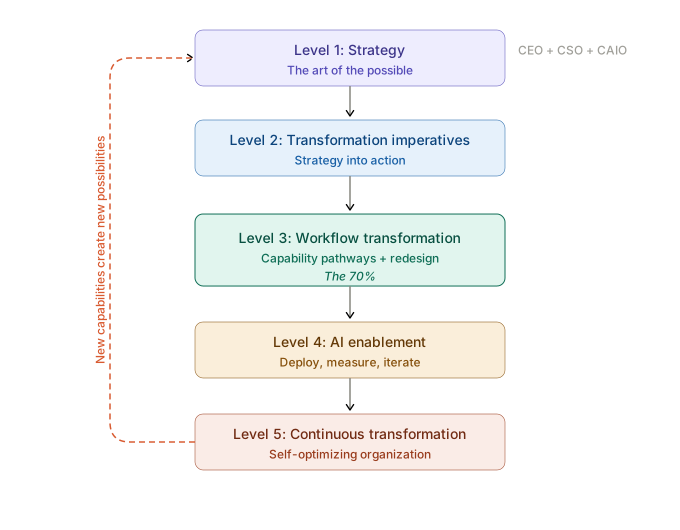
Your Level 1 triad has set the strategy. The Level 2 portfolio has been built. Domain owners have been chartered. The capability decomposition is about to begin.
And somewhere on the fourth floor of your finance building, a senior analyst who has been with the company for twelve years just heard from a colleague that “AI is going to redesign how accounts payable works.” Nobody from leadership has told her anything. She does not know what this means for her job. She does not know who decided this, when it is happening, or whether she should be updating her resume. What she does know is that she has read about the wave of AI-attributed layoffs across the industry, the companies that cut thousands of positions citing AI capabilities that had not been deployed yet, and her employer just chartered something that sounds a lot like what those companies did before the cuts started.
This is what happens when the transformation work begins without the communications strategy. The work itself may be excellently conceived and well-intentioned. The people affected by it are filling the information vacuum with fear.
Where does communications fit within change management?
Communications sits inside change management, which the Methodology treats as a parallel track running alongside the entire transformation rather than a one-time announcement. Before addressing what to do about the information vacuum, it is important to understand where communications sits within that broader discipline.
Traditionally, change management has three legs. Each activates at a different point in the transformation lifecycle, and each serves a distinct purpose.
The first leg is communications: building awareness of why the transformation is happening, managing the narrative, and keeping every level of the organization informed as the work progresses. This is the leg that activates first, before the capability decomposition, before the education cascade, before a single workflow is redesigned. It is the subject of this article.
The second leg is org impact assessment and job redesign: analyzing what the redesigned workflows mean for roles, skills, organizational structure, and career paths. This leg activates as workflow designs produce output, because you cannot assess how jobs change until you can see the redesigned workflows. Article 15 covers this in depth.
The third leg is training: building the system-specific competence that people need to work effectively in the new workflows with the new technology. This leg activates at Level 4, when the technology is selected, configured, and ready for people to learn. You cannot develop system-specific training materials, job aids, or step-by-step guides until the systems exist. Article 22 covers this.
These are not sequential phases that happen one after another. They are parallel workstreams that activate at the point in the lifecycle where they become relevant, and the first two run concurrently for much of the Level 3 work. The domain owner who treats change management as something to address after the design work is finished is the domain owner whose transformation will be technically sound and organizationally rejected.
Why does AI transformation change the communications challenge?
AI transformation changes the communications challenge because it introduces concerns — about job security, autonomy, and identity — that are qualitatively different from anything the change management profession has encountered before. Every experienced change management professional has managed communications through an ERP implementation, a platform migration, or a digital transformation, and the Methodology described in this article draws on that same research-grounded discipline. But a communications strategy that does not account for these differences will underperform regardless of how well executed it is.
The first difference is the nature of anxiety. In an ERP implementation, employees worry about learning a new system. In an AI transformation, employees worry about whether they will have a job. Pew Research found that 52% of workers are worried about the implications of AI for their employment.1 BCG’s AI at Work 2025 survey found that employees at organizations undergoing comprehensive AI-driven redesign are more worried about job security (46%) than those at less-advanced companies (34%).2 Gallup’s State of the Global Workplace 2026 confirms the pattern from the other direction: 18% of US employees fear technology-driven job elimination within five years, and that figure rises to 23% inside organizations actively implementing AI.16 Deployment itself raises the anxiety unless communication counteracts it. The communications strategy is not addressing routine change resistance. It is addressing existential fear about professional relevance, and the distinction matters for every message, every channel, and every sender the strategy employs.
The second difference is the external narrative. When your organization launched its last digital transformation, your employees were not going home at night and reading headlines about the new platform eliminating their profession. AI transformation operates inside a media environment saturated with stories about job displacement, workforce reduction, and human obsolescence. Your communications strategy is not operating in an information vacuum. It is competing with an external narrative that is often more alarming than the internal reality. As Article 1 documented, many of those headlines describe organizations that cut positions citing AI capabilities that had not actually been deployed. But the fear they generate is real, and it is present in your workforce before the first internal communication is sent.
The third difference is the trust and explainability challenge. In an ERP implementation, the system is deterministic: the same inputs produce the same outputs, and employees can learn to predict and trust the system’s behavior. AI systems are probabilistic. They can be wrong in unpredictable ways, they produce outputs that are difficult to explain, and they require a fundamentally different kind of trust.3 The communications strategy needs to build confidence in systems that even technically sophisticated employees may not fully understand, while being honest about limitations that the technology community itself is still working to address.
The fourth difference is the absence of a stable end state. Typical transformation programs have a go-live date after which the system stabilizes and roles settle into a new normal. AI capabilities evolve continuously. The capability meta-layer tagging described in Article 12 exists precisely because new capabilities will emerge and reshape what is possible at each workflow step. When that happens, the roles defined against those steps change too, as Article 14’s reengagement trigger mechanism addresses. The communications strategy cannot promise employees a stable future state that will hold. It must instead build the organizational capacity for continuous adaptation, which is a fundamentally different communications objective than preparing people for a one-time transition.
The fifth difference is that the workforce is already engaging with the technology independently. McKinsey’s 2025 “Superagency” study found that employees are already experimenting with AI three times more than their leaders realize.4 In no previous transformation has the technology been this accessible to individual employees before the organization’s formal deployment. This creates both risks (shadow AI usage without governance, data exposure, inconsistent outputs) and opportunities (ground-level innovation, natural change champions, real-world use case discovery). The communications strategy must acknowledge and channel what is already happening rather than pretending the organization controls the starting point.
The sixth difference is the risk to professional identity and meaning. When AI takes over the analytical, creative, or judgment-based work that defined someone’s professional identity, the impact goes beyond process change. EY’s 2026 research documented this directly: at organizations where AI dramatically increased productivity, employees reported detachment and a loss of meaning even as output improved.5 The communications strategy needs to address the evolution of professional identity, not just the mechanics of new processes. The message is not just “your workflow is changing.” It is “what you contribute and why it matters is evolving, and the evolved contribution is more valuable, not less.”
These six differences do not invalidate the proven change management methodology that follows in this article. They add a layer of complexity and sensitivity that the methodology must account for. Every deliverable, every message, every sender decision should be evaluated through the lens of these AI-specific dynamics. The change management professional who applies standard OCM methodology without adjusting for these factors will produce a technically sound communications plan that fails to address what people are actually experiencing.
What does underbudgeting communications actually cost?
Underbudgeting communications is one of the most reliable predictors of transformation failure, and the research on this point is unambiguous and has been consistent for years. Organizations that starve the communications function pay for it in resistance, disengagement, and adoption that never materializes.
Deloitte’s 2025 Chief Transformation Officer study surveyed transformation leaders across industries and found that change management and talent are cited by executives as the top budget allocation gap in enterprise transformation programs.6 This is not a new finding. Their 2022 study found essentially the same thing: 52% of transformation leaders believed they had underinvested in talent, and 34% believed they had underinvested in change management and communications. Organizations invested the largest portion of their transformation budgets in technology (26%), followed by business changes (19%) and process changes (18%), while the function that determines whether people actually adopt the new processes and technology consistently received less.7
The consequences are visible in the execution data. Three of the top five challenges that transformation leaders cite are execution challenges closely related to managing people and change.6 Deloitte’s 2026 Human Capital Trends found that only 27% of organizations say they manage change well, and only 7% report they are leading in helping their workforce continuously grow and adapt.8 Eighty-five percent say building the ability to adapt continuously is critical to their organization. Seven percent are actually doing it. That gap is the underbudgeting problem expressed in operational terms.
The 2026 data sharpens the indictment. Accenture’s Pulse of Change 2026 research found that only 18% of employees strongly agree their leaders communicate clearly about AI, only 40% say training prepared them for how their roles are changing, and only 20% feel involved in shaping how AI transforms their work.15 And Gallup’s State of the Global Workplace 2026 reports that global employee engagement has fallen to 20%, its second consecutive annual decline and the lowest level since 2020.16 Organizations are asking a disengaged workforce to absorb the largest change program most of them have ever attempted, supported by communications that most employees describe as unclear. That is the cost of treating this function as an afterthought.
There has not been a more important time to get this right. The scope of AI-driven business transformation, redesigning workflows, redefining roles, rebuilding how entire functions operate, represents a level of change that most organizations have never attempted at this scale. And the six AI-specific dynamics described above make the communications challenge harder, not easier. This is the one function where we strongly recommend organizations err on the side of overbudgeting rather than risk the consequences of underinvesting in the very capability that determines whether the rest of the transformation is adopted.
The practical reality is this: beautifully designed workflows that nobody adopts because nobody was prepared for the change are worthless, regardless of how technically brilliant they are. The 70% of the effort that BCG’s 10-20-70 rule assigns to people, processes, and organizational change includes change management as a core component.9 Organizations that invert that ratio, spending the majority on technology and a fraction on the people side, are the organizations producing the pilot proliferation and scaling failures that the research documents.
When should transformation communications start?
Communications should start at Level 2, not Level 3 — the nuance that most organizations miss, and the one that separates the organizations that build momentum from those that build resistance. Beginning at Level 2 gets ahead of the information vacuum before it fills with speculation.
Communications does not begin when the domain owner starts executing their charter at Level 3. It begins at Level 2, when the Level 1 triad announces the transformation portfolio and charters domain owners. That announcement is the first communication event for the enterprise.
This is the moment when the broader organization learns that transformation is happening, which domains are in the first wave, and what the overall strategic direction is. The message at this stage is enterprise-level: here is why we are transforming, here is the competitive and strategic context that makes this necessary, and here is what you can expect to see in the coming months.
Prosci’s benchmarking research across thousands of transformation programs found that 97% of practitioners say they would start change management earlier on the next project.10 The most common regret in enterprise transformation is not starting communications too early. It is starting too late. No one has ever said they learned about a change too early. But organizations routinely discover that employees learned about changes too late, after anxiety and misinformation had already filled the void.
In an AI transformation, starting early is even more critical than in previous transformations because of the external narrative problem. Your employees are already anxious about AI before you announce anything. The enterprise-level communication at Level 2 is the organization’s first opportunity to distinguish its specific transformation from the fear-driven narrative employees are consuming externally. The message must be concrete enough to be credible and honest enough to build trust: here is what we are doing, here is why, and here is how we intend to treat the people who will be affected by it. The workforce investment premise from Article 1 is not a philosophical position. It is a communications strategy.
Who delivers these enterprise-level messages matters as much as the content. Prosci’s research on preferred senders is definitive: employees want to hear business reasons for the change from the senior leaders who authorized and funded it.11 In our methodology, that means the CEO delivers the strategic rationale at the enterprise level. The CSO provides the competitive context that makes the transformation urgent. The CAIO frames what AI makes possible in business terms that connect the transformation to opportunities the organization could not have pursued before.
This Level 2 communication is not the detailed, domain-specific communications strategy. It is the enterprise-level awareness that creates the foundation on which domain-level communications builds. Article 4 describes the chartering process where domain owners receive their imperatives. That chartering moment should include the enterprise-level communication that prepares the broader organization for what is coming.
What communications does the domain owner activate at Level 3?
At Level 3, one of the domain owner’s first actions after receiving their charter (Article 9) should be activating the domain-level communications strategy. This is more specific than the enterprise announcement: it addresses the specific function being transformed, the specific people affected, and the specific timeline.
The domain owner does not develop this strategy personally. Change management practitioners, chartered by the domain owner as part of the transformation team, develop the strategy and the detailed plans that implement it. But the domain owner is accountable for ensuring it is chartered, resourced, and integrated into the transformation timeline from the beginning, not bolted on after the design work is underway.
Who delivers the domain-level messages follows the same preferred sender principle from the research. The domain owner and VPs deliver the strategic messages: why this domain is being transformed, what the business outcome will be, and how this connects to the enterprise strategy. Directors and managers deliver the personal impact messages: what this means for our team specifically, what to expect in the coming weeks, and what support is available. The change management practitioners prepare both groups to deliver those messages effectively, drafting the key messages, coaching the senders on delivery, and scheduling the communications to align with transformation milestones.11
This distinction between who develops the communications and who delivers them is critical. The most common mistake organizations make is having the project team or the change management team send all the communications directly. The research consistently shows this is less effective.11 Employees do not want to hear about the change from the project team. They want to hear business reasons from their senior leaders and personal impact from their direct supervisors. The change management practitioners are the architects of the communications. The leaders and managers are the delivery mechanism. Preparing and equipping those leaders and managers to deliver the messages effectively is one of the highest-value activities the change management team performs.
The manager layer is not just a delivery channel. It is the single strongest adoption lever the research has found. Gallup’s 2026 global workplace study found that employees whose managers actively champion AI are 8.7 times more likely to say AI has transformed how they work, the strongest adoption predictor in the study.16 BCG’s 2026 workforce research puts the same finding in behavioral terms: at future-built companies, 88% of managers role model AI use and incorporate it into daily decisions, versus 25% at AI laggards, and leaders must “communicate consistently the ‘why’ with a narrative designed to inspire.”17 Equipping the domain owner, the VPs, the directors, and especially the managers to champion the change visibly is not a soft activity at the edges of the transformation. It is the highest-leverage communications investment the transformation can make.
In an AI transformation, the coaching of preferred senders takes on additional importance. The domain owner and VPs need to be prepared not just to deliver the strategic rationale but to address the AI-specific anxieties their teams are experiencing. Directors and managers need to be equipped to have honest conversations about what AI means for specific roles on their teams, including the ability to say “I do not know yet, but here is when we will have more clarity” rather than offering false assurances. The change management practitioners should prepare sender-specific talking points that anticipate the AI-specific questions employees will ask, because the questions in an AI business transformation are different from the questions in other transformations.
What does the communications workstream actually produce?
The communications workstream produces concrete deliverables — stakeholder analyses, key messages by audience, sponsor talking points, and channel plans — not just good intentions. Understanding that communications is important is the easy part; knowing what it produces at the deliverable level is what separates organizations that manage change from organizations that talk about managing change.
The deliverables fall into two categories: foundational deliverables that are produced once and updated throughout the transformation, and ongoing deliverables that are produced and refined continuously as the transformation progresses.
What are the foundational communications deliverables?
The stakeholder analysis is the first foundational deliverable the change management practitioners produce, because everything else depends on it. It identifies every group affected by the transformation, the degree to which each group is impacted, their specific concerns, and how they prefer to receive information. In an AI transformation, the stakeholder analysis should also map each group’s current relationship with AI: are they already experimenting independently, are they anxious and disengaged, or are they somewhere in between? Research has documented distinct adoption personas within organizations, from enthusiastic maximalists to cautious observers to active resisters, and the communications strategy needs to address each differently.
The change impact assessment analyzes how each specific change affects each stakeholder group. As the transformation progresses through capability decomposition (Article 10) and workflow redesign (Article 12), the impact assessment is updated with increasingly specific information about what is actually changing. In an AI transformation, the impact assessment must address not just process changes but the shift in the nature of work itself: from execution to orchestration, from data entry to judgment, from sequential tasks to exception management. These are identity-level changes, not just process-level changes, and the communications strategy must acknowledge the difference.
The communications strategy is the overarching plan that governs all subsequent communications activities. It defines the audiences, the messaging themes for each audience, the channels through which communications will be delivered, the frequency of communications, the preferred senders for each message type, and the metrics by which communications effectiveness will be measured. This is not a newsletter schedule. It is the strategic architecture for how information flows to every affected person throughout the transformation.
What are the ongoing communications deliverables?
Key messages by audience are the core ongoing deliverable, developed and updated throughout the transformation lifecycle. Different audiences need different messages at different times, delivered by different people. The change management practitioners draft messages tailored to each stakeholder group, aligned to where that group is in the change process, and prepare the appropriate senders to deliver them. This is an ongoing deliverable because the messages evolve as the transformation produces new information about what is changing and what it means for people.
The communications calendar maps specific messages, delivery dates, audiences, channels, and senders across the transformation timeline. It is aligned to transformation milestones from the broader Level 3 work: capability decomposition workshops, education cascade sessions, workflow redesign reviews, and cross-department coordination checkpoints. Every significant transformation milestone should have a corresponding communications activity that prepares people for what is happening and what comes next.
The sponsor activation plan defines specific activities for the domain owner and VPs to be visible and active sponsors of the transformation. Prosci’s benchmarking research consistently identifies active and visible executive sponsorship as the number one contributor to change success, ranking ahead of communications, training, and every other factor.10 The practitioners ensure sponsors show up, deliver the right messages, and do so repeatedly. Best practice in the field recommends that key messages be delivered five to seven times to each audience through multiple channels and voices.12
Two-way feedback mechanisms ensure that communications is not just broadcasting but listening. Town halls with real question-and-answer sessions. Post-communication surveys that assess not just whether people received the message but whether they correctly interpreted it. Manager-facilitated team discussions that surface concerns, questions, and misinformation at the ground level. Change management research on the sender-receiver gap is instructive here: what the sender says and what the receiver hears are rarely the same thing, especially the first time.12 The only way to know whether the intended message actually landed is to measure what people heard, then adapt.
In an AI transformation, the two-way channels serve an additional function: surfacing the invisible adoption that is already happening. McKinsey’s finding that employees are experimenting three times more than leaders realize4 means the listening channels need to actively seek information about how people are already using AI tools, what they are learning, and where they are encountering risks. This ground-level intelligence is valuable not just for communications but for the entire transformation: it reveals where adoption is happening naturally, where governance gaps exist, and where the organization’s assumptions about readiness are wrong.
The change champion and ambassador network identifies employees across the organization who can serve as local advocates, feedback conduits, and peer mentors. McKinsey’s “Reconfiguring Work” research specifically recommends identifying superusers as change agents, noting that the most enthusiastic AI adopters can mentor peers and drive cultural change through what they describe as a middle-out approach rather than purely top-down or bottom-up.13 These champions are not management appointees delivering corporate messages. They are respected colleagues who have embraced the transformation and whose credibility with their peers makes them more effective communicators than any formal channel.
How does communications content evolve through the transformation?
Communications content evolves by following Prosci’s ADKAR framework, which identifies five sequential elements individuals need to successfully adopt a change: Awareness, Desire, Knowledge, Ability, and Reinforcement. Communications primarily serves the Awareness and Desire elements, with later phases supporting Knowledge and Reinforcement. The substance of what is communicated changes as the transformation progresses, and this progression is not arbitrary.14
The research is explicit that this progression matters and cannot be compressed. The research states directly that communications about new processes, new systems, or project timelines fall on deaf ears until people have heard from preferred senders about the topics they care about most.12 The first question every employee asks when they learn about a change is “why is this happening?” Until that question is answered credibly, by the right sender, nothing else penetrates.
In an AI transformation, the Awareness content must do something it has never had to do in previous transformations: directly counter an external narrative that is shaping employee perceptions before the organization says a word. The awareness messages must acknowledge the broader industry conversation about AI and workforce displacement, connect it honestly to what the organization is and is not doing, and establish the workforce investment premise from Article 1 as the organization’s governing principle. Employees who have been reading about AI layoffs for months need to hear their own organization’s leaders say, clearly and specifically, “that is not what is happening here, and here is why.”
As the transformation progresses into capability decomposition and the education cascade, communications shifts to building Desire: why should I engage with this, what is in it for me, and how will this make my contribution more valuable rather than less? In an AI transformation, the Desire-building messages must address the identity dimension. It is not enough to explain that the new workflow is more efficient. The communications need to convey that the evolved role is more strategic, more analytical, and more interesting than the current one. The human contribution in the redesigned workflow is not a diminished version of what the person does today. It is an elevated version, one that focuses on judgment, exception handling, relationship management, and the kind of contextual decision-making that AI cannot perform. This is the message that converts anxiety into engagement.
As workflow redesign and job redesign produce outputs, communications supports Knowledge: what specifically is changing, what do the redesigned workflows look like, what are the three categories of role evolution (augmented, consolidated, emergent from Article 15), and what does this mean for specific teams and individuals? This is the most sensitive phase of the communications lifecycle and the one where the preferred sender framework matters most. Employees want to hear about how changes affect them personally from their direct supervisors, not from a company-wide email.
At Level 4, when technology is deployed, communications supports Ability and Reinforcement: how to do the new work, where to find help, what early successes look like, and what the organization is learning from the first iteration cycles. The training workstream (Article 22) carries the primary weight at this phase, but communications continues to reinforce the narrative and celebrate progress. Because AI capabilities evolve continuously, the communications function at Level 4 and beyond must also prepare people for the reality that the current state is not the final state, building the organizational capacity for continuous adaptation that the no-stable-end-state dynamic requires.
Throughout this progression, the leaders delivering the messages need development of their own. MIT Sloan Management Review’s Spring 2026 issue documents the people-first leadership practices that sustain transformation: reframing the challenge, engaging from the top, bridging people and perspectives, and sustaining long-term commitment.18 HBR’s May 2026 executive panel on leading the human-AI organization reached the same conclusion through the eyes of three chief human resources officers: preparing leaders for the human side of AI transformation is now a core leadership development agenda, not an afterthought.19
How does the CAIO’s department support communications?
The CAIO’s department serves as the communications partner that keeps the narrative technically accurate — the challenge unique to AI transformation. The redesigned workflows from Article 12 include AI-enabled steps that most employees and many managers do not fully understand. The communications strategy does not need to explain the operational details of how AI works at each workflow step; that is the responsibility of the training workstream at Level 4 (Article 22) and the org impact assessment practitioners during job redesign (Article 15). But the communications strategy does need to ensure that the key messages, the sponsor talking points, and the awareness-level framing are accurate enough to be credible and honest enough to build trust.
The CAIO’s AI-Business Translators, described in Article 5, serve as subject matter experts for the change management practitioners developing key messages and sponsor preparation materials. The Translators understand both the technical capabilities and the business context well enough to ensure that the narrative the organization tells about its AI transformation is grounded in reality. They are not the communications senders. They are the partners who help the communications team ensure that when the CEO says “AI will transform how our finance organization operates,” the statement is accurate, and when the domain owner stands in front of a town hall and fields questions about what AI means for the department, the talking points reflect what AI can and cannot actually do.
This partnership is particularly important for three communications responsibilities. First, building awareness-level messages that are specific enough to be credible without crossing into training-level operational detail. The communications should convey that the finance organization’s workflows are being redesigned to leverage AI for higher-speed, higher-accuracy operations, with human roles evolving toward judgment, exception handling, and strategic analysis. That framing is accurate, builds awareness, and does not attempt to deliver the operational training that belongs in Article 22. Second, preparing sponsors to field AI-specific questions honestly. When employees ask “Will AI replace my role?” the domain owner needs a prepared, accurate answer that the Translators have helped validate. Third, correcting misinformation. When the two-way feedback channels surface misconceptions about AI capabilities, whether overblown fears or unrealistic expectations, the Translators help the communications team craft corrections that are technically sound and delivered through the preferred sender framework.
How does communications work across the levels of the Methodology?
Communications activates across multiple levels of the Methodology, with each level’s communications building on the previous one. The enterprise framing established early sets the foundation that domain-level and deliverable-level communications extend as the transformation moves forward.
At Level 2, enterprise-level awareness communications accompanies the portfolio announcement and domain owner chartering. The CEO, CSO, and CAIO deliver the strategic rationale to the organization, including the direct acknowledgment of the AI-specific dynamics that make this transformation different from previous ones. This prepares the ground for everything that follows.
At Level 3, domain-level communications activates when the domain owner receives their charter and runs continuously alongside all Phase 3A through 3C work described in article 9, Domain Owners Charter. The content evolves as the transformation progresses through capability decomposition, education cascade, workflow redesign, data readiness, cross-department coordination, and job redesign. The change management practitioners produce the deliverables described in this article and keep them current as the transformation produces new information.
At Level 4, communications evolves to support technology deployment: preparing people for go-live, explaining what the new systems and tools do, and reinforcing the narrative during the transition period when first-cycle friction is expected and budgeted for, as Article 12 described.
At Level 5, communications becomes part of the continuous transformation operating rhythm. As the organization builds the capability for ongoing self-optimization, the communications function shifts from transformation-specific messaging to an embedded practice of keeping the organization informed about continuous improvements, new capabilities, and evolving roles.
The thread that runs through all of these levels is the workforce premise from Article 1: this transformation is investing in people, not eliminating them. Every communication, at every level, should be consistent with that premise. The moment the communications say one thing and the organization’s actions say another, trust collapses, and trust is the foundation on which everything else in the methodology depends.
Sources
- 1.Pew Research Center, “Public Views About Artificial Intelligence and the Workforce,” 2024. 52% of workers worried about AI implications for their employment https://www.pewresearch.org/internet/2024/artificial-intelligence-and-the-workforce/
- 2.BCG, “AI at Work 2025,” October 2025. Employees at comprehensive AI redesign companies more worried about job security (46%) than those at less-advanced companies (34%) https://www.bcg.com/publications/2025/ai-at-work
- 3.IMD, “AI Digital Transformation: Reshaping Organizations,” June 2025. Trust and explainability identified as key differentiators in AI adoption compared to previous technologies https://www.imd.org/ibyimd/artificial-intelligence/ai-digital-transformation-reshaping-organizations-work-and-our-global-future/
- 4.McKinsey, “Superagency in the Workplace: Empowering People to Unlock AI’s Full Potential,” January 2025. Employees experimenting with AI 3x more than leaders realize https://www.mckinsey.com/capabilities/quantumblack/our-insights/superagency-in-the-workplace
- 5.EY, “Redesigning Work Around Human Skills in the Age of AI,” March 2026. Employees at high-productivity AI deployments reporting detachment and loss of meaning. AAA Framework: Augment, Adapt, Account https://www.ey.com/en_us/insights/ai/redesigning-work-around-human-skills-in-the-age-of-ai
- 6.Deloitte, “2025 Chief Transformation Officer Study,” April 2025. Change management and talent cited as top budget allocation gap; three of top five challenges relate to managing people and change https://www.deloitte.com/us/en/services/consulting/articles/2025-chief-transformation-officer-ctro-study.html
- 7.Deloitte, “2022 Chief Transformation Officer Study,” March 2022. 52% underinvested in talent; 34% underinvested in change management and communications; technology received 26% of budget https://www2.deloitte.com/us/en/pages/consulting/articles/survey-chief-transformation-officers-success.html
- 8.Deloitte, “2026 Global Human Capital Trends,” March 2026. Only 27% manage change well; 7% leading in continuous workforce adaptation; 85% say continuous adaptability is critical https://www.deloitte.com/us/en/insights/topics/talent/human-capital-trends.html
- 9.BCG, “AI Radar 2025” and “How Agents Are Accelerating the Next Wave of AI Value Creation,” December 2025. 10-20-70 rule: 70% of value from people, processes, organizational change https://www.bcg.com/publications/2025/agents-accelerate-next-wave-of-ai-value-creation
- 10.Prosci, “Best Practices in Change Management,” 12th Edition. 97% would start earlier; active executive sponsorship is #1 contributor to change success https://www.prosci.com/blog/prosci-methodology
- 11.Prosci, “Communications Checklist for Change Management.” Preferred senders: business reasons from senior leaders, personal impact from direct supervisors https://www.prosci.com/blog/communications-checklist-for-change-management
- 12.Prosci, “Why Some Communications Work and Others Don’t.” Sender-receiver gap; messages fall on deaf ears until preferred senders address “why”; 5-7 repetitions recommended https://www.prosci.com/blog/understanding-why-some-communications-work-and-others-dont
- 13.McKinsey, “Reconfiguring Work: Change Management in the Age of Gen AI,” August 2025. 7% employee involvement threshold; 21-30% for highest performers; middle-out approach; superusers as change agents https://www.mckinsey.com/capabilities/quantumblack/our-insights/reconfiguring-work-change-management-in-the-age-of-gen-ai
- 14.Prosci, “ADKAR Model.” Awareness, Desire, Knowledge, Ability, Reinforcement. Communications builds Awareness and Desire; training builds Knowledge and Ability https://www.prosci.com/blog/prosci-adkar-change-management
- 15.Accenture, “Pulse of Change 2026,” January 2026 (fielded November-December 2025; 3,650 C-suite executives and 3,350 workers). Biggest barrier to AI value is bringing people along the journey; only 18% of employees strongly agree leaders communicate clearly about AI; 40% say training prepared them for role changes; 20% feel involved in shaping how AI transforms their work https://www.accenture.com/us-en/insights/pulse-of-change
- 16.Gallup, “State of the Global Workplace 2026: The Human Side of the AI Revolution,” April 8, 2026. Global engagement fell to 20%, second consecutive annual decline, lowest since 2020; employees whose managers actively champion AI are 8.7x more likely to say AI transformed their work; 18% of US employees fear technology-driven job elimination within five years, rising to 23% inside AI-implementing organizations https://www.gallup.com/workplace/708071/global-employee-engagement-continues-decline.aspx
- 17.BCG, “AI Transformation Is a Workforce Transformation,” March 2026. 88% of managers at future-built companies role model AI use and incorporate it into daily decisions vs 25% at AI laggards; leaders must “communicate consistently the ‘why’ with a narrative designed to inspire”; restates the 10-20-70 rule https://www.bcg.com/publications/2026/ai-transformation-is-a-workforce-transformation
- 18.MIT Sloan Management Review, Spring 2026 issue. People-first leadership practices for transformation: reframing the challenge, engaging from the top, bridging people and perspectives, sustaining long-term commitment https://sloanreview.mit.edu/issue/2026-spring/
- 19.Harvard Business Review Executive panel, “Leading the Human-AI Organization,” May 28, 2026. Three CHROs on reimagining leadership development for the AI age https://hbr.org/2026/05/leading-the-human-ai-organization
Frequently Asked Questions
We already have a corporate communications team. Is that not sufficient for transformation communications?
Corporate communications and change management communications serve different purposes and require different expertise. Corporate communications keeps the organization informed about company news, events, and general updates. Change management communications is specifically designed to move people through the stages of adopting a change: building awareness of why the change is needed, creating desire to participate, supporting knowledge of what is changing, and reinforcing new behaviors. The deliverables are different, the targeting is different, and the measurement is different. Change management research is direct on this point: a communications plan developed without a change management framework usually results in a “telling plan” rather than a communications plan, and telling plans do not produce adoption. Your corporate communications team is a valuable partner, but the transformation needs dedicated change management practitioners who understand the ADKAR progression and can develop the targeted, sender-specific, feedback-driven communications that adoption requires.
How do we handle communications when we do not yet know what the redesigned workflows will look like?
You communicate what you do know and are transparent about what you do not. Early communications should focus on the “why” (strategic rationale, competitive context) and the “how we will work through this” (the process, the timeline, how people will be involved). You do not need to have the answers to communicate effectively. Change management research has found that starting communications with incomplete information is significantly more effective than waiting until all details are available. The information vacuum fills itself with anxiety and misinformation. Honest communication about what is known, what is not yet known, and when more information will be available builds trust that serves the transformation throughout its lifecycle.
How much should we budget for the change management communications workstream?
The research does not prescribe a specific dollar figure because the investment varies by transformation scope, organizational size, and complexity. What the research does prescribe is the ratio: BCG’s 10-20-70 rule states that 70% of transformation resources should go to people, processes, and organizational change, with only 30% going to technology and algorithms.9 The change management function, including the communications workstream, is a significant component of that 70%. If your transformation budget is overwhelmingly allocated to technology with a thin slice for change management, the ratio is inverted, and the research is clear about the consequences. Given the unprecedented scale of AI-driven business transformation, this is the one area where we recommend erring on the side of overinvestment.
Our employees are already anxious about AI. Will talking about it more make the anxiety worse?
The research says the opposite. The anxiety exists whether you communicate or not. The question is whether it is shaped by accurate information from trusted leaders or by rumors and worst-case assumptions from the information vacuum. The research consistently shows that early, honest, sender-appropriate communications reduces anxiety by replacing uncertainty with information. The anxiety does not come from knowing about the change. It comes from not knowing, and imagining the worst. In an AI transformation specifically, Accenture’s 2026 Pulse of Change research found that the biggest barrier to realizing AI’s potential is bringing people along the journey, and that employees need a clearly communicated vision, not silence.15
How do we measure whether our communications are actually working?
Measure at three levels. First, delivery: are the communications reaching their intended audiences through the planned channels and senders? This is the easiest to measure and the least meaningful. Second, comprehension: are people correctly interpreting the messages? Post-communication surveys and manager-facilitated discussions can assess this. The sender-receiver gap means that what was sent and what was heard are often different; measuring comprehension catches the gap early. Third, and most important, impact: are people moving through the ADKAR stages? Are awareness levels increasing? Is desire to engage building? Are resistance behaviors decreasing? These are the metrics that tell you whether the communications workstream is producing the outcome it exists to produce. If delivery is high but comprehension and impact are low, the communications strategy needs adjustment, not more volume.
This series addresses “what” to do, not “how” to do it. If you are a business executive and would like help thinking through the “how,” please feel comfortable reaching out.
*Previous: Article 7: AI Governance · Next: Article 9: The Domain Owner’s Charter*

About the author
Shawn Plaster
Founder & CEO, Plaster Group
Shawn is the author of Plaster Group's five-level AI Business Transformation Methodology and its 27-article Insights series, and leads the firm's enterprise AI transformation work.
Previous: Article 7: AI Governance · Next: Article 9: The Domain Owner’s Charter
© 2026 Plaster Group, LLC. All rights reserved. This article may not be reproduced, distributed, or transmitted in any form without prior written permission from Plaster Group. Brief excerpts may be quoted for review or commentary purposes with attribution to the author and a link to the original article.
Ready to move forward?
Let's discuss how your organization can build with AI — securely, strategically, and starting from where you are today.
Start a Conversation