In 2025, U.S. companies announced 1.2 million job cuts, nearly twice the prior year's total. Approximately 55,000 of those cuts explicitly cited artificial intelligence as the reason. In the first half of 2026, the pace accelerated into record territory: AI was the number one stated reason for U.S. job cuts for four consecutive months, March through June, a first since Challenger, Gray & Christmas began tracking the category. May 2026 set the all-time monthly record, with AI cited in 40% of announced cuts, and companies attributed 101,743 cuts to AI in six months, nearly double that full-year 2025 total. Note the detail that sharpens the story rather than softening it: overall layoffs are falling (total H1 2026 announcements were down 40% from a year earlier) while the share attributed to AI keeps hitting records. This is not a layoff wave. It is an attribution wave. Block cut 40% of its workforce. Amazon eliminated 30,000 corporate roles. Meta, Microsoft, Salesforce, Workday, CrowdStrike, and dozens of others followed. CEOs are no longer euphemistic about it. They are openly attributing headcount reductions to AI capabilities.1
The market has applauded. Investors reward the announcements. Boards ask for more. The narrative has taken hold: AI is here, it can do the work, and the organizations that move fastest to reduce headcount will win.
The data tells a completely different story.
Are companies really firing people because of AI?
Most AI-attributed layoffs are not based on proven AI capability — they are based on anticipated capability, on what companies expect AI to deliver rather than what it has already delivered. In a survey of more than 1,000 global executives published by Harvard Business Review, the vast majority of AI-attributed layoffs were found to be anticipatory. A separate study put a finer point on it: 60% of executives said they made headcount reductions in anticipation of AI efficiencies. Only 2% said they had made large staff reductions as a result of actual AI implementation.2
Read that again. Two percent.
Oxford Economics applied a simple economic test: if machines were truly replacing humans at scale, output per remaining worker should be skyrocketing. The productivity data does not support that conclusion. Their assessment was blunt: some firms are dressing up routine cost-cutting as innovation, and the primary motivation appears to be investor relations. Meanwhile, only 16% of individual workers had high AI readiness in 2025, and only 23% of organizations offered any kind of AI training. Companies are making permanent workforce decisions based on a promise, cutting people for not being productive with tools their employers never trained them to use.3
The freshest named example shows how thin the attribution can be. When Block cut roughly 4,000 jobs in February 2026, about 40% of its workforce, Jack Dorsey explicitly attributed the cuts to AI and predicted that most companies would follow within a year. Third parties were not convinced. A University of Virginia Darden School analysis asked whether AI was the strategy or the scapegoat behind the layoff. A Mizuho analyst concluded that the vast majority of the cuts were probably not due to AI. And an NBER working paper found that many CEO-attributed AI layoffs were corrections for pandemic-era overhiring. The pattern is consistent: the announcement says AI, and the evidence says cost-cutting.13
Are companies that made AI-driven layoffs regretting them?
Companies that made AI-attributed layoffs are already regretting them and quietly reversing course. If these were sound strategic decisions, the organizations making them would be reporting improved performance and moving on. Instead, a different pattern is emerging: regret, followed by quiet reversal.
According to Forrester, 55% of employers who made AI-attributed cuts in 2025 already regret the decision, and half are expected to quietly rehire.4 Gartner reinforces this with a specific prediction: by 2027, 50% of companies that attributed headcount reduction to AI will rehire staff to perform similar functions, often under different job titles. And Gartner's survey of 321 customer service leaders revealed that only 20% had actually reduced staffing because of AI. The vast majority of recent workforce reductions were influenced by broader economic conditions rather than automation. These are not companies replacing workers with technology. These are companies cutting costs and calling it innovation.5
When those forecasts were published, the reversal was a prediction. It is now an observation. Robert Half found that 32% of roughly 2,000 U.S. hiring managers surveyed had eliminated a role primarily because of AI and later rehired for the same or a similar position. Orgvue independently found that 32% of organizations that made AI-linked layoffs have since had to rehire staff. And a Careerminds survey fielded in February 2026 found that two in three companies that made AI-driven cuts are already rehiring, with one in three spending more on restaffing than the layoffs saved. Two independent datasets landing on the same 32%, plus a third showing majority reversal, is no longer a warning about regret. It is documentation of it.14
The most visible example is Klarna. The Swedish fintech's CEO declared that AI could do all of the jobs humans do, reduced headcount from 5,500 to 3,400 according to the company's own IPO prospectus, and celebrated $10 million in annual marketing savings alone. Then customer satisfaction deteriorated as the CEO himself later acknowledged, telling Bloomberg that cost had been "a too predominant evaluation factor" and that "what you end up having is lower quality." By late 2025, the CEO reversed course, publicly stating that "really investing in the quality of the human support is the way of the future for us" and launching a new initiative to hire customers as human support agents. The company that was supposed to prove AI replaces human labor became the canonical cautionary tale of the 2025-2026 wave.6
Precision matters here, because Klarna's subsequent results hand critics an easy rebuttal if the lesson is stated sloppily. The company posted a strong first quarter in 2026: revenue of $1.0 billion, up 44% year over year, with positive net income, and it still frames AI-driven headcount reduction as a win.15 Klarna is not a story about AI failing. It is a story about full substitution failing. What broke was the wholesale replacement of human customer support and the quality and brand cost that followed, which Klarna itself corrected by rehiring human support capacity. AI-enabled attrition was not the mistake. Indiscriminate substitution was.
Klarna is not an outlier. The pattern it established (aggressive efficiency claim, followed by quality degradation, followed by strategic reversal) has been documented across enough organizations that analysts now treat it as a structural expectation rather than an exception. The institutional knowledge left with the people. The AI systems were deployed without the human expertise needed to direct them effectively. And the output quality gap that followed created the rehire pressure that the data now documents across the 2025-2026 wave.
What do you actually lose when you cut staff for AI?
What you actually lose is institutional knowledge — the accumulated expertise, relationships, and judgment that walk out the door with every person you let go, none of which the financial model captured. The financial calculus behind AI-attributed layoffs typically models labor cost savings. It rarely models what those people took with them when they left.
Gartner puts it directly: AI is not mature enough to fully replace the expertise, empathy, and judgment that human workers provide. Relying solely on AI right now is premature and could lead to unintended consequences. Organizations that cut too fast and too deep are discovering that the technology requires more human oversight than the initial business case anticipated, not less.5 The AI did not replace the human judgment. It required more of it.
Here is what the financial models miss. Every enterprise runs on institutional knowledge that does not exist in any system, any process document, or any training dataset. It exists in the heads of experienced employees who understand why the process works the way it does, what the exceptions are, which customer relationships require special handling, what the undocumented dependencies are between systems, and what judgment calls get made fifty times a day that no one ever wrote down. McKinsey's research confirms what practitioners already know: most enterprise processes remain exactly this, tacit knowledge locked in the heads of experienced employees rather than documented in any system.7
When those employees leave, that knowledge leaves with them permanently. You cannot fine-tune an AI model to recover it. You cannot hire replacements who have it. You cannot consult your way back to it. It is gone.
And here is the connection that almost no one is making: that tacit knowledge is precisely what you need to redesign your workflows for AI. The people who understand how the business actually operates (not how the process documentation says it operates, but how it actually works) are the people who must be in the room when the organization redesigns how work should be done in an AI-enabled world. Firing them before the redesign is complete is like burning the blueprints before construction starts.
Why is now the wrong time to cut headcount for AI?
The timing is precisely backwards because a well-executed AI transformation depends on the very people being cut — the ones who understand the work well enough to redesign it. The research across every major consulting firm and academic institution studying this issue converges on the same sequence:
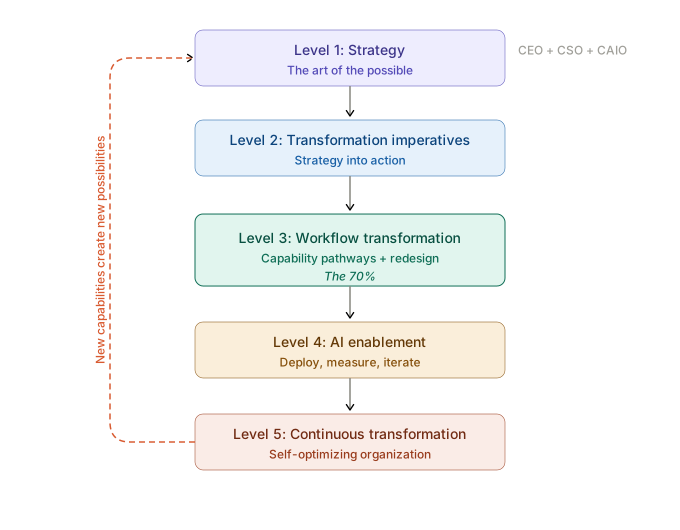
First, understand what AI makes possible. Then set enterprise strategy informed by that understanding. Then decompose that strategy into specific Business Transformation Imperatives. Then educate the workforce at every level on what AI can do. Then redesign workflows for how work should actually be done with humans and AI working together. Then redesign jobs based on the redesigned workflows. Then deploy AI tools that enable the new workflows. Then, and only then, right-size the organization to fit the new operating model.
The data on where organizations actually stand is sobering. Only 6% qualify as AI high performers according to McKinsey.7 Only 5% are achieving AI value at scale according to BCG.8 Only 21% have fundamentally redesigned any workflows.7 Only 34% are truly reimagining their business rather than layering AI onto existing processes.9 The vast majority of enterprises have not even begun the transformation work that these layoffs presuppose.
What these companies are doing is right-sizing first, before the transformation is designed, before the workflows are redesigned, before the jobs are redefined, and before the AI capabilities are deployed in production and proven at scale. They are demolishing the bridge before they have built the new one.
Every person in an enterprise today is needed for one of two things: running the business in its current form (which does not stop during transformation), or helping transform the business into its future form. Both of these require people who understand the business. Cutting headcount before the transformation is complete means you either cannot maintain current operations, or you cannot execute the transformation. In most cases, both.
How do AI-driven layoffs affect the employees who stay?
AI-attributed layoffs damage the people who stay as much as those who leave, eroding the morale and trust that transformation depends on. The strategic error is not limited to the people who leave. It extends to the people who stay.
Research identifies a growing segment of employees who have simply stopped trying, workers who do not believe their employer deserves their discretionary effort. This group continues to grow, and the trend shows no signs of reversing. The cause is not mysterious. Employees watch colleagues get fired for AI that does not work. They are told to be grateful they still have jobs. They are asked to absorb the work of eliminated positions while also embracing the AI tools that their employer just used to justify firing their colleagues. The result is a workforce that has stopped extending itself.
This is precisely the opposite of what AI transformation requires. McKinsey's research shows that companies involving at least 7% of employees in transformation initiatives double their chances of delivering positive results, with the highest performers involving 21% to 30%.7 The transformation that these organizations need to execute is the most complex operational change in the history of business. It requires creativity, collaboration, domain expertise, and discretionary effort from every level of the organization. It requires people who are willing to reimagine how their own work should be done, people who trust their employer enough to engage honestly with a process that will fundamentally change their roles.
A workforce that has watched its colleagues get fired for AI that does not yet work is not a workforce that will extend that trust. No amount of AI compensates for the productivity loss of a demoralized, disengaged organization.
What should companies do instead of cutting staff for AI?
Instead of cutting headcount, the organizations that will emerge as market leaders are investing in their people and building the organizational capability to transform. The ones that win this era are not the ones cutting headcount fastest.
This means keeping the people who understand your business. Every person who understands your domain, your customers, your operations, your exceptions, your dependencies is a person you need for the transformation ahead. Rather than cutting headcount, redeploy people toward the transformation effort itself. The same employees whose current roles may eventually be redesigned are the employees who understand those roles well enough to help redesign them.
It means building AI fluency at every level of the organization. Not a briefing deck. Not a vendor demo. Substantive, working engagements where employees at every level experience what AI makes possible and develop enough understanding to make informed decisions about how their own work should change. BCG found that persona-based learning journeys deliver AI adoption at a level 20 times higher than a broad-based approach.10 The investment in education pays for itself in transformation quality.
It means redesigning workflows before deploying AI tools. Organizations that take a "work-backward" approach, redesigning work first and then deploying technology that enables the new design, achieve dramatically better outcomes than those taking a "tech-forward" approach. One global financial services firm that deconstructed tasks before deploying AI achieved a 59% workload reduction according to MIT Sloan Management Review, precisely because the redesign came first.11
It means redesigning jobs based on the redesigned workflows, not based on assumptions about what AI might eventually be able to do. When the workflows are redesigned, the new role requirements become clear: what skills are needed, what judgment calls humans make, what oversight AI requires, what new capabilities the organization needs to build. The right-sizing decisions become evidence-based rather than anticipatory.
And it means right-sizing only after the transformation is implemented and proven, when you have real data on what the new operating model requires rather than projections based on promises.
This is not slower. It is dramatically faster than the alternative, because the alternative (cut first, transform later) produces the regret cycle, the rehire cycle, the institutional knowledge loss, and the morale collapse that the data now documents. The methodology we have developed, detailed across this article series, tells you how to execute each step. And it starts from a fundamentally different premise: that the way you succeed with AI is by investing in your people, not by eliminating them.
When do AI-related headcount reductions actually make sense?
Headcount adjustments during transformation are legitimate only when a specific AI capability has been deployed in production, proven at scale, and demonstrated that it can reliably perform the work — and when the person’s skills cannot be redeployed to the transformation effort or other value-creating roles. We should be honest about this. There are situations where right-sizing is appropriate, and in those cases a headcount adjustment is a sound business decision.
But the bar should be high. The questions to ask before any AI-attributed workforce reduction: Has the AI system been deployed in production (not in pilot)? Has it been proven at scale (not in a controlled test)? What are its error rates, and how does it handle edge cases? What is the rollback plan if it fails? How will institutional knowledge be retained? Has the workflow been redesigned, or are we automating the old process? Can this person be redeployed to the transformation effort itself? Are we going to grow top line revenue via new products or services or new markets or customer segments? If so, can I use these people to help with that growth?
If the answers to these questions are not grounded in evidence, the layoff is premature. The data is unambiguous on this point.
Which organizations will win the AI era?
The organizations that win will be the ones that kept their people and built the capability to transform, not the ones that cut fastest. Two years from now, two very different types of organizations will be competing in the same markets.
The first type will have cut headcount aggressively, lost institutional knowledge, demoralized their remaining workforce, struggled to execute transformation without the domain expertise they eliminated, and spent significant resources rehiring (often offshore, often at lower quality) to fill the gaps they created. They will have saved money on labor costs in the short term and lost competitive position in the medium term.
The second type will have kept their people, invested in AI fluency at every level, redesigned workflows with the employees who understand them, redeployed people into roles defined by the new operating model, and built an organization that transforms continuously rather than episodically. They will have spent more on workforce investment in the short term and built a compounding competitive advantage that their leaner competitors cannot replicate.
The competitive advantage in AI transformation is not the technology. Everyone has access to the same models, the same platforms, the same vendor ecosystems. The competitive advantage is organizational: the domain expertise, the institutional knowledge, the workforce capability to transform, and the trust between employer and employee that makes transformation possible.
The companies that are destroying that advantage in the name of AI efficiency are making the most expensive mistake in enterprise transformation. The data already proves it. The question is whether more organizations will make the same mistake before the evidence becomes impossible to ignore.
This article is the first in a 27-article series on Plaster Group’s AI Business Transformation Methodology. The series provides a comprehensive, research-backed methodology for executing AI transformation at every level of the organization, from strategy through continuous optimization, without sacrificing the workforce capability that makes transformation possible.
Sources
- 1.Challenger, Gray & Christmas, year-end and monthly job cut reports, 2025–2026, including "Challenger Report: June Layoffs Cool to 45,849, Down 53% From May; AI Leads Reasons for Fourth Consecutive Month," July 2, 2026. H1 2026: 101,743 AI-attributed cuts (May 2026 record: 38,579, 40% of announcements); total H1 2026 cuts down 40% year over year https://www.challengergray.com/wp-content/uploads/2026/01/Challenger-Report-December-2025.pdf
- 2.Thomas H. Davenport and Nik Srinivasan, "Companies Are Laying Off Workers Because of AI's Potential, Not Its Performance," Harvard Business Review, January 2026 https://hbr.org/2026/01/companies-are-laying-off-workers-because-of-ais-potential-not-its-performance
- 3.Oxford Economics, "Evidence of an AI-Driven Shakeup of Job Markets Is Patchy," 2025 https://www.oxfordeconomics.com/resource/evidence-of-an-ai-driven-shakeup-of-job-markets-is-patchy/
- 4.Forrester, "Future of Work Predictions 2026." 55% employer regret rate; 50% expected to rehire https://investor.forrester.com/news-releases/news-release-details/forrester-ai-led-job-disruption-will-escalate-while-fears-job
- 5.Gartner, Inc., "Gartner Predicts Half of Companies That Cut Customer Service Staff Due to AI Will Rehire," February 2026 (321 customer service leaders surveyed) https://www.gartner.com/en/newsroom/press-releases/2026-02-03-gartner-predicts-half-of-companies-that-cut-customer-service-staff-due-to-ai-will-rehire
- 6.Klarna SEC filing (IPO prospectus, 2025) and CEO public statements. Headcount reduction from 5,500 to 3,400; CEO Bloomberg interview acknowledging quality degradation; strategic reversal to human support.
- 7.McKinsey, "The State of AI in 2025," November 2025 (1,993 participants, 105 nations). 6% high performers; 21% workflow redesign; 31 organizational variables tested; 7% employee involvement threshold https://www.mckinsey.com/capabilities/quantumblack/our-insights/the-state-of-ai
- 8.BCG, "The Widening AI Value Gap," September 2025 (1,250+ firms). 5% create substantial value at scale https://www.bcg.com/publications/2025/are-you-generating-value-from-ai-the-widening-gap
- 9.Deloitte, "The State of AI in the Enterprise 2026," January 2026 (3,235 leaders). 34% truly reimagining business https://www.deloitte.com/us/en/what-we-do/capabilities/applied-artificial-intelligence/content/state-of-ai-in-the-enterprise.html
- 10.BCG, "Strategies to Tackle the AI Skills Gap," January 2026. Persona-based learning 20x adoption rate https://www.bcg.com/publications/2025/strategies-tackle-ai-skills-gap
- 11.Ravin Jesuthasan, "Want AI-Driven Productivity? Redesign Work," MIT Sloan Management Review, 2025. 59% workload reduction, 40% cost savings https://sloanreview.mit.edu/article/want-ai-driven-productivity-redesign-work/
- 12.Forrester, reskilling and redeployment research, 2025–2026. 80% of business leaders considering reskilling; 51% identify as strategically important.
- 13.Fortune, "Block: Jack Dorsey cuts 4,000 jobs citing AI," February 27, 2026; UVA Darden School of Business, "Is AI the Strategy, or the Scapegoat, Behind Block's 40% Layoff?," March 13, 2026 (includes Mizuho analyst assessment); NBER working paper on CEO-attributed AI layoffs and pandemic-era overhiring, January 2026 https://news.darden.virginia.edu/2026/03/13/is-ai-the-strategy-or-the-scapegoat-behind-blocks-40-layoff/
- 14.Robert Half survey of approximately 2,000 U.S. hiring managers, reported in CNBC, "Employers who laid off workers citing AI are already starting to regret it," July 1, 2026; Orgvue research, March 2026 (32% of organizations rehiring after AI-linked layoffs); Careerminds survey, fielded February 2026, reported in Forbes Technology Council, "Why Companies Regret Laying Off Workers For AI," April 24, 2026 https://www.cnbc.com/2026/07/01/employers-who-laid-off-workers-for-ai-are-reversing-their-decisions.html
- 15.Klarna Group plc, "Klarna Delivers Strong Start to 2026 With $1Bn Revenue and $68M Adj. Operating Profit," Q1 2026 earnings release, May 14, 2026. Revenue $1.0B, up 44% year over year; positive net income https://investors.klarna.com/News--Events/news/news-details/2026/Klarna-Delivers-Strong-Start-to-2026-With-1Bn-Revenue-and-68M-Adj--Operating-Profit/default.aspx
Frequently Asked Questions
Our board is pressuring us to show AI-driven efficiency gains. How do we respond?
Show them the data in this article. Then reframe the conversation. The efficiency gains the board wants are real, but they come from redesigning workflows with AI, not from cutting headcount before the redesign is done. Present the methodology: we will achieve efficiency gains that are sustainable and compounding by redesigning how work is done, rather than gains that are temporary and followed by a costly rehire cycle. The board wants results. Plaster Group’s AI Business Transformation Methodology produces better results than premature headcount reduction, and the 55% employer regret rate makes this case concretely.4
Our competitors are all announcing AI-driven headcount reductions. Are we falling behind if we do not?
Your competitors are announcing headcount reductions. They are not announcing the regret, the rehiring, the institutional knowledge loss, or the morale damage that follow. Fifty-five percent of them already regret it, and a third have already begun rehiring. The competitive advantage does not go to the organization that cuts fastest. It goes to the organization that transforms most effectively. When your competitors are rebuilding institutional knowledge they destroyed, you will be operating on redesigned workflows with a workforce that trusts you and understands your business.
We have genuine overstaffing from pandemic-era hiring. Is AI not a valid reason to address it?
If the overstaffing is real, address it honestly. But do not attribute routine right-sizing to AI capabilities that have not been deployed. The research suggests that many companies are using AI as convenient cover for headcount corrections that have nothing to do with AI. If you are correcting pandemic-era over-hiring, say so. If you are making AI-driven workforce decisions, ensure the AI capability is deployed, proven, and actually performing the work before you cut the people who currently do it. Conflating the two damages credibility with employees and creates the morale problems that make the actual AI transformation harder.
How do we redeploy people whose current roles will eventually be automated?
Redeploy them to the transformation effort itself. The people whose roles will change are the people who understand those roles best. They are your most valuable asset in redesigning the workflows that will define the future operating model. Train them on what AI makes possible, then put them on the teams that are redesigning how their own work should be done. Forrester reports that 80% of business leaders are now considering reskilling employees, with 51% identifying it as strategically important. The redeployment path exists. Most companies simply did not explore it before making cuts.12
What does right-sizing after transformation actually look like in practice?
After the workflows have been redesigned and deployed, after the AI capabilities are in production and proven, and after the first iteration cycle has been completed, the organization has real data on what the new operating model requires. Some roles will have been eliminated by design. Some will have been redefined. Some new roles will have been created. The right-sizing decisions are surgical, evidence-based, and anchored in actual operating data rather than projections. This is fundamentally different from the anticipatory cuts being made today. It is slower to start and dramatically less expensive to execute, because the organization is not rebuilding what it already destroyed. But also consider redeploying headcount to growth initiatives. It doesn’t always have to be about cutting costs. In fact, growing top line revenue by entering new industries and markets is what the research suggests will separate the winners from the losers.
This series addresses “what” to do, not “how” to do it. If you are a business executive and would like help thinking through the “how,” please feel comfortable reaching out.

About the author
Shawn Plaster
Founder & CEO, Plaster Group
Shawn is the author of Plaster Group's five-level AI Business Transformation Methodology and its 27-article Insights series, and leads the firm's enterprise AI transformation work.
Next: Article 2: The Business Transformation That AI Requires
© 2026 Plaster Group, LLC. All rights reserved. This article may not be reproduced, distributed, or transmitted in any form without prior written permission from Plaster Group. Brief excerpts may be quoted for review or commentary purposes with attribution to the author and a link to the original article.
Ready to move forward?
Let's discuss how your organization can build with AI — securely, strategically, and starting from where you are today.
Start a Conversation