This article is part of a 27-article series on the AI Business Transformation Methodology. This piece introduces the full methodology and makes the case for why business transformation should precede AI deployment.
You have made the investment. Your board has heard the AI strategy. Your Chief AI Officer is hired, your budget is allocated, and initiatives are underway across the organization. You are not standing still. You are moving, and moving with conviction.
And yet something is not working the way it should.
The pilots are promising but they are not scaling. The individual productivity gains are real but they are not showing up in the enterprise P&L. Different parts of the organization are experimenting with AI tools but those experiments are not connecting to each other or to a coherent business outcome. Your competitors appear to be moving just as fast, or faster, and the differentiation you expected from your AI investment has not materialized.
You are not alone in this experience. And the reason it is happening is not that your team is underperforming or that the technology is overhyped. The reason is that the approach most organizations are taking, including very likely yours, is fundamentally backwards.
How much are companies spending on AI, and is it paying off?
The scale of AI investment globally is staggering. According to Gartner, worldwide AI spending topped $1.5 trillion in 2025, with 2026 spending forecast to reach $2.59 trillion, a 47% year-over-year increase and an upward revision from the $2.52 trillion Gartner projected in January.1 McKinsey’s most recent global survey found that 88% of organizations report regular AI use in at least one business function, up from 78% just one year prior.2 The commitment is real and it is widespread.
But the results are not matching the investment. According to McKinsey, nearly two-thirds of organizations have not yet scaled their AI programs beyond pilots and experiments. Only about 6% of organizations report AI contributing more than 5% to their earnings, McKinsey’s threshold for what they consider an AI high performer.2 Boston Consulting Group’s research is equally stark: 60% of organizations generate no material value from their AI investments, and only 5% create substantial value at scale.3 PwC’s 29th Global CEO Survey of 4,454 chief executives adds the view from the corner office: 56% report no significant financial benefit from AI to date, and only 12% report both cost and revenue gains.9 And a McKinsey finding reported by Forbes in March 2026 puts the deployment reality plainly: roughly 10% of enterprise functions use AI agents. The ambition is enterprise-wide. The deployment is not.10
These are not organizations that failed to invest. These are organizations that invested heavily and are not seeing the return.
The most telling data point comes from McKinsey’s analysis of what actually differentiates the 6% who are succeeding from the rest. Out of 25 organizational attributes they tested, one factor had the single largest effect on whether AI investments translated to bottom-line impact. It was not the sophistication of the models. It was not the size of the data estate. It was not the scale of the technology budget.2
It was whether the organization had fundamentally redesigned its workflows.
And according to McKinsey, only 21% of organizations have done that in some capacity.2 Accenture’s Pulse of Change 2026 landed on the same number from an independent survey: 86% of executives plan higher AI investment in 2026, yet only 21% report redesigning end-to-end processes with AI at the core.11
The most direct evidence arrived in June 2026. BCG’s AI at Work 2026, a survey of 11,749 workers across 14 markets, found that a clear AI strategy lifts measurable business impact by roughly 25 percentage points, while better tools alone move it by about 5. The title BCG chose for the report states the conclusion outright: “Why Strategy Matters More Than Tools.”12
Why isn’t AI investment producing the results companies expect?
The core problem is technology-first thinking applied to what is fundamentally a transformation-first problem — companies buy and deploy AI before rethinking how the business should operate. There is a pattern playing out in enterprises across every industry. It looks like progress. It feels like progress. But it is not producing the outcomes it should.
The pattern goes like this. The organization acquires exciting AI capabilities. Leadership asks where those capabilities can be applied. Teams identify use cases. Pilots get funded. Some succeed. The organization declares that AI is working and funds more pilots. A technology roadmap gets built, a timeline of AI tools and platforms to deploy across the business. The roadmap looks strategic because it is sequenced and budgeted. But it starts from the wrong place.
It starts from the technology and works backward to the business.
This is the hammer-looking-for-nails dynamic, and it is the dominant pattern in enterprise AI adoption today. BCG calls it the “imagination gap”: the inability of leadership teams to see beyond incremental technology application to genuinely transformative business change.4 BCG quantifies what the right ratio looks like in a framework they call the 10-20-70 rule: 10% of the effort should go to algorithms, 20% to technology and data, and 70% to people, processes, and cultural transformation.5 McKinsey’s State of Organizations 2026 translates the same idea into a spending rule: for every dollar spent on AI technology, invest five dollars in people.13
70% people and processes. 30% technology.
Most organizations are inverting that ratio. They are spending the majority of their energy, attention, and executive bandwidth on the 30% (selecting tools, running pilots, building technology roadmaps) while underinvesting in the 70% that actually determines whether AI creates value. The organizations that are capturing real value from AI follow the 10-20-70 ratio. The organizations that are stuck in pilot mode have it reversed.
Why do organizations keep defaulting to a technology-first approach?
Organizations default to technology-first because it is concrete, fast, and easy to show as progress — which is precisely what makes it dangerous. If the technology-first approach is not working, why does every organization reach for it?
Three reasons.
First, it is familiar. Enterprise technology adoption has followed the same pattern for decades. You buy the software (SAP, Oracle, Salesforce, whatever the era demands) and then you do process redesign work to conform the organization to how the software operates. The technology dictates the process. Entire consulting practices were built around this model. It worked, more or less, because the software was rigid and the organization had to adapt to it.
AI is fundamentally different. AI technologies are dramatically more flexible and adaptable than any previous generation of enterprise software. You are no longer constrained by rigid configurations that force a specific workflow. You can build and configure AI capabilities around your specific business needs. MIT Sloan Management Review captured this shift precisely in “Want AI-Driven Productivity? Redesign Work,” arguing that organizations must take a “work-backward” approach rather than a “tech-forward” approach: instead of asking how technology can be applied to existing jobs and processes, leaders must redesign work first and then deploy technology that enables the new design.6
But most organizations have not made this mental shift. They are applying the old model (technology first, process redesign second) to a technology that does not require it and does not reward it.
Second, technology-first feels faster. Deploying an AI tool and demonstrating a productivity gain in a pilot can happen in weeks. Redesigning workflows across a business function takes months. Under pressure to show results to the board and to keep pace with competitors, most leadership teams choose the path that produces visible activity quickly, even if that activity does not compound into enterprise value.
Third, and most importantly, the technology-first approach still produces improvement. AI is powerful enough that even poorly deployed (layered on top of unredesigned processes, disconnected from strategy, running in isolated pilots) it generates some gains. People work a little faster. Reports get produced more efficiently. Customer inquiries get triaged more quickly. These gains are real and they are visible. They create the impression that the approach is working.
But they are not compounding. They are not connecting to each other. They are not producing the enterprise-level transformation that the investment was supposed to deliver. Deloitte’s research captures this precisely: value comes from process redesign, not process automation. As one of Deloitte’s technology leaders put it, if you just take your existing workflow and try to apply advanced AI to it, you are going to weaponize inefficiency.7
Bain reached the same conclusion in June 2026: companies create value with AI by changing how work gets done, not by layering tools onto existing work. Nearly 40% of the companies that measured their AI cost savings landed below 10%, despite targeting 11 to 20%. The winners share one habit: they redesign the work before they apply the tool.14
And here is the competitive danger: the organization that deploys AI on top of unredesigned processes will always be behind the organization that redesigns first. Both will improve. But the one that built the right foundation will improve at an accelerating rate, because every AI capability added is multiplied by the well-designed workflow underneath it. The gap compounds over time. By Year 2 and Year 3, these are not competitors in the same race. They are operating on different planes entirely.
What is the right starting point for AI transformation?
The right starting point is not AI — it is the business itself, using a methodology that begins with strategy and works toward technology rather than the reverse. If technology-first is the wrong starting point, what is the right one?
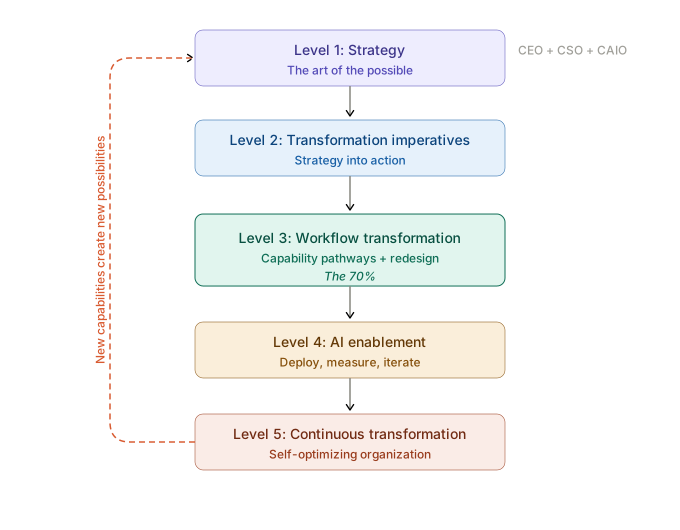
The answer is a five-level architecture that begins with business strategy and works down through transformation to technology enablement. Each level feeds the next. Skipping a level, or starting in the middle, is how organizations end up with the pilot proliferation and scaling failures the data describes.
What is Level 1 of the AI Business Transformation Methodology?
Level 1 begins with business strategy, informed by what AI now makes possible — not with an AI roadmap. Strategy sets the direction; AI expands the sense of what is achievable.
This requires a partnership that most organizations have not yet formed. The CEO, the Chief Strategy Officer, and the Chief AI Officer need to be in the same room, working on the same problem: where is this business going, and how does AI change what is achievable?
There is a productive tension at the center of this partnership. The CEO and CSO cannot write effective strategy without understanding what AI now enables; capabilities that were impossible or prohibitively expensive even three years ago are now achievable. But the CAIO cannot deploy AI effectively without business strategy driving the decisions about where and how to deploy it. Each needs what the other knows.
The resolution is co-creation. The CSO brings the competitive landscape, the market dynamics, the growth opportunities, and the strategic context of how the business makes money and where it is vulnerable. The CAIO brings an understanding of what AI makes possible, not at a theoretical level, but specifically for this business, this industry, these competitive dynamics. The CEO brings the authority to commit resources and the judgment to set ambition at the right level.
Together, they produce business strategy that accounts for what AI makes possible. Not an AI strategy. Not a technology roadmap. A business strategy, with the full weight of competitive analysis, market intelligence, and strategic rigor that the word implies, informed by capabilities that did not exist when the last strategy was written.
The CAIO’s first and most important job in this partnership is not building a technology plan. It is expanding the strategic imagination of the leadership team. Showing the CEO and CSO what is now achievable changes the boundaries of what the organization considers strategically possible. That expanded imagination is what produces bolder, more differentiated strategy.
What is a Business Transformation Imperative (Level 2)?
A Business Transformation Imperative is a specific, strategically-derived program that transforms how the business operates in a defined domain — the correct unit of action at Level 2, and emphatically not a technology project. Strategy, once set, must decompose into action, and it is these imperatives, not use cases, that carry it forward.
Not “deploy a large language model in customer service.” Instead: “fundamentally redesign how we engage customers so that resolution quality increases while cost-per-interaction decreases by 40%.” Not “implement AI in the supply chain.” Instead: “build a predictive supply chain capability that identifies disruptions 72 hours before they impact production.”
The difference is not semantic. The first framing starts with technology and hopes it produces a business outcome. The second starts with a business outcome and determines what capability, including but not limited to AI, is required to achieve it.
These imperatives are prioritized, resourced, and managed as a portfolio. Not everything can happen simultaneously. Some imperatives are funded now, some are sequenced for later, some are deferred. The portfolio is owned by the business (the CEO, CSO, and CAIO together) not by the technology organization. And it is backed by a genuine resource reallocation commitment, because a strategy that does not change where money and people go is not actually a strategy.
What happens at Level 3, and why does it carry 70% of the effort?
Level 3 is where business transformation begins in earnest, redesigning capability pathways and workflows — and it is where 70% of the effort should be concentrated. Everything before it sets direction; this is where the operating model actually changes.
Each Business Transformation Imperative from Level 2 gets assigned to a domain leader, typically a C-suite executive or senior vice president, who is chartered with delivering it. Their organization’s first task is to decompose the imperative into the specific capabilities it needs. What must we be able to do that we cannot do today?
But before those leaders can design new ways of working, they need to understand what AI makes possible in their specific domain. The same productive tension that existed at Level 1 between the CEO, CSO, and CAIO now cascades down through the organization. Department leaders, their directors, their senior managers, everyone who will be responsible for operating the new workflows, needs substantive education on what is achievable. Not a briefing deck. Not a vendor demo. A working engagement where they experience what is possible and develop enough fluency to make informed design decisions about their own operations.
Then comes the core of the 70%: redesigning workflows for how work should actually be done in an AI-enabled world. This is not process redesign in the traditional sense, conforming the business to how the technology works. This is the opposite. It is designing how humans and AI collaborate to produce the best possible outcomes, and then selecting technology that conforms to that design.
This workflow redesign is inseparable from redesigning jobs. When workflows change, every person’s role, responsibilities, skills, and performance metrics change with them. The supporting infrastructure (training, tools, job aids, support systems) has to be rebuilt. And because multiple departments are redesigning concurrently, enterprise-wide coordination is required to ensure that one department’s redesigned workflow connects properly to the departments upstream and downstream of it.
This is hard work. It is the hardest work in the entire methodology. It is also the work that determines whether AI investments pay off.
How does AI tool selection work at Level 4?
At Level 4, AI tool selection becomes dramatically clearer because the workflows have already been redesigned: you are no longer asking “what AI tools should we buy?” but “what AI tools enable the specific workflows we have already designed?” The path from need to solution is direct because the need has been precisely defined.
Implementation follows, but it does not end at deployment. The first deployment is Version 1.0, not the final state. Teams that have never worked in AI-enabled workflows will encounter gaps between the design and the reality. Handoffs between humans and AI agents will need tuning. Orchestration patterns will need adjustment. The iteration cycles are planned and budgeted, not treated as failures. Each cycle builds organizational muscle that makes the next cycle faster and more effective.
What is Level 5, continuous transformation?
Level 5 is a permanent operating capability rather than a finish line — the methodology transitions into continuous self-optimization instead of ending with a completed transformation. As the workforce develops fluency and confidence with AI-enabled work, and as AI tools continue to advance in capability, the organization enters a state of ongoing reinvention.
Individual employees begin identifying improvement opportunities themselves. The coordination and governance overhead that initially required massive human effort begins shifting to AI-orchestrated systems. The feedback loop from Level 5 back to Level 1 means that new AI capabilities continuously create new strategic possibilities, which generate new Business Transformation Imperatives, new capability pathways, new workflow redesigns. Each cycle runs faster than the last.
Transformation becomes the organization’s permanent state, not a periodic program imposed from above, but a continuous capability embedded in how the organization operates.
Why does the sequence of AI transformation matter so much?
Sequence determines destiny: organizations that move from strategy to imperatives to workflow redesign to AI enablement build something fundamentally different — and far more durable — than those that start with AI tools and work backwards. The order in which the work is done compounds into a lasting advantage.
The difference is compounding.
When a workflow is redesigned before AI is deployed, every AI capability added to that workflow multiplies the value of the design. When the AI tool is improved or upgraded, the well-designed workflow captures more of that improvement. When adjacent workflows are redesigned and connected, the integration is clean because the design anticipated it.
When AI is deployed on top of a workflow not redesigned, the opposite dynamics take hold. The AI automates an inefficient process, locking in the inefficiency. Upgrading the AI tool produces marginal improvement because the bottleneck is the process, not the technology. Connecting to adjacent workflows is painful because neither was designed for integration.
Both organizations invested in AI. Both are seeing improvement. But one is building on a foundation designed for compounding returns. The other is building on a foundation that resists them. As MIT Sloan Management Review argued in “Why AI Will Not Provide Sustainable Competitive Advantage,” once AI becomes ubiquitous it will transform economies but will not uniquely benefit any single company, because every competitor will have access to the same technology. The differentiator is not the AI. It is the transformation underneath it.8 Over time, and it does not take long, these become fundamentally different organizations competing in the same market. And the gap between them does not close. It widens.
What does this methodology require of an organization?
This methodology demands things that are genuinely difficult.
It requires the CEO to resist the pressure to deploy technology fast and instead invest in the harder, slower, more valuable work of business transformation. The board will want to see AI wins quickly. The competitive pressure to announce AI initiatives is real. The discipline to say “we are investing in getting the foundation right before we scale” is not easy, but it is the discipline that separates the 6% from the rest.
It requires the CEO to bring the Chief Strategy Officer back to the strategic table as a co-equal partner. When organizations treat AI as a technology initiative, the strategic conversation gets reframed as a technology conversation, and the strategy leader gets displaced. This methodology treats AI as a business strategy issue, which is exactly where the CSO’s competitive intelligence, market sensing, and strategic framing capability belongs. Bringing the CSO back to the table is not a courtesy. It is a competitive necessity.
It requires the CAIO to redefine their own role, from technology leader building an AI roadmap to strategic imagination partner who helps the CEO and CSO see what is now possible. This is a fundamental shift in how most CAIOs understand their mandate, and it demands skills that the typical technical career path does not develop. But it is the shift that makes the Level 1 partnership productive rather than performative.
This is not a three-month initiative or a single budget cycle. It is a multi-year transformation, but not in the way most people fear. Value is generated in waves, not at the end. The first domains through the transformation produce returns within months while building the playbooks and organizational muscle that make each subsequent wave faster. The organizations that resist the pressure to skip steps in the interest of speed will move faster in Year 2 and Year 3 than the organizations that deployed technology quickly but built on an outdated foundation.
And it requires expecting and budgeting for iteration. No organization has done this before at full enterprise scale. The first pass through a redesigned, AI-enabled workflow will not be perfect, not because the people are not good enough, but because this is genuinely new work that no one has practiced. The organizations that plan for iteration, budget for rework, and treat first-cycle friction as learning rather than failure will build the muscle for continuous transformation. The organizations that expect perfection on the first pass will interpret normal learning curves as evidence that the transformation is failing, and they will retreat to the familiar territory of incremental technology deployment, which is exactly how the gap compounds.
What choice does every organization investing in AI face?
Every organization investing in AI right now is choosing, whether it realizes it or not, between a technology-first path and a transformation-first one — and that choice will determine the next decade. Most are making it by default rather than by design.
One path treats AI as a technology to deploy. It starts with tools, looks for applications, builds a technology roadmap, and measures success in pilots launched and productivity gains captured. It produces real but incremental improvement. Based on McKinsey’s finding that only 6% of organizations qualify as AI high performers, this is the path the vast majority are currently on.2
The other path treats AI as the catalyst for the most consequential business transformation of this generation. It starts with strategy, decomposes into business transformation imperatives, invests 70% of its effort in redesigning how work actually gets done, and then deploys AI technology into workflows specifically designed to leverage it. It produces compounding returns that accelerate over time. It is the path the 6% are on, and the research from McKinsey, BCG, and Deloitte is unambiguous about the difference in outcomes.2,3,7
The technology itself is not the differentiator. Every organization has access to the same AI capabilities. The differentiator is the approach: whether you start from the business and work toward the technology, or start from the technology and hope it finds its way to business value.
That choice is being made right now, in how you structure your next board discussion about AI, in whether your CSO is in the room when AI strategy is set, in whether your CAIO is building a technology roadmap or expanding your strategic imagination, and in whether you are measuring success in pilots deployed or in workflows redesigned.
The organizations that get this right will not just outperform their competitors. They will operate at a level their competitors cannot reach by deploying technology faster, because the advantage is structural, not technological, and structural advantages compound in ways that technology investments alone never do.
Sources
- 1.Gartner, September 2025, January 2026, and “Gartner Forecasts Worldwide AI Spending to Grow 47% in 2026,” May 19, 2026. Worldwide AI spending $1.5 trillion in 2025; $2.59 trillion forecast for 2026, 47% year-over-year increase, revised upward from the January 2026 forecast of $2.52 trillion https://www.gartner.com/en/newsroom/press-releases/2026-05-19-gartner-forecasts-worldwide-ai-spending-to-grow-47-percent-in-2026
- 2.McKinsey, “The State of AI in 2025,” November 2025 (1,993 participants, 105 nations). 88% regular use; 6% high performers; 25 organizational attributes tested; workflow redesign single largest predictor; 21% have redesigned workflows https://www.mckinsey.com/capabilities/quantumblack/our-insights/the-state-of-ai
- 3.BCG, “The Widening AI Value Gap,” September 2025 (1,250+ firms). 60% no material value; 5% create substantial value at scale https://www.bcg.com/publications/2025/are-you-generating-value-from-ai-the-widening-gap
- 4.BCG, “From Potential to Profit: Closing the AI Impact Gap,” January 2025. “Imagination gap” concept https://www.bcg.com/publications/2025/closing-the-ai-impact-gap
- 5.BCG, AI Radar 2025 and “How Agents Are Accelerating the Next Wave of AI Value Creation,” December 2025. 10-20-70 rule https://www.bcg.com/publications/2025/agents-accelerate-next-wave-of-ai-value-creation
- 6.Ravin Jesuthasan, “Want AI-Driven Productivity? Redesign Work,” MIT Sloan Management Review, 2025. “Work-backward” vs “tech-forward” approach https://sloanreview.mit.edu/article/want-ai-driven-productivity-redesign-work/
- 7.Deloitte, “Work Redesign Essential to Realize AI Return on Investment,” October 2025. “Weaponize inefficiency” quote https://www.deloitte.com/us/en/about/press-room/work-design-essential-to-ai-roi.html
- 8.David Wingate, Barclay L. Burns, and Jay B. Barney, “Why AI Will Not Provide Sustainable Competitive Advantage,” MIT Sloan Management Review, May 2025 https://sloanreview.mit.edu/article/why-ai-will-not-provide-sustainable-competitive-advantage/
- 9.PwC, “29th Annual Global CEO Survey,” 2026 (4,454 CEOs, 95 countries). 56% no significant financial benefit from AI to date; 12% report both cost and revenue benefits https://www.pwc.com/gx/en/news-room/press-releases/2026/pwc-2026-global-ceo-survey.html
- 10.McKinsey finding reported in Forbes, “Roughly 10% of Enterprise Functions Use AI Agents, McKinsey Finds,” March 22, 2026 https://www.forbes.com/sites/josipamajic/2026/03/22/10-of-enterprise-functions-use-ai-agents-mckinsey-finds/
- 11.Accenture, “Pulse of Change 2026,” January 2026 (3,650 C-suite leaders and 3,350 workers, fielded November and December 2025). 86% plan higher AI investment; 21% redesigning end-to-end processes with AI at the core https://www.accenture.com/us-en/insights/pulse-of-change
- 12.BCG, “AI at Work 2026: Why Strategy Matters More Than Tools,” 4th edition, June 3, 2026 (11,749 workers, 14 markets). Clear AI strategy lifts measurable business impact by about 25 percentage points; better tools alone about 5 points https://www.bcg.com/publications/2026/ai-at-work-why-strategy-matters-more-than-tools
- 13.McKinsey, “The State of Organizations 2026,” February 2026 (10,018 senior executives, 15 countries). For every dollar spent on AI technology, invest five dollars in people https://www.mckinsey.com/capabilities/people-and-organizational-performance/our-insights/the-state-of-organizations
- 14.Bain & Company, “How Companies Create Value with AI: Redesign, Not Tools,” June 15, 2026. Nearly 40% of companies that measured AI cost savings landed below 10% despite targeting 11 to 20% https://www.bain.com/insights/how-do-companies-create-value-with-ai/
Frequently Asked Questions
How is this methodology different from the AI roadmaps most organizations are already building?
An AI roadmap typically starts with AI capabilities and maps them to potential business applications: technology first, business second. This methodology inverts that sequence. It starts with business strategy informed by what AI makes possible, decomposes that strategy into business transformation imperatives, and only brings in AI technology after workflows have been redesigned to leverage it. The difference in outcomes is significant: McKinsey’s research shows that workflow redesign is the single largest predictor of whether AI investments translate to bottom-line impact, and only 21% of organizations are doing it.2
Does this mean we should stop our current AI initiatives while we build the methodology?
No. Existing initiatives that are producing value should continue. But they should be evaluated against the methodology to determine whether they are connected to a strategic business outcome and whether they would benefit from workflow redesign. In many cases, current initiatives can be repositioned within the methodology rather than stopped. The methodology is about changing the direction of future investment and the sequencing of future transformation, not about dismantling work already in progress.
Why does the CEO need to be personally involved at Level 1? Can this be delegated to the CAIO?
The Level 1 partnership requires three things that only the CEO can provide: the authority to commit resources and reallocate them based on the strategy, the judgment to set the right level of ambition for the transformation, and the accountability to the board for business outcomes. A CAIO who builds a strategy without the CEO’s involvement builds a strategy without organizational commitment. A CEO who delegates AI strategy to the CAIO without participating in it gets a technology plan disconnected from business intent. The partnership is not optional. It is the mechanism that connects AI’s possibilities to business strategy.
Our organization does not have a Chief Strategy Officer. Does the methodology still apply?
Yes. The strategic function exists in every organization. It may sit with the CEO directly, with a head of corporate strategy, or with a senior executive who owns strategic planning. The title matters less than the function: someone who brings competitive landscape analysis, market intelligence, and strategic framing to the Level 1 partnership. If that function is currently absent from AI-related strategic discussions, bringing it in is one of the highest-leverage changes the CEO can make.
How long does a full transformation take?
The timeline varies by organization size, complexity, and the number of domains being transformed. But the methodology does not require completing all five levels before seeing value. Strategy and Business Transformation Imperatives at Levels 1 and 2 can be established in the first two to three months. The first wave of domains entering Level 3 begins producing value within months as workflows are redesigned and AI is enabled. Each subsequent wave moves faster because the organization has built playbooks and muscle from earlier waves. Full enterprise transformation is a multi-year journey, but compounding returns begin early and accelerate throughout.
This series addresses “what” to do, not “how” to do it. If you are a business executive and would like help thinking through the “how,” please feel comfortable reaching out.

About the author
Shawn Plaster
Founder & CEO, Plaster Group
Shawn is the author of Plaster Group's five-level AI Business Transformation Methodology and its 27-article Insights series, and leads the firm's enterprise AI transformation work.
Previous: Article 1: Stop Firing Your Future · Next: Article 3: Strategy in the Age of AI
© 2026 Plaster Group, LLC. All rights reserved. This article may not be reproduced, distributed, or transmitted in any form without prior written permission from Plaster Group. Brief excerpts may be quoted for review or commentary purposes with attribution to the author and a link to the original article.
Ready to move forward?
Let's discuss how your organization can build with AI — securely, strategically, and starting from where you are today.
Start a Conversation