This article is part of a 27-article series on the AI Business Transformation Methodology for AI. This piece focuses on Level 1: Strategy (The Art of the Possible).
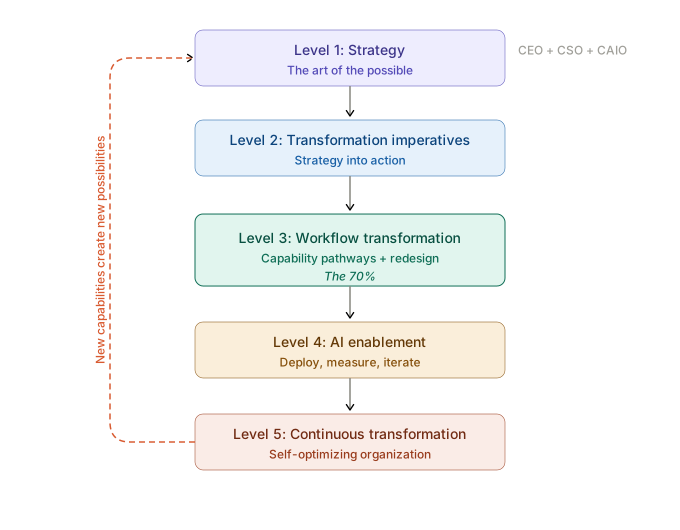
In most enterprises right now, three separate conversations are happening about AI, and none of them are connected to each other.
The CEO is talking to the board about AI ambition, competitive positioning, and the expectation that AI investments will produce measurable returns. The Chief AI Officer is building a technology plan: evaluating tools, designing an architecture, assembling a roadmap of capabilities to deploy. The Chief Strategy Officer is running competitive analysis and strategic planning through the traditional process, increasingly aware that AI is reshaping the competitive landscape but uncertain how to integrate that awareness into the strategic frameworks they own.
Each of these leaders is doing their job well. The problem is that they are doing it in isolation. And the result is a strategy that does not account for what AI makes possible, an AI plan that is not anchored in business strategy, and a competitive analysis that does not reflect the new boundaries of what is achievable.
The disconnect is now measurable at the very top of the house. A Pearl Meyer survey reported by Fortune in April 2026 found that boards and C-suites disagree about who owns AI strategy. The most consequential capability shift in a generation is underway, and the people governing it have not agreed on whose job it is.10
This is the single highest-leverage problem most organizations can solve right now, and the solution does not require a reorganization, a new technology investment, or a consulting engagement. It requires three leaders in the same room, working on the same problem, with the shared objective of producing business strategy that is genuinely informed by what AI now makes possible.
What blind spots do the CEO, CSO, and CAIO each have on AI strategy?
Each of the three leaders — CEO, CSO, and CAIO — carries a critical blind spot that only the other two can fill, which is exactly why AI strategy requires a partnership rather than any single owner. Understanding these blind spots is the first step toward building a partnership that resolves them.
What is the CEO’s blind spot on AI strategy?
The CEO’s blind spot is an imagination gap: CEOs set ambition and commit resources — things no one else can do — but most lack the AI fluency to understand what is now strategically possible, and that gap directly limits the ambition they set. According to BCG, 72% of CEOs are already their company’s chief decision maker on AI, and half believe their job stability depends on getting AI right in 2026.1 The urgency is real. But making decisions without understanding what AI makes possible produces strategies bounded by yesterday’s assumptions.
According to BCG, this is the “imagination gap”: the inability of leadership teams to see beyond incremental technology application to genuinely transformative business change. When the CEO does not understand what AI makes achievable, they default to strategies bounded by yesterday’s assumptions. The AI investment gets framed as an efficiency play (reduce cost, accelerate existing processes, automate routine tasks) rather than a growth play that fundamentally expands what the business can do, who it can serve, and how it competes.2
In practice, leaders spend less time on strategy than most people assume. The majority of CEO time goes to managing change, moving the organization from point A to point B. The strategic question, whether point B is bold enough and whether it accounts for what is now possible, often gets less attention than the operational question of how to get there. When the CEO does not have a partner who can expand what “bold enough” means in the context of AI’s capabilities, the strategy underperforms its potential before the first initiative is even launched.
What is the CSO’s blind spot on AI strategy?
The CSO’s blind spot is that their strategic frameworks are anchored to a landscape AI is rapidly shifting: they bring competitive intelligence, market analysis, and strategic framing — more critical now than ever — but Deloitte’s 2026 Global CSO Survey reveals a role under structural pressure.3
According to Deloitte, 95% of CSOs expect competitive dynamics and AI-driven disruption to materially reshape their strategic priorities. Yet only 28% currently co-lead enterprise AI-related decisions. Only 35% co-lead or fully own decision-making for their organization’s top priorities. And only 16% say their organizations are using AI to fundamentally reimagine lines of business or create new sources of competitive advantage.3
The CSO is building strategy on a competitive landscape that AI is actively reshaping, and in most organizations, they are doing so without substantive input on how. Their time, according to Deloitte, is disproportionately consumed by process management and special projects rather than the market sensing, competitive analysis, and partnership development that represent their highest-value contribution.3
The reason is structural, not personal. When organizations treat AI as a technology initiative, the strategic conversation gets reframed as a technology conversation. The discussion happens between the CEO, CIO, and CAIO. The CSO, the person whose entire function is strategic framing, has no obvious seat at a technology table. So they get displaced at exactly the moment their contribution matters most.
What is the CAIO’s blind spot on AI strategy?
The CAIO’s blind spot is business translation: they understand what AI can technically do — that depth is what earned them the role — but knowing what is possible and communicating it in terms that expand a CEO’s strategic thinking are two fundamentally different skills.
The CAIO who walks into a strategy session and says “we can deploy agentic workflows that automate 60% of claims processing” is speaking technology. They are describing a capability in the language of their own domain. The CEO hears it, categorizes it as an efficiency initiative, and moves on.
The CAIO who walks into the same session and says “we can fundamentally change the economics of our claims operation in a way that lets us price 15% below our nearest competitor while maintaining margins, and we can do it in six months” is speaking strategy. Same underlying AI capability. Completely different language. The second version changes how the CEO thinks about competitive positioning. It expands what the CEO considers strategically possible. It opens a conversation about pricing strategy, market share, and competitive differentiation that the first version never reaches.
This translation skill is not a deficiency in most CAIOs. It is a skill that the technical career path simply does not develop. Data science, machine learning engineering, AI research: these fields train people to think in terms of models, architectures, and technical performance metrics. They do not train people to think in terms of competitive positioning, margin structure, market share dynamics, or board-level narrative. BCG’s research found that 14% of organizations are still stagnating with minimal or no AI action at all, and among those that have moved further, future-built companies are three times as likely as others to have appointed a chief AI officer with a clearly defined mandate. Most CAIOs are operating without a mandate that explicitly includes the translation function the responsibility requires.4 The structure, meanwhile, is being built at extraordinary speed. IBM’s Institute for Business Value reports that 76% of CEOs surveyed across 33 geographies now have a Chief AI Officer, up from 26% a year earlier, and that companies with a CAIO report roughly 5% higher AI ROI. The role is arriving faster than the mandate is being defined.11
The CAIO who recognizes this gap and actively works to close it, by learning from the CEO and CSO how they think about the business, what language they use in board presentations, what metrics drive their decision-making, becomes dramatically more effective. The CAIO who does not will remain a technical leader presenting technology plans, no matter how brilliant those plans are.
How does this partnership resolve the AI strategy chicken-and-egg problem?
The partnership resolves a chicken-and-egg paradox most organizations have never named: strategy needs to know what AI makes possible, but understanding what AI makes possible strategically requires strategic framing — so no single leader can start. Bringing the three together breaks the deadlock that stalls Level 1.
You cannot write effective strategy without understanding what AI now enables. Capabilities that were impossible or prohibitively expensive three years ago are now achievable. A strategy written without awareness of those capabilities will be conservative by default, bounded by assumptions that are no longer true.
But you cannot deploy AI effectively without strategy driving the decisions. AI deployed without strategic direction produces the pilot proliferation and scaling failures that McKinsey, BCG, and Deloitte all document: 88% regular use, 6% real impact.5
Most organizations resolve this paradox by ignoring the first half. They skip the strategy step, because they do not know how to incorporate AI’s possibilities into strategy, and go straight to technology deployment. Deloitte’s 2026 State of AI report quantifies the result: only 34% of organizations are using AI to truly reimagine their business, while the remaining two-thirds are either redesigning processes incrementally or layering AI onto existing operations with little structural change.6 This is the technology-first pattern, and it is why most AI investments are not producing enterprise-level returns.
The CEO-CSO-CAIO partnership resolves the paradox by making strategy and AI capability awareness happen simultaneously, in the same conversation. The process is iterative, not sequential:
The CSO opens with strategic context. Here is how our competitive landscape is shifting. Here is where our growth opportunities are. Here are the strategic questions we need to answer to win in this market over the next three to five years.
The CAIO responds with capability context. Given those strategic questions, here is what AI now makes possible that changes the answer. Here is what was unachievable two years ago that is within reach today. Here is what that means for the specific options in front of us.
The CEO synthesizes. Given our competitive position, our growth ambitions, and what is now possible, here is the strategy. Here is where we are going. Here is the resource commitment that backs it.
But this is not a three-step sequence. It is a conversation that cycles. What the CAIO shows is possible reshapes the CSO’s competitive analysis, because if a competitor could also do this, the strategic calculus changes. The CSO’s revised analysis prompts the CAIO to explore different capabilities, ones that address competitive threats the original conversation did not surface. The CEO’s ambition level adjusts upward as the boundaries of possible expand, which prompts the CSO to evaluate whether the market opportunity supports that ambition, which prompts the CAIO to assess whether the capability can scale to that level.
The strategy that emerges from this iterative process is something none of the three could have produced alone. The CEO without the CAIO sets strategy that is too conservative. The CAIO without the CSO builds capabilities that are technically impressive but strategically misaligned. The CSO without the CAIO frames the competitive landscape using boundaries that are no longer accurate.
Together, they produce strategy that is simultaneously ambitious, strategically grounded, and technically achievable, because each blind spot has been filled by the leader who can see what the others cannot. Research from Harvard Business School’s Digital Data Design Institute, published in Harvard Business Review, supports this model directly: successful AI adoption comes not from concentrating AI leadership in a single role but from distributed leadership where builders, operators, and strategists collaborate across functions.7 Harvard Business Review sharpened the point in March 2026: the right question is not who owns AI, but who owns which AI-related decisions. That is exactly what the triad does. It works because it allocates decision rights across the CEO, CSO, and CAIO, not because it concentrates ownership in any one of them.12
What must the CAIO learn to make this partnership work?
The CAIO faces the steepest learning curve of the three partners — not because their expertise is less valuable, but because the strategy environment is least familiar to them. They must learn to translate technical possibility into the language of business strategy.
CEOs have been setting strategy with boards for their entire careers. CSOs have been doing competitive analysis and strategic framing as their core function. The CAIO, in most cases, has spent their career in technical environments where the audience understood the language of models, data architectures, and AI capabilities. The Level 1 partnership asks the CAIO to operate in a fundamentally different environment, one where technical precision matters less than strategic relevance, and where the measure of success is not whether the AI capability works but whether it changes how the CEO thinks about the business.
This requires the CAIO to invest in understanding how the CEO and CSO think. What does the CEO care about when they are talking to the board? What metrics does the CSO use to evaluate competitive positioning? How does the CFO think about margin structure? What language does the executive team use when they discuss growth opportunities?
The CAIO who learns this language, who can take an AI capability and express it in terms of competitive advantage, revenue impact, market share, or customer value, becomes the most strategically valuable person in the room. They are the only one who can bridge what is possible and what is strategic. That bridge is the CAIO’s unique contribution, and it is what makes the Level 1 partnership productive rather than performative.
This is also why the CAIO’s department cannot be staffed exclusively with data scientists and machine learning engineers. The CAIO alone cannot serve as the translation layer for the entire enterprise. As the transformation moves from Level 1 through the rest of the methodology, the CAIO’s team will need hybrid professionals: people who are technically fluent enough to understand AI capabilities and business-experienced enough to translate those capabilities into operational impact for every domain they touch. Building that team is a strategic priority, one we will address directly in a subsequent article.
Why does the CSO matter more than ever in the age of AI?
The CSO has never mattered more because AI raises the stakes on exactly the strategic framing they provide — yet the function faces a quiet crisis, not of competence but of positioning. The role is more essential and more precariously placed at the same time.
When organizations treat AI as a technology initiative, the CSO gets structurally displaced. All the energy, budget, and executive attention flows to the CAIO and CIO. The strategic conversation becomes a technology conversation. And the person whose entire function is strategic framing, the person who should be at the center of the most consequential strategic shift in a generation, is on the sideline managing special projects and wondering where they fit.
This is exactly backwards.
AI has not diminished the CSO’s relevance. It has amplified it. The competitive landscape is shifting faster than at any point in modern business history. The strategic possibilities have expanded dramatically. The need for rigorous competitive analysis, market sensing, and strategic framing is greater, not less. BCG’s own research on the CSO role found that when transformations fail, execution is typically not the reason. Rather, it is a lack of alignment, and success hinges on tight coordination among strategic leaders.8
What the CSO uniquely brings to the Level 1 partnership is the filter that separates what is achievable from what is worth achieving. The CAIO can show dozens of AI capabilities that are technically possible. The CSO determines which of those capabilities address a real competitive need, open a genuine market opportunity, or defend against an emerging threat. Without that filter, the organization chases every shiny AI capability. With it, the organization focuses its transformation on the capabilities that produce strategic differentiation.
Deloitte’s research suggests the path forward for CSOs is clear: embed AI in core strategy and seek out ways to help the organization make decisions with speed and clarity.9 Our methodology provides the mechanism. The Level 1 partnership gives the CSO a defined seat at the most consequential table in the organization, with a clear mandate and a clear contribution.
What does the Level 1 partnership produce?
The Level 1 partnership produces business strategy that accounts for what AI makes possible — not an AI roadmap. It replaces the technology-first roadmap with strategy that treats AI as an input to ambition rather than the output of it.
Specifically, it replaces three separate, disconnected activities with one integrated conversation. It replaces the CAIO presenting an AI roadmap for the CEO to evaluate, because the strategy is co-created, not presented. It replaces the CSO running strategic planning without AI input, because AI’s capabilities are woven into the competitive analysis from the beginning. And it replaces the CEO making AI investment decisions based on what vendors and peers are doing, because the investment decisions now flow from a strategy the CEO helped create with full understanding of what is possible and what is strategically valuable.
The practical structure is not a single offsite. It is an ongoing operating rhythm. An initial intensive (perhaps two to three days of focused work) to establish the strategic foundation. What is our competitive position? What does AI make possible for us specifically? Where does the intersection of competitive need and AI capability produce the boldest, most defensible strategy?
Then a regular cadence: monthly strategic reviews where new AI capabilities, competitive developments, and market opportunities are integrated in real time. The Level 1 partnership is not an event. It is a standing function that continuously refines strategy as both the competitive landscape and AI capabilities evolve.
This ongoing cadence matters because AI capabilities are advancing rapidly. A strategy set in January may need updating by June, not because the strategy was wrong, but because new capabilities have expanded what is possible. The Level 1 partnership ensures that the organization’s strategy stays current with the frontier of what is achievable, rather than anchoring to what was achievable when the strategy was written.
What is the highest-leverage AI move you can make this month?
The highest-leverage change you can make this month is forming the CEO–CSO–CAIO partnership: of everything in the AI Business Transformation Methodology, it requires the least organizational disruption and produces the most strategic clarity.
You do not need to reorganize the company. You do not need to purchase new technology. You do not need a transformation office or a consulting engagement. You need three leaders who are already in your organization, already doing valuable but disconnected work, to start doing that work together.
If your CSO is not currently involved in AI-related strategic decisions, invite them. Not as a courtesy, but because the competitive intelligence they carry is essential to determining which AI capabilities are strategically valuable and which are technically interesting but strategically irrelevant.
If your CAIO is building a technology roadmap in isolation, redirect them. Their first job is not to plan what AI to deploy. Their first job is to help you and your CSO understand what AI makes possible for your specific business, in terms that change how you think about competitive strategy.
If you as CEO are evaluating AI investments without a clear understanding of what AI makes strategically possible, stop. You are making resource allocation decisions with an incomplete picture. The partnership gives you the complete picture.
Form the partnership. Set the cadence. Start the conversation that should have been happening from the beginning.
Everything else in the transformation — the Business Transformation Imperatives, the capability pathways, the workflow redesign, the AI enablement — flows from the strategy this partnership produces. Get Level 1 right, and the rest of the methodology has a foundation to build on. Skip it, and every subsequent level is building on assumptions that may no longer be true.
This is where it starts.
Sources
- 1.BCG, “AI Radar 2026: As AI Investments Surge, CEOs Take the Lead,” January 2026 (2,360 executives, 640 CEOs). 72% of CEOs chief AI decision maker; half believe job stability depends on AI https://www.bcg.com/publications/2026/as-ai-investments-surge-ceos-take-the-lead
- 2.BCG, “From Potential to Profit: Closing the AI Impact Gap,” January 2025. “Imagination gap” concept https://www.bcg.com/publications/2025/closing-the-ai-impact-gap
- 3.Deloitte, “2026 Chief Strategy Officer Survey,” February 2026. 95% expect reshaping; 28% co-lead AI decisions; 35% co-lead top priorities; 16% using AI to reimagine https://www.deloitte.com/us/en/about/press-room/deloitte-2026-chief-strategy-officer-survey.html
- 4.BCG, “The Widening AI Value Gap,” September 2025 (1,250+ firms). 14% stagnating; future-built companies 3x more likely to appoint CAIO https://www.bcg.com/publications/2025/are-you-generating-value-from-ai-the-widening-gap
- 5.McKinsey, “The State of AI in 2025,” November 2025 (1,993 participants). 88% regular use; 6% high performers https://www.mckinsey.com/capabilities/quantumblack/our-insights/the-state-of-ai
- 6.Deloitte, “The State of AI in the Enterprise 2026,” January 2026 (3,235 leaders). 34% truly reimagining business https://www.deloitte.com/us/en/what-we-do/capabilities/applied-artificial-intelligence/content/state-of-ai-in-the-enterprise.html
- 7.John Winsor and Jen Stave, “Your AI Strategy Needs More Than a Single Leader,” Harvard Business Review, August 2025 (from HBS Digital, Data, and Design Institute) https://hbr.org/2025/08/your-ai-strategy-needs-more-than-a-single-leader
- 8.BCG, research on CSO role and transformation alignment. When transformations fail, execution is typically not the reason; lack of strategic alignment is.
- 9.Deloitte, CSO research, 2026. Path forward for CSOs: embed AI in core strategy and help organizations make decisions with speed and clarity.
- 10.Fortune, “Boards say the C-suite owns AI strategy. The C-suite doesn’t agree,” April 22, 2026 (Pearl Meyer survey) https://fortune.com/2026/04/22/ai-ownership-c-suite-board-disagree-pearl-meyer-survey-brad-jayne/
- 11.IBM Institute for Business Value, “IBM Study: CEOs are Reshaping C-suite Roles for the AI Era,” May 4, 2026 (2,000 CEOs and equivalents, 33 geographies, 21 industries). 76% of surveyed organizations have a Chief AI Officer, up from 26% a year earlier; about 5% higher AI ROI with a CAIO https://newsroom.ibm.com/2026-05-04-ibm-study-ceos-are-reshaping-c-suite-roles-for-the-ai-era
- 12.Harvard Business Review, “Who in the C-Suite Should Own AI?,” March 12, 2026. Decision-rights framing: the right question is who owns which AI-related decisions https://hbr.org/2026/03/who-in-the-c-suite-should-own-ai
Frequently Asked Questions
What if our CEO is already deeply involved in AI decisions?
According to BCG, 72% of CEOs are already their company’s chief decision maker on AI.1 The question is not whether the CEO is involved, but whether they are making those decisions with the right partnership. A CEO making AI decisions without CSO strategic context and CAIO capability context is making decisions with an incomplete picture, regardless of how personally engaged they are.
How is this different from the AI governance committees many organizations have already formed?
AI governance committees typically focus on risk management, compliance, and oversight of AI deployments. These are important functions, but not the same as strategic co-creation. The Level 1 partnership is not a governance body. It is a strategy-setting function where three leaders actively co-create business strategy. Governance asks “are we deploying AI safely?” The Level 1 partnership asks “where should this business go, given what AI now makes possible?”
What if our CAIO reports to the CIO rather than the CEO?
The reporting structure matters less than the access. The CAIO needs to be in the Level 1 conversation regardless of where they sit on the org chart. If the current structure does not provide that access, the CEO can create it; a standing strategic partnership does not require a reporting line change. That said, organizations where the CAIO has direct CEO access tend to produce bolder, more strategically integrated AI investments than those where AI strategy is filtered through the technology organization.
How much time does this partnership require?
The initial intensive requires two to three days of focused work, a meaningful time commitment but a one-time investment. The ongoing cadence requires approximately half a day per month for the strategic review. For three executives who collectively control billions in resource allocation, dedicating half a day per month to ensuring those resources are strategically directed is not a cost. It is the highest-return time investment available.
What if our CSO is skeptical about AI?
Skepticism is different from disengagement. A CSO who is skeptical about AI’s strategic value but engaged in the Level 1 conversation will pressure-test the CAIO’s claims against competitive reality, which is exactly what the partnership needs. The CSO’s job is not to be an AI enthusiast. It is to ensure that only strategically valuable capabilities receive investment. Healthy skepticism makes the partnership’s output more rigorous, not less.
This series addresses “what” to do, not “how” to do it. If you are a business executive and would like help thinking through the “how,” please feel comfortable reaching out.
About the author
Shawn Plaster
Founder & CEO, Plaster Group
Shawn is the author of Plaster Group's five-level AI Business Transformation Methodology and its 27-article Insights series, and leads the firm's enterprise AI transformation work.
Previous: Article 2: The Business Transformation That AI Requires · Next: Article 4: From Strategy to Action
© 2026 Plaster Group, LLC. All rights reserved. This article may not be reproduced, distributed, or transmitted in any form without prior written permission from Plaster Group. Brief excerpts may be quoted for review or commentary purposes with attribution to the author and a link to the original article.
Ready to move forward?
Let's discuss how your organization can build with AI — securely, strategically, and starting from where you are today.
Start a Conversation