This article is part of a 27-article series on the AI Business Transformation Methodology. This piece focuses on the CAIO’s role across all five levels.
The Chief AI Officer is one of the newest roles in the C-suite and one of the most misunderstood. It is also spreading faster than almost any C-suite role on record: IBM’s Institute for Business Value reports that 76% of CEOs surveyed across 33 geographies now have a Chief AI Officer, up from 26% a year earlier, and that companies with a CAIO report roughly 5% higher AI ROI. (A narrower benchmark of about 110 Fortune 1000 firms puts prevalence closer to 38.5%, so the figure depends on the population surveyed, but the direction is unmistakable.)6 Most organizations wrote a job description that sounds right but starts from the wrong place: build an AI strategy, evaluate and select AI tools, establish a center of excellence, manage pilots and deployments, report AI progress to the board.
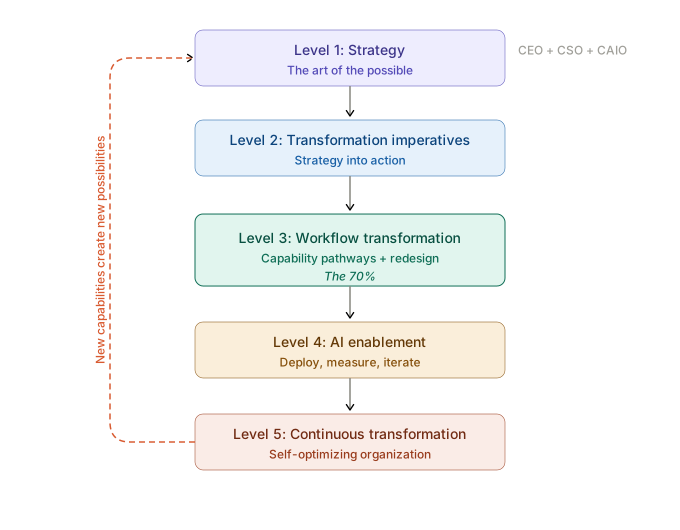
These are important activities. They are also Level 4 activities in the AI Business Transformation Methodology. The CAIO who starts there skips the strategic work at Level 1 that determines whether the organization is pursuing the right transformation, the imperative-building at Level 2 that ensures the transformation is properly scoped and resourced, and the workflow redesign at Level 3 that determines whether the technology actually produces enterprise value.
This article is written for two audiences. For the CEO: here is what you should expect and demand from your CAIO, what department structure makes their mandate achievable, and what budget that requires. For the CAIO: here is what the job actually looks like when the organization is doing AI transformation correctly, and what it takes to build the function that makes it possible.
What does a Chief AI Officer actually do?
A Chief AI Officer’s real job is to be an enterprise transformation partner with deep AI fluency — not a technology executive who builds roadmaps and selects tools. Most organizations hired for the second version: a senior technology leader who builds an AI roadmap, evaluates and selects AI platforms, establishes a center of excellence staffed with data scientists, manages a portfolio of AI pilots, and presents adoption metrics to the board. This is a technology-executive mandate. It produces technology roadmaps, pilot portfolios, and deployment timelines.
The AI Business Transformation Methodology requires something fundamentally different: a strategic partner who expands the CEO’s and CSO’s understanding of what is possible (Level 1), helps calibrate Business Transformation Imperatives for ambition and feasibility (Level 2), provides education and workflow design advisory to every domain undergoing transformation (Level 3), guides iterative AI enablement (Level 4), and ensures continuous transformation becomes self-sustaining (Level 5).
The first version is a technology executive. The second is an enterprise transformation partner with deep AI fluency. Same title. Fundamentally different mandate.
The gap between these two versions explains much of why AI investments are not producing enterprise-level returns. According to McKinsey, AI high performers are three times more likely than their peers to have senior leaders who demonstrate ownership of and commitment to AI initiatives. But leadership alone is not enough. The kind of leadership matters. A CAIO operating as a technology executive at Level 4 will produce the same pilot proliferation and scaling failures that the research documents. A CAIO operating as a transformation partner across all five levels connects the strategic work at the top to the operational work at the bottom, ensuring that AI deployment is anchored in strategy and enabled by redesigned workflows.1
What is the CAIO’s role in setting AI strategy?
At Level 1, the CAIO’s job is to expand how the CEO and CSO understand what AI makes possible — co-creating business strategy, not presenting a technology roadmap. Article 3 in this series covered that partnership in depth. What that article did not cover is how personally demanding this role is for someone whose career has been built in technology.
The Level 1 environment is unfamiliar for most CAIOs. The audience is not technical. The currency is not models, architectures, or performance benchmarks. The measure of success is not whether the AI capability works but whether it changes how the CEO thinks about the business. Operating effectively in this environment requires three capabilities that the typical technical career path does not develop:
Business language fluency. The ability to express AI capabilities in terms of competitive positioning, margin impact, revenue opportunity, and market share rather than in terms of technical specifications. This is not about dumbing things down. It is about translating genuine capability into the language that moves strategic decisions. The CAIO who can say “we can restructure our pricing model to undercut the market by 15% while protecting margins” is making a strategic argument. The CAIO who says “we can deploy a transformer-based pricing agent leveraging reinforcement learning on a fine-tuned LLM, trained on our transactional dataset to optimize price-demand curves at the SKU level” is making a technology pitch. The first changes strategy. The second gets filed.
Strategic listening. The ability to hear the CEO’s and CSO’s strategic concerns and immediately connect them to AI capabilities that address those specific concerns, rather than presenting a catalog of what AI can do and hoping something resonates. This requires the CAIO to deeply understand the business: how it makes money, where it is vulnerable, what keeps the CEO up at night, what the CSO sees shifting in the competitive landscape. The CAIO who listens first and then connects capabilities to concerns is dramatically more effective than the CAIO who leads with a technology presentation.
Constraint honesty. The willingness to tell the CEO and CSO what is not yet possible, or what requires foundational work (like data infrastructure investment) before it becomes achievable. The CAIO who oversells what is possible undermines trust. The CAIO who is honest about constraints while clearly showing what is achievable within those constraints builds the credibility that makes the Level 1 partnership productive over time. According to Deloitte, data management readiness sits at only 40% across enterprises. A CAIO who pretends this is not a constraint is setting the transformation up for failure. A CAIO who names the constraint and proposes how to address it while pursuing achievable imperatives in parallel is doing the job right.2
What does the CAIO do at Levels 2 through 5?
Across Levels 2 through 5, the CAIO functions as connective tissue: the feasibility voice at Level 2, the education-and-workflow-design engine at Level 3, the tool-selection guide at Level 4, and the builder of continuous-improvement capability at Level 5. The Level 1 role gets the most attention because it is the most visible — but this connective work across the remaining levels is what determines whether the Methodology actually produces results.
At Level 2, the CAIO serves as the feasibility voice in the portfolio conversation. When the Level 1 triad is building Business Transformation Imperatives, the CAIO answers the questions that the CEO and CSO cannot: Is this imperative technically achievable given current AI capabilities? Does our data infrastructure support it, or do we need a foundational data imperative first? Is the timeline realistic given the organizational change required? Are we being ambitious enough, or are we constraining the imperative to what feels safe rather than what AI actually makes possible? This calibration role ensures the portfolio is neither unrealistically ambitious nor unnecessarily conservative.
At Level 3, the CAIO’s department has its greatest impact and its most resource-intensive responsibility. Two critical functions operate here.
The first is education. When a domain leader is chartered with a Business Transformation Imperative, they and their team need to understand what AI makes possible in their specific domain before they can design new workflows. This is not a briefing deck or a vendor demonstration. It is a substantive, working engagement where domain leaders experience what is achievable, ask questions grounded in their operational reality, and develop enough fluency to make informed design decisions about their own work. The CAIO’s department runs these engagements, tailored to each domain’s specific context.
The second is workflow design advisory. As domain teams redesign how work should be done in an AI-enabled environment, the CAIO’s team partners with them to ensure the designs leverage AI’s actual capabilities. Without this advisory function, domain teams tend to either under-design (they don’t know what AI can do, so they design workflows that barely use it) or over-design (they assume AI can do things it cannot yet do reliably, creating workflows that fail in practice). The CAIO’s team provides the technical grounding that keeps workflow designs ambitious but realistic.
This Level 3 role is where the CAIO’s department earns its investment. MIT Sloan Management Review’s research on AI-driven productivity found that a global financial services firm that took this approach to work redesign, deconstructing tasks before deploying AI rather than layering AI onto existing processes, achieved a 59% workload reduction in its customer order process. That kind of result is only possible when the workflow redesign is done properly, and proper workflow redesign requires the education and advisory support the CAIO’s department provides. Without it, domain leaders are chartered with transformation imperatives and left to figure out AI on their own, which is how organizations end up with fragmented, inconsistent, and underwhelming results.3
At Level 4, the CAIO guides tool selection and deployment, ensuring AI tools map to the well-defined capabilities and redesigned workflows from Level 3 rather than being selected in isolation. The CAIO also manages the iteration cycles, helping domain teams interpret first-cycle results and adjust their workflows and tool configurations based on what they learn.
At Level 5, the CAIO ensures the organization builds the muscle for continuous self-optimization. This means gradually shifting from centrally coordinated transformation (where the CAIO’s department drives every initiative) to distributed, democratized improvement (where individual teams identify and implement AI-enabled improvements on their own). The CAIO’s long-term role evolves from hands-on transformation partner to the architect of the organization’s ongoing AI capability.
How should you staff a CAIO’s department?
Staff the CAIO’s department around the 70% — the people, process, and cultural transformation that BCG’s 10-20-70 rule identifies as the majority of the work — not around data science. One person cannot serve as the translation layer for an entire enterprise; the department behind the CAIO is what makes the role scalable, and how it is staffed determines whether that 70% effort actually gets resourced.4
The talent pool. The department cannot be staffed primarily with data scientists and machine learning engineers. Those technical skills are necessary, perhaps representing 20-30% of the team, but they are not sufficient. The largest group in the department should be AI-Business Translators: hybrid professionals who are technically fluent enough to understand AI capabilities and experienced enough in business operations to translate those capabilities into practical impact for specific domains.
This is a new kind of professional, and they are genuinely hard to find. They tend to come from one of two paths. The first is business operators who have developed real AI fluency, not people who took a weekend course, but people who can engage substantively with what AI can and cannot do in an operational context. The second is technologists who have spent significant time in business-facing roles and understand how organizations actually make decisions, manage operations, and serve customers. Neither path is common, which means this talent pool requires active development through internal rotation programs, targeted external recruitment, and deliberate career path design, not just posting job listings and hoping.
How to find them: the CAIO’s sourcing partnership with domain leaders. The most important thing to understand about sourcing AI-Business Translators is that the domain expertise half of the hybrid profile cannot be hired quickly from outside. Deep knowledge of how a supply chain actually operates, how a finance organization closes the books, how procurement manages vendor relationships, how customer service handles escalations — this takes years to develop. McKinsey’s research on domain leaders confirms this: “You can’t hire a domain owner. The person in that role has to know the company and have domain expertise. You need to find them and upskill them.” The same principle applies to the translators who will embed in those domains. You can teach a supply chain expert about AI capabilities. You cannot teach an AI expert about supply chain in six months.5
This means the CAIO cannot build the translator team in isolation. The sourcing process works through the CAIO’s VPs interfacing with the VPs in each domain organization: who in your organization combines deep domain expertise with the technical curiosity and fluency to reimagine how work should be done? From there, senior directors in the domain organization do the actual talent identification — they know their people well enough to recognize who has the hybrid profile and who would thrive in an embedded translator role. The domain’s C-suite leader may bless the arrangement, but the operational work of identifying, evaluating, and releasing the right people happens at the VP and senior director level. These candidates are rare, they are valuable to their current leaders, and the CAIO’s organization needs the domain’s active partnership to identify them and, in many cases, to release them into the CAIO’s department or into a shared arrangement where they serve as embedded translators while maintaining their domain connection.
Three sourcing channels, weighted by organizational structure. Where translators come from depends significantly on how the enterprise structures its technology function. In organizations with decentralized IT, where each business unit has its own technology staff, the translator talent pool often exists within the domains themselves. These are technology professionals who have spent years inside a specific function — supporting the finance systems, managing the supply chain platforms, running the HR technology stack — and have developed deep domain familiarity through daily operational partnership with business users. They understand both the systems and the business processes those systems support. They are natural translator candidates because they already bridge the domain and technology gap within their function.
In organizations with centralized IT, the CIO’s organization is a primary sourcing channel. Most centralized IT organizations align their technical resources by domain — a team supporting Finance, a team supporting Supply Chain, a team supporting HR — specifically so those technical professionals develop enough domain familiarity to be effective partners. These people may not have the same depth of domain knowledge as someone who has operated within the function for their entire career, but they bring a technical foundation and cross-functional perspective that is extremely hard to develop from scratch. They have also often participated in enterprise-wide technology implementations like ERP deployments, where they experienced firsthand what happens when process redesign and technology enablement are done well or poorly. That implementation experience is directly transferable to the AI transformation context.
The third channel is external recruitment, but it should be the supplementary channel rather than the primary one. External hires bring fresh perspective and may bring AI fluency that internal candidates lack, but they do not bring the institutional knowledge, the domain relationships, or the understanding of how the specific organization actually operates. The strongest translator teams combine internally sourced domain experts (who need AI fluency development) with a smaller number of externally recruited AI-fluent professionals (who need domain immersion). The internal candidates provide the foundation. The external hires accelerate the AI capability development.
One practical reality the CAIO should anticipate: some domains will produce translator candidates more readily than others. Functions like finance, supply chain, and operations have been heavily technology-dependent for decades and tend to have more leaders and senior professionals with hybrid domain-and-technology profiles. Functions like HR, legal, and corporate communications have historically been less technology-intensive at the senior level, which means the CAIO may need to source translators for those domains from the CIO’s organization (where technical staff aligned to those functions have developed domain familiarity from the technology side) rather than from within the domain itself. The sourcing strategy should be domain-specific, not one-size-fits-all.
Beyond the AI-Business Translators, the department needs two additional specialized functions. But before describing the roles, it is important to understand the organizational structure they sit within.
The department hierarchy. At enterprise scale, the CAIO’s department is not a flat team of practitioners reporting directly to the CAIO. It has the same organizational structure as any other C-suite executive’s department: the CAIO has VPs reporting to them, those VPs have directors, and those directors manage the practitioner teams described below. The VPs in the CAIO’s department are the ones who interface with domain VPs on translator sourcing, manage the department’s capacity across active imperatives, and ensure the quality of the department’s output. The directors manage the day-to-day work of the translator teams, the workflow design engagements, and the technology strategy function. The two practitioner roles below in addition to the AI-Business Translator role are where the substantive expertise lives, but they operate within a management chain that provides the oversight, coordination, and resource allocation that enterprise-scale transformation requires.
AI Workflow Designers: specialists in designing human-AI collaboration patterns. This is an emerging discipline with no established career path yet, but it is the skill set that makes Level 3 workflow redesign technically sound. These people understand interaction design, process engineering, and AI agent capabilities well enough to lead the technical design of workflows where humans and AI work together effectively. They call in AI-Business Translators for domain expertise, for help troubleshooting bottlenecks, for ensuring cross-domain coordination is applied at the workflow design level, and as extra design capacity when the workflow design workload falls behind schedule.
AI Technology Strategists: the professionals who research and continuously monitor the AI capability frontier — what is emerging, what is maturing, and what is becoming production-ready. They interface with both Translators and Workflow Designers to keep them current on available capabilities before Level 4 technology selection occurs. They assess feasibility specifically when a design implements new or emerging technology. They run proof of concepts related to new AI capabilities to prove out what is possible before recommending adoption. They feed emerging capability intelligence back to the CAIO for the Level 5 to Level 1 feedback loop that keeps the organization’s strategy current with the frontier of what is achievable. They also own and maintain the organization’s AI capability category taxonomy — a classification framework that categorizes AI capabilities by type (such as predictive AI, generative AI, agentic AI, perceptive AI, process automation, and physical AI) rather than by specific product or vendor. This taxonomy serves a critical operational purpose: when workflow redesign teams tag each AI-enabled step in their designs with the relevant capability category (a design practice described in Article 12), the AI Technology Strategists can rapidly cross-reference new or evolved capabilities against all active and completed workflow designs to identify which specific steps are affected. This converts what would otherwise be an enterprise-wide “do we need to reassess everything?“ question into a scoped, actionable assessment — these particular workflow steps, in these particular departments, are affected by this specific capability evolution. The taxonomy itself is expected to evolve as the AI landscape changes; categories may be added, merged, or retired. The AI Technology Strategists’ ongoing responsibility is to keep it current and useful, not to make it permanent. And they advise on tool selection in partnership with the CIO’s organization at Level 4. They do not build, deploy, or maintain production AI systems; that responsibility sits with the CIO’s technology organization. They are essential for keeping the entire department grounded in what AI can and cannot do, but they should represent the smallest function in the department, because the majority of the work (the 70%) is organizational, not technical.
The charter. The department’s charter should define it as connective tissue across all five levels, not as a technology silo. The department does not own AI. It enables the business to own its own transformation with AI fluency and design support. The charter should explicitly include Level 1 strategic partnership, Level 2 feasibility assessment, Level 3 education and workflow design advisory, Level 4 tool selection guidance and iteration support, and Level 5 continuous transformation architecture. Harvard Business Review reached the same conclusion in March 2026: the right question is not who owns AI but who owns which AI-related decisions, and the smartest organizations use the CAIO to coordinate decision rights across functions rather than to own AI outright. That is exactly the posture this charter takes.7
This charter distinguishes the CAIO’s department from a traditional AI center of excellence. A center of excellence typically operates as a service bureau: business units submit requests, the center builds AI solutions and hands them back. That model reinforces the technology-first pattern because the business unit is asking for an AI solution rather than redesigning its operations and then determining what AI capability the new design requires. The CAIO’s department under this charter does not build solutions for the business. It builds the business’s capacity to transform itself.
Sizing the department. The most common question CEOs and CFOs ask is: how big should this department be? The honest answer is that headcount and department-sizing benchmarks remain unpublished by the major research firms, even as the surrounding data explodes: CAIO prevalence is now benchmarked (IBM), CAIO compensation is now benchmarked (Christian & Timbers published 2026 benchmarks), and the ROI linkage is now measured. Department sizing is not, because the function is too new and the variation across industries and transformation scope is too wide.8 But three sizing tools, grounded in the research, give the CEO, CAIO, and CFO a credible framework for making this decision.
The first is the Budget Ratio Test. BCG’s 10-20-70 rule states that 10% of AI transformation resources should go to algorithms, 20% to technology and data infrastructure, and 70% to the redesign of workflows, people, and organizational culture. The CAIO’s department is a significant portion of that 70% investment. Most organizations currently have this ratio inverted, spending 70% or more on technology and 30% or less on the organizational change that determines whether the technology pays off. The diagnostic is straightforward: examine your total AI transformation spend, check the ratio, and if your investment in people and organizational change is less than your investment in technology, you are almost certainly underinvesting in the work that drives 70% of the value. BCG’s research shows that leading companies allocate more than 80% of their AI investments to reshaping key functions and creating new offerings rather than smaller-scale productivity initiatives.4
The second is Imperative-Based Scaling. Rather than sizing the department in the abstract, size it based on the number of active Business Transformation Imperatives in the portfolio. Each active imperative needs embedded support from the CAIO’s department: translators who embed in the domain, education capacity for the domain’s leadership and teams, and workflow design advisory support. As the portfolio scales from first-wave imperatives to subsequent waves, the department scales with it. Start modestly with the first wave and grow as the transformation expands. This approach ties department investment directly to transformation scope, which makes the business case concrete for the CFO.
The third is the Composition Principle. Within whatever size the department reaches, the composition should reflect the 70% reality. The largest function should be the AI-Business Translators, because the business transformation work — education, domain embedding, cross-domain coordination, and workflow design participation — is where the majority of the value is created. Workflow design capacity should be sufficient to support active imperatives. And the AI Technology Strategist function, while essential for keeping the department grounded in what is achievable, should be the smallest group, because 70% of the value comes from organizational work, not technical work. If the department is 80% technologists and 20% business-facing professionals, the composition is inverted the same way the budget usually is.
What should a CEO expect from a CAIO — and by when?
A CEO should expect concrete milestones on a clear timeline: a productive Level 1 strategic partner within 90 days, an initial department structure within six months, and active Level 3 support reaching first-wave domains within twelve months. Here is what each of those looks like.
Within 90 days, the CAIO should be participating productively in Level 1 conversations: translating AI capabilities into business language that changes how you think about competitive strategy. If after 90 days the CAIO can only present technology roadmaps and vendor evaluations, they are not operating at the level this methodology requires. That does not necessarily mean the wrong person is in the role. It may mean the mandate needs to be reset. Share this methodology with your CAIO and have a direct conversation about what you need from the partnership.
Within six months, the CAIO should have an initial department structure in place, even if small, with at least a few AI-Business Translators who can begin embedding in first-wave domains. The education capability should be operational, with the first domain leaders going through the working engagement that builds their AI fluency.
Within twelve months, first-wave domains should be receiving active Level 3 support from the CAIO’s department, with workflow redesign underway and the CAIO’s team serving as the bridge between what AI makes possible and how each domain actually operates.
What to watch for. Three warning signs indicate the CAIO is operating under the old mandate rather than the methodology-aligned one. First, if the CAIO is spending the majority of their time on technology evaluation, vendor management, and tool deployment, they are operating at Level 4 and skipping Levels 1-3. Second, if the CAIO’s department is entirely data scientists and engineers with no business translators, the 70% effort is not staffed. Third, if the CAIO cannot explain AI capabilities in business terms that change your strategic thinking, the Level 1 partnership is not working.
These are not character judgments about the CAIO. They are structural indicators that the role needs to be repositioned. Most CAIOs are highly capable leaders who are executing the mandate they were given. If that mandate was “build an AI roadmap and deploy technology,“ they are doing exactly what was asked. The methodology asks something different, and the CEO is the person who resets the mandate.
Sources
- 1.McKinsey, “The State of AI in 2025,“ November 2025 (1,993 participants). AI high performers 3x more likely to have committed senior leadership https://www.mckinsey.com/capabilities/quantumblack/our-insights/the-state-of-ai
- 2.Deloitte, “The State of AI in the Enterprise 2026,“ January 2026 (3,235 leaders). Data management readiness at 40% https://www.deloitte.com/us/en/what-we-do/capabilities/applied-artificial-intelligence/content/state-of-ai-in-the-enterprise.html
- 3.Ravin Jesuthasan, “Want AI-Driven Productivity? Redesign Work,“ MIT Sloan Management Review, 2025. 59% workload reduction, 40% cost savings https://sloanreview.mit.edu/article/want-ai-driven-productivity-redesign-work/
- 4.BCG, 10-20-70 rule. AI Radar 2025 and “How Agents Are Accelerating the Next Wave of AI Value Creation,“ December 2025. Leading companies allocate 80%+ to reshaping key functions https://www.bcg.com/publications/2025/agents-accelerate-next-wave-of-ai-value-creation
- 5.McKinsey, “Building the AI Muscle of Your Business Leaders,“ December 2025. Domain leader sourcing and upskilling https://www.mckinsey.com/capabilities/tech-and-ai/our-insights/building-the-ai-muscle-of-your-business-leaders
- 6.IBM Institute for Business Value, “IBM Study: CEOs are Reshaping C-suite Roles for the AI Era,” May 4, 2026 (2,000 CEOs and equivalents, 33 geographies, 21 industries). 76% of surveyed organizations have a Chief AI Officer, up from 26% a year earlier; about 5% higher AI ROI with a CAIO. Fortune 1000 comparison: AI & Data Leadership Executive Benchmark Survey (about 110 firms), 38.5% CAIO or equivalent https://newsroom.ibm.com/2026-05-04-ibm-study-ceos-are-reshaping-c-suite-roles-for-the-ai-era
- 7.Harvard Business Review, “Who in the C-Suite Should Own AI?,” March 12, 2026. The CAIO as coordinator of AI decision rights across functions https://hbr.org/2026/03/who-in-the-c-suite-should-own-ai
- 8.Christian & Timbers, “AI Executive Compensation 2026: Benchmarks, Trends, and What to Expect,” 2026. CAIO compensation benchmarks https://www.christianandtimbers.com/insights/ai-executive-compensation-2026-benchmarks-trends-and-what-to-expect
Frequently Asked Questions
We already have a CAIO who is doing good work. Does this mean we need to replace them?
Almost certainly not. Most CAIOs have the technical expertise and organizational credibility to be highly effective in the methodology-aligned role. What typically needs to change is the mandate, not the person. Share this methodology with your CAIO and have a conversation about repositioning the role. Most technically strong leaders welcome the expanded mandate because it gives them strategic influence they did not have when they were confined to technology decisions.
How is the CAIO’s department different from an AI center of excellence?
A center of excellence typically operates as a service bureau: business units submit requests, the center builds AI solutions. The CAIO’s department under this methodology does not build solutions for the business. It builds the business’s capacity to transform itself. The difference is fundamental: the center of excellence model reinforces technology-first thinking because the business unit is asking “give me an AI tool.“ The CAIO’s department model supports transformation-first thinking because it helps the business unit redesign its operations and then determine what AI capability the new design requires.
Where do we find AI-Business Translators? This seems like a role that barely exists.
It is an emerging role, and the talent market is thin. As described in the talent pool section above, the most effective approach starts with the CAIO’s VPs working with domain VPs and their senior directors to identify candidates who combine deep domain expertise with technical curiosity and fluency. The domain expertise half of the hybrid profile takes years to develop and cannot be hired quickly from outside. The CAIO’s sourcing strategy should account for the organization’s IT structure: in decentralized IT organizations, translator candidates often exist within the domain departments themselves; in centralized IT organizations, the CIO’s domain-aligned technical staff are a primary talent pool. External recruitment supplements but does not replace internal sourcing. One talent pool worth particular attention: professionals who have led or participated in multiple full-lifecycle enterprise system implementations (SAP, Oracle, and similar platforms). These individuals already understand enterprise-scale business transformation, they know what happens when process redesign and technology enablement are done well or poorly, and they have lived the organizational complexity that most AI initiatives are only now encountering. Adding AI fluency to that foundation is significantly easier than teaching a data scientist how enterprise transformation actually works. Building this talent pool will take time so plan accordingly. Start with 3-5 strong hires and develop the rest from within.
What is the relationship between the CAIO’s department and the CIO’s organization?
The division is clear in principle, though close collaboration is essential in practice. The CAIO’s department focuses on the business transformation side: strategy, governance, business-AI translation, education, workflow design advisory, and organizational change. The CIO’s organization focuses on the technology infrastructure side: platforms, model deployment and lifecycle management, integration, security, and technical operations. The CAIO’s department determines what capabilities the redesigned workflows require. The CIO’s organization builds, deploys, and maintains the production AI systems that deliver those capabilities reliably and securely. The handoff point between the two is Level 4, where workflow designs from the CAIO’s domain need to be implemented in production systems from the CIO’s domain. That handoff requires close partnership, particularly around tool selection where both the CAIO’s business feasibility perspective and the CIO’s technical infrastructure perspective are needed.
How do we justify the budget for the CAIO’s department?
Apply the Budget Ratio Test from BCG’s 10-20-70 rule. Most enterprises are spending tens or hundreds of millions on AI tools, platforms, and infrastructure. That is the 30% (algorithms plus technology and data). The CAIO’s department is part of the 70% investment in people, processes, and organizational change that determines whether the technology spend produces returns. If the department’s budget is a small fraction of the technology spend, the ratio is inverted, and the research is clear that inverted ratios produce the pilot proliferation and scaling failures most organizations are experiencing. Frame the department’s budget not as a new cost but as a correction to an existing imbalance.4
This series addresses “what” to do, not “how” to do it. If you are a business executive and would like help thinking through the “how,” please feel comfortable reaching out.

About the author
Shawn Plaster
Founder & CEO, Plaster Group
Shawn is the author of Plaster Group's five-level AI Business Transformation Methodology and its 27-article Insights series, and leads the firm's enterprise AI transformation work.
Previous: Article 4: From Strategy to Action · Next: Article 6: The Chief Strategy Officer’s AI Moment
© 2026 Plaster Group, LLC. All rights reserved. This article may not be reproduced, distributed, or transmitted in any form without prior written permission from Plaster Group. Brief excerpts may be quoted for review or commentary purposes with attribution to the author and a link to the original article.
Ready to move forward?
Let's discuss how your organization can build with AI — securely, strategically, and starting from where you are today.
Start a Conversation