This article is part of a 27-article series on the AI Business Transformation Methodology. This piece focuses on Level 2: Business Transformation Imperatives.
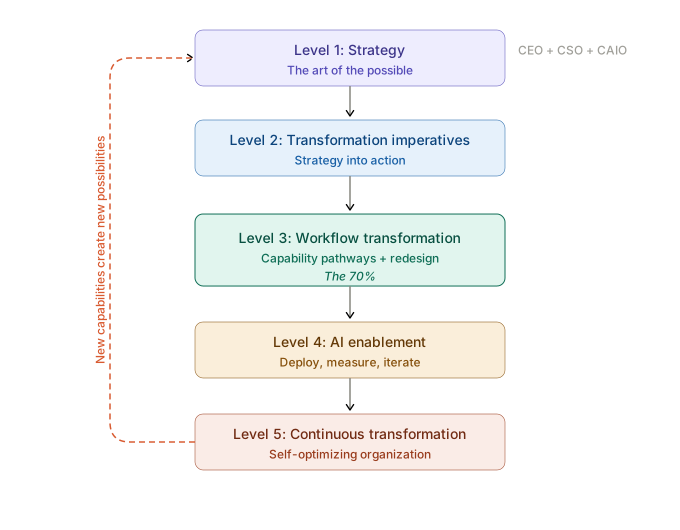
The strategy is set. The CEO, CSO, and CAIO have done the Level 1 work: they understand what AI makes possible, they have integrated that understanding into business strategy, and the leadership team is aligned on where the organization is going.
And then a familiar pattern emerges. Initiatives multiply. Teams across the business interpret the strategy through their own lens and launch efforts that may or may not connect to the enterprise intent. Budget requests come in from every direction, each claiming strategic alignment. Six months later, the CEO has a portfolio of activity but not a portfolio of transformation.
This is the Level 2 problem. Strategy without disciplined decomposition into the right units of action produces scattered effort, diluted investment, and the illusion of progress without the substance of transformation. The bridge between strategy and execution is not a technology roadmap, not a list of AI use cases, and not an innovation portfolio. It is a prioritized set of Business Transformation Imperatives: specific, strategically-derived programs that transform how the business operates in defined domains.
This article covers how to build those imperatives, how to prioritize them into a portfolio, how to back them with real resources, and how to hand them off to the domain leaders who will execute them.
Why aren’t AI use cases the same as transformation imperatives?
AI use cases are not imperatives because they start from the technology and ask where to apply it — the very inversion the methodology is designed to prevent. Most organizations that accept the strategy-first premise still stumble at Level 2 by decomposing their strategy into use cases. “Deploy AI in customer service.” “Automate invoice processing.” “Build a chatbot for employee HR questions.” These feel like progress because they are specific and actionable. But they are technology application targets, not transformation programs.
A Business Transformation Imperative starts from the business outcome and works backward to the capability required.
Consider the difference:
Use case: “Deploy predictive analytics in supply chain planning.”
Imperative: “Build a supply chain intelligence capability that reduces stockout frequency by 60% and cuts excess inventory carrying costs by $40M annually.”
Use case: “Implement AI-assisted underwriting.”
Imperative: “Redesign the underwriting process so that 80% of standard applications receive a decision within 4 hours while maintaining or improving risk accuracy.”
The use case describes a technology deployment. The imperative describes a business transformation with specific, measurable outcomes that connect directly to the enterprise strategy set at Level 1. The use case can be completed by deploying a tool. The imperative requires workflow redesign, job redesign, training, change management, and AI enablement working together, which is exactly what Level 3 delivers.
The use case format persists because it is what technology teams and AI vendors naturally produce. There is nothing wrong with use cases as a tactical planning tool within Level 4. But they are insufficient as the unit of action for Level 2 because they do not create the conditions for the 70% effort of workflow transformation that determines whether AI investments produce enterprise-level returns. Deloitte’s 2026 State of AI report illustrates the consequence: only 34% of organizations are using AI to truly reimagine their business, while 37% are layering AI onto existing operations with little or no structural change.1 The use case approach produces the latter. Business Transformation Imperatives produce the former. The deployment data shows how wide the gap remains: as of March 2026, McKinsey research found that roughly 10% of enterprise functions were using AI agents, a reminder of how far ambition runs ahead of deployment when the unit of action is the tool rather than the transformation.4
What makes a good Business Transformation Imperative?
A good imperative is defined by five characteristics that separate it from vague aspirations on one end and narrow technology projects on the other. Not every statement framed as a business outcome qualifies; these five traits are the test.
Strategically derived. Every imperative traces directly to a strategic priority set at Level 1. If you cannot draw a clear line from the imperative to a board-level business outcome, it does not belong in the portfolio. This is the most important filter and the one most often violated. Organizations routinely include imperatives that sound strategic but actually originated from a department’s technology wish list rather than from enterprise strategy.
Outcome-defined. The imperative specifies what changes in business terms, not technology terms. Revenue, cost, speed, quality, market position, customer experience, risk reduction. The outcome is how success gets measured. “Deploy a machine learning model in fraud detection” is technology-defined. “Reduce fraud losses by $25M annually while cutting false positive rates by 40%” is outcome-defined. The second version tells the domain leader what they are accountable for delivering, not what tool they should buy.
Domain-scoped. The imperative identifies the part of the business that owns the transformation. “Transform how we do product development” is scoped to the product organization. “Redesign customer engagement” is scoped to sales and service. The scope determines who gets chartered at the end of Level 2 to carry the imperative into Level 3. Imperatives that span the entire enterprise without a clear owner tend to stall because no single leader is accountable.
Capability-oriented. The imperative describes what the organization needs to be able to do, not what technology it needs to buy. “Build a predictive supply chain intelligence capability” points toward new organizational capabilities. “Implement a demand forecasting AI tool” points toward a purchase order. The capability framing is critical because it creates the space for Level 3’s workflow redesign work. When you frame the imperative as a capability, the question becomes “how do we redesign our operations to deliver this capability?” rather than “where do we plug in this tool?”
Ambitious but achievable. This is where the CAIO’s Level 1 contribution directly informs Level 2. The imperative should push beyond what the organization can do today (otherwise it is not transformative) but remain within the range of what AI capabilities and organizational capacity can realistically deliver. The CAIO’s art-of-the-possible knowledge sets this boundary. The CSO’s competitive analysis determines whether the ambition level is sufficient to produce strategic differentiation. The CEO’s judgment determines whether the organization can absorb the change required. All three perspectives are needed to calibrate the right level of ambition.
How should you prioritize a portfolio of imperatives?
Prioritize by using three lenses to choose a small set of imperatives and scale them, rather than spreading investment across too many at once. The Level 1 strategy typically generates more imperatives than an organization can pursue simultaneously — a healthy sign that the strategy is rich — but portfolio discipline is about making choices, not building lists. According to Deloitte, only 25% of organizations have converted 40% or more of their AI pilots into production systems, a failure rate that reflects what happens when investment is spread too thin.1 BCG’s research on AI high performers consistently shows the opposite pattern: they focus on a small set of initiatives and scale them swiftly, rather than spreading investment across dozens of experiments.2
Three lenses help the Level 1 triad (CEO, CSO, CAIO) prioritize:
Strategic impact. Which imperatives most directly advance the enterprise strategy? Not all strategic priorities carry equal weight. Some are existential: if we do not do this, we lose our market position. Some are offensive: this creates a new competitive advantage that competitors cannot easily replicate. Some are foundational: this enables multiple future imperatives (a data infrastructure imperative, for example, may be a prerequisite for several others). Rank by strategic weight, with the CSO providing the competitive analysis that distinguishes existential from optional.
Value and feasibility. For each imperative, what is the expected value (revenue impact, cost reduction, risk mitigation) and what is the realistic difficulty? Difficulty includes organizational complexity, data readiness, workforce readiness, and integration requirements. The CAIO’s assessment of data readiness is particularly important here: some imperatives may be strategically compelling but technically constrained by the current state of the organization’s data infrastructure. Those imperatives may still belong in the portfolio, but they may need to be sequenced after a foundational data imperative or paired with a parallel data readiness workstream.
Sequencing logic. Some imperatives enable others. A data governance imperative may need to precede a predictive analytics imperative. A workforce upskilling program may need to run in parallel with an operational transformation. The portfolio has a time dimension, not just a priority dimension. The first wave of imperatives should be selected not only for their individual value but for what they enable in subsequent waves.
The output is a prioritized, sequenced portfolio of typically 3-5 imperatives for the first wave, with subsequent waves planned at a higher level but not yet resourced in detail. The portfolio is owned collectively by the Level 1 triad and reviewed at the monthly strategic cadence described in Article 3.
What separates organizations that truly transform from those that just perform it?
The test of seriousness is resource reallocation: genuinely transforming organizations actually move money and people to their priority imperatives, while those merely performing transformation do not. This is the hardest part of Level 2, and it is the part that separates the two.
McKinsey’s research on resource reallocation consistently shows that organizations which aggressively reallocate resources (moving money and people from lower-priority areas to higher-priority ones) significantly outperform those that spread resources incrementally across all existing commitments. Yet most organizations default to incremental allocation because reallocation creates internal friction. Leaders whose budgets shrink resist. Teams that get redeployed feel disrupted. The political cost of reallocation is real, and most leadership teams avoid it by funding transformation “on top of” existing commitments rather than “instead of” lower-priority activities.3
A strategy that does not change where money and people go is not a strategy. It is an aspiration.
The CEO’s role at Level 2 is to ensure that the imperatives are backed by genuine reallocation. This means some existing programs get defunded or deprioritized. Some teams get redeployed. Some budget lines shrink so others can grow. This is the CEO’s decision, and it is the decision that signals whether the transformation is real. BCG’s 2026 research makes the ownership point directly: AI has made work reinvention a CEO mandate, an agenda item the CEO owns rather than a technology program the CEO delegates.5
The board should see this reallocation as evidence of strategic commitment. According to BCG, leading companies allocate more than 80% of their AI investments to reshaping key functions and creating new offerings rather than spreading resources across smaller-scale productivity initiatives. That concentration of investment is a choice, and it is the choice that produces outsized returns.2
The CSO’s contribution here is ensuring that the reallocation serves the competitive strategy. Resources should flow toward the imperatives that produce the greatest strategic differentiation, not just the ones that are easiest to fund. The CAIO’s contribution is ensuring that the resources include the Level 3 investment that most organizations underbudget: the education, workflow redesign, and organizational change work that represents the 70% effort in BCG’s 10-20-70 formulation, where 10% of the work is algorithms, 20% is data and technology, and 70% is people, processes, and culture.6 McKinsey’s State of Organizations 2026 offers the same discipline as a resourcing heuristic: for every dollar spent on AI technology, invest five dollars in people.7 If the budget looks like it is primarily funding technology acquisition and deployment (Level 4 activities) with a thin allocation for organizational change, the portfolio is underfunded in the place that matters most.
For a live example of what reallocation at this scale looks like, consider Accenture. In 2026 the company restructured itself around its AI-driven reinvention strategy, reorganizing its services into seven “Reinvention Partners” units under a Chief Strategy and Services Officer and disclosing $923 million in restructuring charges tied to the transformation, including a new talent strategy built around AI. CEO Julie Sweet described the effort as blowing up 50 years of company history.8 Whatever one thinks of the specific choices, that is what strategy-led reallocation looks like: money, people, and structure moving to match the imperatives, not an innovation budget layered on top of an unchanged organization.
How do you hand off imperatives to domain leaders for Level 3?
The final output of Level 2 is a set of charters, each assigning a specific imperative to a domain leader who will own its execution through Levels 3 and 4 — not just a portfolio of imperatives. The charter is what turns a prioritized list into accountable ownership.
The charter is a strategic document, not a delegation memo. It should include: the imperative itself (outcome-defined and strategically derived), the resources allocated, the expected timeline for the first iteration cycle, the success metrics tied to business outcomes (not technology deployment milestones), and the support the domain leader will receive from the CAIO’s department during Level 3.
That last point deserves emphasis. The domain leader is not being told to “go figure out AI for your department.” They are being given a strategically-derived imperative, adequate resources, and access to the CAIO’s department, whose embedded AI-Business Translators will help them understand what is possible in their specific domain and support the workflow redesign process. According to Deloitte, only 20% of organizations report that their talent is highly prepared for AI, making this embedded support from the CAIO’s department essential rather than optional.1 The charter establishes this support relationship from the outset so that the domain leader knows they are not operating alone.
The chartering conversation itself is a critical handoff moment. The domain leader needs to understand not just what they are being asked to deliver, but why this imperative was prioritized, how it connects to the enterprise strategy, and what the Level 1 triad expects to learn from this first wave. This conversation should include the CEO (to signal the strategic importance and resource commitment), the CSO (to provide the competitive context that makes the imperative urgent), and the CAIO (to preview the capability and education support available).
Once chartered, the domain leader activates Level 3 by assigning one or more directors to lead its execution — typically people with deep operational knowledge of the domain(s) who can drive the decomposition, coordinate with the CAIO’s department, and oversee the workflow redesign effort. The domain leader stays accountable for the outcome and engaged at the review and decision points, but the operational leadership of Level 3 sits at the director level. That process, the 70% effort, is where the transformation becomes real. The charter is the input that activates it.
Should imperatives execute all at once or in waves?
Imperatives execute in waves, not as a single synchronized enterprise program where every imperative moves through Levels 3 and 4 simultaneously. Sequencing them in waves keeps focus and resources concentrated where they matter most.
The first wave, typically 2-3 imperatives, moves through capability decomposition, workflow redesign, and AI enablement while the remaining imperatives are in detailed planning or waiting for dependencies to clear. The first wave is the most important not only for the value it produces directly, but for the organizational muscle it builds. The patterns, playbooks, mistakes, and lessons from the first wave become the foundation that accelerates every subsequent wave.
This wave structure is what makes the transformation timeline realistic. The full enterprise transformation may take two to three years, but value from the first wave begins within months. The second wave moves faster because the organization has learned from the first. The third wave, faster still. And because AI capabilities continue to advance during the journey, later waves benefit from tools and capabilities that did not exist when the first wave began.
The wave structure also keeps the portfolio alive. At each monthly strategic review, the Level 1 triad evaluates whether the portfolio priorities are still correct given competitive developments, new AI capabilities, and lessons learned from waves in progress. An imperative that was deprioritized six months ago may become urgent because a competitor has moved. An imperative that was first-wave may be overtaken by a more strategically valuable opportunity the team did not see when the portfolio was built. The portfolio is a living document that evolves with the business, not a plan that was locked at the beginning and executed without adjustment.
This ongoing adjustment is the practical connection between Level 2 and the Level 5 feedback loop described in Article 2. As the organization learns from early waves and as AI capabilities advance, new strategic possibilities emerge. Those possibilities flow back to Level 1, where they may reshape the strategy, which in turn generates new imperatives at Level 2, which generate new waves of transformation. The cycle accelerates over time as the organization builds the capability for continuous transformation.
Sources
- 1.Deloitte, “The State of AI in the Enterprise 2026,” January 2026 (3,235 leaders). 34% truly reimagining; 37% layering with little structural change; 25% converted 40%+ of pilots to production; 20% talent highly prepared https://www.deloitte.com/us/en/what-we-do/capabilities/applied-artificial-intelligence/content/state-of-ai-in-the-enterprise.html
- 2.BCG, “The Widening AI Value Gap,” September 2025 and AI Radar 2025. Leaders focus on fewer, higher-impact initiatives; leading companies allocate 80%+ to reshaping key functions https://www.bcg.com/publications/2025/are-you-generating-value-from-ai-the-widening-gap
- 3.McKinsey, resource reallocation research. Organizations that aggressively reallocate resources significantly outperform those that spread incrementally.
- 4.McKinsey finding reported in Forbes, “Roughly 10% of Enterprise Functions Use AI Agents, McKinsey Finds,” March 22, 2026 https://www.forbes.com/sites/josipamajic/2026/03/22/10-of-enterprise-functions-use-ai-agents-mckinsey-finds/
- 5.BCG, “AI Has Made Work Reinvention a CEO Mandate,” 2026. Work redesign as a CEO-owned agenda item, not a delegated technology program https://www.bcg.com/publications/2026/ai-has-made-work-reinvention-a-ceo-mandate
- 6.BCG, “AI Transformation Is a Workforce Transformation,” March 2026. 10-20-70: 10% algorithms, 20% data and technology, 70% people, processes, and culture https://www.bcg.com/publications/2026/ai-transformation-is-a-workforce-transformation
- 7.McKinsey, “The State of Organizations 2026,” February 2026 (10,018 senior executives, 15 countries). 88% of organizations experimenting with AI while 81% report no meaningful bottom-line impact; for every dollar spent on AI technology, invest five dollars in people https://www.mckinsey.com/capabilities/people-and-organizational-performance/our-insights/the-state-of-organizations
- 8.Fortune, “Accenture’s Julie Sweet Blew Up 50 Years of Company History. She Says the Hardest Part Is Still Ahead,” April 29, 2026; Accenture Form 8-K exhibit on the Reinvention Services reorganization, June 2026. $923M in restructuring charges; seven “Reinvention Partners” units under Chief Strategy and Services Officer Manish Sharma https://fortune.com/2026/04/29/accenture-ceo-julie-sweet-ai-restructuring-transformation/
Frequently Asked Questions
How many imperatives should be in the first wave?
Typically 2-3 for an enterprise’s first wave. Fewer than two does not create enough organizational learning to accelerate subsequent waves. More than four typically exceeds the organization’s capacity for Level 3 workflow redesign, particularly in the first wave when the playbooks and patterns have not yet been established. The CAIO’s assessment of organizational readiness and the CEO’s judgment about how much change the organization can absorb should set the number.
What if our most strategically important imperative has poor data readiness?
This is common and it does not mean the imperative should be abandoned. It means the portfolio may need to include a foundational data imperative that runs in parallel or slightly ahead. Alternatively, the first iteration cycle of the strategic imperative can be scoped to work with available data while the data infrastructure is being built. The key is to be honest about the data constraint during prioritization rather than discovering it partway through Level 3.
Who should own the portfolio: the CEO, the CSO, or the CAIO?
The portfolio is collectively owned by the Level 1 triad. In practice, the CSO often manages the portfolio as part of their strategic planning function, with the CEO providing the resource authority and the CAIO providing the capability feasibility assessment. The important principle is that no single role owns it unilaterally: the portfolio requires competitive analysis (CSO), capability knowledge (CAIO), and resource authority (CEO) to remain strategically sound.
How do we handle imperatives that span multiple domains?
Cross-domain imperatives (e.g., “redesign the end-to-end customer journey from marketing through sales through service”) are among the most strategically valuable and the most organizationally difficult. They require a single accountable leader, typically the executive whose domain touches the largest portion of the imperative, with explicit coordination agreements from the other domain leaders involved. The CAIO’s department often serves as the connective tissue across domains during Level 3, ensuring that workflow redesigns in one domain connect properly to those in adjacent domains.
How often should the portfolio be reviewed and adjusted?
Monthly, as part of the standing strategic cadence described in Article 3. The review should assess whether in-progress imperatives are on track, whether completed waves have produced the expected value, whether competitive developments have changed the priority order, and whether new AI capabilities have created opportunities that were not visible when the portfolio was built. The portfolio should feel dynamic, not static.
This series addresses “what” to do, not “how” to do it. If you are a business executive and would like help thinking through the “how,” please feel comfortable reaching out.

About the author
Shawn Plaster
Founder & CEO, Plaster Group
Shawn is the author of Plaster Group's five-level AI Business Transformation Methodology and its 27-article Insights series, and leads the firm's enterprise AI transformation work.
Previous: Article 3: Strategy in the Age of AI · Next: Article 5: The CAIO’s Real Job
© 2026 Plaster Group, LLC. All rights reserved. This article may not be reproduced, distributed, or transmitted in any form without prior written permission from Plaster Group. Brief excerpts may be quoted for review or commentary purposes with attribution to the author and a link to the original article.
Ready to move forward?
Let's discuss how your organization can build with AI — securely, strategically, and starting from where you are today.
Start a Conversation