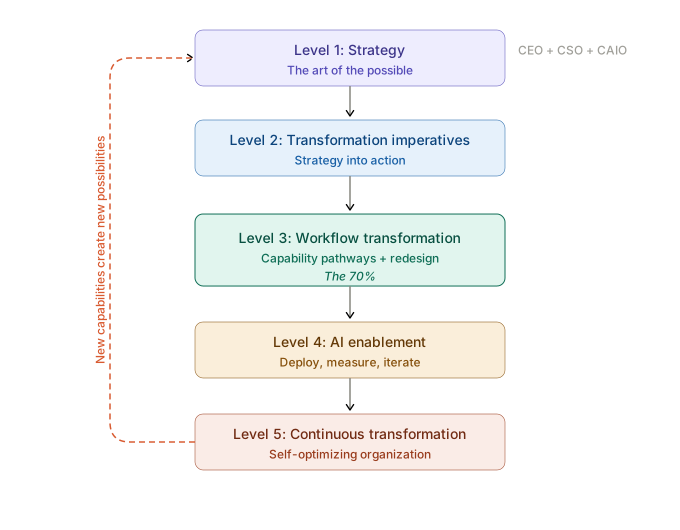
This article is part of a 27-article series on the AI Business Transformation Methodology. This piece focuses on the CSO’s role at Levels 1 and 2.
You are watching the most consequential shift in competitive dynamics in your career unfold. AI is reshaping how competitors operate, how customers evaluate value, how new entrants disrupt established markets, and how the very definition of strategic advantage is evolving. This is your territory. This is what the Chief Strategy Officer’s function exists to navigate.
And yet, in most organizations, you are not at the table where the AI decisions are being made.
The AI budget is growing. The Chief AI Officer is presenting to the board. The CEO is making resource allocation decisions about AI investments. And you are managing special projects, running the traditional strategic planning cycle, and wondering how AI fits into frameworks that were built for a different competitive reality.
This is not a reflection of your value. It is a reflection of how your organization has framed AI: as a technology initiative rather than a business strategy issue. That framing is wrong. It is costing your organization the strategic rigor that this moment demands. And it is sidelining the one leader whose entire function is to ensure that competitive decisions are made with strategic discipline.
Why are Chief Strategy Officers being sidelined in AI transformation?
Chief Strategy Officers are being structurally displaced because most organizations frame AI as a technology initiative rather than a business strategy issue — a displacement driven by how the work is scoped, not by any failing of the CSO. Deloitte’s 2026 Global CSO Survey of global strategy leaders quantifies what many CSOs are experiencing but few are naming publicly.1
According to Deloitte, 95% of CSOs expect competitive dynamics and AI-driven disruption to materially reshape their strategic priorities. Yet only 28% currently co-lead enterprise AI-related decisions. Only 35% co-lead or fully own decision-making for their organization’s top priorities. And only 16% say their organizations are using AI to fundamentally reimagine lines of business or create new sources of competitive advantage.1
The survey found that CSO time is disproportionately consumed by process management and special projects rather than the market sensing, competitive analysis, and partnership development that represent the CSO’s highest-value contribution. More than half report managing too many priorities with too little time, often stretched across multiple strategic initiatives simultaneously.1
The reason this is happening is structural. When organizations frame AI as a technology initiative, the strategic conversation becomes a technology conversation. The discussion happens between the CEO, CIO, and CAIO: technology leaders making technology decisions. The CSO, the person whose entire function is strategic framing, has no obvious seat at a technology table. The displacement is not about the CSO’s competence. It is about the organization’s framing of the problem.
What does the CSO uniquely bring to AI transformation?
The CSO brings three contributions that no other C-suite leader can provide: rigorous competitive positioning, disciplined portfolio prioritization, and the enterprise-wide strategic coherence that ties AI investments to where the business is actually going. Without them, the organization’s AI investments are strategically undisciplined.
The competitive filter. The CAIO can show dozens of AI capabilities that are technically possible. The CEO can set ambitious goals. But neither of them can determine which capabilities address a real competitive need, open a genuine market opportunity, or defend against an emerging threat. That judgment requires deep competitive intelligence, market analysis, and strategic pattern recognition that the CSO’s function is specifically built to provide. According to BCG, 60% of organizations generate no material value from their AI investments despite significant spending, largely because investment is spread across too many initiatives without strategic discipline. The filter that separates what is achievable from what is worth achieving is the CSO’s unique contribution. Without it, the organization chases every technically impressive AI capability. With it, the organization focuses its transformation investment on the capabilities that produce strategic differentiation.2
Strategic framing rigor. AI creates an overwhelming number of possibilities. Without strategic framing, those possibilities become a scattered portfolio of experiments. The CSO brings the discipline of strategic frameworks: where do we compete, how do we win, what capabilities create sustainable advantage. As MIT Sloan Management Review argued in “Why AI Will Not Provide Sustainable Competitive Advantage,“ once AI becomes ubiquitous it will transform economies and lift markets as a whole, but it will not uniquely benefit any single company. The technology itself is being commoditized. The strategic decisions about how to deploy it are not. Those decisions require exactly the kind of rigorous competitive framing that the CSO provides.3
Competitive landscape intelligence. The CSO monitors competitors, market shifts, emerging threats, and partnership opportunities. In the age of AI, this intelligence is changing faster than at any point in modern business history. Competitors are making strategic moves enabled by AI that were not possible two years ago. New entrants are using AI to reshape value chains. Customer expectations are shifting as AI-enabled experiences become the standard in adjacent industries. The CSO’s competitive intelligence function is the organization’s early warning system for threats and opportunities that AI creates. Disconnecting that function from AI-related strategic decisions is like navigating through the most turbulent competitive environment in a generation without the instruments designed to read it.
Does AI make the CSO more or less relevant?
AI amplifies the CSO’s relevance rather than diminishing it — the displacement narrative misses this entirely. As AI accelerates the pace at which competitive landscapes shift, the strategic discipline the CSO provides becomes more valuable, not less.
The reason is counterintuitive but well-supported by the research. As AI models become commoditized and accessible to every competitor, the technology itself stops being a differentiator. Harvard Business Review made this case directly in “When Every Company Can Use the Same AI Models, Context Becomes a Competitive Advantage,“ arguing that when everyone has the same tools, the differentiator becomes organizational context: the workflows teams actually follow, the signals they respond to, the judgment calls that repeat across real work. The CSO is the leader best positioned to understand that context at a strategic level and to determine which elements of it create defensible competitive advantage.4
McKinsey’s research on how AI is transforming strategy development reaches the same conclusion from a practitioner perspective. AI can augment insight generation, reduce bias in strategic analysis, and simulate scenarios. But AI models cannot generate new proprietary signals. The strategic insights that come from deep competitive intelligence, customer relationships, and pattern recognition across markets are uniquely human contributions, and they will become even more critical as external data grows more affordable and accessible to every competitor. When researchers recently asked large language models for strategic advice, they got generic, undifferentiated recommendations that any competitor could receive from the same models. AI expands strategic options. Making choices among those options requires the competitive context, industry judgment, and strategic pattern recognition that the CSO provides.5
This means AI is a powerful tool for the CSO’s function, not a replacement for it. A CSO with AI fluency can run competitive analysis faster, deeper, and across more dimensions than ever before. They can model strategic scenarios with more sophistication. They can identify competitive threats and market opportunities earlier. The CSO who embraces AI as a tool for their own function becomes the most strategically valuable version of the role that has ever existed.
What does the CSO need to learn about AI?
The CSO needs to develop enough AI fluency to operate effectively in the Level 1 partnership — the same way Article 5 in this series addressed what the CAIO needs to learn (business language from the CEO and CSO). According to BCG, approximately 90% of CEOs believe that by 2028, AI will redefine what success looks like within their industry. The strategic frameworks that governed competitive analysis before AI will not be adequate for the competitive landscape that is forming now.6
This does not mean becoming a technologist. It means developing enough understanding to do three things well.
First, understand what underlies the CAIO’s capability assessments. When the CAIO says “we can build a predictive supply chain intelligence capability,“ the CSO benefits from understanding not just what that means as a business outcome but what the underlying AI technology actually does and what makes it possible. This is not about challenging the CAIO’s expertise. It is about developing enough depth that the CSO can think about durability of competitive advantage, potential for competitor replication, and adjacent strategic possibilities that a surface-level understanding would miss. The CSO who understands what the technology does, not just what it produces, becomes a significantly more effective strategic partner.
Second, integrate AI’s implications into strategic frameworks. Traditional competitive analysis frameworks (Porter’s Five Forces, value chain analysis, competitive positioning maps) need to be updated for a world where AI capabilities can shift competitive dynamics rapidly. The CSO who can run a competitive analysis that accounts for AI-enabled disruption produces fundamentally better strategic guidance than one who analyzes the competitive landscape through pre-AI frameworks.
Third, recognize when AI creates a strategic inflection point. Not every AI advancement matters strategically. But some create genuine inflection points: moments where a new capability changes the competitive calculus in a way that requires a strategic response. When a competitor deploys AI that compresses a process from two weeks to two hours, for example, customer expectations in that market permanently shift, and every other company’s value proposition has to be reevaluated. The CSO who can distinguish that kind of inflection from routine technical improvement (with the CAIO’s help) becomes the organization’s most important strategic sensor.
How can the CSO reclaim a strategic role in AI transformation?
The CSO reclaims the strategic seat by reframing AI from a technology initiative into a business strategy issue and inserting strategic discipline into how AI investments are prioritized. Understanding why the CSO matters is necessary but not sufficient — the CSO needs a practical approach to reclaiming the role that this moment requires.
Reframe AI as a strategy issue. Every conversation the CSO has with the CEO, the board, and the leadership team should reinforce this framing. AI is not an IT project. It is the most consequential competitive shift in a generation, and the strategic response to a competitive shift is the CSO’s core mandate. BCG’s research found that when transformations fail, execution is typically not the reason. Rather, it is a lack of alignment, and success hinges on tight coordination among strategic leaders. The CSO is the strategic alignment leader. Make that case explicitly.7
Claim the Level 1 seat. Using the methodology from this article series, make the case to the CEO for the three-way strategic partnership described in Article 3. McKinsey’s research found that AI high performers are three times more likely than their peers to have senior leaders who demonstrate ownership of and commitment to AI initiatives.8 The CSO’s argument: you need my competitive intelligence and strategic framing to ensure AI investments are directed at the capabilities that produce strategic differentiation rather than scattered across technically impressive but strategically marginal experiments. HBR’s research from Harvard Business School’s Digital Data Design Institute supports this, finding that successful AI adoption comes from distributed leadership where builders, operators, and strategists collaborate across functions. The CSO is the strategist in that model.9
Bring competitive intelligence that connects AI to strategy. Do not wait for an invitation. Bring the CEO a competitive analysis that specifically addresses how AI is reshaping the competitive landscape. Which competitors are making AI-enabled strategic moves? Where are new entrants using AI to disrupt the value chain? What customer expectations are shifting because of AI-enabled experiences from other industries? This is also an opportunity to challenge yourself: explore whether AI tools can help you produce this competitive analysis faster, deeper, or across more dimensions than your traditional methods allow. This kind of analysis demonstrates the CSO’s value in a way that makes the Level 1 seat self-evident.
Build personal AI fluency. Invest in developing enough AI understanding to be an effective partner in the Level 1 conversation. The CSO who can engage substantively with the CAIO about what is achievable and what is not, what is durable competitive advantage and what is easily replicated, earns credibility that makes the partnership productive. This is not a weekend course. It is an ongoing development commitment, and the CAIO’s team should be a resource for it.
Own the portfolio at Level 2. As described in Article 4, the Business Transformation Imperatives portfolio is a natural extension of the CSO’s strategic planning function. Offer to manage the portfolio as part of the existing strategic planning cadence, with the CEO providing resource authority and the CAIO providing capability feasibility assessment. This positions the CSO at the center of the transformation’s ongoing governance, not as an occasional contributor.
The Moment That Defines the Role’s Future
The CSO role is at an inflection point, and how the organization frames AI determines which future the role gets. In organizations that frame AI as a technology initiative, the CSO will continue to be marginalized: managing special projects while the CAIO and CIO make the strategic decisions that reshape the business. In organizations that frame AI as a business strategy issue, the CSO becomes one of the three most important leaders in the enterprise transformation.
Deloitte’s research suggests that momentum is building toward the second path. CSOs are increasingly expected to embed AI in core strategy and to help their organizations make decisions with speed and clarity. But the shift will not happen by default. It requires the CSO to actively reframe the conversation, demonstrate the value of strategic rigor applied to AI decisions, and claim the seat that this moment requires.10
MIT Sloan Management Review’s most widely read AI article of 2025, “Philosophy Eats AI,“ posed the question of whether leaders are making AI decisions that reflect their organization’s strategic philosophies, or simply defaulting to the philosophies built into the AI tools they are using. The CSO is the person who ensures the organization’s own strategic philosophy governs its AI decisions, not the other way around.11
This is not a moment to wait for an invitation. It is a moment to lead.
Sources
- 1.Deloitte, “2026 Chief Strategy Officer Survey,“ February 2026. 95% expect reshaping; 28% co-lead AI decisions; 35% co-lead top priorities; 16% using AI to reimagine; CSO time consumed by process management https://www.deloitte.com/us/en/about/press-room/deloitte-2026-chief-strategy-officer-survey.html
- 2.BCG, “The Widening AI Value Gap,“ September 2025 (1,250+ firms). 60% generate no material value from AI https://www.bcg.com/publications/2025/are-you-generating-value-from-ai-the-widening-gap
- 3.David Wingate, Barclay L. Burns, and Jay B. Barney, “Why AI Will Not Provide Sustainable Competitive Advantage,“ MIT Sloan Management Review, May 2025 https://sloanreview.mit.edu/article/why-ai-will-not-provide-sustainable-competitive-advantage/
- 4.Rohan Narayana Murty and Ravi Kumar S, “When Every Company Can Use the Same AI Models, Context Becomes a Competitive Advantage,“ Harvard Business Review, February 2026 https://hbr.org/2026/02/when-every-company-can-use-the-same-ai-models-context-becomes-a-competitive-advantage
- 5.Alexander D’Amico, Bruce Delteil, and Eric Hazan, “How AI Is Transforming Strategy Development,“ McKinsey, February 2025 https://www.mckinsey.com/capabilities/strategy-and-corporate-finance/our-insights/how-ai-is-transforming-strategy-development
- 6.BCG, “AI Radar 2026: As AI Investments Surge, CEOs Take the Lead,“ January 2026 (2,360 executives). ~90% of CEOs believe AI will redefine industry success by 2028 https://www.bcg.com/publications/2026/as-ai-investments-surge-ceos-take-the-lead
- 7.BCG, research on transformation alignment. When transformations fail, lack of strategic alignment is the primary cause, not execution.
- 8.McKinsey, “The State of AI in 2025,“ November 2025. AI high performers 3x more likely to have committed senior leadership https://www.mckinsey.com/capabilities/quantumblack/our-insights/the-state-of-ai
- 9.John Winsor and Jen Stave, “Your AI Strategy Needs More Than a Single Leader,“ Harvard Business Review, August 2025. Distributed leadership: builders, operators, strategists https://hbr.org/2025/08/your-ai-strategy-needs-more-than-a-single-leader
- 10.Deloitte, CSO research, 2026. CSOs increasingly expected to embed AI in core strategy and help organizations make decisions with speed and clarity.
- 11.David Kiron and Michael Schrage, “Philosophy Eats AI,“ MIT Sloan Management Review, January 2025. Most widely read AI article of 2025 https://sloanreview.mit.edu/article/the-top-10-mit-smr-articles-of-2025/
Frequently Asked Questions
I am a CSO who is already involved in AI decisions. What does this methodology add?
If you are already at the table, the methodology gives you a structured role within a defined architecture. Rather than participating in AI discussions as a general strategic advisor, you have a specific mandate: co-create strategy at Level 1, ensure Business Transformation Imperatives are competitively grounded at Level 2, and manage the portfolio that governs the transformation. The methodology turns general participation into defined accountability with clear deliverables.
How do I build AI fluency without becoming a technologist?
Focus on strategic fluency, not technical depth. You need to understand what AI capabilities exist and what they mean for competitive dynamics, not how the underlying models work. The CAIO’s team should be your primary resource for this. Ask for regular briefings focused on capability implications rather than technical architecture. Read HBR and MIT Sloan Management Review coverage of AI strategy (which is written for business leaders, not technologists). Attend industry conferences where AI-enabled competitive moves are discussed in business terms. The goal is to be a credible partner to the CAIO, not to compete with their technical expertise.
What if our CEO does not see AI as a strategy issue?
This is the most common barrier, and it is the CSO’s job to change it. Bring the CEO a competitive analysis that shows how AI is reshaping your specific industry’s competitive landscape: which competitors are making AI-enabled moves, where new entrants are emerging, what customer expectations are shifting. Make the case concrete and specific to your business. The abstract argument (“AI is strategic“) is less persuasive than the specific one (“our top competitor just announced an AI-enabled capability that directly threatens our market position in segment X“).
How does the CSO’s role relate to the CAIO’s at Level 1?
They are complementary, not competitive. The CAIO brings an understanding of what AI makes possible. The CSO brings an understanding of what is strategically valuable given the competitive landscape. The CEO synthesizes both perspectives and makes resource commitments. Neither the CAIO nor the CSO can do each other’s job. The CAIO without the CSO risks building impressive AI capabilities that miss the strategic target. The CSO without the CAIO risks building strategy on assumptions about what is achievable that are either too conservative or too optimistic. The partnership produces better outcomes than either perspective alone.
Should the CSO own the AI transformation?
No. The transformation is collectively owned by the Level 1 triad: CEO, CSO, and CAIO. But the CSO should own the strategic governance of the transformation: ensuring that the portfolio of Business Transformation Imperatives remains aligned with competitive strategy, that new competitive developments are reflected in portfolio priorities, and that the transformation as a whole is producing strategic differentiation rather than incremental efficiency. This is the CSO’s natural mandate, and claiming it positions the role at the center of the transformation without overstepping into the CAIO’s or CEO’s territory.
This series addresses “what” to do, not “how” to do it. If you are a business executive and would like help thinking through the “how,” please feel comfortable reaching out.

About the author
Shawn Plaster
Founder & CEO, Plaster Group
Shawn is the author of Plaster Group's five-level AI Business Transformation Methodology and its 27-article Insights series, and leads the firm's enterprise AI transformation work.
Previous: Article 5: The CAIO’s Real Job · Next: Article 7: AI Governance
© 2026 Plaster Group, LLC. All rights reserved. This article may not be reproduced, distributed, or transmitted in any form without prior written permission from Plaster Group. Brief excerpts may be quoted for review or commentary purposes with attribution to the author and a link to the original article.
Ready to move forward?
Let's discuss how your organization can build with AI — securely, strategically, and starting from where you are today.
Start a Conversation