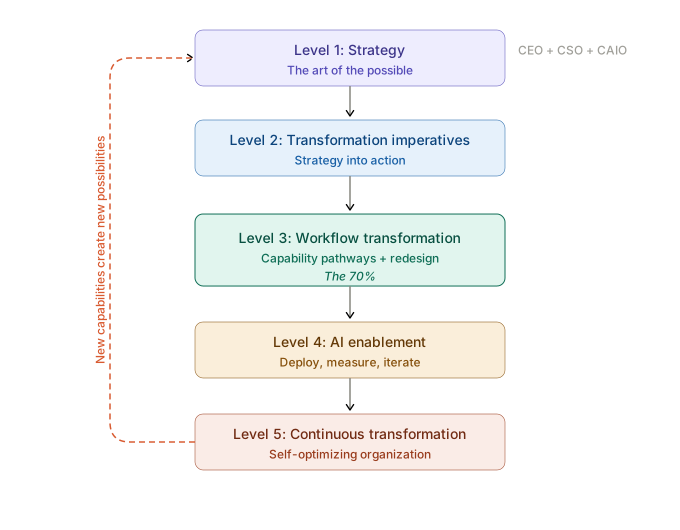
This article is part of a 27-article series on the AI Business Transformation Methodology. This piece addresses the third leg of change management — the training function that activates at Level 4 to build role-specific competence for people operating in workflows that have been fundamentally redesigned around AI.
The workflow redesigns are complete. The job redesigns have produced specific role definitions for every person in the supply chain planning organization, what the evolved role does, what judgment it applies, what the human contribution looks like when AI generates the demand forecasts the team used to build manually. The technology has been selected and is being configured. Go-live is six weeks away.
Someone on the domain owner’s team asks: what about training? The head of learning and development pulls up the standard playbook that served the organization well through previous enterprise transformations. A structured session on how to use the new forecasting platform. Job aids showing how to navigate the screens. A refresher on the updated approval workflow. It worked before. People learned the system and did their jobs.
This will not work. Not because the L&D team is inadequate, they are good at what they do, but because what they are about to build is not the same kind of thing they have built before. The role itself has changed. The senior planner is no longer building the forecast and defending it in the monthly S&OP meeting. The AI is generating forecasts continuously, accounting for patterns across thousands of SKUs, dozens of regions, and hundreds of supplier relationships at a depth no human can match. The planner’s job is now to apply contextual judgment the model cannot see, a supplier’s early warning signs, a competitor’s product launch, a port disruption, a shift in consumer sentiment the historical data has not yet captured, and to decide when to accept the AI’s forecast, when to adjust it, and when to escalate.
That is different work, with different judgment, in collaboration with a probabilistic system that behaves differently every time. The training has to teach what the evolved role requires, not how to operate a tool. This is the training leg of the change management stool, rebuilt for AI business transformation.
How does AI training differ from the education cascade in this series?
The training this article addresses is role-specific competence building for people operating in redesigned workflows — a different function from the education cascade covered in Article 11, which built broad AI fluency across the organization. The distinction matters enough to establish before the rest of the argument builds, because the two are often conflated and each fails when substituted for the other.
The education cascade described in Article 11 is owned by the CAIO’s department. Its audience is the people who will design the transformation: domain owners, VPs, directors, senior managers, managers, and the business process analysts who do the actual workflow redesign work. Its purpose is to build AI fluency deep enough that these people can design workflows that genuinely reflect what AI makes possible, rather than producing incremental improvements constrained by their existing mental models. It happens during Phase 3B, before workflow redesign begins. It is deliberately technology-agnostic, because the goal is capability understanding, not tool training.
The training workstream this article addresses is a different function entirely. Its owner is the change management team. Its audience is every person whose role was changed through workflow redesign and job redesign, the employees who will operate within the transformed workflows once the organization goes live. Its purpose is to build role-specific competence for the evolved role each person now holds. It activates at Level 4, after the technology has been selected and configured and after Article 15’s job redesign has produced defined role specifications. It is deliberately technology-specific, because people need to know how to do their evolved jobs in the actual systems they will use.
Both are essential. Both are training in some broad sense. But they serve different audiences at different stages with different content for different purposes, delivered by different organizational functions. Organizations that conflate them fail in two directions. When the education cascade is skipped or shortchanged, transformation participants enter the design work without the AI fluency to design ambitiously, and the workflows they produce underuse what AI makes possible. When the change management training workstream is skipped or shortchanged, affected employees enter their evolved roles without the competence to operate effectively in them, and adoption stalls regardless of how well-designed the workflows are. The remainder of this article is about the second of those functions.
Why doesn’t traditional transformation training work for AI?
Traditional transformation training does not translate to AI because it assumes the system being taught is stable, knowable, and procedural — and AI is none of those things. Every enterprise learning and development leader has built training for major enterprise transformations. ERP implementations. Digital platform migrations. Shared services consolidations. CRM rollouts. The pattern across these programs was consistent enough that the training playbook became reliable: a blended curriculum centered on how the new system worked, the new process it enabled, and the specific tasks each role would perform differently after go-live. Cohorts learned together. Practice environments let people get comfortable before they were accountable for real outputs. Job aids captured the procedural knowledge. Assessments confirmed competence. It worked because the system being trained was stable, knowable, and procedural.
AI business transformation breaks the assumptions that made that playbook work. Five differences matter for how the training function must be rebuilt.
First, the underlying system behaves fundamentally differently. Traditional transformation training taught procedures for deterministic systems. Same inputs, same outputs. The trainee could learn to predict the system’s behavior and execute the defined process with confidence. AI systems are probabilistic. They produce different outputs in similar situations because they identify contextual differences the human did not explicitly specify. The trainee cannot memorize a procedure and expect it to cover every case, because there is no single correct procedure. The training has to teach judgment alongside procedure, the ability to evaluate AI outputs, recognize when to trust them, recognize when to question them, and exercise human judgment in the specific contexts the workflow design calls for.
Second, the job itself has changed. In traditional transformations, the task composition of the role usually stayed recognizable. The employee did the same type of cognitive work in a new system with new screens. The skills changed, but the fundamental nature of the work did not. AI is changing what the work actually is. Article 15 documented the three categories of role evolution: augmented roles where the title stays the same but the work is fundamentally different (the supply chain planner who used to build forecasts and now applies judgment to AI-generated ones), consolidated roles where multiple legacy positions merge into broader roles, and emergent roles that did not exist before. Training for the evolved role is not training for the old role with new tools. It is training for a different role. And the pattern reaches technical roles as well: McKinsey’s May 2026 research on software delivery in the agentic era documents top engineering organizations replacing two-week sprint cycles with daily cycles that blend human judgment with overnight agent execution, which means engineering roles are being redesigned around AI just as business roles are.1
Third, the workforce is entering this training with a different kind of anxiety than previous transformations produced. Article 8 documented how AI transformation introduces existential concerns about professional relevance rather than routine change resistance. BCG’s AI at Work 2025 survey of more than 10,000 employees found that workers at organizations undergoing comprehensive AI-driven redesign are more worried about job security (46%) than those at less-advanced companies (34%).2 Training is not just skill-building in this environment. It is one of the most important signals about whether the organization is investing in people. How the training is built, how it is resourced, and how it is delivered carries meaning beyond its curriculum content.
Fourth, there is no stable end state. Traditional transformation training could be built once and revised during version upgrades, with the training program essentially stable between upgrade cycles. AI capabilities evolve continuously. When the AI Technology Strategists described in Article 5 identify a significant new capability and cross-reference it against tagged workflow designs, affected roles can change, sometimes substantially, through the reengagement trigger mechanism described in Article 15. Training must reengage in parallel. A training program designed as a one-time event and never refreshed will be actively misleading people about their evolved role within a year of go-live.
Fifth, the scale of the training gap is already visible in the research, and the data is sobering. Deloitte’s State of AI in the Enterprise 2026 survey of 3,235 leaders across 24 countries found that worker access to AI grew 50% in one year, from fewer than 40% to around 60% of workers equipped with sanctioned AI tools. But fewer than 60% of workers with access actually use AI in their daily workflow, unchanged from the prior year.3 Access without competence does not produce adoption. Accenture’s Learning, Reinvented research, based on 14,000 workers and 1,100 executives across 20 industries, found that only 26% of workers have been trained to collaborate effectively with AI, and only 35% are satisfied with the AI tools they have been given.4 These are not training programs that have been tried and failed at the margins. For most of the workforce, they have not been built at all. And the stakes of the gap are documented: Stanford’s Digital Economy Lab study of 51 successful enterprise deployments found that 77% of the toughest implementation challenges were intangible, change management, data quality, and process redesign, while the technology itself was consistently the easiest part.5
The training leg of change management was always important. What is different now is that the conventional playbook will not produce the outcome the transformation requires, and there is no credible evidence yet that most organizations have recognized this and started rebuilding.
When does role-specific training activate, and what does it depend on?
Role-specific training activates at Level 4, but its effectiveness depends on a chain of upstream deliverables that must already be in place. Understanding that chain clarifies why training cannot be shortcut, front-loaded, or bolted on late.
The training function depends on Article 18’s technology selection. You cannot design training for systems that have not been selected. Vendor-specific job aids, system-specific practice environments, and the actual hands-on exposure that lets people build confidence all require the real technology, not a placeholder.
The training function depends on Article 19’s integration architecture and Article 20’s deployment work. Training has to reflect how the systems actually connect, what data flows where, and how the deployed environment behaves, not how the technology works in isolation. A training program built against vendor documentation but disconnected from the organization’s actual integrated environment will teach people a workflow that does not match what they encounter at go-live.
The training function depends on Article 15’s job redesign output. Without defined evolved roles, training has no target. Generic AI fluency content cannot substitute for role-specific competence-building because it does not connect to the specific judgment calls, handoffs, and accountabilities that define each person’s evolved position.
The training function depends on Article 12’s workflow designs. The designs specify, at each step, who or what performs the work, what triggers human intervention, what quality checks are built in, and what data flows between steps. Training content has to reflect these specifications precisely, because they are what the trainee will encounter in production.
The training function depends on Article 7’s governance classifications. The risk classifications and human oversight requirements attached to each AI-enabled workflow step become part of the training itself. The trainee needs to understand not just how to do the work but what they are accountable for, what decisions they must make versus what the AI can make autonomously, when to escalate, and what the audit trail requires.
The training function depends, finally, on Article 8’s communications workstream having run well enough that the workforce arrives at training ready to learn rather than resistant, anxious, or disengaged. People who have been fed rumors and speculation for months because communications was underbuilt do not absorb role-specific training effectively, no matter how well the training is designed.
The change management training function is the integrator of all of these inputs into role-specific competence-building. It does not generate the role definitions, or the governance classifications, or the workflow designs. It takes them as specifications and builds the competence development that operationalizes them. When any of the upstream inputs is weak or missing, training pays the price.
What must role-specific training accomplish?
Role-specific training has to build four things, each addressing a specific failure mode that has shown up in the research.
1. Competence for the evolved role, not the old role. The first and most fundamental requirement is that the training is designed against the role definitions from Article 15, not against the role that existed before the transformation. This sounds obvious. It is not.
Deloitte’s State of AI 2026 research found that 84% of organizations have not redesigned jobs to fit AI, and that the most common talent adjustment organizations are making (cited by 53% of respondents) is “educating the broader workforce to raise overall AI fluency,” with only 33% redesigning career paths and only 30% reimagining organizations.3 When generic AI fluency education is positioned as the primary talent adjustment, the training is by definition not aligned to the evolved roles, because the evolved roles have not been defined.
For the supply chain planner whose role has evolved from model-building to judgment-applying, the training builds capability in the judgment work: how to evaluate an AI-generated forecast, what contextual factors the model cannot see, what signals to look for that suggest an anomaly deserves escalation rather than acceptance, how to incorporate supplier intelligence, competitive dynamics, and market signals into the override decision. It does not spend most of its time on the forecasting platform’s user interface, because navigating the interface is no longer where most of the planner’s value comes from.
For the accounts payable specialist whose role has evolved from manual matching to vendor relationship analysis and exception investigation, the training builds capability in the analytical and investigative work: what vendor payment patterns signal, how to investigate an AI-flagged exception, when to push back on an AI recommendation, when to engage procurement about a vendor relationship problem the AI surfaced. It does not focus primarily on the matching tool’s screens.
For the customer service representative whose role has evolved from scripted response to complex case handling, the training builds capability in the judgment-intensive work the AI now routes to them: handling the emotionally sensitive cases, the genuinely ambiguous ones, the ones where the customer’s real need is different from the request they submitted. It does not spend most of its time on how to use the new support platform.
The test for whether training is aligned to the evolved role is straightforward: look at the curriculum and ask what percentage of it is teaching judgment in the specific contexts the new role requires versus what percentage is teaching tool operation. If the ratio is inverted, the training is designed against the old role.
2. Judgment taught alongside procedure. The second requirement is that the training teaches judgment, not just procedure, and it teaches judgment in ways that actually develop it rather than merely describing it.
Judgment is developed through practice on realistic scenarios with timely feedback. It is not developed by reading a policy document or sitting through a presentation. Deloitte’s research on public sector AI adoption describes the pattern clearly: public agencies that have successfully built AI-era competence use simulations, structured practice, and scenario-based learning to develop the decision-making capability their workers need.6 The US Department of Veterans Affairs uses AI-powered simulations to strengthen crisis responders’ empathy and intervention skills in realistic scenarios. Montgomery County, Maryland deploys AI as a practice partner that prompts teams to rehearse complex situations before they occur. These are not theoretical examples. They are operational training programs running today, and they work because they create the conditions for judgment to develop through practice rather than through instruction.
The judgment the training has to develop includes several distinct competencies. Recognizing when an AI output is reliable and when it is not. Understanding the specific failure modes of the AI the trainee will actually be working with, because generic AI literacy does not transfer to the specific edge cases their system produces. Knowing when to override and when to escalate. Understanding what contextual information the AI did not have and should be applied to the decision. Developing the pattern recognition to notice when something is off, even when the AI’s output looks reasonable on its face.
All of this is harder to teach than procedural knowledge. It is also what determines whether the workforce can actually operate the redesigned workflows. Organizations that skip this and stay on procedural training produce employees who either defer to the AI too much (because they do not trust their own judgment) or override the AI too much (because they do not trust the AI), and both patterns degrade the workflow’s intended performance. The trust environment this training operates in is also shifting under the workforce’s feet: Capgemini found that trust in fully autonomous AI agents fell from 43% to 27% in a single year, even as agent use in operations doubled.7 The goal is calibrated trust, not blanket confidence. MIT Sloan Management Review’s research on managing agentic AI at scale gives supervisors the same frame from the other side: oversupervision negates the benefits of autonomy, while undersupervision creates operational and compliance risk.8
3. Governance and guardrails embedded in the content. The third requirement is that governance is part of the training, not a separate compliance session. The classifications and oversight requirements from Article 7 are not a checklist of rules for the employee to memorize. They are the structure of accountability the employee operates within, and the training has to make that structure concrete and operational.
Accenture’s Learning, Reinvented research documented that 53% of workers still do not know who is accountable when AI errors occur.4 This is a governance content failure embedded in a training failure. The training did not teach them what they are accountable for, what decisions they must make versus what the AI can make autonomously, what happens when the AI is wrong, who has the authority to override, or what escalation paths exist when they are not sure. In the absence of that clarity, employees either freeze (refusing to act without explicit instruction) or improvise (taking actions they are not actually authorized to take). Neither produces the outcome the workflow design intended.
Embedding governance in the training means, operationally, that the training content includes for each evolved role: the decision rights the role holds, the specific decisions that remain human-only versus augmented by AI versus autonomous-with-oversight, the escalation paths when the AI produces output the employee questions, the audit trail expectations for each decision, and the review cadence their work will be subject to. These are not separate topics taught in a separate session. They are woven through the role-specific training content so that when the employee is learning how to handle an AI-flagged exception, they are simultaneously learning what they are accountable for, when to escalate, and how to document the decision.
The practical benefit is that governance stops being a set of rules the organization tells employees to follow and becomes a structure the employees actually use because they understand why it exists and what it accomplishes.
4. Continuous capability evolution. The fourth requirement is that the training is designed from the outset to evolve, because the capabilities it is training people on will evolve whether the training program is ready or not.
BCG’s research on effective AI upskilling at scale identified three elements that distinguish programs that actually shift behavior from programs that do not: learning embedded in daily work (so capability-building is part of how the job gets done, not a separate activity), design grounded in behavioral science (so leaders model the change, employees understand the why, and early wins reinforce engagement), and robust tracking (so the organization measures whether the upskilling actually produces outcomes, not just whether people completed the training).9 BCG’s data on persona-based learning journeys tailored to specific roles showed AI adoption at a level 20 times higher than broad-based approaches. The implication for continuous evolution is that the training architecture has to support these elements at a level of specificity that generic training cannot maintain as capabilities change.
The reengagement mechanism from Article 15 is the operational trigger. When the AI Technology Strategists identify a significant new capability that affects tagged workflow steps, they cross-reference it against the role definitions for those steps, which triggers updates to the affected roles. Training content for those roles updates in parallel. Because the training is persona-based and tied to specific workflow steps through the role definitions, the updates can be targeted rather than requiring wholesale program redesign.
This only works if the training architecture was built with continuous evolution in mind from the beginning. Training programs designed as one-time events, with content locked after initial development, cannot absorb continuous capability change. Programs designed with modular content, embedded in workflow-specific practice environments, and tied to the role definitions rather than to a specific version of the technology, can.
How is the training built?
The change management training function delivers on its four requirements through a blended model, described here at a high level. The depth of operational detail an L&D or change management practitioner would need to actually build the program is beyond this article’s scope. What follows is what the domain owner and the change management function (wherever it sits in your organization) need to understand about the structural shape of the training function they are chartering.
Effective AI-era training for evolved roles uses a blended model that layers multiple modalities reinforcing each other. The research consistently documents that no single delivery mode produces the outcomes the evolved roles require.
Structured, facilitator-led training remains the most effective starting point for role-specific competence-building, particularly when the transformation affects many employees moving into the same evolved role. Cohort-based delivery is how the organization efficiently brings a group to a shared understanding of the new role’s expectations, the governance framework they operate within, and the initial hands-on experience with the selected technology. BCG’s research on AI skills development is explicit on this point: workshops “lay important groundwork,” and the real transformation happens when employees then apply new skills to their actual work with coaching support.10 The failure mode the research identifies is not structured training itself. It is training that ends after the structured session and never reinforces or refreshes.
Hands-on practice environments let people build judgment in realistic scenarios before they are accountable for real outputs. Simulations, sandboxes, guided practice with the actual AI system using representative but non-live data, and structured shadowing of experienced operators are the mechanisms. The practice environments referenced here are the same Training environment the CIO's organization establishes as Environment 5 of the seven-environment topology described in Article 20; the change management training program and the CIO's build-and-test work share the physical environment, with each function exercising it for its own purpose.
This layer matters because judgment does not develop from exposure to content; it develops from applying judgment and getting feedback. The public sector examples Deloitte documented (crisis responder simulations, practice-partner rehearsals) work precisely because they create the conditions for judgment to develop through repeated practice on realistic scenarios.6
Embedded reinforcement in daily work is what keeps the capability alive after the structured foundation is in place. AI-powered coaching delivered at the point of need, job aids that surface when the employee is actually facing the situation the aid addresses, peer networks that connect employees working through similar challenges, and manager support that reinforces the training’s expectations in daily supervision, these are the mechanisms. Accenture’s Learning, Reinvented research documented that one global cloud provider increased learning completion rates 20% by embedding AI-powered coaching directly into daily workflows, and that embedded learning in the flow of work is the common element across the organizations achieving effective human-AI collaboration.4
Continuous refreshment closes the loop. The reengagement mechanism from Article 15 is the trigger; the training architecture described above is what makes the refresh operationally feasible at reasonable cost.
Several design decisions follow from this blended model. Training design is persona-based, meaning each evolved role gets its own training content tailored to that role’s specific judgment, governance, and workflow requirements, not broad-based generic AI training. Different roles in the same department receive different training because their evolved roles are different. The CAIO’s AI-Business Translators remain partners, not owners, at this stage. Their role at Level 4 is to ensure training content accurately reflects AI capabilities and limitations for specific workflow steps, the same advisory function they played during design and deployment, now applied to training content review. And training measurement focuses on behavior change and outcomes in the role, not on completion rates or satisfaction scores. Completion is necessary but insufficient. The real question is whether trained employees are applying what they learned in their daily work and producing the outcomes the role requires.
None of this is radically new as change management methodology. What is new is applying it to roles whose work has been fundamentally reshaped, with governance and judgment dimensions that previous enterprise transformations did not require, in an environment where the capabilities being trained on continue to evolve after go-live.
What do the three legs of change management produce together?
Step back and look at what the three legs of change management produce together.
Communications, covered in Article 8, builds the awareness and desire that move the workforce through the early stages of Prosci’s ADKAR progression.11 It addresses the existential anxiety that AI transformation produces. It keeps the narrative grounded in the workforce investment premise from Article 1. It prepares people to engage with the transformation rather than resist it.
Organizational impact assessment and job redesign, covered in Article 15, defines what the evolved roles actually are. It does the analytical work of translating redesigned workflows into role specifications, skills requirements, and organizational structure changes. It identifies the three categories of role evolution and maps each affected employee to their evolved position. It navigates the most sensitive human dimension of the transformation.
Training, covered in this article, builds the knowledge and ability for those evolved roles, supported by reinforcement that keeps the capability current as AI capabilities evolve. It is the leg that translates the role specifications into actual human competence.
Together the three legs produce workforce readiness. Not just access to AI, which the Deloitte research shows most organizations have now achieved. Competent operation within redesigned work, which is what actually produces the business outcomes the transformation was chartered to deliver. The workforce premise from Article 1 is the thread that runs through all three legs: this transformation is investing in people, not eliminating them. The training leg is where that investment becomes operationally tangible. An organization that stands up a serious, role-specific, continuously refreshed training function for its affected workforce is signaling, with actions rather than words, that it intends to build the evolved workforce, not replace it. An organization that treats training as an afterthought, or defaults to the playbook that worked for previous transformations, is signaling something else, whether it intends to or not.
How does the training leg activate across the methodology?
The training leg activates across the levels of the methodology in a specific pattern.
At Level 2 and Level 3, the training leg is in planning mode. The change management team is engaged, the training practitioners are scoped into the program, and training strategy is drafted in parallel with job redesign output. The training team is an active participant in the cross-functional rhythm, but no training content can yet be built because the technology has not yet been selected and the evolved roles are still being defined.
At Level 4, training activation begins in earnest. Role definitions from Article 15 and technology specifications from Articles 18, 19, and 20 become the inputs. Role-specific competence-building programs are designed, built, and delivered as the technology is configured and deployed. Training runs in parallel with and continues past go-live, because the iteration cycle Article 17 described means the deployed AI behavior will produce adjustments that the training content must reflect.
At Level 5, training becomes part of the continuous transformation operating rhythm. The capability meta-layer tagging from Article 12 triggers targeted reassessment when AI capabilities evolve. Role definitions update through Article 15’s reengagement mechanism. Training content refreshes for affected roles accordingly. The training function is no longer a one-time program that ends; it is an operational capability the organization maintains indefinitely, because the workforce the organization is now building is one that continuously evolves alongside the technology it works with.
The thread across all of these levels is the same one that runs through every other article in this series. AI business transformation is not a technology implementation. It is a fundamental reshaping of how the organization creates value, and the people who will operate within that reshaped organization need to be built, not just accommodated. Training is how that building happens at the individual role level. Get it right, and the organization has the workforce its redesigned workflows require. Get it wrong, and the workflows remain theoretical.
Sources
- 1.McKinsey, “Rewiring Software Delivery for the Agentic Era,” May 28, 2026. Top firms shifting to a daily sprint model blending human judgment with overnight agent execution, replacing two-week sprint cycles https://www.mckinsey.com/capabilities/mckinsey-technology/our-insights/rewiring-software-delivery-for-the-agentic-era
- 2.BCG, “AI at Work 2025: Momentum Builds, But Gaps Remain,” June 2025 (10,635 employees, 11 countries). 46% job security concern at comprehensive AI-redesign companies vs 34% at less-advanced companies; 36% feel AI training is sufficient; 18% of regular AI users received no training at all https://www.bcg.com/publications/2025/ai-at-work-momentum-builds-but-gaps-remain
- 3.Deloitte, “State of AI in the Enterprise 2026,” January 2026 (3,235 leaders, 24 countries). Worker AI access grew 50% in one year to 60%; fewer than 60% with access use AI daily; 84% have not redesigned jobs to fit AI; 53% cite educating the workforce as primary talent adjustment; 33% redesigning career paths; 30% reimagining organizations https://www.deloitte.com/us/en/what-we-do/capabilities/applied-artificial-intelligence/content/state-of-ai-in-the-enterprise.html
- 4.Accenture, “Learning, Reinvented: Accelerating Human-AI Collaboration,” September 2025 (14,000 workers and 1,100 executives across 20 industries, 12 countries). 26% of workers trained to collaborate with AI; 35% satisfied with AI tools; 11% of organizations equipped for co-learning; 53% do not know who is accountable for AI errors; 20% higher learning completion rates from embedded AI coaching https://www.accenture.com/us-en/insights/consulting/learning-reinvented-accelerating-human-ai-collaboration
- 5.Stanford Digital Economy Lab, “The Enterprise AI Playbook: Lessons from 51 Successful Deployments,” March 2026 (Pereira, Graylin, Brynjolfsson). 77% of the toughest implementation challenges were intangible: change management, data quality, process redesign; the technology was consistently the easiest part https://digitaleconomy.stanford.edu/app/uploads/2026/03/EnterpriseAIPlaybook_PereiraGraylinBrynjolfsson.pdf
- 6.Deloitte, “Scaling the Public Sector’s Human Edge: Making Human-AI Collaboration Work,” 2026. AI fluency defined as understanding how systems work, when to rely on them, when to question them; VA crisis responder simulations; Montgomery County practice-partner model; Singapore 18,000 internal AI bots; decision rights by risk classification https://www.deloitte.com/us/en/insights/industry/government-public-sector-services/government-trends/2026/human-ai-collaboration-government-workforce.html
- 7.Capgemini, “AI Agents: Rise of Agentic AI” research, 2026. Trust in fully autonomous AI agents fell from 43% to 27% in one year; agent use in operations doubled from 10% in 2024 to 21% in 2025; agentic AI projects up 48% https://www.capgemini.com/insights/research-library/ai-agents/
- 8.MIT Sloan Management Review, “Agentic AI at Scale: Redefining Management for a Superhuman Workforce,” 2026. Oversupervision negates autonomy benefits; undersupervision creates operational and compliance risk https://sloanreview.mit.edu/article/agentic-ai-at-scale-redefining-management-for-a-superhuman-workforce/
- 9.BCG, “AI Transformation Is a Workforce Transformation,” February 2026. Three elements of effective upskilling: learning embedded in daily work, design grounded in behavioral science, robust tracking. Future-built companies 4x more likely to have structured AI learning with protected time https://www.bcg.com/publications/2026/ai-transformation-is-a-workforce-transformation
- 10.BCG, “Strategies to Tackle the AI Skills Gap,” January 2026. Workshops lay important groundwork; real transformation happens when employees apply new skills to actual work with coaching; persona-based learning journeys deliver AI adoption at 20x broad-based approach https://www.bcg.com/publications/2025/strategies-tackle-ai-skills-gap
- 11.Prosci, “ADKAR Model.” Awareness, Desire, Knowledge, Ability, Reinforcement. Training builds Knowledge and Ability https://www.prosci.com/blog/prosci-adkar-change-management
Frequently Asked Questions
We already have a learning and development function. Why do we need a separate change management training workstream for AI?
Your L&D function is a critical partner in this work, and most of the practitioners who build the AI-era training program will come from L&D or will be deeply integrated with it. The distinction is not organizational, it is about the kind of program being built. A traditional L&D team operating from the standard enterprise transformation playbook will build training that focuses on tool operation and procedural knowledge, because that is what produced successful outcomes in previous transformations. The change management training workstream for AI business transformation requires different content (judgment alongside procedure), different design principles (persona-based and role-specific rather than broad-based), different delivery architecture (blended model with embedded reinforcement, not one-time events), and different measurement (behavior change and role outcomes, not completion rates). The question is not whether to use your L&D team. It is whether the program your L&D team builds reflects the structural differences AI transformation introduces, or whether it applies the previous playbook to a situation where that playbook no longer produces the outcome.
How do we handle training when AI capabilities keep changing after we have deployed?
Build the training architecture with continuous evolution in mind from the beginning, rather than designing a one-time program and retrofitting updates when something changes. The capability meta-layer tagging from Article 12 is the mechanism that makes continuous training evolution operationally feasible. When the AI Technology Strategists in the CAIO’s department identify a significant new capability, they cross-reference it against the tagged workflow designs to determine which specific workflow steps are affected. Those tagged steps connect to specific evolved role definitions through the job redesign output from Article 15. The role definitions connect to specific training content through the persona-based design of the training program. The result is that when a capability changes, the updates to the training program are targeted rather than wholesale, and the training refresh cycle becomes a routine operational process rather than a major reengineering effort. This only works if the training architecture was designed for it from the start, which is why the choices made at Level 4 during initial training build matter for years after go-live.
What do we do for employees who struggle to develop the judgment the new role requires?
Apply the bar from Article 1, then exhaust reasonable development options before reaching conclusions about fit. Most employees can develop the judgment the evolved role requires, especially when the training provides adequate structured foundation, sufficient practice in realistic scenarios, and ongoing coaching in the flow of work. Struggling through initial training is normal; failing to develop the required competence after a fair development effort with proper support is different. When an employee is genuinely unable to develop the judgment the evolved role requires, even after substantial investment in their development, the organization has to make a decision. The principle from Article 1 applies: before attributing any headcount reduction to AI, the organization must have deployed the AI system in production at scale, redesigned the workflow, defined the evolved role, and made a serious good-faith effort at reskilling and redeployment. Exhaust the redeployment options, especially redeployment into the transformation effort itself (where operational experience in a redesigned workflow is valuable to other domains about to go through their own transformation), before concluding that a role reduction is warranted. If the organization has not done that work, it has not earned the basis for making that determination.
How should we measure whether the training is working?
Measure at three levels, with increasing weight at each level. Completion: are the intended employees completing the intended training within the intended timeline? This is necessary but tells you little about outcomes. Application: are trained employees actually using what they learned in their daily work? This requires observation and measurement in the operational environment, not self-report. Outcomes: are the role-specific business outcomes the evolved role was defined to produce actually being produced? This is the measurement that matters, and it is the one most organizations never get to because they stop at completion. The supply chain planner’s training worked if the planner is now making better override decisions on AI-generated forecasts, catching anomalies the model misses, and producing more accurate planning outcomes than the prior process produced. The accounts payable specialist’s training worked if the specialist is now surfacing vendor relationship insights that would not have emerged from manual matching, resolving exceptions faster and more accurately, and reducing the cycle time for problematic transactions. If completion is high but application and outcomes are low, the training program needs redesign, not more volume.
Should we use external training vendors for this?
External expertise can be valuable, but be deliberate about what you are outsourcing and what you are not. Vendor-provided training on a specific AI platform’s features and capabilities is appropriate and often the most efficient way to build that specific technical fluency. Role-specific training for your organization’s evolved roles is not something a vendor can build for you, because the evolved roles are specific to your workflow redesigns, your governance decisions, your organizational context, and your strategic imperatives. What a vendor can bring is methodology, delivery capacity, and cross-industry pattern recognition for how AI-era training programs get built. What a vendor cannot bring is the deep understanding of your specific roles, which has to come from your change management practitioners working with your job redesign output, your workflow designs, and your actual operators. The effective model is typically external methodology and facilitation combined with internal content development and program ownership. The failure mode is outsourcing the entire program to a vendor who produces generic AI training your people do not recognize as applying to their actual work, adoption predictably stalls, and the training budget produces nothing.
This series addresses “what” to do, not “how” to do it. If you are a business executive and would like help thinking through the “how,” please feel comfortable reaching out.

About the author
Shawn Plaster
Founder & CEO, Plaster Group
Shawn is the author of Plaster Group's five-level AI Business Transformation Methodology and its 27-article Insights series, and leads the firm's enterprise AI transformation work.
Previous: Article 21: Data Architecture · Next: Article 23: Measuring What Matters at Level 4
© 2026 Plaster Group, LLC. All rights reserved. This article may not be reproduced, distributed, or transmitted in any form without prior written permission from Plaster Group. Brief excerpts may be quoted for review or commentary purposes with attribution to the author and a link to the original article.
Ready to move forward?
Let's discuss how your organization can build with AI — securely, strategically, and starting from where you are today.
Start a Conversation