This article is part of a 27-article series on the AI Business Transformation Methodology. This piece is the capstone of Level 4—the synthetic readiness gate that verifies a domain is ready to go live with its redesigned workflows and AI, and the bridge into Level 5 continuous transformation.
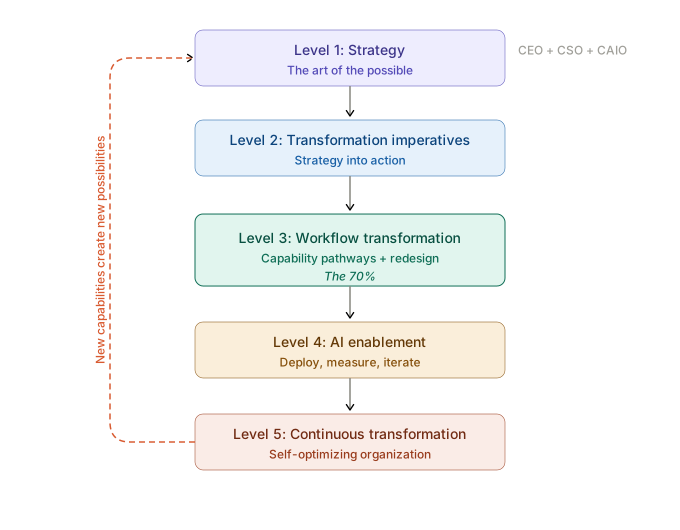
What is Level 4 of the AI business transformation?
Level 4 is the phase of the AI business transformation where everything the organization has designed finally has to work. The strategic choices from Level 1, the business transformation imperatives from Level 2, the workflow redesigns from Level 3: all of it converges at Level 4 into a system that has to run, people who have to operate it, data that has to flow, and governance that has to hold.
Articles 17 through 22 walked through what that convergence looks like in practice. Article 17 framed the transition from Level 3 design into Level 4 build, explaining why it breaks ERP-era playbooks and why the domain owner has to stay engaged through deployment rather than handing off. Article 18 worked through technology selection against the workflow specifications the domain had already produced, with integration feasibility elevated as a selection criterion rather than an afterthought. Article 19 addressed the integration architecture itself, citing lessons from the implementation firms who have lived through AI integrations at scale. Article 20 described deployment into the redesigned workflows in operational depth: the seven-environment topology the CIO's organization must establish, the eight engineering disciplines of AI configuration, the testing methodology built for probabilistic systems rather than deterministic ones, AgentOps as the observability discipline that wires production monitoring from build forward, the four-option iteration framework that domain owners use to respond to production reality, and the wave 1/wave 2 resourcing reality the canonical 70/20/10 ratio does not yet anticipate.
Article 21 laid out the data architecture the CDO’s organization builds to support AI consumption patterns that are fundamentally different from traditional BI. Article 22 covered the training that builds role-specific competence in the redesigned roles, framed around the judgment that AI collaboration requires rather than the procedural knowledge that ERP training taught.
Each of those articles covered a specialized discipline. Article 23 is where they come together at the gate: the moment when the domain decides whether everything is actually ready for users to start doing their work with the redesigned workflow and the underlying AI technologies starting on Day 1.
The gate is not a formality. It is the single most important decision the domain will make across the entire transformation. A domain that passes the gate and goes live successfully enters Level 5 with momentum. A domain that fails the gate, recognizes the gap honestly, remediates, and re-gates enters Level 5 only slightly later and in a much stronger position. A domain that ignores the gate, declares success prematurely, and goes live anyway will spend the next year managing incidents that the gate would have caught.
This article is the framework for making that decision.
Why does Level 4 require a synthetic gate instead of a technology readiness check?
Level 4 requires a synthetic gate because AI go-lives cannot be gated on technology readiness alone the way ERP go-lives could. ERP go-lives had deterministic components. Did the chart of accounts map correctly? Did the month-end close sequence run? Did the interfaces to adjacent systems pass reconciliation? Those questions had yes-or-no answers. The organizational change was significant, but it followed patterns the Fortune 500 had seen before: training, communications, some resistance, a hypercare period, and eventually a steady state.
AI business transformation go-live is different in a way that matters for the gate. Stanford’s Digital Economy Lab studied 51 successful enterprise AI deployments and found that 77% of the toughest challenges were intangible: change management, data quality, process redesign, while the technology itself was consistently described as the easiest part.1 The same study found that 95% of AI transformation failures trace to organizational factors, workforce unpreparedness, missing governance, absent executive ownership, and wrong sequencing, with technology underperformance explaining less than 5%, and that 61% of successful deployments included at least one prior failure whose costs never appear in final ROI. The same finding appears through every tier-1 source in slightly different words. The technology rarely fails on its own. What fails is the domain’s capacity to operate with the technology, or the workflow’s ability to absorb it, or the governance’s ability to hold up under real production conditions, or the people’s readiness to work in genuinely redesigned roles.
This is why the Level 4 gate has to be synthetic. Six dimensions interact, and any one of them can sink the go-live on its own. A beautifully implemented model with untrained users fails. Trained users running the wrong workflow because the redesign wasn’t finished fails. An integrated system with governance that’s still policy-declared rather than operationally embedded fails the first time something goes wrong in production. Harvard Business Review researchers describe this as the “last mile problem”, where organizations become “pilot rich but transformation poor,” and individual productivity improvements vanish before reaching the balance sheet because the organizational design around the technology was never completed.2
The gate verifies all six dimensions together because the dimensions fail together. The six sections that follow specify what the gate measures in each one.
What does the gate check in Dimension 1: Workflow Operational Performance Readiness?
The first dimension the gate verifies is whether the redesigned workflow from Article 12 can actually perform at the levels the domain committed to when it produced the design. This is the foundational check. If the workflow itself isn’t performing against its own specifications, nothing else matters.
At the domain level, the performance measurements are familiar in shape from operational discipline broadly: cycle time, throughput, error rate, rework rate. The difference that matters is what they are measured against. In traditional operations, baselines drift and targets are often set by management commitment rather than validated measurement. In an AI business transformation, the baseline is what the workflow was doing before the redesign, the target is what the Level 3 design committed the redesigned workflow would achieve, and the gate verifies both that the baseline was captured before deployment and that the deployed system is demonstrating performance against it. IBM’s institutional research finds that organizations with documented pre-deployment baselines are 4.2 times more likely to demonstrate measurable value from their AI investments than organizations that skipped this discipline.3 The baseline is not an afterthought. It is the instrument the gate uses to read whether the deployment is working.
The specific performance areas the gate checks at the workflow level, time spent, quality of output, business outcomes, are the measurements Accenture’s delivery teams have identified as the core of what domain-level AI measurement actually looks like in practice.4 But those measurements reveal something at the gate that they would not reveal mid-build. They show whether the workflow has been validated under realistic production conditions rather than controlled test conditions. Test environments filter out the edge cases that real production throws at a system within the first week. Controlled pilots use friendly users who are already committed to the technology. Gate-level validation has to go further: stress testing with realistic volume, edge-case scenarios that span the tails of the distribution, and enough production-like load to know whether the workflow holds up when things get uncomfortable.
The single most common failure pattern at this dimension is declaring workflow performance validated based on pilot results that were run with volume and complexity well below what production will deliver. AI that is “released before it is ready” has signatures that precede go-live: promises made during design that aren’t being kept in test, test results that don’t account for production volume, and the absence of explicit edge-case validation in the test plan. The gate’s job at this dimension is to surface those signatures before go-live rather than after.
A gate that verifies workflow operational performance readiness has evidence of three things. The baseline is documented. The redesigned workflow has been tested under realistic production conditions. The measurements against the Level 3 commitments are present, and they show the workflow meeting or beating what the design promised. If any of those three are missing, the domain is not ready on this dimension.
What does the gate check in Dimension 2: AI Output Quality Readiness?
The second dimension the gate verifies is whether the AI’s output quality has been validated against the thresholds defined by its governance classification from Article 7 and embedded in Article 12’s workflow design. This is the dimension where the probabilistic nature of AI breaks traditional go-live testing most sharply.
In an ERP context, output quality was effectively a pass-fail. The system either produced the correct result for a given input or it didn’t, and defects meant the system was broken. AI output quality is a distribution. The right question at the gate is not “is the AI producing correct output” but “is the AI producing output within the quality bounds that the governance classification requires, at the rates the classification requires, with the human oversight that the classification mandates.” High-risk governance classifications require tighter validation envelopes than low-risk ones. A customer-facing diagnostic recommendation has to meet different output quality thresholds than an internal productivity assistant summarizing meeting notes.
The gate’s failure mode at this dimension is deceptive because AI output in controlled environments often looks excellent. Deloitte’s State of AI 2026 research captures this pattern directly. Models that perform flawlessly in testing often stumble when exposed to real-world edge cases at scale.5 The test set doesn’t contain the rare input patterns that production will contain. The pilot users stayed within comfortable usage patterns that didn’t stress the model’s weaknesses. The governance classification was declared but the enforcement mechanism was never tested against realistic adversarial conditions.
The quality verification the gate requires goes further than model accuracy on a test set. McKinsey’s research finds that 74% of organizations identify inaccuracy as the top AI risk, ahead of cybersecurity, not because inaccuracy is unmeasurable but because the measurement infrastructure most organizations have built measures average accuracy rather than the distribution of failures.6 Average accuracy can be very high while the tail of failures includes exactly the cases that will create incidents in production. The gate verifies that the failure tail has been characterized, that failure modes have been documented, that the human oversight architecture catches the failure modes the technology can’t prevent on its own, and that the organization has tested what happens when the AI produces a wrong answer that a human needs to catch.
At its sharpest, the gate is asking whether the domain is ready for the AI to be wrong in ways the organization hasn’t yet seen. Because it will be. AI is probabilistic, edge cases exist in production that didn’t exist in testing, and the first time production surfaces a failure mode the domain hadn’t anticipated, the question is whether the governance and oversight architecture catches it or whether the failure reaches the customer or the business decision. Quality readiness at the gate means that architecture is operational, not theoretical.
What does the gate check in Dimension 3: Adoption Readiness?
The third dimension the gate verifies is whether the organization is ready for users to adopt the system on Day 1. This is different from measuring usage after go-live, because go-live hasn’t happened yet. The gate verifies that every barrier to Day 1 use has been removed, not that adoption is already occurring.
The barriers are specific and they compound. Access has to be provisioned. Communications have to have reached the users in the format and tone that will get them to actually show up on Day 1 rather than ignore the rollout. Support structures have to be staffed and operational before users start hitting questions. Shadow alternatives, the workarounds users developed during pilot or before the transformation began, have to be identified and addressed, because users who have already built a parallel path will route around the new system at the first friction point unless the parallel path is closed off or the new system’s advantages are immediately obvious.
Boston Consulting Group’s global workforce research surfaces a finding that matters for the gate specifically. Employees who received five or more hours of hands-on AI training become regular users at meaningfully higher rates than those who received less.7 The gate verifies that the training threshold is met, not that training sessions were scheduled. Training delivered isn’t training absorbed, and the gate’s version of adoption readiness is operational. Do the people who need to use the system on Day 1 have enough hands-on experience to use it, or have they only sat through briefings?
The gate also surfaces a specific pattern that Stanford's research on 51 enterprise AI deployments documented directly. When AI deployments encountered resistance late in the cycle, the resistance came from legal, HR, risk, and compliance functions in 35% of cases, more often than it came from end users, who accounted for 23%.⁸ The concerns these functions raise about process risk, accountability, and regulatory exposure are legitimate, and the domain owner’s charter from Article 9 established that these concerns need to be coordinated into the Level 3 design and Level 4 build work as the transformation proceeds. The gate's adoption readiness check verifies that this coordination produced alignment rather than unresolved holds. A domain that has trained users, provisioned access, and scheduled go-live but has unresolved concerns from legal or risk is not ready, regardless of how the user-facing readiness looks.
The questions the gate asks are straightforward in theory and demanding in practice. Can the people who need to use the system do so on Day 1? Have the cross-functional concerns surfaced through the domain owner's coordination been resolved? Are shadow AI alternatives and pilot workarounds addressed? Is support staffed and ready for the volume of questions Day 1 will generate? If the answer to any of those is not a confident yes backed by evidence, the domain isn't ready on adoption.
What does the gate check in Dimension 4: Human-AI Collaboration Handoff Readiness?
The fourth dimension the gate verifies is whether every human-AI handoff point designed into the Level 3 workflow is operational and functioning. This dimension exists because human-AI collaboration is where AI workflows either succeed or collapse, and the handoff points are the specific moments where the architecture holds or breaks.
Stanford’s deployment research produced one of the sharpest findings across all of the research supporting this framework. Systems where AI handles the majority of work autonomously and humans review exceptions delivered a median productivity gain of 71%, compared to just 30% for systems that required human approval of every AI output.9 The architectural choice between escalation models and approval models is not a matter of taste. It is a two-and-a-half-times difference in value captured. The Level 4 gate is the moment the organization finds out which model it actually built, because the difference often emerges in deployment rather than in design.
McKinsey’s research on AI high performers is directly complementary. Organizations that achieve measurable EBIT impact from AI are nearly three times more likely than their peers to have defined human-in-the-loop processes that specify how and when model outputs need human validation.10 Specified, not declared. The specification has to exist, the humans at each handoff point have to know what they are responsible for, and the handoff itself has to work when volume is realistic. Many organizations reach the gate with human-in-the-loop processes that exist on paper but have never been tested at scale. The gate’s job is to surface those gaps.
The gate checks each handoff point individually. At each place in Article 12’s workflow design where the AI hands work to a human or where a human validates, overrides, or escalates AI output, the gate asks three questions. Is the handoff operationally defined, not just documented but actually wired into the system? Is the human at that handoff point trained, available, and able to do their part? Has the handoff been tested under realistic production volume?
The failure mode at this dimension is subtle and common. A workflow with ten designed handoff points might have eight working well, one working at low volume but not at scale, and one that was supposed to be built but wasn’t. The eight that work dominate the pilot evaluation. The two that don’t will dominate production incidents. A gate that checks handoff readiness at the aggregate level will miss the two gaps that matter. A gate that checks each handoff individually finds them.
What does the gate check in Dimension 5: Governance and Risk Enforcement Readiness?
The fifth dimension the gate verifies is whether the governance classifications from Article 7 and the controls embedded in Article 12’s workflow design have moved from being policy-declared to being operationally enforced in the deployed system. This is the shift from governance as a document to governance as a live system behavior.
The World Economic Forum’s Advancing Responsible AI Innovation playbook captures the scale of the gap between what organizations claim and what they have actually operationalized. Less than 1% of organizations have fully operationalized responsible AI in a comprehensive and anticipatory way.11 The gap isn’t that organizations don’t have governance frameworks. It’s that the frameworks live in policy statements rather than in running code, monitoring dashboards, incident response procedures, and the actual behavior of the deployed system when something goes wrong. The gate’s job at this dimension is to verify that the shift from declared to operational has happened.
Deloitte’s 2026 agentic AI research quantifies how fast the gap is widening: 74% of organizations expect at least moderate AI agent use by 2027, but only 21% report a mature agentic AI governance model, and Deloitte’s warning is that skipping guardrails up front makes retrofitting oversight slower and costlier than building it in.12 Okta’s identity research makes the same point in a single line: 91% of organizations already use AI agents, and only 10% have governance for them in place.13 Agents are already everywhere. Controls are not. The gate is where that gap gets closed rather than shipped.
The shift has specific components, and each is testable. Oversight mechanisms that the governance classification requires must be functioning in the deployed system rather than planned for post-go-live. Incident response procedures must exist, must have been walked through in simulated scenarios, and must have clear ownership so that when a real incident occurs, the response is coordinated rather than improvised. Continuous monitoring must be operational, not just infrastructure monitoring for uptime, but AI-specific monitoring for drift, quality degradation, and emergent behavior patterns. Audit trails must be capturing what the governance classification says they should capture. And the specific controls that the workflow design specified for each governance class must be live.
What the gate is verifying at this dimension is the deliverable of work Article 20 covered in operational depth. The runtime guardrails embedded in the agent's response pipeline, the AgentOps governance compliance monitoring that tracks whether enforcement is operating as designed, and the pre-built runbooks that specify the technical response, communication protocol, and documentation requirement when a deviation is detected: each is built during the deployment work Article 20 described, and each is what the gate is now confirming actually works. The gate is not asking whether governance has been thought through. It is asking whether the runtime enforcement that Article 20's engineering disciplines produced is operating against the governance classifications Article 7 established and the workflow specifications Article 12 produced.
Harvard Business Review researchers describe the specific friction this creates for AI. Traditional governance assumes systems behave consistently, which AI systems fundamentally do not, and organizations that retrofit traditional human-review-every-step governance onto agentic AI systems create what they call an “agentic governance” friction that neither enables meaningful oversight nor allows the AI to deliver its value.14 The gate verifies that the domain has resolved this friction rather than carried it into production. Agent governance at scale requires defining boundaries within which autonomous systems operate, with human oversight at the boundaries rather than at every step, and the gate checks whether those boundaries are actually defined and enforced.
A governance dimension that passes the gate has operational oversight, tested incident response, running monitoring, and enforced controls. A governance dimension that fails has policy documents, good intentions, and the promise to operationalize after go-live. The difference is the difference between a deployment that holds up when tested and one that generates its first incident in the first month.
What does the gate check in Dimension 6: Role Competence Readiness?
The sixth dimension the gate verifies is whether the people who will operate in the redesigned roles are actually competent to do so, not just trained. This is the dimension where the distinction between Article 22’s output (training delivered) and Article 23’s check (competence verified) matters most.
Deloitte’s State of AI 2026 research found that while 42% of leaders believe their strategy is highly prepared for AI adoption, only 20% are confident about their organization’s talent readiness.15 The 22-point gap between strategy confidence and talent confidence is where most domains stall at the gate. Training completion metrics show green. Actual capability to do the redesigned job shows yellow or red. The gap becomes visible only when someone looks past training attendance to verify that people can actually perform the work.
Accenture’s Pulse of Change research surfaces a similar finding from the workforce perspective. Only 40% of employees say the training they received prepared them for the role changes AI brought.16 The disconnect between what the training function delivered and what users experienced as competence-building is a direct read on whether the gate’s role competence dimension will pass.
The gate verifies competence through evidence rather than training completion. Has a representative sample of users actually performed the redesigned work using the AI, in conditions close to production, without deployment-team hand-holding? Can the people at each human-AI handoff point make the judgment calls the workflow design assumes they’ll make, knowing when to override AI output, when to escalate, when to proceed, when to pause? Do the people in the roles demonstrate the judgment that AI collaboration requires, as distinct from the procedural knowledge that ERP-era training delivered?
The failure mode is specific to AI and specific to this dimension. ERP-era training taught procedures that were the same every time the user executed them. AI training has to build judgment, because the AI’s output varies and the human’s response has to vary with it. Judgment isn’t something that can be absorbed in a training session. It develops through repeated exposure to real cases, feedback on decisions, and time to internalize patterns. A domain that completed training on schedule but whose users haven’t yet had enough exposure to develop judgment is a domain that will have its judgment formed in production, which is the expensive place for it to be formed.
Competence readiness at the gate means the organization has evidence, not faith, that users can do the redesigned work. A domain that can’t produce that evidence isn’t ready on this dimension, even if every other dimension looks green.
What does the Level 4 gate actually do?
The gate is a go-or-no-go decision. It is not a partial pass. It is not a conditional approval pending future remediation. It is not an approval with exceptions.
McKinsey’s research on what separates productive AI deployments from stalled ones identifies the discipline directly: “a disciplined, stage-gated review process with clear go/no-go criteria separates the merely promising deployments from the ones most likely to be productive.”17 Gartner’s 2026 data reads as the same argument from the failure side: only 28% of AI use cases in infrastructure and operations fully succeed and meet ROI expectations, 20% fail outright, and 57% of leaders reporting failures say they expected too much too fast, while Gartner’s June 2026 Hype Cycle for Agentic AI reaffirmed its prediction that more than 40% of agentic AI projects will be canceled by the end of 2027.18 The binary nature of the gate is a feature, not a limitation. Gates that allow “mostly ready” become commitments to production incidents. The organizational dynamics that create pressure to approve go-live despite gaps, schedule commitments, steering committee fatigue, executive impatience, sunk cost, reluctance to deliver bad news upward, all push toward partial passes. Partial passes are how domains accumulate hidden debt that surfaces as incidents in month four.
The gate’s multi-party structure per Articles 17 through 22 is what gives the binary decision its credibility. The domain owner is UPPERCASE accountable for the transformation outcome and carries the ultimate sign-off. The CIO’s implementation team lead signs on technology and integration readiness. The CDO’s team lead signs on data architecture readiness. The change management team lead signs on adoption readiness, organizational impact completion, and training effectiveness. The directors and senior managers overseeing the work serve as the quality gate per the organizational chain.
Each sign-off is a specific accountability. None of them can be delegated, waived, or substituted. The signatures mean something because each signer has the standing and the visibility to know whether their dimension is actually ready. This parallels the Level 3 readiness gate from Article 16 in discipline, while measuring different things because Level 4 produces different outputs.
The most useful empirical template for how this gate operates in practice comes from Michelin, which runs a two-gate structure documented in MIT Sloan Management Review. Every AI use case is evaluated pre-deployment for potential value, scalability, and business relevance. Then, after deployment, Michelin’s AI Center of Excellence conducts a post-deployment review to confirm realized value and alignment with ethical AI principles.19 Michelin has scaled more than 200 AI use cases using this discipline, generating over 50 million euros in annual ROI. The post-deployment review is the Level 4 gate operationalized in a real enterprise. The domain commits to targets before deployment; the gate verifies achievement against those targets before the domain is declared complete.
When the gate holds, the domain does not go live. The delay is uncomfortable but correct. The remediation plan specifies which dimensions failed, what gaps have to close, and what the re-gate date will be. The conversation with the C-suite is direct. The gate identified gaps that would have created production incidents, the domain is choosing to close them before go-live rather than in hypercare, and the re-gate date is specified. That framing is straightforward because it is true. A domain that went live at partial readiness and spent six months in incident management will do significantly more damage to the transformation’s credibility than a domain that delayed go-live by six weeks to close gaps the gate surfaced. The gate is protection against the worse outcome, not an obstacle to the better one.
What happens immediately after go-live?
The moment the gate passes, go-live happens. The system is live in production. Users are doing their work with the redesigned workflow leveraging new AI capabilities. What happens in the hours, days, and weeks that follow is not post-project cleanup. It is Day 1 of Level 5, and it begins with hypercare as the operating mode rather than the exception.
The implementation firm discipline on hypercare has been refined through decades of ERP go-lives and is now being adapted to AI-specific conditions. The core pattern holds across sources. Hypercare has a defined duration, typically three months for complex enterprise transformations, with the explicit commitment that the period will extend if incident rates haven’t returned to normal operating levels by the stated end date. Hypercare has explicit exit criteria: no critical issues unresolved, key processes running efficiently, SLAs met, and the support team able to resolve most issues without escalating to the deployment team. Hypercare is led by the support team, not the deployment team, with the deployment team involved early to transfer knowledge and deliberately weaned off as the support team develops independence.
The organizational logic matters. Deloitte’s “Implement to Operate” delivery approach describes the pattern directly. Process and technology improvements are developed throughout the project with an eye on ensuring seamless transition to the operate solution.20 The support team isn’t hired after go-live. They are involved during build, shadow the deployment team during testing, and are ready to lead hypercare when the system goes live. This protects the deployment team from perpetual firefighting (the deployment team moves on to the next domain), forces knowledge to be externalized from individuals into documentation and tooling, and builds genuine support team ownership rather than dependency on the team that built the system.
For AI specifically, hypercare has three additional dimensions that ERP hypercare didn't require at this intensity. Model behavior monitoring has to be running from hour one. The iteration cycle from Article 20 is now live in production rather than hypothetical; when production reveals a failure mode that testing didn't surface, the domain's response capability is tested in real time. The four iteration options Article 20 established — adjust the AI configuration within the eight engineering disciplines, adjust the workflow within the boundaries of transformation intent, replace the technology, or escalate to the Level 1 triad — are the response menu the team works from, and the domain owner remains the decision authority on which option applies. The CIO's team executes; the domain owner decides. And governance enforcement is operating against real production conditions for the first time, which means the incident response procedures the gate verified are about to find out whether they were actually ready or just looked ready on paper.
Capgemini frames the state the domain is moving toward as industrialization, the point at which AI shifts from experimentation to execution, from isolated innovation to systematized value creation.21 Hypercare is the bridge between the domain’s build and its industrialized steady state. The domain owner stays engaged through hypercare per Article 17’s requirement, not at the intensity of deployment but at a cadence that lets them make the judgment calls the operations team can’t make alone: when to extend hypercare, when to declare it complete, when iteration has reached the stability that signals the domain is ready to operate without elevated support.
How does Level 4 bridge to Level 5?
Passing the gate, going live, and completing hypercare do not mean the transformation is over. They mean the domain has crossed from building to running, and the running state is where Level 5 continuous transformation begins.
The feedback loop that matters most runs from production experience back to strategy. What the domain is learning in the live state, about users, about the AI’s actual capabilities versus what was projected, about workflow refinements that reveal themselves only at scale, about customer or business outcomes that were hypothesized at Level 2 and are now measurable, becomes input to the next cycle of strategic thinking. The CEO, CSO, and CAIO who set the Level 2 imperatives have new information. The next wave of imperatives reflects what the organization has actually learned rather than what it projected. The transformation becomes a living system rather than a one-time program.
The domain owner’s role shifts. Deployment accountability gives way to continuous-transformation leadership. The domain owner is no longer getting the system live—they are leading a domain that operates with AI and that has to keep getting better. The posture changes. The cadence changes. The questions change. What worked at Level 4, active engagement with deployment decisions, weekly reviews of issues, direct involvement in readiness gates, gives way to the monthly strategic review cadence that Article 4 established for the Level 1 portfolio. The domain owner brings the domain’s learning to that review, and the organization’s strategy benefits.
Article 24 picks up from here, with the structure and discipline of continuous transformation at Level 5. The articles that follow describe what the self-optimizing organization actually looks like, how the feedback loops run, and how the compounding advantage that AI transformation can create gets captured rather than dissipated.
What does being “done with Level 4” actually mean?
Being done with Level 4 does not mean the transformation is done. It means the domain has crossed the threshold from building to running. From projecting to measuring. From transformation-as-project to transformation-as-operating-mode. The gate is the recognition of that crossing, and passing it is the domain’s earned right to operate in the transformed state.
A domain that passes the gate has evidence across all six dimensions that its deployment will hold up in production. A domain that holds the gate because the evidence is not yet there is making the harder, correct call. The hardest conversations in AI business transformation are the ones where the domain owner has to tell the steering committee that the scheduled go-live date is moving because the gate surfaced gaps the organization can’t responsibly ship with. Those conversations are the signature of a discipline that will produce lasting outcomes. The conversations enterprises want to avoid, the ones that come three months after a rushed go-live when production incidents are accumulating and users are reverting to shadow workarounds, are the ones that the gate exists to prevent.
Every article in this series up to this point has argued that AI business transformation is fundamentally different from the technology implementations that preceded it. The Level 4 gate is where that difference becomes operationally real. A domain that treats the gate as a checkbox will have a deployment that behaves like an ERP go-live with AI bolted on. A domain that treats the gate as the synthetic verification the six dimensions actually require will have a deployment that can absorb the iteration, adaptation, and evolution that AI demands. The difference between the two is the difference between a transformation that delivers sustained value and one that generates a wave of disappointment in year two.
Level 5 is next. The feedback loops that will define it are already running.
Sources
- 1.Pereira, E., Graylin, A. W., and Brynjolfsson, E., “The Enterprise AI Playbook: Lessons from 51 Successful Deployments,” Stanford Digital Economy Lab, March 2026.
- 2.Lakhani, K. R., Stave, J., and Spataro, J., “The ‘Last Mile’ Problem Slowing AI Transformation,” Harvard Business Review, March 2026.
- 3.Livingston, S., “2026 Resolutions for AI and Technology Leaders,” IBM Think, January 14, 2026.
- 4.Accenture, “Scaling AI for Business Transformation in Financial Services,” Accenture Banking Blog, February 2026.
- 5.Deloitte, “State of AI in the Enterprise 2026,” Deloitte Insights, based on survey of 3,235 leaders across 24 countries, August–September 2025.
- 6.McKinsey & Company, “State of AI Trust in 2026: Shifting to the Agentic Era,” McKinsey QuantumBlack, March 25, 2026.
- 7.Boston Consulting Group, “AI at Work 2025: Momentum Builds, but Gaps Remain,” BCG, based on survey of 10,635 workers across 11 countries, July 2025.
- 8.Pereira, Graylin, and Brynjolfsson, “The Enterprise AI Playbook: Lessons from 51 Successful Deployments,” Stanford Digital Economy Lab, March 2026.
- 9.Pereira, Graylin, and Brynjolfsson, “The Enterprise AI Playbook: Lessons from 51 Successful Deployments,” Stanford Digital Economy Lab, March 2026.
- 10.Singla, A., Sukharevsky, A., and Yee, L., “The State of AI in 2025: Agents, Innovation, and Transformation,” McKinsey QuantumBlack, November 2025.
- 11.World Economic Forum in collaboration with Accenture, “Advancing Responsible AI Innovation: A Playbook,” World Economic Forum AI Governance Alliance, 2025.
- 12.Deloitte, “Business and IT Leaders Report AI Agents Are Scaling Faster Than Their Guardrails,” Deloitte Insights, 2026.
- 13.Okta, “Okta for AI Agents” (general availability April 30, 2026) and Okta agent governance research, 2026.
- 14.Lakhani, Stave, and Spataro, “The ‘Last Mile’ Problem Slowing AI Transformation,” Harvard Business Review, March 2026.
- 15.Deloitte, “State of AI in the Enterprise 2026,” Deloitte Insights, August–September 2025.
- 16.Accenture, “Pulse of Change 2026,” based on survey of 3,650 C-suite executives and 3,350 workers, January 2026.
- 17.McKinsey & Company, “From Promising to Productive: Real Results from Gen AI in Services,” McKinsey QuantumBlack, August 2024.
- 18.Gartner, “Gartner Says AI Projects in I&O Stall Ahead of Meaningful ROI Returns,” April 7, 2026, and “Hype Cycle for Agentic AI, 2026,” June 2026.
- 19.Davenport, T. H., and Bean, R., “Accelerating Manufacturing Innovation at Michelin with Data and AI,” MIT Sloan Management Review, October 2025.
- 20.Deloitte, “Unlocking AI Capabilities with MLOps,” Deloitte AI Institute.
- 21.Capgemini, “From Gen AI Experiments to Enterprise-Scale Agents: How Capgemini Is Industrializing AI with Databricks Agent Bricks,” Capgemini, November 2025.
Frequently Asked Questions
What happens if we fail the gate? Do we delay go-live?
Yes. The gate exists precisely because some domains will not be ready on the originally scheduled date, and the discipline of holding the gate is what distinguishes successful transformations from the ones that become cautionary tales. The failure pattern enterprises want to avoid is the one where a domain reaches the gate, shows gaps in two or three dimensions, and goes live anyway because the schedule was committed and the steering committee didn’t want to deliver bad news upward. That domain will spend the next six months in incident management, and the organizational credibility damage to the transformation will be significantly larger than the damage from a six-week delay. When the gate holds, the response is remediation. Identify which dimensions failed, what specific gaps exist, what the remediation plan is, who owns it, and when the re-gate will occur. The re-gate is usually weeks, not months. Holding the gate once is far less expensive than the alternative.
Our business case assumed we’d hit specific performance targets. What if the gate shows we’re close but not there? Do we go live anyway?
The gate’s binary nature makes this the hardest call the domain owner will make, because “close” is genuinely painful to hold against. The right question isn’t whether the performance is close to the target, but whether the gap represents something the domain can responsibly ship with. Some gaps are cosmetic: the workflow hits 95% of target performance and the remaining 5% is a stretch goal that wasn’t strictly required. Other gaps are structural: the workflow hits 95% but the missing 5% is the edge case that will create customer-facing incidents. The distinction is the domain owner’s judgment to make, ideally in consultation with the CAIO translator and the CIO’s implementation lead. If the gap is genuinely structural, it’s a gate-hold. If the gap is cosmetic and the domain has demonstrated competence to close it in hypercare, it can be a conditional go-live with the gap explicitly identified and the remediation plan committed. “Close but not quite” is not a blanket answer. It is a judgment call the gate structure is designed to force.
How do we staff hypercare without burning out the deployment team that just spent months getting to go-live?
The implementation firm pattern is unambiguous. Hypercare is led by the support team, not the deployment team. This is the only sustainable model, and it has to be architected during build rather than bolted on at go-live. The support team is identified early, shadows the deployment team during testing, builds independent capability during the final weeks before go-live, and leads hypercare from Day 1 with the deployment team available for escalation but not in the front line. The deployment team moves to the next wave or the next domain. This pattern forces knowledge to be externalized, documentation, runbooks, tooling, rather than living in the heads of the people who built the system, which is a benefit beyond sustainability. Domains that don’t architect this pattern find their deployment teams still firefighting four months after go-live, which makes the next domain’s build that much harder to staff.
What do we tell the C-suite when the gate holds and go-live gets delayed?
Direct framing works better than softened framing. The message is: the gate identified specific gaps in these dimensions that would have created production incidents, the domain is choosing to close those gaps before go-live rather than in hypercare, the remediation plan is these specifics, and the re-gate date is this date. Make the distinction between gate-blocking issues and hypercare issues explicit so the steering committee understands the domain isn’t trying to achieve perfection, just trying to avoid shipping with known structural gaps. Reference the alternative, going live at partial readiness and spending months managing incidents, because the steering committee may not have that tradeoff top of mind. Most importantly, have this conversation with the Level 1 triad sponsor before it becomes a steering committee agenda item. A domain owner who has pre-aligned with the domain C-level leader walks into the steering committee with support already secured.
How do we handle users who had access to the pilot but now have to wait for full go-live, or who developed workarounds during the pilot that the redesigned workflow doesn’t support?
This is the category of adoption risk that the gate’s adoption readiness dimension specifically surfaces. Pilot users who have been operating in an in-between state for months often develop expectations and workflow patterns that the production system was never designed to support. The gate check is whether those expectations have been actively managed. Communications have to explicitly address what’s changing between pilot and production and why. Training for pilot users has to cover the differences rather than assuming pilot familiarity carries forward. Support structures have to be ready for the first week’s worth of “I could do it this way in the pilot” questions. Most importantly, the shadow workarounds have to be identified during the gate’s adoption readiness check. Pilot users who built unofficial scripts, spreadsheet-based workarounds, or backdoor access routes will route around the production system at the first friction point unless those paths are closed or the production system is obviously better. The gate verifies that this work has happened, not that it’s been scheduled.
The gate signals our domain is ready, but one of the other domains transforming alongside us isn’t. Can we go live independently, or do we have to wait?
It depends on whether the shared dependencies from Article 14’s cross-domain coordination have been resolved. If the coordination work established which domains share infrastructure and which don’t, and if the dependent domain’s readiness is not tied to the other domain’s progress, independent go-live is appropriate. A domain that has its own workflow redesign, its own technology stack, its own data architecture, and its own governance can pass its own gate without waiting on peers. The exception is when the domains share a critical component that hasn’t been fully decoupled: a shared data architecture still being migrated, a shared integration layer still being completed, shared governance enforcement infrastructure that covers both domains. In those cases, the dependent domain has to wait because its readiness is contingent on the other domain’s readiness in the shared dimensions. The CAIO translators across the affected domains are the right people to raise the dependency explicitly if it hasn’t already surfaced in the coordination cadence that Article 14 established.
This series addresses “what” to do, not “how” to do it. If you are a business executive and would like help thinking through the “how,” please feel comfortable reaching out.

About the author
Shawn Plaster
Founder & CEO, Plaster Group
Shawn is the author of Plaster Group's five-level AI Business Transformation Methodology and its 27-article Insights series, and leads the firm's enterprise AI transformation work.
Previous: Article 22: Change Management · Next: Article 24: Building the Self-Optimizing Organization
© 2026 Plaster Group, LLC. All rights reserved. This article may not be reproduced, distributed, or transmitted in any form without prior written permission from Plaster Group. Brief excerpts may be quoted for review or commentary purposes with attribution to the author and a link to the original article.
Ready to move forward?
Let's discuss how your organization can build with AI — securely, strategically, and starting from where you are today.
Start a Conversation