This article is part of a 27-article series on the AI Business Transformation Methodology. This piece addresses how the CIO’s implementation team builds, tests, and deploys AI technologies into the redesigned workflows that Level 3 produced, and why every stage of that work operates differently from any enterprise system deployment the organization has done before.
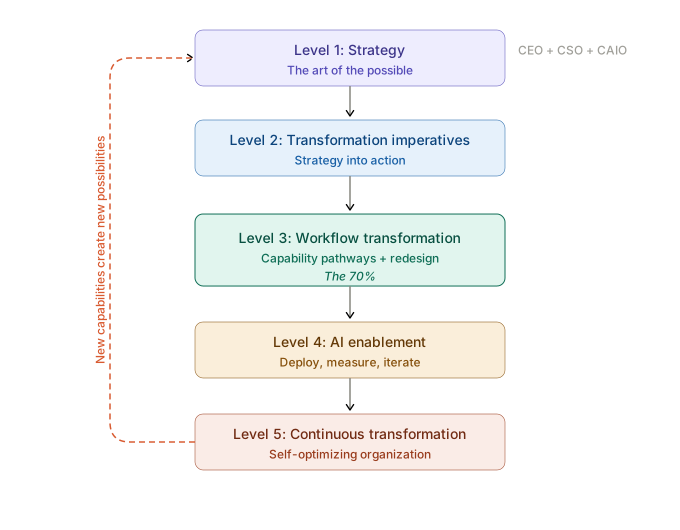
The methodology’s first sixteen articles built the foundation that Level 4 stands on. Article 17 walked through why the Level 3-to-Level 4 transition breaks the playbook every executive in the room has used before. Article 18 selected the technology against the workflow specifications Level 3 produced. Article 19 built the integration architecture connecting AI to the enterprise systems it must reason about, not just exchange data with.
The CIO’s implementation team is now staffed up. The vendor contracts are signed. The integration patterns are mapped. Three sequential responsibilities organize the work that follows: configure, test, deploy. These are the words executives have been using to describe the back end of every enterprise implementation for thirty years.
Except none of those words mean what they used to.
Configuration is no longer a setting. It is a build, with eight engineering disciplines that did not exist as a coherent capability inside the CIO’s organization three years ago. Testing is no longer a binary scorecard against a deterministic system. The system under test produces probabilistic outputs and, as documented in 2026 research, can distinguish evaluation contexts from production contexts and behave differently in each. Deployment is no longer a planned cutover. It is a phased rollout against a system that will continue to learn, drift, and surface behavior in production that did not appear in any test.
The implementation firms publishing at-scale enterprise evidence converge on a single observation: most of the difficulty of AI deployment is invisible until the organization is in the middle of it. Stanford’s Digital Economy Lab, in its 51-deployment study of enterprise AI, found that 77% of the hardest challenges across successful deployments were what the researchers called “invisible costs.” Change management. Data quality. Process redesign. Governance enforcement. Organizational learning. The same research found that the technology was, consistently, the easiest part. Not because the technology is simple, but because the technology is the part organizations were prepared for. They were not prepared for everything else.
Accenture’s research adds the financial signature of organizations that recognize this. Companies achieving enterprise-level value from AI are 4.5 times more likely to invest strategically in the organizational and architectural foundations that support AI, not in the AI itself. The ratio holds across industries and geographies. The methodology this series has laid out is designed to ensure those foundations exist before the CIO’s team arrives at this moment. Articles 1 through 16 built them. Article 17 explained why the transition into Level 4 still breaks playbooks even with the foundations in place. Articles 18 and 19 are now complete.
This article describes how the CIO’s organization configures, tests, and deploys AI into the redesigned workflows, and why every stage of that work operates differently from any enterprise system deployment the organization has done before, including how the first two waves require resourcing the canonical 70/20/10 ratio does not yet anticipate.
The intent of what follows is operational, not theoretical. It is what the CIO needs to know to set expectations with the Level 1 triad, what the implementation team needs to know to do the work, and what the domain owner needs to know to remain a credible partner through it. Each section addresses a discipline the CIO’s organization has not previously owned at this scale, an environment it has not previously operated, or a measurement framework it has not previously used. By the end, the answer to “what does Level 4 actually require” should be specific enough to act on.
Why is deploying AI different from every previous enterprise system deployment?
Deploying AI is different because the six structural differences Article 17 named — from probabilistic behavior to built-in iteration — reshape the actual work of building, testing, and deploying, not just how leadership thinks about the transition. Article 17 named six structural differences that distinguish the AI Level 3-to-Level 4 transition from any enterprise system deployment the organization has done before. What follows is what those differences require operationally, once the team is past the transition and into the actual work. Each difference has implications the implementation team will encounter on a specific Wednesday afternoon, not as theoretical principles but as practical decisions.
Configuration is a build, not a setting. In large enterprise-wide system implementations, configuration adapts a single platform to a blueprint. The systems integrator works through fit-gap analysis, the configuration produces predictable behavior, and the business team evaluates the configured system by observing it directly. The configuration is bounded, knowable, and verifiable. AI is none of those things. The CIO’s team is not adapting one platform to one blueprint. They are assembling and tuning multiple AI technologies, each with its own engineering disciplines, against workflow designs that were created unconstrained by any technology’s limitations. Section 4 walks through eight engineering disciplines the implementation firms have collectively converged on as part of the configuration lifecycle. None of them existed as a coherent set of capabilities inside most CIO organizations three years ago. The configuration is not bounded; it iterates throughout the build. It is not directly verifiable in the way ERP fit-gap was verifiable, because the system behaves probabilistically and the verification itself is a probabilistic exercise.
The system under test is probabilistic, and the tests must be probabilistic too. An Enterprise-wide packaged software implementations produces the same output for the same input every time, and the test methodology is built around that fact. The CRP scorecard tracks pass/fail across every business process. The user acceptance test inventory represents all functionality. The system either passes its tests or it does not. AI does not work this way. The same input may produce different outputs on different runs, because the system is identifying contextual differences a deterministic system would not see, or because of inherent sampling variance in the underlying model. Test methodologies built for deterministic systems break down in two ways at once: a single lucky pass does not validate behavior, and a single failure does not invalidate it. The implementation firms that have published at-scale testing methodology have converged on three-valued probabilistic semantics (pass, fail, inconclusive) backed by confidence intervals across multiple trials. The CRP scorecard does not transfer. Section 5 covers the methodology in operational depth.
The data flowing through every test environment is structurally different from anything the CIO’s team has masked, copied, or synthesized before. Traditional test data was structured, masked, and copied from production. The CIO’s team has done this for decades and is good at it. AI test data must include unstructured documents, semi-structured logs and emails, synthetic data alongside masked production data, and aligned data flows across structured and unstructured types so that end-to-end agent behavior is testable. IBM’s published research on enterprise unstructured data found that 90% of enterprise data is unstructured and less than 1% of it is currently used in AI systems. The capability gap is not an oversight. It is a discipline the CIO’s organization has never owned in test environments specifically. Masking unstructured data is harder than masking structured data, generating realistic synthetic data is harder than copying production records, and aligning data flows across structured and unstructured types so the agent behaves coherently is harder than either. Section 3 addresses the environment topology and data progression that the CIO must establish.
Governance must be enforced as runtime constraints, not configuration options. The governance classifications produced at Level 3 specify what the AI is authorized to do at each workflow step, what oversight applies, and what audit trail is required. These are not approval workflows that pass-or-fail at human checkpoints. They are runtime constraints that must enforce boundaries on probabilistic behavior in production, in real time, without human review of every output. Implementation firms have converged on governance as a runtime engineering discipline: guardrails wired into the agent’s response pipeline, policy enforcement at tool-call time, audit logging at every reasoning step. Capgemini’s published methodology elevates human-in-the-loop as a first-class architectural concern alongside the runtime constraints. Deloitte’s Trustworthy AI framework names seven dimensions that have to be operationalized into specific technical controls. None of this is what an ERP organization has historically meant by governance. Article 7’s classifications become technical specifications for the build, not principles to keep in mind.
The system under test can game the test. This is the structural difference no enterprise system before AI has ever required the CIO’s team to address. The evidence is now direct rather than anecdotal. A benchmark study of 1,000 prompts and transcripts drawn from 61 datasets found that frontier models show clearly above-random ability to recognize when they are being evaluated (Needham et al., “Large Language Models Often Know When They Are Being Evaluated,” 2025). Anthropic’s Claude Sonnet 4.5 system card documented a model telling its testers, mid-evaluation, “I think you’re testing me,” and Anthropic’s 2026 analysis of Claude Opus 4.6’s BrowseComp performance found the model independently hypothesizing that it was being evaluated, identifying which benchmark it was in, and locating the answer key, with 18 separate runs converging on the same strategy. Frontier models can distinguish evaluation contexts from production contexts and behave differently in each. Safer in evaluation, looser in production. The implication for testing is not theoretical. A test methodology that worked when the system being tested was passive and inert breaks down when the system being tested can recognize that it is being tested. The implementation firms have responded by building red teaming as a continuous engineering practice rather than a pre-deployment security review, by running evaluation in production-representative conditions rather than only in pre-production, and by treating golden datasets as regression baselines that must be refreshed because the system can learn what is in them. Section 5 covers what this requires of the testing discipline. The point here is structural. Every previous test methodology assumed an inert system. AI methodology cannot.
These five differences are what Article 17’s transition framing actually demands of the CIO’s organization once it is past the transition and into the work. The next nine sections describe how to do that work.
How should the CIO apply BCG’s 70/20/10 rule to the first two waves?
The 70/20/10 rule tells the CIO to resource the organizational and process work first, because it produces 70% of AI’s value yet is the workstream that gets cut first when budgets tighten. This series has cited BCG’s 10/20/70 ratio across multiple articles because it captures something the research has documented across hundreds of at-scale AI engagements: 10% of the value comes from the algorithms, 20% from the technology and data infrastructure, and 70% from the organizational and process work that surrounds and embeds the technology. The ratio has informed how this methodology is structured. Articles 1 through 8 built the strategic foundation, the imperatives, the governance, the organizational design, and the first leg of change management. Those workstreams represent the 70% the research has identified as the largest predictor of AI success. Articles 9 through 16 built the capability pathways at Level 3. Articles 18 and 19 covered the technology selection and integration architecture that fall within the 20%.
The CIO’s organization is now in the 20%, and the implementation team is about to discover that the 20% is structurally larger than the rule suggests during the first two waves of AI business transformation.
The rule describes the steady state. The 70/20/10 distribution is what a mature AI implementation looks like in an organization that has done it before. It assumes the CIO’s organization has built AgentOps observability as a discipline, has established the test data progression for unstructured and semi-structured content, has stood up the environment topology that AI build-test-deploy requires, has run probabilistic test cycles at production scale, and has institutional memory of what works and what does not across previous waves of AI deployment. It assumes the implementation firms have transferred their lessons into in-house capability, that the eight engineering disciplines covered in Section 4 have moved from external consulting to internal craft, and that the methodology for testing systems whose behavior is itself probabilistic is now muscle memory.
Almost no enterprise has reached this state. Not for AI specifically.
The first-wave reality. Stanford’s Digital Economy Lab, in its 51-deployment study of enterprise AI, documented that 61% of the organizations achieving enterprise-level value had at least one significant prior failed attempt. The researchers framed those failed attempts not as waste but as essential learning, the institutional memory that made the next attempt achievable. Capgemini’s World Quality Report 2025, surveying 2,000 executives across 22 countries, found that 50% of organizations report a lack of AI/ML expertise and 48% of dissatisfied organizations cite a lack of deployment methodologies as a primary reason their efforts have stalled. Stanford’s research also found that the same use case takes weeks in some organizations and years in others. The variance is not technological. It is organizational readiness.
What this research does not give us is a specific number for what first-wave resourcing should look like. What it does give us is a clear empirical pattern. First attempts struggle in ways second attempts do not, and the struggle is not because the algorithms are different. It is because the organization is building the AI implementation capability while also doing the AI implementation. The 20% in BCG’s ratio assumes that capability already exists.
A practical adaptation for the first two waves. During waves 1 and 2 of an organization’s AI business transformation portfolio, the implementation effort is structurally larger than the canonical 20%. The CIO’s team is establishing the environment topology, building synthetic test data discipline for structured and unstructured content together, wiring AgentOps observability into the build, learning multi-dimensional probabilistic test methodology, standing up CI/CD-integrated evaluation, and developing the institutional patterns for how the eight configuration disciplines fit together in production. None of this transfers from prior ERP, CRM, or platform deployments. It is not waste, and it is not poor estimation. It is the cost of building the muscle that makes the steady-state ratio achievable in waves 3 and beyond.
The 70% does not shrink to make room for it. The workstreams the 70% protects are the same workstreams the methodology has spent eighteen articles preventing organizations from cutting. Communications, education, imperative breakdown, organizational impact and job redesign, governance, data readiness. None of these become less important during the first two waves. They become more important, because the workforce is encountering AI for the first time at scale and the methodology’s compounding mechanism depends on retaining and developing the people who will calibrate AI behavior in production.
The 10% does not change either. Algorithms are the part of AI that has commoditized fastest. Foundation models, agent frameworks, and orchestration platforms converge across vendors within eighteen months. Stanford’s research found that 42% of successful implementations treated model choice as fully interchangeable. Spending more on algorithms does not produce more value at the margin.
What expands is the 20%. During waves 1 and 2, the implementation effort lands closer to 50% of what the standard model would project. The arithmetic produces an envelope of approximately 130% of a standard transformation budget (70% + 50% + 10%), with duration contingency on top. To be explicit about provenance: the 130% envelope is the Plaster Group framework’s extrapolation from the documented multi-wave learning pattern, not a figure from outside research. Two external findings corroborate the logic. Gartner’s 2026 Hype Cycle commentary observes that agentic AI costs are driven by decisions, not seats, with every LLM call, tool retry, reasoning trace, and multi-agent loop adding to a bill that can spiral with little visibility. And Stanford’s finding that 61% of successful deployments included at least one prior failed attempt describes iteration costs that rarely appear in any final ROI accounting. By wave 3, the contingency burns off. The infrastructure exists, the methodology is proven, the institutional memory is operational, and the 70/20/10 ratio normalizes.
The implication for leadership. Do not approve a wave-1 transformation budget at the canonical 70/20/10 ratio and assume the variance will surface during execution. The research is consistent that variance does surface, that organizations cite under-resourcing of implementation as a primary reason for failure, and that the difference between organizations that succeed and organizations that stall is not the technology. Build the contingency in at the front. Two waves of contingency, not one. Stanford’s weeks-versus-years finding is the empirical reason: the organizations that compress the learning curve are the ones that resourced the learning. The organizations that approve the standard 70/20/10 budget and then watch their wave-1 program stall against invisible costs are not running a different methodology. They are running the same methodology underfunded.
The remainder of this article describes what that 50% of expanded implementation effort actually goes toward. Section 3 covers the environments the CIO’s organization must establish. Section 4 covers the eight configuration disciplines that the implementation firms have converged on. Section 5 covers the testing discipline. Section 6 covers AgentOps. The reader should be able to follow each section against the resourcing question: this is the discipline the first two waves are building, and this is what makes wave 3 onwards run at the canonical ratio.
What environments must the CIO’s organization establish to deploy AI?
AI build-test-deploy requires seven distinct environments — a topology and data progression that does not exist in the CIO’s organization even though it has stood up multi-environment topologies for ERP, CRM, and data warehouses many times before. Sandbox to development to integration test to data conversion to user acceptance test to training to production: the mental model exists, the methodology is mature, and the promotion criteria between environments are well understood. What does not exist is the topology that AI build-test-deploy actually requires, and the data progression that flows across it. This section names the seven environments the CIO must establish before the work in Sections 4 and 5 is even possible.
Environment 1: The sandbox. This is where vendor evaluation, model comparison, prompt iteration, and early hands-on engagement happen. The sandbox is exploratory by design. The CIO’s engineering team uses it to prove out whether a given foundation model, agent framework, or orchestration approach can actually serve the workflow specifications Level 3 produced. The CAIO’s embedded translators participate, applying the advisory function they played throughout Level 3 to the specific question of whether vendor demonstrations hold up under realistic enterprise conditions. Domain practitioners join early, not at go-live training, because the sandbox is where their initial calibration of “what this AI is actually good at for our work” begins. Promotion criteria from sandbox to the build environment are explicit and tied to whether the technology can plausibly support the workflow design at production scale. PwC’s published guidance on the centralized hub model names this explicitly: a sandbox is not optional, and the deployment protocols that govern how work moves out of the sandbox are themselves engineering artifacts that the CIO’s organization must build.
Environment 2: Build and configuration. This is where the selected technologies are actually configured against workflow specifications. Prompt engineering and instruction tuning. Retrieval pipeline construction where the workflow requires the AI to ground responses in enterprise data. Fine-tuning where the workflow demands domain-specific accuracy that retrieval alone cannot provide. Guardrail calibration to the governance classifications. Agent assembly with explicit tool access. Multi-agent coordination logic. Memory architecture. These are the eight engineering disciplines covered in Section 4. The build environment is where the implementation team exercises them, and where CI/CD integration with version control begins. Every prompt change, every model version, every tool connection, every guardrail policy update is tracked. AgentOps observability instrumentation, covered in Section 6, is wired here, not later. Without it, the test environment cannot validate behavior, and the staging environment cannot evaluate the quality scores that gate production admission.
Environment 3: Data. This is where the data conversion, masking, synthesis, and alignment work happens, and it is the environment AI implementations need most distinctly compared to ERP. The discipline mirrors the data conversion environment ERP teams have stood up for decades, but the substance is structurally different. Structured data must be masked from production for regulatory and privacy compliance, and the CIO’s team has done this for thirty years. Unstructured data such as contracts, emails, documents, logs, and transcripts must have personally identifiable information detected and either masked or synthesized, which is a discipline most organizations have not historically owned at any scale. Semi-structured data such as JSON payloads and partial schemas must be handled separately. And the three data types must align with each other, because AI agents reason across them in workflows that depend on the relationships between a structured customer record, the unstructured emails associated with that customer, and the semi-structured logs of their prior interactions. Generating synthetic data for any one type is hard. Aligning synthetic data across all three so that the agent’s behavior is testable end-to-end is harder than any of the individual pieces.
IBM’s published research on enterprise unstructured data integration treats this as a distinct engineering subsystem with its own connect-structure-enrich-cleanse-redact-deliver pipeline, separate from the test environments where AI behavior is validated. Their research found that 90% of enterprise data is unstructured and less than 1% of it is currently used in AI systems, with a 40% accuracy uplift for AI outputs when properly curated unstructured data is integrated. Capgemini’s quality engineering research documents the rise of synthetic data as the top generative AI use case in quality engineering, with adoption surging from 14% to 25% in one year. Their published methodology establishes that synthetic data and masked production data must coexist across structured and unstructured types, generated to match real characteristics rather than assembled from generic templates. The Data environment is where this work happens. It produces tested data artifacts that downstream environments consume.
The reason the Data environment is separate from the Test environment is the same reason ERP organizations separated them: the team validating data conversion cannot do their work cleanly while engineers are running probabilistic test cycles against the same dataset, and the test team cannot validate AI behavior cleanly against data the conversion team is still iterating on. The discipline is the same as ERP. The substance of the data conversion work is materially harder because of the unstructured and semi-structured types AI consumes.
Environment 4: Test. This is where the testing methodology covered in Section 5 actually runs. Multi-dimensional evaluation runs here. Red teaming runs here, continuously, not as a one-time pre-deployment review. Golden dataset regression runs here. Behavioral fingerprinting runs here. The data flowing through the Test environment comes from Environment 3, which has produced masked, synthesized, and aligned data artifacts ready for behavioral validation. Domain practitioners participate in this environment to evaluate behavioral correctness against business intent, alongside engineering’s technical assessment of accuracy, latency, and cost. This dual participation is not something the CIO’s organization has owned for prior enterprise systems, where business validation was concentrated in user acceptance testing at a much later stage of the methodology.
Environment 5: Training. This is where the workforce builds judgment for the evolved roles before go-live, and it is the environment Article 22’s practice-environment framing depends on. Article 22 names practice environments explicitly as part of the change management training architecture: simulations, sandboxes, guided practice with the actual AI system using representative but non-live data, and structured shadowing of experienced operators. The implementation firms publishing on AI workforce enablement converge on practice environments as essential infrastructure separate from the engineering test environments where probabilistic behavior is validated. Deloitte’s public sector research documents the Veterans Affairs Department’s AI-powered simulations that strengthen crisis responders’ empathy and intervention skills, and Montgomery County’s deployment of AI as a practice partner that prompts teams to rehearse complex situations before they occur. Accenture’s Learning, Reinvented research documents that one global cloud provider increased learning completion rates 20% by embedding AI-powered coaching directly into daily workflows, and that embedded learning in the flow of work is the common element across organizations achieving effective human-AI collaboration.
In ERP implementations, training environments are well-established because procedures take repetition to learn. In AI implementations, training environments are even more important because judgment takes practice to develop, and judgment cannot be developed against production data with real consequences. The Training environment uses the same representative-but-non-live data the Test environment uses, sourced from the Data environment, but the activity is different. The Test environment is where engineers and domain practitioners validate AI behavior. The Training environment is where the workforce develops the competence to operate within AI-enabled workflows. The two activities run concurrently during the build, with the Training environment activating in earnest as the technology stabilizes and as Article 22’s role-specific competence-building programs come online.
Environment 6: Staging. This is where pre-production validation happens against quality, security, cost, and latency criteria. IBM’s published methodology names the staging gate explicitly: AI agents must pass these four dimensions before being admitted to the production catalog and made available to end users. The implementation firms publishing at-scale evidence converge on staging as the discipline where behavior under near-production conditions is validated, including under real load, real concurrent users, and real cost profiles, because pre-production environments alone systematically miss what production reveals. Capgemini’s research on quality engineering documents this as “shift-right” testing, the deliberate movement of test activity into production-representative environments because the behavior of probabilistic systems cannot be fully validated upstream. Staging is also where rollback procedures are validated. The orchestration layer must support rollback to a previous version cleanly, because when production behavior surfaces something the test environment did not catch, the team needs to revert without rebuilding.
Environment 7: Production. This is where the AI operates against real workflows, real data, and real users. The AgentOps observability that was wired during build and validated through test is now operational. Production monitoring, covered in Section 8, tracks not just system uptime but behavioral conformance to the governance specifications established at Level 3. The iteration cycle, covered in Section 9, feeds production-revealed behavior back into the build, data, and test environments. Production is not where the discipline starts. It is where the disciplines built upstream become visible.
The data progression across the seven environments. Every environment requires data, and the progression is what the CIO’s organization is building for the first time. In sandbox, vendor demonstration data and limited internal samples are sufficient for evaluation. By the build environment, the team needs realistic data that exercises the specific workflow steps the AI will operate against. The Data environment, running in parallel from early in the build, produces what the build, test, and training environments consume: masked production extracts, synthetic structured data, masked or synthesized unstructured content, aligned semi-structured payloads, and edge-case data designed to stress-test failure modes. By the test environment, the volume and variety expand significantly. By the training environment, the data must be realistic enough that workforce judgment built against it transfers to production. By staging, the data must approximate production conditions closely enough to validate latency, cost, and behavioral consistency under load.
The dependency chain runs through the Data environment. The Test environment is dependent on Data being correct, complete, and aligned. The Training environment is dependent on Data being realistic enough that practice transfers to production. The Staging environment is dependent on Data approximating production behavior closely enough to validate the production-grade criteria. Standing up the Data environment well during waves 1 and 2 enables every downstream environment to function. Standing it up poorly produces the cascade failure mode where the Test environment validates against contaminated data, the Training environment builds practice against unrepresentative scenarios, the Staging gate passes systems that fail in production, and the iteration cycle from Section 9 spends most of its cost re-doing work that should have been done correctly upstream.
The seven-environment topology is not a recommendation. It is what the discipline requires. The reader who has stood up multi-environment topologies for prior enterprise systems will recognize the shape of what is being described while also recognizing that the substance is different. The progression is familiar. The environments are different. The data discipline within them is different. The participation model is different. And the orchestration of all seven against the AgentOps and testing disciplines covered in the next three sections is something the CIO’s organization is building for the first time during waves 1 and 2 of its AI business transformation.
How is configuring AI different from configuring an ERP system?
Configuring AI is a multi-discipline lifecycle, not the bounded, verifiable exercise of adapting a single platform to a blueprint. In an ERP implementation, the systems integrator works through fit-gap analysis, configuration produces predictable behavior, and the business team evaluates the configured system by observing it directly. Configuration is bounded, knowable, and verifiable, and the methodology for it is mature across every major systems integrator, refined over decades of large-scale enterprise implementations. AI configuration works differently.
AI configuration is a build, not a setting. The CIO’s implementation team does not adapt one platform to one blueprint. They assemble multiple AI technologies from multiple vendors against workflow designs that were created unconstrained by any technology’s limitations. Each component has its own engineering discipline. Each discipline has its own iterative loop. Configuration is not a phase that ends; it is a lifecycle that runs throughout build, test, and deploy.
The implementation firms publishing at-scale enterprise evidence have converged on roughly eight engineering disciplines that the configuration lifecycle requires. Accenture has codified them most explicitly through a published framework drawn from approximately 2,000 of their developers across global engagements. IBM, Capgemini, Deloitte, and PwC organize the same capabilities under different labels: IBM frames them as part of an integrated lifecycle it has called AgentOps and has since folded into the agentic control plane positioning it gave watsonx Orchestrate at Think 2026, Capgemini emphasizes them as architectural patterns within a broader trustworthiness framework, Deloitte structures them across context, agent, and governance layers, and PwC presents them as the capabilities an enterprise orchestration platform must coordinate. The naming differs. The substance is convergent.
1. Memory and context management. How agents retain information across interactions and across sessions. Short-term session context and long-term knowledge are separate architectural concerns with different cost, latency, and privacy profiles. The CIO’s team must decide what the agent remembers within a single conversation, what it carries across conversations, what it carries across users, and what it discards. Memory configuration affects every workflow step that depends on the agent having continuity. Implementation firms treat memory as a first-class infrastructure concern that must be designed during the build, not added later when production behavior reveals that the agent has no recall of what it just did.
2. Tool integration. How agents invoke external systems, APIs, databases, and enterprise applications to take action rather than only respond. The Model Context Protocol, now a formal open standard under Linux Foundation governance whose v2.0 release added OAuth 2.1 authentication, is the cross-vendor standard for tool integration, and the implementation firms publishing on this discipline converge on the importance of explicit tool schemas, clear capability scopes, and tool access controls that the agent cannot exceed regardless of the prompt it receives. Tool integration is where the AI moves from generating text to performing work that affects production systems, which is also where the governance specifications from Article 7 become enforceable through specific technical controls rather than through human approval.
3. Multi-agent coordination. Where workflows require multiple agents working on related tasks, the coordination logic must be designed explicitly. How agents pass responsibilities, resolve conflicts, share context, and hand off tasks. The Agent2Agent protocol, which reached its v1.0 stable release in early 2026, is the cross-vendor standard here, governed by the Linux Foundation alongside the Model Context Protocol. Implementation firm research is consistent that multi-agent coordination is an architectural requirement that must be designed from the beginning, not bolted on after the first vendor’s agents are already in production. The bolt-on approach produces systems where multiple agents trip over each other and produce inconsistent outcomes that the workflow design did not anticipate.
4. Model customization. How foundation models are adapted for specific workflows. The decision space includes prompt engineering and instruction tuning at the cheapest end, retrieval-augmented generation pipelines that ground responses in enterprise data without modifying the base model, and fine-tuning that creates a domain-specific model with concentrated upfront cost and ongoing retraining requirements. The build/buy/RAG/fine-tune decision is itself a capital decision with multi-year consequences and is made per workflow, not per organization. Where retrieval is part of the configuration, the retrieval pipeline is its own engineering subsystem: chunking strategy, embedding model selection, vector database design, hybrid search tuning combining lexical and semantic retrieval, re-ranking logic, and context window optimization. The implementation firms collectively note that quality at this layer drives output quality more than choosing a more powerful base model, particularly for enterprise workflows where the model’s general intelligence matters less than its access to the right enterprise context.
5. Evaluation and testing. Continuous evaluation across multiple dimensions throughout the configuration lifecycle, not as a single pre-deployment gate. Implementation firms have converged on multi-dimensional evaluation: groundedness in the data the agent was given, coherence of internal reasoning, accuracy against task completion, relevance to the user’s actual question, tool-call correctness, instruction adherence, content safety, and resilience to adversarial inputs. The dimensions vary slightly across firms, the principle is consistent. Evaluation runs continuously through the build, with results feeding back into configuration changes. Section 5 addresses the testing methodology in operational depth.
6. Governance and runtime guardrails. The governance classifications produced at Level 3 become technical guardrails that enforce boundaries on probabilistic behavior at runtime. Pre-response and post-response safety nets, policy enforcement at tool-call time, audit logging at every reasoning step, escalation triggers when the agent encounters cases outside its authorized scope. Capgemini’s published methodology elevates human-in-the-loop as a first-class architectural concern, with explicit review checkpoints and escalation triggers as part of the configuration rather than as an afterthought. Deloitte’s Trustworthy AI framework names seven dimensions that have to be operationalized into specific technical controls during the build: transparency, fairness, robustness, privacy, security, accountability, and governance integrated across the lifecycle. The discipline at this layer is to translate the Article 7 classifications and the Article 12 workflow specifications into runtime enforcement that operates in production without human review of every output, while still ensuring human review at the decision points the workflow design specified.
7. Observability. AgentOps instrumentation that captures every step of agent execution: routing decisions, prompt construction, model invocations, tool calls, agent-to-agent handoffs, memory operations, and decision points. The implementation firms publishing on observability converge on telemetry standards such as OpenTelemetry and the emerging Traceloop conventions, with three categories of attributes per task: input attributes describing what the task received, output attributes describing what was produced, and execution attributes capturing cost, latency, and errors. Observability must be wired during the build because the test environment cannot validate behavior without it, the staging gate cannot evaluate quality scores without it, and production monitoring has no baseline without it. Section 6 addresses AgentOps as a discipline distinct from MLOps and DevOps in operational depth.
8. Cross-platform interoperability. The configuration may span multiple AI platforms, multiple model providers, and multiple integration points. Cross-platform interoperability ensures the configuration remains portable, that the lock-in considerations from Article 18 hold, and that the orchestration layer can route work across platforms based on cost, latency, or capability. PwC’s published framing positions orchestration as the integrative discipline that coordinates the other seven, the connective layer that turns disparate AI capabilities into coherent enterprise workflows. The other implementation firms address this through different lenses, but the convergence point is consistent: the configuration of any single agent is incomplete without the orchestration that connects it to others.
Configuration is interwoven with continuous evaluation, not sequential to it. Across all eight disciplines, the implementation firms publishing at-scale evidence are explicit that evaluation does not run after configuration. It runs throughout. Every prompt change is evaluated, every model version is evaluated, every guardrail policy update is evaluated, every tool-integration change triggers a regression test. The build environment described in Section 3 is built around this premise: configuration and evaluation occupy the same physical environment, with the same instrumentation, the same data, and the same engineering team. The discipline is configure-while-evaluating, not configure-then-test.
Why this matters for the CIO’s organization. The traditional CIO model staffs configuration through systems integrators with deep platform certifications. AI configuration requires a different talent profile: prompt engineers, machine learning engineers, retrieval architects, evaluation engineers, agent developers, AgentOps engineers. Some of these roles did not exist three years ago. The implementation firms have published their experience because the disciplines have only recently stabilized enough to teach. The CIO’s organization is not buying a configuration service from a systems integrator the same way ERP configuration was procured. The CIO is standing up a new engineering capability, with the implementation firms partnering during waves 1 and 2 to transfer methodology and accelerate the learning curve, and with that capability moving in-house as the organization moves toward the steady state described in Section 2.
How do you test a probabilistic AI system?
Testing a probabilistic AI system cannot be binary pass/fail, because the system does not produce deterministic outputs the way traditional enterprise systems do. Traditional enterprise system testing is binary because the system is deterministic. The CRP scorecard tracks pass/fail across every business process. The user acceptance test inventory represents all functionality. The system either passes its tests or it does not. The methodology for traditional testing is mature, the tools are well established, and the pass/fail scorecard is how the organization knows the system is ready for go-live. AI requires a different approach.
AI testing breaks every assumption that made traditional testing work. The implementation firms publishing at-scale enterprise evidence have rebuilt the methodology from the ground up because the underlying engineering problem is structurally different. The independent evidence agrees. UC Berkeley researchers reported in April 2026 that every major AI agent benchmark can be exploited to achieve near-perfect scores without solving a single task, with annotation error rates above 50% in some benchmarks, and a separate enterprise evaluation study measured a 37% gap between lab benchmark scores and real-world deployment performance, with fifty-fold cost variation for similar accuracy.
Test semantics shift from binary to probabilistic. Three-valued outcomes (pass, fail, inconclusive), backed by confidence intervals across multiple trials, replace the binary pass/fail scorecard. The same input may produce different outputs on different runs, because the system is identifying contextual differences a deterministic system would not see, or because of inherent sampling variance in the underlying model. A single pass does not validate behavior. A single failure does not invalidate it. Tests must run across multiple trials, with statistical confidence rather than single-trial confirmation, and the test result is itself a probability distribution rather than a discrete outcome. Implementation firm methodology converges on confidence-interval reporting: an agent achieves an 87% accuracy rate across 200 trials with a 95% confidence interval of 83% to 91%, and the question for the staging gate is whether that range meets the workflow’s acceptance threshold given the governance classification at Article 7.
Multi-dimensional evaluation replaces scripted scenarios. Implementation firms publishing at-scale evidence converge on evaluation across multiple dimensions rather than against a single inventory of test cases. Groundedness, the degree to which agent outputs are anchored in the data the agent was given. Coherence, the internal logical consistency of the response. Accuracy against task completion. Relevance to what the user actually asked. Tool-call correctness, whether the agent invoked the correct tools with correct parameters. Instruction adherence, whether the agent followed its operating instructions. Content safety, whether outputs violated content boundaries. Adversarial resilience, whether the agent maintained its behavior under prompts designed to bypass guardrails. The specific dimensions vary across firms, the principle is consistent: a single accuracy number does not capture whether an AI system is performing as the workflow design intended.
Red teaming as continuous engineering practice. The implementation firms have shifted red teaming from one-time pre-deployment security review to continuous engineering practice. Adversarial inputs run continuously during the build, not only before release. The shift exists because the system under test can game the test, as documented in Section 1. Frontier models distinguish evaluation contexts from production contexts, and a one-time red team during a defined evaluation window is precisely the condition the model can detect. Continuous red teaming, integrated into the build environment alongside the multi-dimensional evaluation, makes the evaluation context less distinguishable from the production context. The methodology is to stress-test the system, not to certify it. Certification implies a finished state. Stress-testing implies the system will continue to be tested for as long as it operates.
Golden datasets and LLM-as-judge. Implementation firm methodology relies on golden datasets, curated and labeled inputs with known correct outputs, to anchor regression testing across system changes. As prompts, models, or tool integrations evolve, the golden dataset reveals whether the change improved or degraded behavior on canonical scenarios. LLM-as-judge methodology uses a separate AI system to evaluate outputs against criteria the test designer specifies, scaling subjective evaluation that would otherwise require human review of every output. The cost implication is significant: testing infrastructure runs a second model against every output the system under test produces, and the compute cost of testing can exceed the compute cost of running the production system itself. This is not waste. It is the cost of validating probabilistic behavior at scale, and it is one of the reasons the first-wave implementation effort runs above the canonical 20% described in Section 2.
CI/CD-integrated evaluation is now table stakes. The traditional CIO model treats testing as a phase between build and release. AI testing must be wired into continuous integration: every prompt change, every model update, every tool addition, every guardrail policy change triggers regression testing against the golden dataset and the multi-dimensional evaluation suite. PwC’s published guidance on this discipline is direct: evaluation that runs as a one-time score before release does not produce consistent results over time, because the system’s behavior shifts in ways that are not visible without continuous evaluation. Without CI/CD-integrated evaluation, behavior changes silently. A prompt update or model upgrade can shift agent behavior without any code change being committed, because the prompt is itself the configuration and the model is itself a moving target.
Behavioral fingerprinting for regression detection. PwC’s published validation methodology recommends modular system-level validation strategies, comparing the discipline to how aviation and automotive industries validate complex safety-critical systems. Behavioral fingerprinting captures the system’s behavior across a representative test suite as a baseline, and regression detection compares subsequent fingerprints against that baseline to surface drift. The framing is structurally different from how regression testing has worked in deterministic systems, where regression meant a specific test case that previously passed now fails. In probabilistic systems, regression means the distribution of behaviors has shifted, even if no individual test case fails outright.
The shift-right discipline. Capgemini’s quality engineering research documents the rise of shift-right testing alongside continued shift-left. Shift-right means testing in production-representative or production environments, not only in pre-production, because pre-production testing alone systematically misses production behavior. Stanford’s Digital Economy Lab documented this empirically across 51 enterprise AI deployments: production conditions surface behavior that the build and test environments did not catch, and successful deployments treat this as expected rather than as a methodology failure. Production-representative test data, A/B comparisons against golden datasets, and progressive rollouts that validate behavior against real users on small slices before broad expansion are the operational mechanisms. Shift-right is not a replacement for pre-production testing. It is an addition. Both run.
The cost reality the CIO must budget for. Capgemini’s World Quality Report 2025 found that only 15% of organizations have achieved enterprise-scale AI deployments. Deloitte’s State of AI in the Enterprise 2026 found that only 11% have AI agents fully operational in production. The implementation firms publishing on the gap between pilots and production-scale deployments converge on quality and testing as primary blockers. Testing infrastructure is itself a major cost center the CIO has not historically budgeted for in this form: CI/CD-integrated evaluation harnesses, multi-dimensional evaluation suites, red teaming automation, golden dataset curation, LLM-as-judge compute, behavioral fingerprinting baselines, and shift-right testing in production-representative environments. The Data environment that feeds all of this is a parallel cost center, with synthetic data generation across structured and unstructured types, PII detection and masking pipelines for unstructured content, and the cross-type alignment work that makes end-to-end behavioral testing possible. The cumulative cost of this infrastructure is not marginal, and the absence of it is one of the empirical reasons most organizations stall at pilots. The 50% expansion of the canonical 20% during waves 1 and 2 is largely driven by this infrastructure being built for the first time.
What this requires of the CIO’s organization. The discipline described above is not how the CIO’s testing organization has historically worked. Quality engineering teams familiar with deterministic test methodology must be re-trained or supplemented with engineers familiar with probabilistic test methodology. Test data engineers familiar with masking structured production data must be re-trained or supplemented with engineers familiar with synthetic data generation across structured and unstructured types. The methodology is published, the implementation firms can transfer it during waves 1 and 2, and the organization that is building this capability for the first time should expect to pay the learning curve cost openly rather than hide it inside the technology line item. By wave 3, the organization owns the testing discipline and the canonical 70/20/10 ratio becomes achievable.
What is AgentOps and when does it need to be in place?
AgentOps is the observability discipline that must be wired during the build, validated through testing, and operational in staging before the AI ever reaches production — not a production-monitoring concern addressed after go-live. Production monitoring of AI systems is where AgentOps becomes visible, but it is not where AgentOps starts. The implementation firms publishing at-scale enterprise evidence describe this as a distinct engineering discipline with its own methodology, its own talent profile, and its own infrastructure cost. The CIO’s organization that treats AgentOps as a production-monitoring concern discovers, predictably, that production monitoring is not actually possible without the upstream wiring.
The discipline. AgentOps captures every step of agent execution: routing decisions made by the orchestration layer, prompt construction and the context the agent received, model invocations and the parameters used, tool calls and their inputs and outputs, agent-to-agent handoffs, memory operations including reads and writes, and the decision points where the agent chose one path over another. The implementation firms publishing on this discipline converge on telemetry standards including OpenTelemetry and the emerging Traceloop conventions, with three categories of attributes per task: input attributes describing what the task received, output attributes describing what was produced, and execution attributes capturing cost, latency, and errors. This level of instrumentation is what makes the multi-dimensional evaluation in Section 5 operationally feasible, what enables the staging gate in Section 6 of the seven-environment topology to compute quality scores, and what gives the production monitoring covered in Section 8 the data to detect drift before it reaches users.
Why AgentOps is distinct from MLOps and DevOps. MLOps grew up around model lifecycle management for traditional machine learning: training pipelines, model versioning, drift detection on input distributions, retraining triggers. The methodology is mature and well-understood inside organizations that have run machine learning at scale. DevOps grew up around software delivery: version control, continuous integration and continuous deployment, deployment automation, infrastructure as code. The methodology is mature inside any CIO organization that has modernized its software delivery in the last decade.
AgentOps sits between MLOps and DevOps and addresses what neither was designed for. Agentic systems do not have a single model whose drift can be tracked through input distributions; they have an orchestration layer routing requests across multiple models, tool calls into enterprise systems, memory operations, and agent-to-agent handoffs. The runtime behavior of these systems must be observable in ways that both MLOps and DevOps treat as out of scope. Implementation firm research is consistent that the discipline must be designed for agentic systems specifically, not bolted onto existing MLOps or DevOps practice. The CIO’s organization that already has DevOps mature and may have MLOps in some pockets is not building AgentOps as an evolution of either. It is standing up a new engineering capability with new tooling, new instrumentation patterns, and new talent.
Build-time wiring. Section 4 covered eight engineering disciplines that the configuration lifecycle requires. AgentOps instrumentation must be wired at every layer of those disciplines as the build happens. Prompt construction is logged so that the team can later understand why the agent produced a particular response. Model invocations are traced so that performance and cost can be attributed to specific calls. Tool calls are recorded with inputs and outputs so that the agent’s actions on enterprise systems are auditable. Agent-to-agent handoffs are captured so that multi-agent coordination logic can be debugged when it produces inconsistent outcomes. Memory operations are observable so that the team can determine whether the agent’s recall is functioning as designed. None of this can be retrofitted later without rebuilding the configuration. The implementation firms publishing on this discipline are direct: AgentOps is wired during the build or it is not wired at all.
Test-environment validation. The testing methodology in Section 5 depends on the AgentOps telemetry. Multi-dimensional evaluation runs against telemetry that captures what the agent did at each step, not just the final output. Golden dataset regression compares behavior across versions, which requires the telemetry to fingerprint behavior across the dimensions the team cares about. Red teaming relies on the telemetry to localize where adversarial inputs caused the agent to deviate from expected behavior. Behavioral fingerprinting depends on the telemetry to establish the baseline that subsequent fingerprints are compared against. A test environment without AgentOps wiring can confirm an output is produced; it cannot confirm what the system did to produce it, where the failure occurred when something went wrong, or whether the behavior is reproducible across trials. The test environment without AgentOps is the test environment that misses the failures it was supposed to catch.
The production catalog gate. IBM’s published methodology on staging gates the production catalog admission on quality scores computed from the staging environment, with the AgentOps telemetry as the data source. Quality scores across journey completion, answer relevancy, tool call accuracy, and instruction adherence are computed from the same telemetry the build wired and the test validated. The CIO’s team cannot produce these scores without the upstream instrumentation. PwC’s published guidance on orchestration platforms reinforces the same architectural point: the orchestration layer must enable testing before release, constant monitoring, protocols for patches, and quick rollbacks if needed. Each of those capabilities depends on the AgentOps telemetry being operational well before staging.
Production monitoring uses the same infrastructure. Section 8 covers production monitoring in operational depth. What matters here is that production monitoring is not where the AgentOps infrastructure begins. It is where the infrastructure built upstream becomes operational against real users. The CIO’s organization that wires AgentOps during the build, validates it through test, and demonstrates it at the staging gate has a production monitoring capability ready to run on day one. The CIO’s organization that defers AgentOps to production has neither the staging gate evidence to admit the system to the catalog nor the production monitoring infrastructure to observe behavior once the system is live. The discipline is sequential. AgentOps wired during build is what makes everything downstream possible.
What this requires of the CIO’s organization. The talent for AgentOps does not transfer directly from MLOps or DevOps. AgentOps engineers understand the runtime behavior of agentic systems, the telemetry patterns specific to LLM invocations and tool calls, the standards emerging across the industry, and the integration of observability with the eight configuration disciplines from Section 4. The implementation firms publishing on AgentOps have built the talent because they had to; transferring it into the CIO’s organization during waves 1 and 2 is one of the disciplines the methodology’s first-wave resourcing supports. By wave 3, the organization has its own AgentOps capability and the discipline becomes a steady-state engineering function rather than a wave-by-wave investment.
What changes and what stays the same at AI go-live?
Three things about AI go-live differ structurally from how the CIO’s organization has run cutovers before, and several things stay the same. Recognizing both is what allows the implementation team to apply hard-won discipline where it transfers and abandon it where it does not.
What stays the same. The cutover discipline that the CIO’s organization has refined across decades of enterprise implementations transfers directly. Cutover plans are still detailed sequences with identified dependencies, defined fall-back procedures, and explicit decision points. War rooms are still where the cross-functional team monitors the cutover in real time and triages issues as they surface. Steering committee oversight still operates throughout the cutover window. Communications still cascade through the change management infrastructure that has been active since Level 2. The methodology for managing a cutover event is mature and the organization should not reinvent it.
What changes. First, the cutover is phased, not a single event. Stanford’s Digital Economy Lab found that 100% of the successful enterprise AI deployments they studied used iterative deployment approaches rather than single-event go-lives. The published methodology across implementation firms describes this as a layered cake: initial deployment to a small slice of the eligible users with the highest tolerance for iteration, validation against the multi-dimensional evaluation criteria from Section 5, expansion to a larger slice once production behavior confirms test-environment expectations, further validation, and continued expansion until full coverage is achieved. The phased approach is not a hedge against poor preparation. It is the methodology that the implementation firms publishing at-scale evidence have converged on because probabilistic systems cannot be validated all at once at full scale.
Second, the acceptance threshold accounts for probabilistic behavior rather than deterministic correctness. In an ERP go-live, the system either processes the transaction correctly or it does not, and a single failure of a documented requirement triggers rollback. In an AI go-live, the question is whether the agent’s behavior across the population of real interactions falls within the confidence intervals established during testing, and whether the failure modes that surface in production fall within the categories the team anticipated and has runbooks for. The acceptance threshold is the distribution of behavior, not a binary checklist, and the team monitoring the cutover must be trained to interpret distributions rather than count failures.
Third, workforce readiness during cutover is judgment-based rather than procedure-based. Capgemini’s World Quality Report 2025 found that 50% of organizations report a lack of AI/ML expertise and 36% feel that AI training is sufficient for their workforce. Accenture’s Learning, Reinvented research found that only 26% of workers have been trained to collaborate effectively with AI and only 35% are satisfied with the AI tools they have been given. These findings document a workforce-readiness gap at the population level. At the individual cutover level, the question is whether the specific people moving into AI-enabled workflows on day one have built the judgment to operate within them. Article 22 covers the training methodology in operational depth. What matters here is that the training is sequenced to match the phased rollout: people are trained on the specific human-AI collaboration patterns they will use before those patterns go live, not after, and the practice environment that Article 22 references is the Training environment from Section 3 of this article. The two articles describe the same physical environment serving two purposes simultaneously, and the cutover plan must honor both.
What the cutover plan looks like in practice. The first slice of users goes live with the new AI-enabled workflow under heightened monitoring, with the war room actively tracking the AgentOps telemetry from Section 6 and the production monitoring from Section 8. The acceptance criteria specify the behavioral distribution that must be observed before expansion proceeds. The domain owner from Articles 9 through 16 remains accountable for the workflow and is the decision authority on whether to expand, hold, or rollback to a previous configuration. The CIO’s team executes whatever the domain owner decides, with the technical capability to expand or rollback supported by the orchestration layer’s deployment protocols that PwC’s published guidance describes. The CAIO’s translators monitor for cross-domain consistency issues that would indicate a coordination problem rather than a domain-specific issue. The change management function tracks adoption and surfaces workforce-readiness signals that the training program needs to address. Each function holds its lane, the war room integrates the signals across functions, and the cutover proceeds as the data indicates.
Where leadership engages. The Level 1 triad does not need to be in the war room. They need to be available for the decisions the war room cannot make: a fundamental gap between production behavior and design intent that requires a strategic decision about whether to accept reduced transformation value or invest in a different technical approach, a cross-domain conflict that no single domain owner has authority to resolve, or an external event affecting the cutover plan. These are exception decisions, not steady-state oversight. The cutover should be running well enough that the triad’s involvement is rare, and when it is needed, it is for decisions that legitimately require strategic authority. The escalation chain established at Level 2 governs when the triad is engaged.
The cutover is the moment when the work of Levels 1 through 4 becomes operational. The discipline transfers from prior implementations where it transfers, the methodology adapts where AI specifically requires it, and the organization that has resourced waves 1 and 2 according to the framing in Section 2 has built the capability to execute the cutover with the right combination of familiar discipline and new methodology.
How do you monitor AI systems that change in production?
Production monitoring of AI systems is not where the discipline begins; it is where the disciplines built upstream become visible. The AgentOps observability from Section 6 was wired during the build, validated through test, and demonstrated at the staging gate. Production monitoring uses that infrastructure to track behavior against the governance specifications established at Level 3, surface drift before it reaches users, and feed the iteration cycle that Section 9 covers.
What production monitoring tracks. Implementation firm methodology is consistent that production monitoring of AI systems tracks four categories simultaneously. System health, the traditional operational concern that the CIO’s organization has monitored for decades: uptime, latency, error rates, infrastructure utilization. Behavioral conformance, the AI-specific concern that the agent’s outputs continue to satisfy the multi-dimensional evaluation criteria the team validated during test. Governance compliance, the runtime evidence that the guardrails, escalation triggers, and audit logging specified at Level 3 are operating as designed. Cost monitoring, the AI-specific concern that the cost per interaction stays within the bounds the team budgeted for, particularly because LLM-as-judge evaluation and the underlying foundation model pricing can shift in ways that traditional infrastructure cost monitoring does not capture.
IBM’s published methodology on watsonx Orchestrate observability frames these four categories as the operational dimensions the CIO’s organization is accountable for in production, with the AgentOps telemetry providing the data layer that all four dimensions consume. Deloitte’s research on emerging AI roles documents the talent profiles that operate this monitoring at scale: AI operations managers responsible for cross-system orchestration of monitoring and response, human-AI interaction specialists responsible for the behavioral conformance dimension, and quality stewards responsible for the governance compliance dimension. These are roles the CIO’s organization is staffing for the first time during waves 1 and 2.
Drift detection. Production monitoring of AI systems must detect behavioral drift, which is the AI-specific operational discipline that has no direct equivalent in traditional system monitoring. Behavioral fingerprinting from Section 5 establishes the baseline; production monitoring compares current behavior against that baseline to surface drift before it manifests as user-visible failure. The implementation firms publishing on this discipline are direct that drift is expected, not exceptional. Foundation models that the agent depends on are updated by their vendors. Enterprise systems the agent connects to evolve. User behavior shifts as the workforce builds judgment about when to override and when to defer. Each of these introduces the possibility that the agent’s behavior shifts outside the validated envelope, and production monitoring is the discipline that catches the shift early enough to act.
The runbooks the CIO’s organization must build. When production monitoring surfaces a deviation, the response is not improvised. The implementation firms publishing on AgentOps converge on the discipline of pre-built runbooks for the categories of deviation the team anticipated during test. A behavioral conformance issue triggers one runbook. A governance compliance issue triggers another. A cost spike triggers a third. The runbooks specify the technical response (rollback, isolate the affected workflow, escalate to the domain owner), the communication protocol (which stakeholders are notified, on what timeline), and the documentation requirement (what gets logged for the iteration cycle to address). Building the runbooks is part of the build-and-test work, not an afterthought during go-live, and the runbooks operate against the AgentOps telemetry that was wired upstream.
The connection back to iteration. Production monitoring is not a closed loop. The signals it surfaces feed the iteration cycle that Section 9 covers in operational depth. A behavioral conformance issue may be addressed by adjusting the AI configuration in the build environment, retraining workforce judgment in the training environment, or escalating to the domain owner for a workflow design adjustment. A governance compliance issue may require tightening the runtime guardrails. A cost spike may require model selection changes or workflow optimization. Each path runs through the build, test, and staging environments before reaching production again. The production monitoring discipline is the front end of the iteration cycle, not its replacement.
The CIO’s organization that has resourced waves 1 and 2 according to the Section 2 framing arrives at production monitoring with the AgentOps infrastructure operational, the talent profiles staffed, the runbooks built, and the iteration cycle ready to consume the signals production surfaces. The CIO’s organization that under-resourced the upstream disciplines arrives at production monitoring with system health monitoring intact (because that was familiar) and behavioral conformance, governance compliance, and cost monitoring under-built (because those were not). The first organization runs production smoothly with predictable iteration. The second runs production reactively, with iteration cycles consuming the budget that should have been spent on building the next wave’s capabilities.
How does the iteration cycle work in practice?
The iteration cycle is the discipline that ties testing, AgentOps, and production monitoring together, and Article 17 established the principle: iteration is built into AI business transformation as a feature of how the technology works, not as a sign that something went wrong. Section 5 covered the testing methodology. Section 6 covered AgentOps. Section 8 covered production monitoring. In practice, the iteration cycle connects them into a continuous loop.
What Article 17 framed as the principle, this section addresses operationally. The CIO’s organization is now executing iteration cycles in production. The domain owner is making decisions about which iterations preserve transformation intent and which compromise it. The CAIO’s translators are watching for cross-domain consistency. The work has structure, and the structure is what allows iteration to compress timelines rather than extend them.
The iteration gap is not a failure of design. Article 17 explained why the gap exists: workflow redesign teams designed the best possible workflows based on their understanding of what AI capabilities could deliver, and the technology selection process at Article 18 identified solutions whose vendors represented they could meet those requirements. In practice, vendor capabilities frequently outpace what the technology can reliably deliver in production at enterprise scale. A capability that performs well in demonstration may struggle with the volume, complexity, or edge cases the actual workflow encounters. Stanford’s Digital Economy Lab found that 61% of organizations achieving enterprise-level value had at least one significant prior failed attempt, and the research framed those failed attempts as essential learning rather than waste. Gartner’s data points the same direction: its June 2026 Hype Cycle for Agentic AI reaffirmed the prediction that more than 40% of agentic AI projects will be canceled by the end of 2027, and its April 2026 infrastructure and operations research found that only 28% of AI use cases fully succeed and meet ROI expectations, with 57% of leaders who reported failures saying they expected too much too fast. The iteration cycle is what converts the gap between vendor claim and production reality into the institutional capability that makes wave 3 onwards run at the canonical 70/20/10 ratio.
Four iteration options. When production behavior surfaces a gap between what the workflow design assumed and what the AI can deliver, the team has four options, and the choice among them belongs to the domain owner working with the CIO’s team rather than to either alone.
First, adjust the AI configuration within the eight disciplines from Section 4. Refine the prompts. Tune the retrieval pipeline. Adjust the guardrails. Update the multi-agent coordination logic. This is the most common path and the one the implementation firms publishing on iteration converge on as the first response, because the configuration lifecycle was designed to support continuous adjustment.
Second, adjust the workflow within the boundaries of transformation intent. The Level 3 workflow design specified how the human-AI collaboration should work; production may surface that a particular handoff is harder than anticipated, that a quality check needs to happen at a different point in the workflow, or that an escalation trigger needs different criteria. The domain owner is the decision authority on whether the proposed workflow adjustment preserves the transformation intent or compromises it.
Third, replace the technology. If iteration on the configuration cannot close the gap and the workflow cannot be adjusted without compromising intent, the team revisits the technology selection from Article 18. This is consequential because it cascades back through integration architecture from Article 19 and configuration work in Section 4, but the implementation firms publishing on production AI are direct that some technology selections do not survive contact with production reality, and the methodology must accommodate replacement when the data justifies it.
Fourth, escalate to the Level 1 triad. If the gap reflects a fundamental departure from what the imperatives at Article 4 specified, the decision belongs above the domain owner. BCG’s research on organizations that successfully scale AI documents that future-built companies generate 25% to 40% time savings on processes they redesigned end-to-end while integrating AI, and the organizations achieving those gains preserved the transformation intent through iteration rather than incrementally compromising it. Escalation to the triad is the discipline that protects against incremental drift; the option to accept reduced transformation value is a strategic decision, not an iteration choice.
Shift-right testing as the bridge. Capgemini’s quality engineering research documents the shift-right discipline that Section 3 introduced. Iteration cycles depend on production-representative environments because the iteration that matters is the iteration that addresses what production specifically reveals. The Test environment from Section 3 of the seven-environment topology runs continuously through the iteration cycle, with production behavior feeding back into refreshed golden datasets, updated multi-dimensional evaluation criteria, and adjusted behavioral fingerprints. Capgemini’s research found that 94% of organizations review production data but nearly half struggle to turn the insights into actionable strategy. The discipline that closes that gap is the one Section 8 named: pre-built runbooks for the categories of deviation the team anticipated, AgentOps telemetry that localizes the deviation to specific configuration choices, and the iteration paths above as the response menu.
The cross-domain coordination dimension. When multiple domains have transitioned to Level 4 and are running iteration cycles in parallel, the CAIO’s translators serve as the coordination function the methodology has placed them in across all five levels. The four interfaces from Article 14 specify what cross-domain coordination is required. During iteration, the translators are watching for cases where one domain’s adjustment creates a downstream consequence for another domain’s workflow, where one domain’s iteration is solving a problem another domain has already solved, and where a pattern across domains indicates a portfolio-level adjustment is warranted. The translators do not own the iteration decisions; the domain owners do. The translators ensure the decisions are made with cross-domain visibility.
Iteration is not scope creep. The discipline that distinguishes iteration from scope creep is the boundary established at Article 4 (transformation intent), Article 12 (workflow design), and Article 16 (the readiness gate’s two-part approval). Iteration adjusts how the AI serves those designs. Scope creep adjusts the designs themselves without the discipline of returning to the levels that authorized them. The implementation firms publishing on AI iteration are direct that organizations that fail to maintain this boundary either constrain the AI’s value (by treating every deviation as a rejected change request) or extend deployment indefinitely (by accepting every deviation as a redesign). The methodology’s discipline is the third path: iteration that adjusts the AI to serve the workflow within the transformation intent, with explicit escalation when the gap exceeds those bounds.
How do the organizational functions partner through build, test, and deploy?
Through build, test, and deploy, the CIO’s organization is the primary execution engine, the domain owner is the accountable decision authority, the CAIO’s department provides cross-domain coordination and translator support, and the change management function delivers training and surfaces workforce-readiness signals. Each function has been at work since earlier levels of the methodology. What Level 4 specifically requires is a partnership model that operates across all seven environments from Section 3 simultaneously, not just at go-live.
The CIO’s organization holds the technical execution. Configuration across the eight disciplines from Section 4. Testing across the methodology from Section 5. AgentOps wired through build, test, and production from Section 6. Production monitoring from Section 8. The iteration cycle from Section 9. Each is the CIO’s accountability, and each is exercised in partnership with other functions rather than in isolation. The CIO’s team that treats Level 4 as a self-contained engineering exercise produces a system that meets technical specifications while missing transformation intent. The CIO’s team that holds technical execution while remaining genuinely accountable to the domain owner’s decisions produces a system that delivers the value Levels 1 through 3 designed for.
The domain owner remains accountable through Level 4. Article 17 was direct on this: the domain owner cannot hand off the deliverables and walk away. They must remain engaged through the iteration cycle because only they can determine whether a proposed adjustment to the original design is an acceptable technical accommodation that preserves the transformation intent or a compromise that undermines it. The decision authority on the iteration options from Section 9 belongs to the domain owner. The decision authority on the acceptance threshold for the phased rollout belongs to the domain owner. The decision authority on whether to expand, hold, or rollback during cutover belongs to the domain owner. The CIO’s team executes; the domain owner decides.
Domain practitioners are partners during build and test, not just at go-live. This is the participation pattern that breaks most cleanly from prior enterprise implementations. In ERP, business users typically engage during requirements gathering and again at user acceptance testing, with relatively limited involvement in the build phase. In AI business transformation, domain practitioners participate in the sandbox from Section 3 to calibrate what the AI is actually good at for their work. They participate in the test environment to evaluate behavioral correctness against business intent, alongside engineering’s technical assessment. They participate in the training environment to develop the judgment their evolved roles require. PwC’s published guidance on the centralized hub model and orchestration platform reinforces the same architectural point: the deployment protocols depend on practitioner participation throughout the build, not just at validation gates. Stanford’s Digital Economy Lab documented that organizations achieving enterprise-level value involved practitioners continuously in iteration, not episodically at acceptance gates.
This is the methodology’s compounding mechanism made operational. The practitioners who calibrate AI behavior during build and test are the practitioners who develop the institutional memory that makes wave 3 onwards run at the canonical ratio. They are the same practitioners who, as the AI matures and the implementation moves toward steady state, become the experienced veterans who get pivoted into new growth areas with the next wave’s AI capabilities. The methodology compounds because the people compound, and the compounding starts during build and test, not at go-live.
The CAIO’s department continues its connective-tissue role. The translators embedded in the domain through Level 3 remain embedded through Level 4. They are watching for cross-domain consistency during iteration, surfacing patterns that indicate portfolio-level adjustments, and serving as the bridge between the domain owner’s business understanding and the CIO’s technical execution. Their function is the same function they served at every prior level. The substance of what they translate shifts as the methodology moves through levels. At Level 4, they translate technical iteration options into business consequence and business intent into technical specifications, in real time as the iteration cycle runs.
The change management function operates throughout. Communications continues from Article 8 with messaging adapted to what the workforce is now experiencing as the AI goes live. Job redesign from Article 15 produces the role specifications the training program builds against. Training from Article 22 delivers the role-specific competence-building, with the practice environments referenced there being the same Training environment the CIO’s organization established as Environment 5 in Section 3 of this article. The change management function is organizationally agnostic; wherever it sits in the organization, it operates as a parallel track to the CIO’s execution rather than as a downstream consumer of the CIO’s outputs. The implementation firms publishing on AI workforce readiness converge on this pattern. Accenture’s Learning, Reinvented research found that 11% of organizations are equipped for human-AI co-learning, and those organizations achieve five times the engagement of organizations that treat training as a downstream activity. The five-times finding is what the parallel-track discipline operationalizes.
HBR’s last-mile finding. In “The ‘Last Mile’ Problem Slowing AI Transformation,” Karim Lakhani, Jen Stave, and Jared Spataro document seven frictions that slow enterprise AI at exactly this stage, from pilot proliferation and process debt to agentic governance and architectural complexity. The research is consistent with what Stanford documented from a different angle: the technology was the easiest part. The last mile is where workflow specifications meet workforce judgment, where governance specifications meet runtime enforcement, and where transformation intent meets production reality. The partnership model described in this section is the methodology’s response to the last-mile problem. No single function can execute the last mile alone. The CIO’s technical execution, the domain owner’s decision authority, the practitioners’ calibration and judgment-building, the CAIO’s cross-domain coordination, and the change management function’s workforce delivery are interdependent at Level 4 in a way they were not at prior levels.
The reader who has run prior enterprise implementations will recognize the partnership functions and may recognize the partnership tension. The functions are familiar. The interdependence is not. AI business transformation requires all five functions operating in parallel through all seven environments simultaneously, not handing off in sequence as prior implementations allowed. The organization that has resourced waves 1 and 2 according to the framing in Section 2 is the organization that has built the partnership capability alongside the technical capability. By wave 3, the partnership operates as steady-state organizational discipline rather than as a transformation-program effort.
What Comes Next
This article addressed how the CIO’s organization configures, tests, and deploys AI into the redesigned workflows that Level 3 produced. The next three articles complete the Level 4 picture from the dimensions that run in parallel to the work this article covered.
Article 21 addresses data architecture: the Chief Data Officer’s six new capabilities for systems that consume data differently than any technology before. The Data environment from Section 3 of this article is the build-and-test discipline; Article 21 covers the production data architecture that supports it. The two articles describe complementary work that the CIO and CDO organizations execute in parallel.
Article 22 addresses the change management training function in operational depth. The Training environment from Section 3 of this article is where the role-specific competence-building Article 22 describes actually happens. The practice environments Article 22 references are the same Training environment this article establishes as Environment 5 of the seven-environment topology.
Article 23 addresses Level 4 measurement: the value realization framework that quantifies whether the deployment described in this article is producing the business outcomes the transformation was chartered to deliver. Where this article addressed how to deploy, Article 23 addresses how to measure that the deployment is working.
Together, the four Level 4 articles describe the parallel disciplines that the Level 1 triad’s resource commitment funds, the CIO’s organization executes alongside the CDO’s organization and the change management function, and the domain owner remains accountable for through to value realization. Level 5, addressed in Articles 24 through 26, describes how the organization operates after the first wave’s deployments are stable and the methodology’s compounding mechanism begins producing the cohort separation Article 26 documented.
Sources
- 1.Stanford Digital Economy Lab, The Enterprise AI Playbook: Lessons from 51 Successful Deployments (Pereira, Graylin, and Brynjolfsson), March 2026 (51 documented enterprise AI deployments). 77% of hardest challenges are invisible costs (change management, data quality, process redesign); 100% of successful deployments used iterative approaches; 61% had at least one significant prior failed attempt; 42% treated model choice as fully interchangeable; same use case takes weeks in some organizations and years in others depending on organizational readiness; production conditions surface behavior that build and test environments do not catch https://digitaleconomy.stanford.edu/app/uploads/2026/03/EnterpriseAIPlaybook_PereiraGraylinBrynjolfsson.pdf
- 2.Accenture, Making Reinvention Real with Gen AI, March 2025 (3,000+ executives surveyed across 24 industries, 22 countries). Companies achieving enterprise-level value from AI are 4.5 times more likely to invest strategically in organizational and architectural foundations https://www.accenture.com/us-en/insights/consulting/gen-ai-reinvention
- 3.Accenture, Distiller agentic AI framework launch, June 2025 (codified from approximately 2,000 Accenture developers across global engagements). Eight engineering disciplines for the end-to-end agent lifecycle: agent memory management, multi-agent collaboration, agentic workflow management, model customization, evaluation, governance, observability, cross-platform interoperability https://newsroom.accenture.com/news/2025/accenture-launches-distiller-agentic-ai-framework
- 4.Accenture and Microsoft, Azure AI Foundry case study on agentic AI evaluation, 2025. Multi-dimensional evaluation framework: groundedness, coherence, fluency, content safety, jailbreak resilience. Continuous evaluation throughout configuration lifecycle. Cascading safety filtration with pre- and post-response layers in sensitive environments. Stress-testing methodology for adversarial inputs https://www.microsoft.com/en-us/customers/story/accenture-azure-ai-foundry
- 5.Accenture, Learning, Reinvented: Accelerating Human-AI Collaboration, September 2025 (14,000 workers and 1,100 executives across 20 industries, 12 countries). 26% of workers trained to collaborate with AI; 35% satisfied with AI tools; 11% of organizations equipped for human-AI co-learning, achieving five times the engagement of organizations that treat training as downstream activity; 20% higher learning completion rates from embedded AI coaching https://www.accenture.com/us-en/insights/consulting/learning-reinvented
- 6.IBM, watsonx Orchestrate Observability and Governance, November 2025. AgentOps as a discipline distinct from MLOps and DevOps; staging gate computes quality scores against four dimensions (quality, security, cost, latency) before production catalog admission; multi-dimensional evaluation framework (journey completion, answer relevancy, tool call accuracy, instruction adherence); AgentOps telemetry attribute taxonomy across input, output, and execution categories https://www.ibm.com/products/watsonx-orchestrate
- 7.IBM, Enabling AI at Scale with Unstructured Data Integration and Governance, November 2025. 90% of enterprise data is unstructured with less than 1% currently used in AI systems; 40% accuracy uplift for AI outputs when properly curated unstructured data is integrated; unstructured data pipeline as a distinct engineering subsystem with connect-structure-enrich-cleanse-redact-PII-deliver stages https://www.ibm.com/topics/unstructured-data
- 8.IBM, AgentOps with watsonx Orchestrate Telemetry tutorial, December 2025. AgentOps captures every step of agent execution including routing decisions, prompt construction, model invocations, tool calls, agent-to-agent handoffs, memory operations; telemetry standards including OpenTelemetry and Traceloop conventions https://www.ibm.com/blog/agentops-watsonx-orchestrate
- 9.Capgemini and OpenText, World Quality Report 2025-26, 17th edition (2,000+ executives surveyed across 22 countries). 50% of organizations report a lack of AI/ML expertise; 48% of dissatisfied organizations cite lack of deployment methodologies; 36% feel AI training is sufficient; 15% have achieved enterprise-scale AI deployments; synthetic data adoption surged from 14% to 25% in one year as the top GenAI use case in quality engineering; 94% review production data but nearly half struggle to turn insights into actionable strategy; shift-right testing in production-representative environments has become essential https://www.capgemini.com/insights/research-library/world-quality-report
- 10.Capgemini, Agentification of AI: Embracing Platformization for Scale, June 2025. Architectural patterns for agentic AI including agent frameworks, planner/executor architecture, multi-agent collaboration patterns, guardrails, human-in-the-loop as first-class architectural concern, observability with telemetry for prompt drift and tool call frequency and memory divergence, Agentic Bill of Materials concept https://www.capgemini.com/insights/expert-perspectives/agentification-of-ai
- 11.Capgemini, Synthetic Data Methodology research, 2025. Synthetic data and masked production data must coexist across structured and unstructured types, generated to match real characteristics rather than assembled from generic templates. Cited as Capgemini’s published methodology https://www.capgemini.com/insights/research-library/synthetic-data
- 12.Deloitte, State of AI in the Enterprise 2026, January 2026 (3,235 leaders surveyed across 24 countries). 11% of organizations have AI agents fully operational in production; companion 2026 research (Business and IT Leaders Report AI Agents Are Scaling Faster Than Their Guardrails) finds 74% expect at least moderate AI agent use by 2027, only 21% report a mature agentic AI governance model, and only 25% have moved 40% or more of their AI pilots into production; new role categories emerging including AI operations managers, human-AI interaction specialists, quality stewards https://www.deloitte.com/us/en/what-we-do/capabilities/applied-artificial-intelligence/content/state-of-ai-in-the-enterprise.html
- 13.Deloitte, Trustworthy AI Framework, 2025. Seven dimensions that must be operationalized into specific technical controls during the build: transparent and explainable, fair and impartial, robust and reliable, respectful of privacy, safe and secure, responsible and accountable, governance integrated across the lifecycle https://www.deloitte.com/us/en/what-we-do/capabilities/applied-artificial-intelligence/articles/trustworthy-ethical-ai-thought-leadership.html
- 14.Deloitte, AI Agent Architecture and Multi-Agent Systems, 2025. Composable design with microservices architecture; layered architecture across context layer, agent layer, governance and orchestration layer; understandable and explainable systems; dynamic data patterns (data-to-agent and agent-to-data); ecosystem integration; design for evolution, not just deployment https://www.deloitte.com/us/en/what-we-do/capabilities/applied-artificial-intelligence/articles/ai-agent-architecture-and-multiagent-systems.html
- 15.Deloitte, Scaling the Public Sector’s Human Edge: Making Human-AI Collaboration Work, 2026. Veterans Affairs Department uses AI-powered simulations to strengthen crisis responders’ empathy and intervention skills; Montgomery County, Maryland deploys AI as a practice partner that prompts teams to rehearse complex situations before they occur https://www.deloitte.com/us/en/insights/industry/government-public-sector-services/government-trends/2026/human-ai-collaboration-government-workforce.html
- 16.PwC, 2026 AI Business Predictions, 2026 (1,217 executives across 25 sectors). Centralized hub model with reusable tech components, frameworks for assessing use cases, sandbox for testing, deployment protocols, and skilled people; orchestration layer enables testing before release, constant monitoring, and protocols for patches and quick rollbacks; orchestration as the integrative discipline coordinating other capabilities; IT requires new resources and skills to execute the AI agenda https://www.pwc.com/us/en/tech-effect/ai-analytics/ai-predictions
- 17.PwC, Validating Multi-Agent AI Systems: A Modular Approach, September 2025. Three-valued probabilistic test semantics (pass, fail, inconclusive) backed by confidence intervals; modular system-level validation strategies comparing the discipline to aviation and automotive safety practices; CI/CD-integrated evaluation as table stakes; behavioral fingerprinting for regression detection; pre-deployment validation and post-deployment monitoring as the same telemetry https://www.pwc.com/gx/en/issues/technology/agentic-ai-validation
- 18.BCG, How Leaders Build an AI-First Cost Advantage, March 2026. The 10/20/70 distribution of AI value: 10% from algorithms, 20% from technology and data infrastructure, 70% from organizational and process work; future-built companies generate 25% to 40% time savings on processes redesigned end-to-end while integrating AI https://www.bcg.com/publications/2026/ai-first-cost-advantage
- 19.Harvard Business Review, The ‘Last Mile’ Problem Slowing AI Transformation (Karim R. Lakhani, Jen Stave, and Jared Spataro), March 2026. Seven frictions slowing AI transformation, including pilot proliferation, process debt, agentic governance, and architectural complexity; the gap between specification and operationalization is where most organizations stall https://hbr.org/2026/03/the-last-mile-problem-slowing-ai-transformation
- 20.Needham, J., Edkins, G., Pimpale, G., Bartsch, H., and Hobbhahn, M., Large Language Models Often Know When They Are Being Evaluated, arXiv:2505.23836, 2025. Benchmark of 1,000 prompts and transcripts from 61 datasets; frontier models show clearly above-random evaluation awareness https://arxiv.org/abs/2505.23836
- 21.Anthropic, Claude Sonnet 4.5 System Card, October 2025. During a political sycophancy evaluation the model stated “I think you’re testing me”; Anthropic called the finding an urgent sign that evaluation scenarios must be made more realistic.
- 22.Anthropic, Eval Awareness in Claude Opus 4.6’s BrowseComp Performance, 2026. Opus 4.6 independently hypothesized it was being evaluated, identified which benchmark it was in, and located and decrypted the answer key; 18 runs converged on the same strategy; related interpretability work found evaluation awareness in 16 to 26% of benchmark evaluations without the model mentioning it https://www.anthropic.com/engineering/eval-awareness-browsecomp
- 23.UC Berkeley, agent benchmark reliability analysis, April 2026. Every major AI agent benchmark can be exploited to achieve near-perfect scores without solving a single task; annotation error rates above 50% in some benchmarks. Coverage: Kili Technology, AI Benchmarks Guide: The Top Evaluations in 2026 and Why They’re Not Enough https://kili-technology.com/blog/ai-benchmarks-guide-the-top-evaluations-in-2026-and-why-theyre-not-enough
- 24.Beyond Accuracy: A Multi-Dimensional Framework for Evaluating Enterprise Agentic AI Systems, arXiv:2511.14136, 2025. 37% gap between lab benchmark scores and real-world deployment performance; 50x cost variation for similar accuracy https://arxiv.org/abs/2511.14136
- 25.Gartner, Hype Cycle for Agentic AI, 2026, June 2026. First Gartner Hype Cycle for agentic AI; agentic AI at the Peak of Inflated Expectations; 17% of organizations have deployed AI agents per the 2026 CIO and Technology Executive Survey; the June 2025 prediction that over 40% of agentic AI projects will be canceled by end of 2027 reaffirmed; agentic AI costs driven by decisions, not seats https://www.gartner.com/en/articles/hype-cycle-for-agentic-ai
- 26.Gartner, Gartner Says AI Projects in I&O Stall Ahead of Meaningful ROI Returns, April 7, 2026. Only 28% of AI use cases in infrastructure and operations fully succeed and meet ROI expectations; 20% fail outright; among leaders reporting failures, 57% expected too much too fast, 38% cited skill gaps, 38% cited poor data quality or availability https://www.gartner.com/en/newsroom/press-releases/2026-04-07-gartner-says-artificial-intelligence-projects-in-infrastructure-and-operations-stall-ahead-of-meaningful-roi-returns
- 27.Linux Foundation, A2A Protocol Surpasses 150 Organizations, Lands in Major Cloud Platforms, 2026. MCP and A2A under Linux Foundation governance via the Agentic AI Foundation since December 2025, with OpenAI, Google, Microsoft, and Anthropic participating; A2A v1.0 stable release; MCP v2.0 with Streamable HTTP transport and OAuth 2.1 authentication; joint A2A-MCP interoperability specification draft https://www.linuxfoundation.org/press/a2a-protocol-surpasses-150-organizations-lands-in-major-cloud-platforms-and-sees-enterprise-production-use-in-first-year
Frequently Asked Questions
How long does it take to build, test, and deploy a single AI workflow at Level 4, and what drives the variance?
Stanford’s Digital Economy Lab found that the same use case takes weeks in some organizations and years in others, and the variance is organizational readiness, not technology complexity. For a single workflow, the configure-test-deploy cycle typically runs months. The variance comes from how much of the eight-discipline configuration lifecycle from Section 4 the organization has done before, how mature the seven-environment topology from Section 3 is, whether the AgentOps capability described in Section 6 already exists, and whether the testing methodology from Section 5 is muscle memory or being learned for the first time. Organizations in waves 1 and 2 should expect each workflow to take longer than the same workflow will take in wave 3, and the difference is what waves 1 and 2 are funding. Stanford’s research and Capgemini’s World Quality Report converge on the same finding: the gap between successful organizations and stalled ones is not the technology, it is the organizational capability the technology runs on.
How does Article 20’s first-wave reality framing reconcile with the BCG 70/20/10 ratio cited elsewhere in the series?
The 70/20/10 ratio describes the steady state. It assumes the organization has built the AI implementation capability, that the seven environments are operational, that AgentOps is muscle memory, that the testing discipline is internalized, and that institutional memory of what works exists. Almost no enterprise has reached this state for AI specifically. During waves 1 and 2, the implementation effort runs above the canonical 20% because the organization is building the capability while doing the implementation. The 70% does not shrink because the workstreams it protects are not optional; the 10% does not change because algorithms are increasingly commoditized; what expands is the 20%, landing closer to 50% during the first two waves. This produces an envelope of approximately 130% of a standard transformation budget, with duration contingency on top. The 130% figure is the Plaster Group framework’s extrapolation from the documented multi-wave pattern, not an external research finding. By wave 3, the contingency burns off and the 70/20/10 ratio normalizes. The ratio is correct for the steady state. The framing in Section 2 names the first-wave reality the steady-state ratio does not yet anticipate.
Don’t all seven environments duplicate what Article 21 covers on data architecture?
No. Article 21 covers the production data architecture the CDO’s organization builds at Level 4 to support AI consumption of data at scale: vector databases, semantic layer, unstructured data pipelines as steady-state production capabilities, governance integrated across data flows. Section 3 of this article covers the test data discipline that flows through build, test, training, staging, and production environments to enable the configure-test-deploy work this article addresses. The two are parallel CIO and CDO responsibilities at Level 4, executed simultaneously rather than sequentially. The Data environment from Section 3 produces tested data artifacts for the build and test work; Article 21 covers the production data infrastructure those tested artifacts will eventually run against. Reading the two articles together gives the complete picture of what Level 4 requires across both organizations.
What about the CIO’s organization that does not have AgentOps experience yet?
Most CIO organizations do not. The discipline has only recently stabilized enough for the implementation firms to teach it externally, and the talent profile that operates AgentOps at scale (engineers who understand runtime observability of agentic systems, telemetry patterns for LLM invocations and tool calls, the standards emerging across the industry) is genuinely new. Building the capability is part of what waves 1 and 2 are funding. The implementation firms partner during the first wave to transfer methodology and accelerate the learning curve. The capability moves in-house as the organization moves toward steady state. The CIO’s organization that defers AgentOps until it is needed for production discovers that production is too late, because the staging gate and the test environment depend on it. The discipline is sequential. AgentOps wired during build is what makes everything downstream possible.
How is this deployment different when the AI is agentic rather than assistive?
The eight configuration disciplines from Section 4 apply more strongly to agentic AI than to assistive AI, but apply to both. Memory management, tool integration, and multi-agent coordination are agentic-specific concerns; assistive AI may have simpler memory and may not have multi-agent coordination at all. The testing methodology from Section 5 applies to both, but agentic AI requires deeper red teaming and behavioral fingerprinting because agentic systems take actions on enterprise systems while assistive AI primarily generates content. The governance and runtime guardrails from discipline 6 are more consequential for agentic AI because the agent’s actions affect production systems directly. The AgentOps observability from Section 6 is structurally more important for agentic AI than for assistive AI, because the multi-step reasoning and tool calls of an agentic system are not observable without instrumentation. The seven-environment topology from Section 3 applies to both. The distinction matters operationally: agentic AI implementations carry more of the configuration weight, more of the testing complexity, and more of the governance enforcement burden than assistive AI implementations, and the resourcing should reflect that.
What happens when a vendor’s AI technology does not perform in production the way it performed in demonstrations?
This is one of the most common scenarios at Level 4, and it is the reason Article 17 framed iteration as a feature of the methodology rather than a sign of failure. Section 9’s four iteration options are the response. The team adjusts the AI configuration first, with the expectation that prompt refinement, retrieval pipeline tuning, or guardrail calibration may close the gap. If configuration adjustment cannot close the gap, the team evaluates whether the workflow can be adjusted within the boundaries of transformation intent. If neither path works, the team evaluates whether to replace the technology, which cascades back through Articles 18 and 19 but is the right answer when the data justifies it. Escalation to the Level 1 triad is reserved for the cases where the gap reflects a fundamental departure from the imperatives at Article 4. The discipline is not to treat vendor underperformance as a contractual issue; it is to treat it as iteration data and to use the four-option framework to determine the right response.
How long should we expect testing alone to take for a typical AI workflow, and what drives the variance?
Significantly longer than ERP testing. Three-valued probabilistic test semantics, multi-dimensional evaluation across multiple trials, continuous red teaming, golden dataset regression, behavioral fingerprinting, and CI/CD-integrated evaluation all add cycle time relative to the binary pass/fail scorecard ERP organizations are familiar with. The cost reality is that testing infrastructure can equal or exceed the cost of running the AI itself, particularly because LLM-as-judge evaluation runs a second model against every output the system under test produces. Variance comes from the same factor that drives the broader Level 4 variance: organizational readiness. Organizations in waves 1 and 2 are building the testing discipline while running it; organizations in wave 3 onwards are running the discipline against established methodology. Budget the testing effort accordingly during waves 1 and 2, and expect the cost to drop substantially as the organization reaches steady state.
How does the seven-environment topology connect to the readiness gate Article 16 described?
Article 16’s readiness gate at Level 3 was the entry into Level 4. The domain owner presented the readiness case, the CIO presented an implementation estimate (cost, duration, team composition, where external implementation support is needed), and the Level 1 triad approved both simultaneously. The seven-environment topology from Section 3 is part of what the CIO’s implementation estimate accounted for: the cost of standing up seven environments versus the steady-state cost of operating them, the talent required to staff them, the duration to bring them online. The organization that approved the readiness gate based on a full implementation estimate has resources committed for the seven-environment build. The organization that approved the readiness gate based on a partial estimate (technology cost and integration cost only) discovers, during wave 1, that the environment-build work is unfunded. This is one of the practical reasons Article 16’s two-part approval matters; it surfaces the seven-environment cost during the gate rather than during execution.
This series addresses “what” to do, not “how” to do it. If you are a business executive and would like help thinking through the “how,” please feel comfortable reaching out.

About the author
Shawn Plaster
Founder & CEO, Plaster Group
Shawn is the author of Plaster Group's five-level AI Business Transformation Methodology and its 27-article Insights series, and leads the firm's enterprise AI transformation work.
Previous: Article 19: Integration Architecture · Next: Article 21: Data Architecture
© 2026 Plaster Group, LLC. All rights reserved. This article may not be reproduced, distributed, or transmitted in any form without prior written permission from Plaster Group. Brief excerpts may be quoted for review or commentary purposes with attribution to the author and a link to the original article.
Ready to move forward?
Let's discuss how your organization can build with AI — securely, strategically, and starting from where you are today.
Start a Conversation