This article is part of a 27-article series on the AI Business Transformation Methodology. This piece addresses the integration architecture challenge that the research identifies as the single most cited technical barrier to AI scaling, and explains why the CIO's team must approach it as a fundamentally different discipline than any integration the organization has done before.
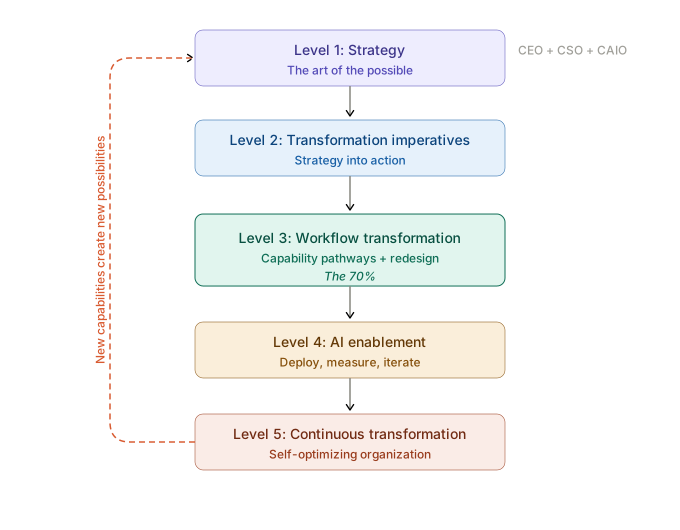
Article 18 selected the technologies. Now those technologies must connect to the enterprise systems that actually run the business: the ERP platforms that process transactions, the CRM systems that manage customer relationships, the supply chain applications that coordinate logistics, the HR systems that manage the workforce, and the financial platforms that close the books every quarter. These systems represent decades of investment, customization, and accumulated business logic. They are not going away. The AI must work with them.
This is where most AI implementations fail.
Deloitte's research across 3,235 senior leaders found that 60% of organizations identify legacy system integration as their primary challenge in scaling AI, with only 14% having solutions ready for deployment and just 11% running AI in production.1 Capgemini's World Quality Report found integration complexity is a top barrier for 64% of enterprises, with data privacy risks cited by 67% of respondents.2 IBM's research documents that 70% of enterprise development capacity remains tied up in maintaining and modernizing legacy systems, leaving limited capacity for the integration work AI demands.3 These are not organizations that lack integration expertise. enterprise CIOs have spent careers connecting enterprise systems. The problem is that AI integration is structurally different from any integration the organization has done before, and the expertise that served the CIO's team through ERP and CRM implementations does not transfer.
What does traditional enterprise integration look like?
Traditional enterprise integration connects applications that exchange structured data through predetermined interfaces, a discipline the CIO’s integration team knows well. An ERP system sends a purchase order to a supplier portal through a defined API. A CRM system passes customer records to a marketing automation platform through a scheduled batch transfer. A data warehouse ingests transaction records from multiple source systems through ETL pipelines that run overnight.
The patterns are well established. The data is structured. The interfaces are static. The interactions are predetermined: system A sends this data to system B in this format at this frequency. Authentication is session-based, designed for human users operating within role-based access controls. Governance is applied at system boundaries: each system enforces its own access rules, and the integration layer moves data between those boundaries. When something breaks, the failure is deterministic: the API returned an error code, the batch job timed out, the data format did not match the schema.
This approach has worked for decades because the systems on both ends are deterministic. Configure the integration correctly, and it performs the same way every time. The CIO's team has deep expertise in this discipline, supported by mature tooling, established patterns, and systems integrators who have delivered thousands of these implementations. The challenge at Level 4 is that AI integration breaks every one of these assumptions.
What makes AI integration a different discipline?
Five structural differences make AI integration a different discipline, and each has been documented by the implementation firms building AI integrations for enterprise clients. These are not theoretical distinctions. They are operational realities that these firms encounter in production.
AI requires dynamic interaction patterns rather than static interfaces. Traditional integration connects known systems through predetermined interfaces. AI agents discover tools dynamically, negotiate access to data sources at runtime, and modify their interaction patterns based on context. Deloitte's research is direct: traditional enterprise systems were not designed for agentic interactions, and most agents still rely on APIs and conventional data pipelines that create bottlenecks and limit their autonomous capabilities.1 Accenture encountered this limitation in its own global deployment and built a dedicated agentic integration platform specifically because existing integration patterns could not handle the dynamic, multi-directional interaction that AI requires.4 The workflow designs from Level 3 specify what the AI needs to do within each enterprise system. The integration architecture must support those interactions even when they are not fully predetermined in advance.
AI must interpret unstructured data, not merely receive structured records. Traditional integration passes structured data through defined schemas: order numbers, customer IDs, transaction amounts. AI must also interpret contracts, emails, meeting notes, support tickets, and documentation alongside those structured records. IBM expanded its enterprise data platform specifically to address this gap, finding that connecting AI to unstructured data through proper integration architecture produces 40% more accurate AI outputs compared to conventional approaches.3 A customer service AI agent resolving a delivery issue may need to pull order status from the ERP, past interaction history from the CRM, product details from a documentation portal, and current stock from the warehouse system simultaneously. The integration architecture must unify access across structured and unstructured sources in a way that no previous enterprise integration has required.
AI demands real-time data access rather than batch processing. Traditional enterprise integration often relies on batch transfers: overnight ETL jobs, scheduled data refreshes, periodic synchronization. AI agents make continuous decisions that require data reflecting the current state of the business. Deloitte found that enterprise data architectures built around ETL processes and data warehouses create fundamental friction for agent deployment, because agents need to understand business context and make decisions on current information, not yesterday's snapshot.1 Capgemini's technology outlook reinforces this: agentic systems require scalable, low-latency infrastructure where edge and cloud work as a single intelligent fabric.5 The workflow designs from Level 3 specify what decisions the AI makes and how quickly those decisions must reflect current conditions. Those specifications become latency and freshness requirements for the integration architecture.
Governance must travel with the data through the integration layer. In traditional integration, governance is applied at system boundaries. Each system enforces its own access rules, and the integration layer is a neutral conduit. In AI integration, data is continuously ingested, transformed, and recombined as it flows into models, which means governance cannot be applied only at the boundaries. It must be embedded in the integration pipelines themselves. All four major implementation firms have built governance directly into their AI integration platforms rather than treating it as a separate layer. Accenture required all telemetry flowing through its integration platform to be verified as accurate, compliant, and used in a responsible and secure way.4 IBM built a dedicated observability and governance layer that provides full lifecycle transparency with real-time monitoring and policy-based controls.3 Capgemini's integration platform includes governance, real-time monitoring, and orchestration as core capabilities.6 The governance specifications from Article 7, operationalized into the workflow designs at Level 3, become direct technical requirements for how the integration architecture handles data in transit, not just data at rest.
Agent identity and access management has no precedent in traditional systems. Traditional enterprise systems assume users are humans operating within role-based sessions. A procurement manager logs in, the system grants access based on their role, and the session ends when they log out. AI agents require contextual, least-privilege permissions that may span multiple systems simultaneously. An AI agent processing a customer request may need read access to the CRM, write access to the order management system, and read access to the inventory system, all within a single workflow execution, with permissions that vary based on the specific task and governance classification. Deloitte identifies this explicitly: legacy systems lack the secure identity management needed for true agentic integration.1 The market began filling this gap in 2026, faster than most organizations' governance did. Okta for AI Agents reached general availability on April 30, 2026, placing agents in the enterprise directory with ownership, lifecycle, and policy controls; Microsoft's Entra Agent ID treats agents as first-class identity principals with support for third-party agents through workload identity federation; Google shipped Agent Identity for Vertex AI; and the IETF is drafting agent authentication standards. The gap between adoption and control remains wide: Okta's research finds that 91% of organizations already use AI agents while only 10% have governance for them in place, and Forrester still names portable agent identity as an unsolved standards gap in the agentic stack.7 The governance framework from Article 7 specified accountability structures and oversight requirements. The integration architecture must translate those into identity and access controls that work for autonomous agents, not human users, and it can now do so with products that exist rather than patterns invented in-house.
What is the most consequential AI integration architecture decision?
Before building anything, the CIO must make a deliberate choice about the overall architectural approach: incremental integration or comprehensive transformation. McKinsey frames this as the most consequential decision a technology leader can make at this stage.8
Incremental integration treats AI as an augmentation layer on top of existing systems. Legacy systems remain intact. AI agents connect through APIs, translating legacy system outputs into more usable forms. An insurance company deploys an underwriting agent that queries a legacy risk engine through APIs, translating its outputs into natural language explanations for underwriters. The underlying system stays intact, but its usability, transparency, and speed are transformed. This path preserves continuity, manages cost, and allows the CIO to scale AI integration at a measured pace. The tradeoff is increased technical debt and the risk that the integration patterns become brittle as the number of AI-enabled workflows grows.
Comprehensive transformation overhauls the architecture to be natively designed for AI workflows. Rather than connecting AI to legacy systems through adapter layers, the architecture is rebuilt so that AI agents, enterprise applications, and data sources operate within a unified, composable framework. This path requires substantially more investment and organizational disruption, but the marginal cost of adding new AI-enabled workflows drops dramatically once the foundation is in place.
Most organizations will pursue a middle path: domain-based modernization, where the domains with the highest transformation value receive comprehensive integration architecture while other domains connect through incremental approaches. The Level 3 workflow specifications inform this decision directly. Domains whose workflow designs require deep, real-time, multi-system integration may justify comprehensive modernization. Domains whose workflows require lighter AI interaction with enterprise systems may be well served by incremental API-based integration. The Level 1 triad's portfolio view and the CIO's assessment of implementation capacity should inform the sequencing.
What is the orchestration layer and why does AI integration require it?
AI integration requires a new orchestration layer between AI agents and enterprise systems that manages responsibilities no previous middleware was designed to handle. Traditional middleware moves data between systems through predetermined paths. The orchestration layer does something fundamentally different: it manages agent memory across multi-step workflows, coordinates multiple AI agents working on related tasks, enforces governance at the workflow level rather than the system level, and provides observability that tracks not just whether data moved successfully but whether the AI’s decisions within the workflow were consistent with the governance specifications. The architecture must address what Forrester identifies as three distinct functional planes: building agents, embedding them into business workflows, and managing and governing them at scale. Enterprises that treat these as a single problem rather than distinct challenges consistently underestimate the complexity.9 Forrester’s own characterization of the market is blunt: this is "the dial-up internet phase of the agentic era," with governance best placed in an out-of-band oversight plane and three standards gaps still open: incomplete instrumentation, absent portable agent identity, and missing cross-plane governance schemas.9
The organizations that have deployed this layer at enterprise scale have surfaced lessons that every CIO should account for. The orchestration layer must be designed for a multi-vendor reality. Organizations will inevitably run agents from multiple providers, and those agents need to share context and hand off tasks without requiring a human to serve as the relay between them. The standards for that interoperability hardened over the past year: the Model Context Protocol and the Agent2Agent protocol moved under Linux Foundation governance in December 2025 with OpenAI, Google, Microsoft, and Anthropic all participating; A2A shipped its v1.0 stable release and MCP its v2.0 release with OAuth 2.1 authentication in early 2026; and a joint interoperability specification now defines the reference architecture, MCP for tool integration and A2A for agent-to-agent coordination. These are no longer emerging standards but formal open standards, with more than 150 organizations behind A2A alone.10 IBM's enterprise deployments demonstrated that this multi-agent coordination is an architectural requirement that must be designed from the beginning, not bolted on after the first vendor's agents are already in production.3 Data accuracy is equally foundational. Every piece of telemetry flowing through the orchestration layer must be verified as accurate, compliant, and used responsibly. AI agents operating on inaccurate data do not simply produce wrong answers; they compound errors across automated workflows in ways that are difficult to trace after the fact. This is why Accenture's global deployment identified data accuracy as the single biggest ground-level challenge, above architecture, above tooling, above talent.4 And governance, monitoring, and orchestration cannot be treated as separate capabilities. When they are separated, gaps emerge between what the AI is authorized to do and what the system can actually observe and enforce, creating exposure that the organization may not discover until an incident surfaces it. This failure mode is now documented at scale. Harvard Business Review's March 2026 research on the last-mile problem describes a global bank whose human-in-the-loop controls broke down under multi-agent architectures, and another institution already running more than 100 agents while planning for tens of thousands; the researchers' recommendation is a centralized agentic control plane.11 The control plane category has also become explicit vendor strategy: IBM repositioned watsonx Orchestrate at Think 2026 as an agentic control plane for agents from any source, and PwC's agent OS won a 2026 CIO 100 award for the same unifying role across clouds and vendors.12
The CIO's architecture team must ensure that whatever orchestration approach they adopt supports the specific governance requirements from the framework, preserves the composability that prevents vendor lock-in, and can accommodate the workflow designs from Level 3 without requiring those designs to be simplified to fit platform constraints.
How do Level 3 deliverables become integration requirements?
The Level 3 workflow designs become the specific, quality-gated integration requirements — precisely what the AI needs from each enterprise system — that most organizations attempting AI integration lack. Without them, teams connect AI to legacy systems without knowing precisely what the AI needs to do within those systems. Accenture’s chief information and asset engineering officer validated this directly: the business processes must be reinvented before technology is infused.4 The methodology ensures that reinvention happened at Level 3, and it is the methodology’s most concrete advantage for integration architecture.
Each workflow design specifies what data the AI needs from each enterprise system and in what format. It specifies what actions the AI takes within those systems and what triggers those actions. It specifies the governance classification that determines what level of oversight applies to each data flow and each AI action. It specifies the human oversight architecture that the integration must support as a system-level constraint. And the cross-department interface specifications from Article 14 identify where AI-enabled workflows in one domain depend on data or actions from systems owned by another domain.
These specifications translate directly into integration requirements. The data access requirements become API specifications and data pipeline designs. The governance classifications become access control policies and monitoring configurations. The human oversight requirements become workflow gates that the integration architecture must enforce. The cross-department dependencies become integration priorities that determine which system-to-system connections must be built first.
Without these specifications, the CIO's integration team is making architectural decisions based on assumptions about what the AI will need. With them, the team is building against documented, quality-gated requirements that have been validated by the domain owners who understand the business processes and confirmed by the CIO's team during the Tier 3 readiness assessment. This is the difference between the organizations in the research that scale AI successfully and the 60% that cite integration as the reason they stalled.
What Comes Next
Integration architecture is the connective tissue that makes AI operational within the enterprise. Article 20 covers how the AI is built, tested and deployed using the redesigned workflows through these connections, including the iteration cycle where the workflow designs meet production reality. Article 21 addresses data architecture at the level of detail the CIO and CDO need, including the data quality, governance, and infrastructure decisions that determine whether the integration architecture has reliable data to work with.
Sources
- 1.Deloitte, "Agentic AI Strategy," December 2025 (2025 Emerging Technology Trends study, 3,235 leaders). 60% cite legacy system integration as primary challenge; only 14% have deployable solutions; 11% in production; traditional systems not designed for agentic interactions; data architectures built around ETL create friction; legacy systems lack secure identity management for agents https://www.deloitte.com/us/en/insights/topics/technology-management/tech-trends/2026/agentic-ai-strategy.html
- 2.Capgemini/OpenText, "World Quality Report 2025-26," November 2025. Integration complexity cited as top barrier by 64% of organizations; data privacy risks by 67%; hallucination and reliability concerns by 60%; only 15% achieved enterprise-scale AI deployment https://www.capgemini.com/news/press-releases/world-quality-report-2025-ai-adoption-surges-in-quality-engineering-but-enterprise-level-scaling-remains-elusive/
- 3.IBM, 2025-2026. watsonx Orchestrate integrates with 80+ enterprise applications; AgentOps provides built-in observability and governance with real-time monitoring; 70% of development capacity tied to legacy maintenance; connecting AI to unstructured data produces 40% more accurate outputs vs. conventional approaches; CEO study (2,000 CEOs): 72% view proprietary data as key to AI value, half acknowledge data environments cannot support AI ambition https://www.ibm.com/consulting/advantage
- 4.Accenture, 2025-2026. AATA agentic integration platform deployed across global IT environment; 80% speed increase in provisioning; Distiller agentic framework covers end-to-end agent lifecycle including memory management, multi-agent collaboration, governance, and observability; biggest ground-level challenge was data accuracy; CIO: "You need to get your business processes reinvented before you infuse technology." https://newsroom.accenture.com/news/2025/accenture-launches-distiller-agentic-ai-framework-to-accelerate-scalable-industry-ai-solutions
- 5.Capgemini, "TechnoVision Top 5 Tech Trends to Watch in 2026," December 2025. Enterprise systems evolving from static systems of record to living engines of intelligent operations; agentic systems require scalable low-latency infrastructure with edge and cloud as single fabric; processes becoming the focus rather than applications https://www.capgemini.com/news/press-releases/agentic-ai-integration-set-to-accelerate-this-year-among-gen-ai-early-adopters/
- 6.Capgemini, "Agentic AI for Enterprise," 2025-2026. RAISE platform provides governance, real-time monitoring, and orchestration for unified agentic control; three implementation routes: off-the-shelf agents, custom agents, embedded agents; 82% of organizations plan to integrate AI agents within three years https://www.capgemini.com/us-en/solutions/solutions-agentic-ai-for-enterprise-by-capgemini/
- 7.Okta, "Okta for AI Agents," general availability April 30, 2026, agents managed in Universal Directory with ownership, lifecycle, and policy, https://www.okta.com/blog/ai/agent-idp-identity-stack/
- 8.McKinsey, "Rethinking Enterprise Architecture for the Agentic Era," March 2026. Incremental vs. comprehensive transformation; agentic mesh as orchestration layer connecting agents to traditional systems; domain-based modernization as middle path; composable architecture as interoperable building blocks https://www.mckinsey.com/capabilities/mckinsey-technology/our-insights/rethinking-enterprise-architecture-for-the-agentic-era
- 9.Forrester, "Announcing Our Evaluation of the Agent Control Plane Market." Three functional planes: build, orchestrate, govern; design tools and methods lag behind AI capability advancement; enterprises must treat planes as distinct problem spaces. Research questionnaires for the landscape report, the precursor to a Wave, were issued in April 2026; no Wave had been published as of mid-2026 https://www.forrester.com/blogs/announcing-our-evaluation-of-the-agent-control-plane-market/
- 10.Linux Foundation, "A2A Protocol Surpasses 150 Organizations, Lands in Major Cloud Platforms," 2026. MCP and A2A donated to Linux Foundation governance under the Agentic AI Foundation, December 2025, with OpenAI, Google, Microsoft, and Anthropic participating; A2A v1.0 stable release and MCP v2.0 (Streamable HTTP transport, OAuth 2.1 authentication) in Q1 2026; joint A2A-MCP interoperability specification draft in Q2 2026; 150+ supporting organizations https://www.linuxfoundation.org/press/a2a-protocol-surpasses-150-organizations-lands-in-major-cloud-platforms-and-sees-enterprise-production-use-in-first-year
- 11.Lakhani, K. R., Stave, J., and Spataro, J., "The 'Last Mile' Problem Slowing AI Transformation," Harvard Business Review, March 2026. Seven frictions slowing AI transformation, including agentic governance and architectural complexity; global bank case where human-in-the-loop controls broke down under multi-agent architectures; recommendation for centralized agentic control planes https://hbr.org/2026/03/the-last-mile-problem-slowing-ai-transformation
- 12.IBM, "Think 2026: IBM Delivers the Blueprint for the AI Operating Model as the AI Divide Widens," May 5, 2026. Next-generation watsonx Orchestrate in private preview as an agentic control plane; agents from any source with consistent policy enforcement, auditability, and accountability https://newsroom.ibm.com/2026-05-05-think-2026-ibm-delivers-the-blueprint-for-the-ai-operating-model-as-the-ai-divide-widens
Frequently Asked Questions
Our enterprise runs on SAP or Oracle with decades of customization. How does AI integration work with heavily customized legacy systems?
The customization is actually where much of the integration complexity lives. Standard SAP or Oracle modules have increasingly well-documented APIs and integration patterns. The custom extensions, proprietary business logic, and modified data structures that the organization has built over decades are what make AI integration challenging, because those customizations were designed for human operators and may not expose the data or functionality that AI agents need. The integration architecture team must inventory these customizations and determine for each one whether the AI can access what it needs through existing interfaces, whether new APIs or data services must be built, or whether the customization itself needs to be modernized. The Level 3 workflow specifications identify exactly which data and functionality the AI needs from each system, which makes this inventory targeted rather than comprehensive.
How do we prioritize which enterprise systems to integrate first when every workflow design touches multiple systems?
Start with the Level 3 workflow designs that the Level 1 triad has prioritized for initial deployment. Map each workflow to the specific enterprise systems it touches and the specific data and actions it requires from each. The systems that appear across the highest-priority workflows with the most demanding integration requirements, real-time data access, governance enforcement, multi-system coordination, should be integrated first. The CAIO's department can help identify where cross-domain workflows share system dependencies, which may create opportunities to build integration infrastructure that serves multiple domains simultaneously.
What happens when the AI needs real-time data from a system that only supports batch processing?
This is one of the most common integration challenges and has no single answer. Options include building a change data capture layer that streams updates from the batch system in near real-time, creating a caching layer that maintains a current-state view refreshed at intervals the workflow can tolerate, or modernizing the specific data feeds the AI needs while leaving the rest of the batch system intact. The right approach depends on the workflow's latency requirements, which the Level 3 specifications define, and the CIO's assessment of the technical feasibility and cost of each option. In some cases, the domain owner may need to adjust the workflow design to accommodate a data freshness constraint that cannot be resolved within the available budget and timeline.
How does the governance framework from Article 7 translate into specific integration architecture requirements?
The governance framework specified risk classifications, accountability structures, and oversight requirements. At the integration level, these translate into concrete technical requirements: high-risk data flows require encrypted transit with full audit logging; high-risk AI actions require approval gates enforced as system-level workflow constraints; accountability traceability requires that every AI decision can be reconstructed from the data it received, the model that processed it, and the action it took. The integration architecture must also enforce data access boundaries: an AI agent operating under one governance classification should not be able to access data classified at a higher risk level without the appropriate oversight controls being triggered.
Should we build the orchestration layer ourselves or adopt a platform from an implementation firm?
The build vs. adopt decision depends on the organization's technical capabilities, the scope of the transformation, and the degree of customization the workflow designs require. The implementation firms offer mature platforms that accelerate deployment, but they also introduce the lock-in considerations Article 18 described. Organizations with strong internal engineering teams and highly specific workflow requirements may benefit from building on open-source orchestration frameworks. Organizations that need to move quickly and are willing to accept platform dependency may benefit from adopting an established platform. In either case, the CIO's team should evaluate the orchestration approach against the same criteria Article 18 established: does it support the governance requirements, preserve composability, and serve the workflow designs without requiring those designs to be simplified?
How do we manage the security implications of giving AI agents access to enterprise systems designed for human users?
AI agent access requires a fundamentally different security model than human user access. Where human access is session-based and role-defined, agent access must be contextual and task-scoped: the agent receives only the minimum permissions needed for the specific workflow step it is executing, and those permissions expire when the step completes. The security team needs the governance specifications from Level 3 as direct input, because those specifications define what the AI is authorized to do at each workflow step. The integration architecture must enforce these boundaries as system-level constraints. This is a new discipline for most enterprise security teams, and the CIO should assess whether the current team has the expertise to design agent-specific access controls or whether this is an area where external expertise is needed.
This series addresses “what” to do, not “how” to do it. If you are a business executive and would like help thinking through the “how,” please feel comfortable reaching out.

About the author
Shawn Plaster
Founder & CEO, Plaster Group
Shawn is the author of Plaster Group's five-level AI Business Transformation Methodology and its 27-article Insights series, and leads the firm's enterprise AI transformation work.
Previous: Article 18: Technology Selection for AI Business Transformation · Next: Article 20: Deploying AI Into Redesigned Workflows
© 2026 Plaster Group, LLC. All rights reserved. This article may not be reproduced, distributed, or transmitted in any form without prior written permission from Plaster Group. Brief excerpts may be quoted for review or commentary purposes with attribution to the author and a link to the original article.
Ready to move forward?
Let's discuss how your organization can build with AI — securely, strategically, and starting from where you are today.
Start a Conversation