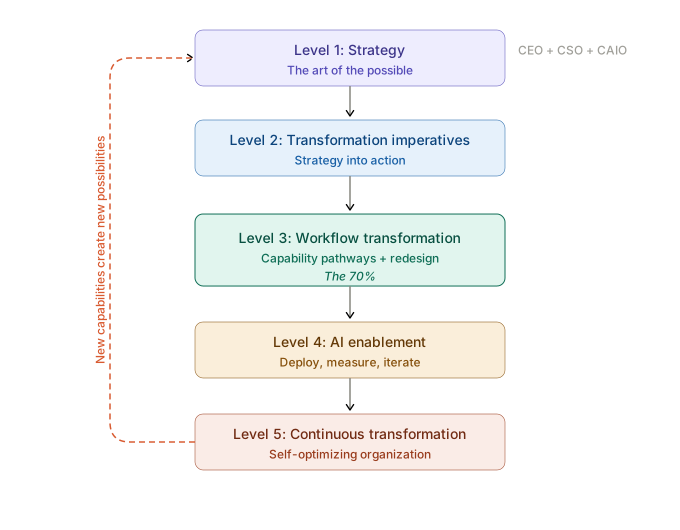
The series synthesis. Article 1 made the moral case that anticipatory AI-attributed layoffs were the wrong response to AI transformation. The 2026 research from every major strategy firm, implementation firm, and academic institution documents the same argument empirically. This article is the bookend to Article 1, the synthesis of the methodology the series has laid out, and the call to business executives making workforce decisions right now.
For several years now, the dominant story about AI and the workforce has been one of displacement. Headcount reductions justified by AI capability that had not yet been proven. Layoffs announced weeks or months before the AI systems that were supposed to replace the displaced work were deployed. A prevailing narrative that AI transformation required workforce reduction as a prerequisite.
The argument was never true, and the research arriving across 2026, from every major strategy firm, implementation firm, and academic institution, now makes that unambiguous. The organizations winning with AI are not the organizations that cut their workforce first. They are the organizations that kept their people, invested in the capability to redesign work, and built the foundations on which AI could generate value.
This article is the series synthesis. It is also the empirical bookend to Article 1, which argued, when the evidence was still emerging, that anticipatory AI-attributed layoffs would prove to be the most expensive strategic error in enterprise history. The evidence has arrived. The argument that was moral is now empirical.
Has the workforce pattern from Article 1 resolved?
The pattern Article 1 described has not resolved — it has accelerated. That is the first thing to understand about the 2026 research.
Challenger, Gray & Christmas, the outplacement firm that has tracked monthly U.S. job cut announcements since 1993 and is cited weekly by the Wall Street Journal, Reuters, and Bloomberg, documents a sharp acceleration in AI-cited layoffs across the first half of 2026. AI-attributed cuts rose from 5 percent of monthly job cut announcements in January to 10 percent in February to 25 percent in March, with the March total of 15,341 AI-cited cuts marking the first month in which AI led every category of stated reason for corporate layoffs. The acceleration continued through the second quarter: AI accounted for 26 percent of announced cuts in April, then a record 38,579 cuts in May, 40 percent of that month’s total and the highest monthly AI-attributed figure Challenger has ever recorded, before cooling to 31 percent in June, the fourth consecutive month in which AI led all stated reasons.1 Through June 30, AI was cited in 101,743 cuts, roughly 23 percent of all announced cuts in the first half and already nearly double the 54,836 recorded for all of 2025.
One precision matters when reading these numbers. AI’s share is rising inside a total that is falling: overall first-half announcements of 443,604 were down 40 percent from the first half of 2025, a comparison base inflated by that year’s government-driven cuts. The story is not that layoffs are rising. It is that AI is claiming a rapidly growing share of the layoffs that do happen. As Andy Challenger put it in the firm’s April report: “Regardless of whether individual jobs are being replaced by AI, the money for those roles is.”1
The acceleration alone does not tell the whole story. The more consequential finding is what is happening to the organizations that made the cuts.
What is the Layoff Cost Paradox?
The Layoff Cost Paradox is LHH’s finding that organizations which lay off without integrated outplacement and redeployment strategies lose talent they later rehire at a premium, producing compounding costs from external rehiring, lost institutional knowledge, and eroded trust. The global talent solutions firm LHH, a business unit of the Adecco Group, surveyed 3,000 HR leaders and more than 8,000 employees across seven countries for its April 2026 report, The Mobility Breakdown.2 The research documents that 87 percent of HR leaders have already conducted or are planning layoffs in the next twelve months, up from 73 percent in 2024 and 77 percent in 2023. Of the employers who actually track the cost of rehiring, 73 percent acknowledge that rehiring talent costs more than targeted redeployment and internal mobility would have cost in the first place.
Separate research published by the workforce planning firm Orgvue in April 2025 found that 32 percent of organizations that made AI-attributed layoffs had already had to rehire, often within months of the original cuts, after discovering that the AI systems could not perform the work the people had performed.3
The pattern has since been confirmed independently. Robert Half data reported by CNBC on July 1, 2026 found that 32 percent of U.S. hiring managers who eliminated a role primarily because of AI later rehired for the same or a similar role. The two 32 percent figures come from separate samples taken more than a year apart, and their agreement is the point. A Careerminds survey of 600 HR professionals, reported alongside the Robert Half data, found that two in three employers that cut jobs because of AI are already rehiring. The reversals now have names: Ford rehired 350 engineers, IBM plans to triple U.S. entry-level hiring in 2026, and Commonwealth Bank of Australia reversed AI-linked cuts.3
The cost paradox is the first empirical validation of Article 1’s core contention that anticipatory layoffs were economically irrational even before the moral case was considered. The organizations that are discovering the cost paradox now are the ones that cannot recover the institutional knowledge they eliminated and cannot afford the premium to replace it.
Are companies expecting to reverse their AI-driven layoffs?
The leaders closest to the AI investment decision have already priced in a reversal, with Forrester’s Predictions 2026 report, published late in 2025, forecasting that approximately 50 percent of AI-attributed layoffs will be reversed within the year through quiet rehiring at reduced compensation or offshore positions.4 In the same research, 55 percent of employers reported that they already regretted the AI-attributed cuts they had made. The balance of expectations among investment leaders has inverted. 57 percent now expect their AI deployments to increase their headcount over the next year, while only 15 percent expect decreases, a near four-to-one reversal of the narrative that dominated 2024 and early 2025.
Forrester introduced the term AI washing to describe layoffs recharacterized after the fact as AI-driven when the underlying cause was market pressure, margin compression, or broader restructuring. The term matters because it names something the macroeconomic data has also been showing. Oxford Economics’ January 2026 research documented that AI-cited cuts accounted for only 4.5 percent of total 2025 U.S. layoffs, while cuts attributed to market and economic conditions accounted for nearly four times that volume.5 The macroeconomic productivity test that would be expected to follow large-scale AI-driven labor displacement still fails to appear in the data. What appears instead is firms, in the framing of Oxford Economics, dressing up layoffs as a good news story.
How do workers see AI in their own organizations?
Workers see the situation clearly, and the picture is grim: global employee engagement fell to 20 percent in 2025, its lowest level since 2020 and costing the world economy an estimated $10 trillion in lost productivity, according to Gallup’s 2026 State of the Global Workplace report, which surveyed workers across more than 140 countries.6 Only 28 percent of U.S. workers now say it is a good time to find a quality job, down from 70 percent in mid-2022. In U.S. organizations where AI has been implemented, 23 percent of employees report that it is very or somewhat likely their job will be eliminated within the next five years. The rate rises to 32 percent in finance, 32 percent in insurance, and 31 percent in technology.
But Gallup also documents the counter-pattern that executives setting AI strategy should be reading most carefully. Employees who believe their manager actively supports their team’s use of AI are 8.7 times more likely to strongly agree that AI has transformed how much work gets done at their organization. They are 7.4 times more likely to say AI gives them more opportunities to do what they do best every day. The multiplier on management engagement with AI is structurally larger than almost any other variable Gallup’s research identifies.
The implication is straightforward. If the multiplier on active management support for AI is 8.7x on the positive side of the ledger, the signal an organization sends when it announces layoffs in the name of AI, before the AI is even deployed, is running in the opposite direction at comparable scale.
The research does not vindicate Article 1 because it documents that layoffs happened. Layoffs were never in dispute. The research vindicates Article 1 because it documents that the layoffs were premature, expensive to reverse, and correlated not with AI-enabled value creation but with disengagement, institutional knowledge loss, and compounding rehiring costs. The organizations that were going to win from AI were never the ones that front-loaded the cuts. The research on what those winning organizations actually do is what the next section takes up.
What does the research say actually works in AI business transformation?
The research consensus is that AI business transformation is 80 percent business and 20 percent technology, and across 2026 that same ratio appears from different methodological angles in research program after research program. The 80/20 principle at the center of this methodology was introduced in Article 2 as a framework proposition grounded in McKinsey’s research on workflow redesign.
McKinsey’s 2026 State of Organizations report, drawing on interviews with 10,000 leaders across 15 countries, surfaces what one executive in the research described in a simpler form: for every dollar an organization spends on AI technology, it should expect to spend roughly five dollars on the people, processes, and organizational redesign around it.7 Organizations that prioritize people in their AI transformations are four times more likely to maintain top-tier financial performance than peers. PwC arrives at the same ratio from a different angle. Its 2026 AI Business Predictions estimates that approximately 20 percent of AI initiative value comes from the technology itself, and approximately 80 percent comes from redesigning work so that AI and humans can do together what neither does well alone. PwC’s April 2026 AI Performance Study, surveying 1,217 senior executives across 25 sectors, documents the behavioral companion: the leading organizations are twice as likely to redesign workflows to incorporate AI rather than simply adding AI tools.8 What this methodology introduced in Article 2 as a principle, the 2026 research now documents as an empirical pattern.
The organizations that invest in the 20 percent (tools, platforms, agents) without investing in the 80 percent (workflow redesign, capability building, cultural readiness, workforce redeployment) are in the group the research documents as unable to convert AI activity into measurable financial returns.
The workforce-investment finding appears across every major 2026 research program, reported with different vocabulary but converging on the same empirical pattern. Bain’s February 2026 Think People First analysis of companies with high workforce engagement documents a 2.3x total shareholder return, annualized over five years, relative to low-engagement peers.9 BCG published a paper in February 2026 whose title is the thesis: AI Transformation Is a Workforce Transformation.10 Deloitte’s 2026 Global Human Capital Trends, based on surveys of more than 9,000 leaders across 89 countries, documents that 85 percent of leaders say building their organization’s and workforce’s ability to adapt is critical, while only 7 percent say they are leading in that work. Only 6 percent of leaders say they are making meaningful progress in designing human-AI interactions. 56 percent of leaders design AI solely for business outcomes; only 40 percent design for business and human outcomes together.11 Deloitte calls the gap that organizations accumulate when they scale AI without the supporting accountability and trust structures culture debt.
Capgemini’s January 2026 research, surveying 1,505 executives in 15 countries, articulates the pattern in one line that has been picked up widely: AI is amplifying, not replacing, human capabilities.12 Sixty-six percent of organizations in the study report measurable productivity improvements from human-AI collaboration. Six in ten are redefining skillsets and actively investing in workforce upskilling.
The research does not say workforce investment is one of several paths to AI value. It says workforce investment is the single most powerful driver of AI financial performance. The methodology this series has laid out across 26 articles, with its insistence that work precedes tools, humans precede agents, and strategy precedes platforms, is the methodology the 2026 research now recommends.
Why does the methodology compound over time?
The methodology compounds because its mechanism is human, not architectural. That distinction is what makes the effect durable.
AI business transformation requires a form of knowledge that does not appear in the training data of any foundation model. It is the institutional memory of how this company actually does what it does. The customer behaviors that don’t match the industry template. The process exceptions the manual never documented. The market signals only the people who have been in the rooms know how to read. Practitioners call it tribal knowledge. It lives in the minds of employees, not in documents, and it is precisely what probabilistic AI systems need, in deployment, to convert statistical prediction into decisions that are correct for this business.
Probabilistic systems do not arrive in production ready. They arrive with capability that has to be calibrated against the reality of a specific organization’s work. The people who provide that calibration are domain practitioners: the finance analysts who know which accounting anomalies are real signals and which are system noise, the supply chain managers who know which vendor delays predict cascade and which are routine, the customer service leaders who know which complaint patterns indicate churn risk. The vast majority of these people do not sit in the CAIO’s organization. They sit in the business. They are the existing workforce.
This is where the compounding begins. In the first phase of AI deployment, domain practitioners supply tribal knowledge to calibrate the probabilistic systems, and the AI systems improve because the feedback they receive is accurate. As the systems mature and need less intervention, those same practitioners become something more valuable. They are now experienced veterans who have seen what it takes to implement AI-driven capabilities in practice. The organization pivots them into new growth areas, new products, new markets, new business models, where their experience becomes the foundation of whatever comes next. The calibrators become the growth drivers. The next wave of AI capabilities brings in the next cohort of calibrators. The cycle repeats, and each turn compounds on the last.
The organizations that cut their experienced domain practitioners in 2024 and 2025 short-circuited this loop at phase one. They have AI systems in production. What they lack is the calibration capacity those systems need to produce accurate output. Deloitte’s 2026 research documents that only 6 percent of leaders say they are making meaningful progress designing the human-AI interactions that calibration requires.11 The AI is deployed. The calibrators are gone. The output is statistical prediction without organizational context, which is why the cut-first cohort shows activity without financial translation.
The organizations that kept their workforce are on a different trajectory. Their practitioners are calibrating AI now. In two to three years they will be the veterans who know how to implement AI-driven capabilities in new contexts. In three to five years they will be driving the growth the next round of AI investment is funding. The methodology compounds because the people compound. The architecture follows from that.
Is the split between AI leaders and laggards actually causal?
The cohort split is causal, and the gap is widening quarter by quarter. Article 26 documented that the distribution of AI-driven financial returns across the Fortune 500 is widening, not narrowing, and that the distribution now visibly distinguishes a minority of organizations generating the majority of AI-driven financial returns from a majority of organizations running pilots that produce operational gains without financial translation.
The 2026 research surveyed in this article does not document a single organization that has cut its way into the leading cohort. The research documents organizations that invested in workforce capability and are now in the leading cohort. It documents organizations that front-loaded cost reduction and are now in the no-measurable-impact cohort. It documents organizations that are discovering the rehiring premium, the culture debt, and the disengagement penalty simultaneously. It does not document the counterexample.
The two closest candidates deserve direct engagement, because critics will raise them. Klarna cut headcount roughly in half between 2022 and 2025 and now reports strong financials, including a first billion-dollar quarter in late 2025 and revenue per employee of 1.24 million dollars. But the reduction came overwhelmingly through attrition and a hiring freeze rather than layoffs, average compensation rose from 126,000 dollars to 203,000 dollars, and the company reversed its most publicized substitution: by early 2026 it was rebuilding human customer support after satisfaction deteriorated, with CEO Sebastian Siemiatkowski calling quality human support “the way of the future.”14 Shrinking by attrition while paying the remaining people substantially more is not cutting your way into the leading cohort; it is closer to this methodology’s argument than to the counterargument. IgniteTech, a private software firm profiled by Fortune in June 2026, replaced roughly 80 percent of its staff over two years over resistance to AI and claims strong margins since. The numbers are self-reported and unverified, and the workforce was replaced rather than eliminated; it is a culture story, not a headcount-reduction story.15 Neither case documents a company that cut its way to top-tier AI value.
One contrary stream in the data deserves acknowledgment rather than rebuttal. The Stanford/ADP “Canaries in the Coal Mine” dashboard shows that through April 2026, employment declines for 22-to-25-year-olds in the most AI-exposed occupations have not reversed, and Anthropic’s Economic Index similarly finds hiring of that age group into the most exposed roles running roughly 14 percent below its expected trend.16 Real, persistent entry-level displacement exists, and pretending otherwise would discredit the argument. The claim this series makes is precise, and it should be read precisely: cutting does not create AI leaders. That is not the same claim as AI is not displacing anyone.
The reinforcing evidence runs the other way at the company level. PwC’s 2026 Global AI Jobs Barometer, an analysis of more than one billion job ads across 27 countries published June 15, 2026, finds headcount at the most AI-exposed companies growing faster than at the least exposed, an AI-skills wage premium that has risen to 62 percent, and AI-skill jobs growing roughly eight times faster than the market. The firms most advantaged by AI are adding people, not shedding them.17 The mechanism matches what a March 2026 National Bureau of Economic Research working paper documents from a survey of roughly 750 executives: AI’s productivity gains are arriving through innovation and demand channels, not through labor cost cutting.18
The pattern across the research is consistent and, for an enterprise leader reading this in 2026, strategically actionable. Workforce investment is not a cost to be managed. It is the lever that produces the compounding. Organizations that treat it as the former are in the cohort that is now visibly losing.
What strategic opportunity does industry convergence open for leaders who kept their people?
Industry convergence hands leaders who kept their people a durable opening, because AI itself is becoming a commodity. The foundation models are converging in capability. The platforms are converging in feature set. The orchestration layers are converging in what they can coordinate. Within eighteen months, the technical difference between what an AI investment looks like at an enterprise bank and what one looks like at an enterprise retailer will be narrower than the difference between the two companies today. This is the direction every technology cycle has gone, and AI is going in the same direction, faster.
What AI cannot commoditize is the knowledge that lives in people. The patterns a twenty-year supply chain veteran has seen. The customer intuition of a senior account executive who has worked a vertical for a decade. The regulatory judgment of a compliance officer who has walked fifteen audits. The cross-industry relationships a seasoned sales leader has built with counterparts in other sectors. These are the competitive moats that remain once the AI tools look the same.
The PwC 2026 AI Performance Study surveyed 1,217 senior executives across 25 sectors and identified the single strongest factor influencing AI-driven financial performance. It is not efficiency. It is not productivity. It is not deployment sophistication. It is the capture of growth opportunities from industry convergence, the pursuit of revenue from offerings and partnerships that cross traditional sector boundaries.8 The organizations leading in AI are 2.6 times as likely as peers to report that AI is improving their ability to reinvent their business model. They are two to three times as likely to pursue growth from industry convergence specifically. Their AI-driven financial performance is 7.2 times that of the rest of the sample.
Industry convergence is the dissolution of traditional sector boundaries that AI makes operationally possible for the first time at scale. A retailer becoming a logistics platform. A bank becoming a data-services firm. A manufacturer becoming a mobility company. The opportunity is real, and the PwC data documents that it is the highest-return strategic move available to organizations with the capability to execute it. Capability is the operative word. AI does not execute industry convergence. People do. AI makes the combinations feasible by handling the technical complexity that used to make them impossible. What it cannot do is see which combinations create real value, evaluate whether they fit the organization’s strategic reality, build the cross-industry relationships that partnerships require, or redesign the work so that the people and the AI produce together what neither could alone. Those are human capabilities, and they are the capabilities that organizations which cut their most experienced workers, and demoralized the ones who stayed, no longer have in sufficient quantity to execute at this level.
The small number of enterprises that have done AI business transformation well built their foundations early, kept their people, and are now using AI to pursue the industry-convergence opportunities the PwC data documents. The rest of the Fortune 500 is not yet there. The research collectively suggests this is not an argument to stop investing. It is an argument to start with the foundation. Not tools. Not platforms. Not agents. People, processes, and strategy.
The decision about whether to keep the people is being made right now, in boardrooms and corner offices, by leaders who will not see the full consequences of the decision for three to five years. The decisions being made this quarter will shape the next decade of the American economy and the working lives of tens of millions of people inside it.
The research published over the past six months makes one thing unambiguous. The organizations that are winning with AI are not the organizations that cut their workforce first. They are the organizations that retained their workforce, invested in the capability to redesign work, and built the foundations on which AI could generate value. The gap between the two cohorts is widening quarter by quarter. The 2026 research surveyed in this article does not document any organization that has cut its way into the cohort that is now winning.
This is not a problem the CEO alone will solve. It is solved by the CEO, the CSO, the CAIO, the CIO, the CHRO, the CFO, the domain owners, the VPs running the transformation, and the board that sets the strategic direction, each of them making the same decision one at a time. The question is what each of them will carry into the next room when they leave the one they are in right now.
Your future is the people you kept.
Sources
- 1.Challenger, Gray & Christmas. Monthly U.S. Job Cut Reports, January through June 2026. Includes “Challenger Report: June Layoffs Cool to 45,849, Down 53% From May; AI Leads Reasons for Fourth Consecutive Month,” July 1, 2026, which reports the first-half totals https://www.challengergray.com/
- 2.LHH (The Adecco Group). The Mobility Breakdown: Redeployment and Outplacement Trends Report. April 21, 2026. Survey of 3,000 HR leaders and 8,000+ employees across the United States, Canada, Switzerland, the United Kingdom, France, Brazil, and Australia.
- 3.Orgvue. “55% of Businesses Admit Wrong Decisions in Making Employees Redundant When Bringing AI Into the Workforce.” Press release, April 29, 2025 https://www.orgvue.com/news/55-of-businesses-admit-wrong-decisions-in-making-employees-redundant-when-bringing-ai-into-the-workforce/
- 4.Forrester Research. Predictions 2026: The Future of Work. Published late 2025 https://www.forrester.com/
- 5.Oxford Economics. Research on 2025 U.S. layoff attribution and macroeconomic productivity effects of AI adoption. January 2026 https://www.oxfordeconomics.com/
- 6.Gallup. State of the Global Workplace 2026. Based on surveys across more than 140 countries. Includes Q1 2026 U.S. workforce data https://www.gallup.com/workplace/349484/state-of-the-global-workplace.aspx
- 7.McKinsey & Company. State of Organizations 2026. February 19, 2026. Based on interviews with 10,000 leaders across 15 countries.
- 8.PwC. 2026 AI Performance Study: Three-Quarters of AI’s Economic Gains Are Being Captured by Just 20% of Companies. Press release and report, April 13, 2026. Survey of 1,217 senior executives across 25 sectors worldwide https://www.pwc.com/gx/en/news-room/press-releases/2026/pwc-2026-ai-performance-study.html
- 9.Bain & Company. Think People First. February 28, 2026. Analysis of workforce-engagement correlation with total shareholder return across five-year annualized period (2020-2024).
- 10.Boston Consulting Group. AI Transformation Is a Workforce Transformation. February 4, 2026.
- 11.Deloitte. 2026 Global Human Capital Trends: From Tensions to Tipping Points, Choosing the Human Advantage. March 4, 2026. In collaboration with Oxford Economics. Survey of more than 9,000 business and HR leaders across 89 countries https://www.deloitte.com/us/en/insights/topics/talent/human-capital-trends.html
- 12.Capgemini Research Institute. The Multi-Year AI Advantage: Building the Enterprise of Tomorrow. January 15, 2026. Survey of 1,505 executives at large organizations globally across 15 countries https://www.capgemini.com/insights/research-library/ai-perspectives-2026/
- 13.EY-Parthenon. CEO Outlook 2026. Q4 2025 fieldwork. Survey of 1,200 global CEOs across 21 countries.
- 14.Klarna headcount, revenue-per-employee, compensation, and Q4 2025 results: Payments Dive, coverage of Klarna workforce and IPO, 2026, https://www.paymentsdive.com/news/klarna-buy-now-pay-later-bnpl-payments-workforce-ipo/742627/
- 15.Fortune. “This Tech CEO Fired 80% of His Workforce Over AI Resistance. Here’s What He’s Learned Since Then.” June 15, 2026 https://fortune.com/2026/06/15/this-tech-ceo-fired-80-of-his-workforce-over-ai-resistance-heres-what-hes-learned-since-then/
- 16.Stanford Digital Economy Lab and ADP, “Canaries in the Coal Mine” dashboard (Brynjolfsson et al.), as reported by Fortune, “What Is AI’s Impact on Entry-Level Jobs?” June 27, 2026, https://fortune.com/2026/06/27/what-is-ai-impact-entry-level-jobs-stanford-adp-canaries-brynjolfsson-richardson/
- 17.PwC. “2026 Global AI Jobs Barometer.” June 15, 2026. Analysis of more than one billion job ads across 27 countries https://www.pwc.com/gx/en/services/ai/ai-jobs-barometer.html
- 18.National Bureau of Economic Research. Working Paper 34984 (with the Federal Reserve Bank of Atlanta). Survey of approximately 750 executives on AI and productivity. March 25, 2026 https://www.nber.org/papers/w34984
Frequently Asked Questions
We already made cuts in 2024 or 2025. Is it too late for our organization to recover?
The research does not describe a closed door. It describes a widening gap. The organizations starting now from a lower base can still build the foundation, but the 2026 research is clear about what that foundation must start with. PwC’s 2026 data shows that organizations with strong foundations are significantly more likely to report meaningful financial returns from AI. Bain’s Think People First analysis documents that workforce engagement itself produces a 2.3x total shareholder return differential.9 EY-Parthenon’s 2026 CEO Outlook documents that CEOs who are moving, even from positions of uncertainty, are disproportionately pursuing transformation on multi-year rather than annual timelines.13 The research supports starting now. It does not support starting with technology first.
If workforce investment is the compounding lever, what does it actually look like in practice?
The practices the 2026 research locates in the leading cohort are specific. Manager-led AI adoption within teams, which Gallup’s research identifies as the strongest non-technical predictor of employee AI use at scale.6 Integrated outplacement and redeployment strategies rather than external rehiring cycles, which LHH documents as substantially less expensive than the alternative.2 Workflow redesign preceding AI deployment, which PwC’s 2026 Performance Study identifies as one of the two strongest predictors of AI-driven financial performance.8 Human-AI interaction design, which Deloitte documents that only 6 percent of leaders are currently making meaningful progress on.11 Cross-functional governance and responsible AI frameworks, which PwC documents in the leading cohort at significantly higher rates than the rest of the sample. The practices are distributed; none of them alone produces the compounding. The combination does.
Our competitors are announcing AI-driven restructuring and the board is asking why we aren’t doing the same. How do we resist that competitive pressure?
Three pieces of context help in that boardroom conversation. First, the competitors announcing AI-driven restructuring are making a decision that is visible. Visibility is not the same as value creation. The research documents that cut-first restructuring is disproportionately concentrated in the cohort showing no measurable AI-driven financial impact. The move draws attention; the outcomes do not follow. Second, the economics are now quantified. LHH’s April 2026 research shows that 73 percent of employers who actually track rehiring costs say those costs exceed the cost of targeted redeployment and internal mobility.2 Organizations that announce the cut today will often be paying a premium to replace the capability within months. Third, the analysts closest to these decisions have already priced in the reversal. Forrester documents that 55 percent of employers report regretting AI-attributed cuts they have made, and the headcount-expectation balance among investment leaders has inverted four-to-one toward increases rather than decreases.4 The competitive pressure is real. The evidence that responding to it with cuts is the move that produces financial returns is not.
This series addresses “what” to do, not “how” to do it. If you are a business executive and would like help thinking through the “how,” please feel comfortable reaching out.

About the author
Shawn Plaster
Founder & CEO, Plaster Group
Shawn is the author of Plaster Group's five-level AI Business Transformation Methodology and its 27-article Insights series, and leads the firm's enterprise AI transformation work.
Previous: Article 26: The Compounding Advantage
© 2026 Plaster Group, LLC. All rights reserved. This article may not be reproduced, distributed, or transmitted in any form without prior written permission from Plaster Group. Brief excerpts may be quoted for review or commentary purposes with attribution to the author and a link to the original article.
Ready to move forward?
Let's discuss how your organization can build with AI — securely, strategically, and starting from where you are today.
Start a Conversation