How AI returns are concentrating among a minority of organizations, why the distribution is widening, and what it means for enterprise leaders in 2026. Article 2 argued that AI business transformation produces a compounding effect. Article 26 is the outcomes article: what that effect produces, over time, for the organizations that built the machinery and for the organizations that did not.
For the first time since enterprise AI spending began accelerating, the pattern of what works is visible. PwC’s 2026 AI Business Predictions put it plainly: a small group of companies has built leading-edge AI operating models, and outsiders can now see the shape of those models clearly enough to describe them.1 That visibility is new. The shape of compounding advantage in AI is observable rather than theoretical. The trajectory of revenue growth, the structure of the organization, the pattern of investment are all describable in concrete terms.
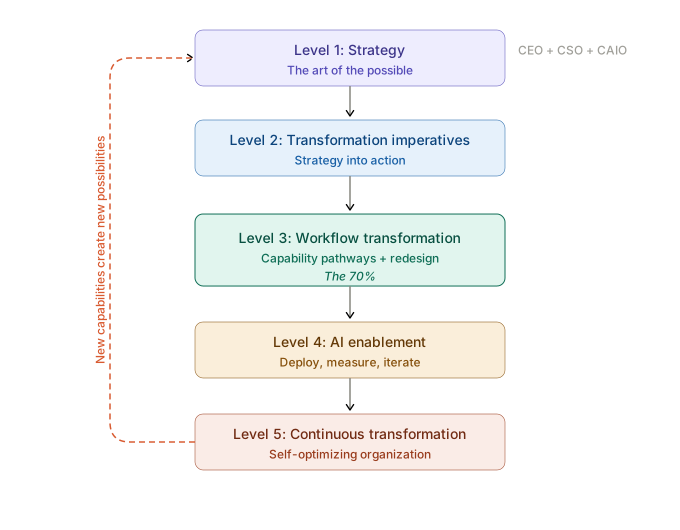
That is what this article is about. Article 2 of this series argued that AI business transformation produces a compounding effect: redesigned workflows multiply the value of each AI capability added, while workflows not redesigned lock inefficiency in place. Article 25 laid out the mechanics of how strategy refreshes itself through the CAIO department’s sensing apparatus. Article 26 is the outcomes article. What does the compounding effect actually produce over time for the organizations that built it? And what does it produce for the organizations that did not?
The answer, as of early 2026, is two organizational trajectories that are getting progressively harder to mistake for each other. One cohort, roughly one-fifth of large enterprises depending on which measurement you use, is capturing most of the revenue, margin, and strategic-option value that AI is creating globally. The other cohort is mostly running pilots, seeing operational value that does not translate to financial outcomes, and losing ground on the cost side of their comparison set. The gap is real, documented across independent research programs, and growing.
This matters because the distribution of AI returns across the Fortune 500 does not pause for organizations to catch up. Organizations that have built the compounding machinery do not wait for peers. Organizations that haven’t started the work do not get a later window equivalent to the one available now. The catch-up path is real but narrower than it was, and narrows further each quarter the foundations aren’t built.
This article walks through four things: the math of the gap, the mechanisms that drive it, what the compounding cohort actually looks like in practice, and why the people side of the transformation is the lever.
How wide is the AI performance gap between leaders and laggards?
The starkest single quantification of the gap is that 74% of AI’s economic value is being captured by just 20% of organizations, according to PwC’s 2026 AI Performance Study, released in April 2026. PwC interviewed 1,217 senior executives across 25 sectors about the revenue and efficiency gains they are seeing from AI, and the practices that underlie those gains.2 That is not a gradient with leaders at one end and laggards at the other. It is a cohort concentration, where a minority of firms are capturing roughly three-quarters of the value being created by a technology that 88% of organizations have adopted in some form.
This finding rhymes with but is not identical to longer-running research on digital and AI maturity. McKinsey’s multi-year tracking of enterprise digital and AI adoption found that the maturity spread between leaders and laggards grew by roughly 60% between the 2016-19 and 2020-22 measurement periods, from 10.3 points to 16.3 points on their composite index.3 In the four years of that period, the gap between the two groups did not narrow despite improving tooling and broader awareness. It expanded. Banking leaders in that dataset achieved 8% annual total shareholder return versus 5% at laggards; insurance leaders achieved 6x the five-year total shareholder return of insurance laggards.
Deloitte’s 2026 Tech Trends report framed the same phenomenon in explicitly compounding terms. Their lead theme observation: innovation does not arrive as an additive force that organizations absorb one capability at a time. It arrives as a multiplicative force, where each new capability amplifies the effect of the capabilities already in place.4 One data point they cite: token costs for foundation models dropped 280-fold over two years, yet some enterprises saw their monthly AI bills rise into the tens of millions. Adoption grew faster than the cost-per-unit declines, because the organizations that had the foundations to scale were using exponentially more. The organizations without the foundations were still running pilots on a cost curve that no longer applied.
Bain’s 2025 Technology Report, the sixth in that series, provides the time-series context for why the concentration persists. Bain noted that leading companies had achieved EBITDA improvements of 10% to 25% from AI while laggards lost ground. Two years into the AI investment, Bain’s characterization is that the leaders continued to extend their lead.5 The gap is not a single-period measurement artifact. It is a trajectory.
Why does the AI advantage compound instead of leveling off?
The gap compounds because AI’s value is structural rather than a one-time productivity step-up that competitors eventually match. If the math of the gap is visible, the question that follows for any enterprise leader is mechanism. The research does not converge on a single answer. It converges on several answers that, looked at together, describe a structural property of the technology and its deployment.
The first mechanism, developed most thoroughly by McKinsey’s research, is capability rewiring across multiple dimensions simultaneously. The research tracked six capability areas, including strategy, talent, operating model, data architecture, adoption, and culture, and found that the highest-performing organizations outperform laggards by 2.0 to 2.5x on each one. The point is not that any single capability produces the advantage. The point is that the capabilities reinforce each other. Better data architecture enables better AI-driven workflow design, which enables better talent deployment, which enables better strategy iteration, which generates the operational feedback that refines the data architecture. This is not a linear causal chain; it is a lattice. Organizations that build only two or three of these capabilities do not get two-sixths or three-sixths of the advantage. They get a fraction of it, because the missing capabilities create gaps that prevent the built capabilities from reinforcing one another.
The second mechanism, articulated most explicitly by BCG, is the virtuous reinvestment cycle. BCG’s Widening AI Value Gap research, covering 1,250 firms across nine industries, documents that the cohort pulling ahead is generating AI-driven financial returns that are then being routed back into further transformation work.6 The reinvestment is not a steady-state allocation. It is financed, in significant part, by the returns the earlier AI business transformation produced. The compounding firms take AI-generated margin and route it back into additional workflow redesign, workforce capability, and organizational investment. The non-compounding firms have no equivalent margin to reinvest, because their AI deployments are not producing the financial returns that would fund further transformation work. The cycle is virtuous on one side and vicious on the other.
A third mechanism, advanced in a February 2026 Harvard Business Review piece, reframes compounding as a question of context rather than capability. As foundation models commoditize, because the major vendors are all selling access to similar models, the question of what differentiates one organization’s AI performance from another’s shifts to what the organization feeds into those models. The workflows that get encoded. The judgment patterns that get captured. The escalation triggers that get defined. The exceptions that get surfaced.7 Organizations accumulate this context over time. Organizations without the workflow foundation to accumulate it cannot retroactively generate equivalent context, because context emerges from executed work, not from documentation or data migration. This is why many leading firms now treat workflow-encoded context as a competitive asset.
A fourth mechanism, developed in MIT Sloan Management Review’s 2025 research on intelligent choice architectures, locates the compounding advantage in decision structure itself. The argument is that AI is moving from adviser to architect. In advisor mode, humans retain the decision and AI provides input. In architect mode, AI structures the choice set the human encounters, including which options are surfaced, in what sequence, with what supporting evidence.8 Organizations that treat AI as decision architecture have embedded a layer of differentiation into every decision the organization makes. Their competitors, still treating AI as a point advisor, receive only the localized benefit.
A fifth mechanism, foundational to the contemporary literature, emerged from Harvard Business School research arguing that AI-based business models break the traditional pattern where the value of scale eventually levels off. In traditional business models, returns to scale diminish past a certain size because coordination costs and organizational complexity rise faster than operational leverage. In AI-based business models, the relationship changes. The scale of the model, the scale of the data, and the scale of the user base all compound rather than diminish.9
These five mechanisms describe different phenomena. Capability rewiring is about the organization’s internal lattice. The reinvestment cycle is about financial flows. Context engineering is about what workflows accumulate. Decision architecture is about how choices get structured. Scale economics is about the mathematics of returns. What they share is a structural property: each describes a form of cumulative organizational investment that becomes progressively harder to replicate as it accumulates. Late movers do not face the same investment the leaders faced. They face a larger one. Because the capability lattice has more nodes. Because the context accumulation has more history. Because the decision architecture covers more decisions. Because the scale advantage keeps climbing.
The practical consequence is that the compounding trajectories do not converge. They diverge.
What does compounding AI advantage look like in practice?
In practice, compounding advantage shows up as three patterns that appear consistently across the recent implementation-firm research. Mechanisms explain why the gap compounds; the observable behavior of organizations in the lead cohort is more specific and more instructive.
The first pattern is a structural shift in what AI spend is for. IBM’s Enterprise 2030 study, released in January 2026 and based on 2,007 senior executives across 33 geographies, documents that AI investment today is weighted roughly 47% toward efficiency applications. By 2030, the same executives project that allocation will invert: 62% of AI spend will go toward innovation, defined as new products, new business models, and new revenue streams, with efficiency applications receiving the smaller share.10 The shift is not that organizations will stop optimizing operations. It is that organizations will stop treating AI as primarily an operations tool. The compounding cohort has already made this transition or is well into it. The non-compounding cohort is still pursuing operational efficiency as the primary goal and will continue to see AI investment underwrite modest cost reductions rather than the more valuable outcomes that innovation spending produces.
In the same study, organizations scaling AI with smaller, custom-built models rather than general-purpose platforms show 24% greater productivity and 55% higher operating margins than comparable firms. Scale advantage in the compounding cohort is coming from specificity, meaning models built for the organization’s actual workflows, not from raw model size or vendor choice.
The second pattern is transformation depth rather than breadth. A case Bain published in June 2025, an unnamed major bank that went through a full AI-native workflow redesign over roughly a year, illustrates what this depth produces at the firm level. The bank’s marketing campaign cycle compressed from 60-100 days to one day. Customer lifetime value doubled. Customer advocacy, measured by Net Promoter Score, tripled.11 The executive Bain interviewed described the outcome a year in as delivering roughly double the EBIT margins of the bank’s competitors in the same market. None of those outcomes were the product of marginal AI deployment. They were the product of redesigning what the work was, with the people inside that work doing the redesigning and operating the rebuilt system.
Bain’s broader framing in the same research was that the transformation motion itself needs to become a permanent characteristic of how the modern enterprise operates, not a discrete initiative with a beginning and an end. The compounding cohort has internalized this framing and built the structural practice that makes it operational. Article 25 of this series described that practice in detail: the sensing-and-translation apparatus that converts continuous signal into continuous strategic refresh. The non-compounding cohort treats transformation as something one does and then stops.
The third pattern is the timescale. Capgemini’s January 2026 research, covering 1,505 executives at large organizations globally, gives it an explicit name: the multi-year AI advantage. Compounding, in Capgemini’s framing, does not happen in quarters. It happens over years. Two-thirds of business leaders in the survey believe that failing to scale AI as rapidly as competitors will cost them strategic opportunities and competitive edge. 64% report that they have begun pausing lower-value AI projects to redirect effort toward high-impact areas. AI budget allocations are rising from 3% of total business spend in 2025 to a projected 5% in 2026, but the leaders’ framing treats the spending as the surface indicator of a deeper organizational shift whose payoff plays out across a multi-year horizon.12
Put together, the three patterns describe what the compounding cohort looks like in operation. They spend AI money on innovation, not just efficiency. They transform work at depth, not breadth. They commit to the transformation for years, not quarters.
Is the compounding-advantage thesis real, or will AI just lift all boats?
The most serious argument against the compounding-advantage thesis is that AI will not produce sustainable competitive advantage in the traditional resource-based sense, because once the technology is ubiquitous it lifts markets as a whole rather than benefiting any single firm. That claim comes from a 2025 piece in MIT Sloan Management Review, co-authored by three researchers including one of the foundational theorists of resource-based strategy.13 The argument is theoretical rather than empirical. It deserves engagement on theoretical grounds.
The theoretical claim is that AI, as a general-purpose technology, eventually commoditizes. Competitors all gain access to the same models, the same tooling, the same cloud infrastructure. Once the adoption distribution has filled out, the advantage dissipates. Everyone has it, so no one has it as an advantage. In this framing, the 20% cohort capturing 74% of current value is a transitional state. It dissolves as the other 80% catch up.
The reframe the rest of the research suggests, and one reason the theoretical argument does not fully fit the empirical picture, is that the commoditization of the technology is not the same as the commoditization of the organizational capability required to deploy it. What the compounding cohort has built is not AI. It is the organizational substrate that turns AI into financial returns: redesigned workflows, foundational data architecture, workforce capability, governance infrastructure, decision frameworks. That substrate does not commoditize in the same way foundation models do. It compounds. The technology gets cheaper and more widely available; the organizational capability to convert it into value stays concentrated.
The empirical data that has attracted the most attention as evidence against the compounding thesis is the finding that nearly 90% of executives surveyed report no measurable AI impact on their organization’s productivity or employment, a figure that circulated widely in early 2026 and is frequently misattributed to Stanford’s 2026 AI Index. It actually originates in a February 2026 National Bureau of Economic Research working paper surveying executives across four countries. What the AI Index itself reports points in the same direction: organizational AI adoption has reached 88%, yet, per McKinsey data cited in the Index’s economy chapter, fewer than 6% of organizations attribute significant enterprise-level EBIT impact to AI.14 The pattern has been compared to the classic 1987 observation that computers appeared everywhere except in the productivity statistics: the paradox is returning.
Read against the cohort-concentration data, the no-measurable-impact finding is not contrary to the compounding thesis. It is the compounding thesis, seen from the other side. If the leading 20% of firms are capturing 74% of the value and the middle of the distribution is running pilots with operational gains that haven’t translated to financial outcomes, then a majority of executives reporting no measurable financial impact is precisely what the thesis predicts. The non-compounding cohort is 80% of the distribution. The NBER and McKinsey findings and the PwC finding are not two different empirical realities in tension. They are the same reality, measured from opposite ends of the distribution.
The theoretical framework that makes this coherent is the productivity J-Curve, developed in 2021 research that came out of Stanford, Chicago Booth, and MIT. The J-Curve argues that general-purpose technologies produce a characteristic pattern: productivity appears flat, or even declines, during the period when organizations are making the complementary investments (workflow redesign, workforce capability-building, organizational restructuring) that unlock the technology’s productivity potential. After the complementary investments pay off, productivity compounds.15 The cohort in the trough phase looks unproductive. The cohort past the inflection point looks exponential. Both are visible in the same cross-sectional snapshot because different firms are at different points on the curve.
Taking this together, the most honest reading of the research is that the widening-gap thesis and the no-measurable-impact observation are both empirically true, simultaneously, because they describe different cohorts. The leaders are past the inflection. The majority are not. The theoretical argument against compounding advantage, that technology commoditizes, is correct about the technology itself and wrong about the organizational capability that surrounds it. The substrate that turns commodity technology into financial returns does not commoditize as fast as the technology does. The gap reflects that lag.
For an enterprise leader, the implication is not that investment is risky because most firms are showing no impact. The implication is the opposite: most firms are showing no impact because most firms have not yet built the substrate. Organizations that build the substrate enter the post-inflection cohort. Organizations that do not remain in the pre-inflection trough.
What is the real lever behind compounding AI advantage?
The compounding lever is people: the organizations in the compounding cohort are investing more in their workforce, not less. The research on what that cohort does differently should make enterprise leaders think twice about how they treat the workforce side of AI business transformation. They are redesigning jobs, not cutting them. They are spending on workforce capability at levels their peers are not.
Accenture’s research from 2025, based on 2,000+ client AI projects and 3,000+ C-level executive surveys, identified five actions that separate organizations creating enterprise-level AI value from those seeing only limited impact. The largest single differentiator between the two groups, measured on Accenture’s workforce-actions scoring, was workforce reshaping. Enterprise-value organizations score 88% higher than limited-impact organizations on actions to reshape the workforce for AI.16 This is not a marginal effect. It is the single largest behavioral difference in their dataset. Supporting differentiators in the same research include executive buy-in (2.5x higher ROI), leadership fluency in AI (6x more likely to have leaders who deeply understand generative AI), and change capability (2.1x more likely to have advanced change-management practices, though only 30% of organizations in the sample rate their change capability as strong).
The business framing for why this matters comes from IBM’s 2025 CEO Study, which surveyed 2,000 CEOs across 33 countries. The study’s foreword, written by IBM’s vice chairman, characterizes the current moment with unusual directness. Organizations that are not leveraging AI and their own proprietary data, in his framing, have effectively chosen not to compete.17 The framing locates the non-compounding cohort not as victims of circumstance but as having made, by default or deliberately, a choice not to build what the compounding cohort has built.
Data from IBM’s Enterprise 2030 research supports the choice framing at the workforce level. Organizations that describe themselves as “AI-first” are 48% more likely to create net-new job roles than peers, and 46% more likely to redesign organizational structure to support AI-driven ways of working. They are not primarily displacing existing workers. They are building new roles that did not previously exist and restructuring the organization around the emerging capabilities. The compounding cohort looks more like a net job creator than a net job cutter.
BCG’s 2026 AI Radar research, conducted across 2,360 executives in 16 markets, characterizes the most advanced adoption group, their Trailblazer category representing roughly 15% of the sample, by their workforce investment behavior. Trailblazer organizations upskill 65% of their workforce, approximately twice the rate of the rest of the sample. 94% of Trailblazers continue investing in AI even when immediate financial returns are not yet visible, a sustained-commitment posture meaningfully rarer at laggards.18 The compounding cohort’s leadership has committed to the transformation through the J-Curve trough deliberately enough to get through it. The non-compounding cohort’s leadership has, by and large, not.
Article 1 of this series argued that firing the workforce to fund AI investment was a category error, that the cuts were typically anticipatory, based on expected rather than actual AI value, and that the companies doing the cutting were trading future capability for short-term savings. The research that has emerged since A1 made that argument has not reversed it. It has reinforced it. The organizations that retained and invested in their workforce are the ones showing up in the compounding cohort. The organizations that cut in anticipation are disproportionately in the group showing no measurable AI impact. The cuts did not fund a compounding transformation; they funded a cost-reduction that the compounding cohort’s competitors were simultaneously building on.
What should enterprise leaders do about the widening gap?
Enterprise leaders reading this in May 2026 should pursue three empirically supported directions rather than a fixed playbook. The research suggests those directions but does not prescribe a step-by-step sequence. Playbooks are the wrong frame for a situation where the leading cohort’s advantage grows faster than most implementation timelines.
The first direction is foundations. PwC’s 29th Global CEO Survey, surveying 4,454 CEOs across 95 countries, found that CEOs whose organizations have built strong AI foundations (responsible AI frameworks, enterprise-wide technology integration, governance structure) are 3x more likely to report meaningful financial returns from AI than CEOs whose organizations have not.19 Foundations are not a gradient. They are a gate. Organizations past the gate see returns that compound. Organizations before the gate are largely in the 56% of the PwC sample that report no significant financial benefit from AI investment to date. Building foundations is not a late-stage polish step. It is an early-stage condition of the compounding trajectory.
The second direction is pace. Capgemini’s research indicates that two-thirds of business leaders now believe that failing to scale AI as rapidly as competitors will cost them strategic opportunity and competitive position. The recognition is widespread. What distinguishes the compounding cohort is that the recognition has translated into action on multi-year timelines, not annual-budget timelines. The organizations in the lead cohort were investing at meaningful rates in 2022-23 and have compounded from that base. The organizations entering the investment now are starting from a lower base and against incumbents who have been compounding for years. The math of compounding is not friendly to late starts.
The third direction is the structural combination of the first two with workforce investment. The research does not document a single organization that achieved enterprise-level AI value through foundations alone, through pace alone, or through workforce investment alone. The compounding cohort is defined by the combination. Accenture’s five-action research found that organizations acting on all five of their identified actions (leading with value, workforce reinvention, digital core, responsible AI, and continuous reinvention) are 2.5 times more likely to achieve enterprise-level results than organizations acting on fewer. The combinatorial requirement is the most difficult feature of the compounding path. Not because any single action is hard, but because all of them have to be happening simultaneously, reinforcing each other, for the lattice to generate returns. Partial commitment produces partial or no results.
What this means for an enterprise leader depends on where the organization currently sits. Organizations in the compounding cohort should extend. Organizations in the middle should accelerate. Organizations in the stagnation cohort have a harder path, not a closed one, but one that requires commitment on all three dimensions rather than a choice between them. The research does not support a “start small, scale later” pattern for this particular transition. The leaders did not start small. They started committed, and the commitment compounded.
What does the latest research mean for the compounding-effect thesis?
The research that has emerged since Article 2 has not softened the compounding-effect thesis — it has sharpened it. That methodology article argued that AI business transformation produces a compounding effect, and that organizations which had redesigned their workflows were multiplying the value of each AI capability they added while organizations that had not were locking inefficiency in place.
What the compounding effect produces, over time, is two organizational trajectories that are becoming increasingly incompatible descriptions of the same market. The leaders are building new products, entering adjacent sectors, creating net-new roles, earning returns that fund additional investment. The organizations in the middle are running pilots that produce operational gains without financial translation. The organizations at the bottom are watching the gap widen and making decisions, often default decisions rather than deliberate ones, that keep them there.
Article 1 of this series argued that the anticipatory layoffs of the 2023-25 period were the wrong way to prepare for AI-driven transformation. The research bears that out. The compounding cohort, almost uniformly, retained its workforce and built capability on top of that workforce. The cohort that cut in anticipation did not save its way into the lead. The organizations quoted in this article’s research as the compounding exemplars are not running skeleton operations that AI supercharged. They are running organizations that invested in people, redesigned work, and used AI as the material for the rebuilding.
Article 27, the series synthesis, returns to what these findings mean for the decisions being made right now in the rooms where transformation strategy gets set. This article’s argument is narrower: the distribution of AI-driven returns across the Fortune 500 is widening quarter by quarter, and the decisions being made in 2026 about how to invest, what to redesign, and how to treat the workforce will determine which side of that distribution an organization occupies by 2028.
The window is narrowing. Not closed, but narrower each quarter that foundational work is deferred.
Sources
- 1.PwC US. “2026 AI Business Predictions.” Published late 2025 https://www.pwc.com/us/en/tech-effect/ai-analytics/ai-predictions.html
- 2.PwC. “2026 AI Performance Study: Three-Quarters of AI’s Economic Gains Are Being Captured by Just 20% of Companies.” Press release, April 13, 2026 https://www.pwc.com/gx/en/news-room/press-releases/2026/pwc-2026-ai-performance-study.html
- 3.McKinsey & Company. “Rewired and Running Ahead: Digital and AI Leaders Are Leaving the Rest Behind.” January 2024 https://www.mckinsey.com/capabilities/mckinsey-digital/our-insights/rewired-and-running-ahead-digital-and-ai-leaders-are-leaving-the-rest-behind
- 4.Deloitte. “Tech Trends 2026.” December 2025 https://www.deloitte.com/us/en/insights/topics/technology-management/tech-trends.html
- 5.Bain & Company. “Technology Report 2025.” 6th annual edition, September 2025 https://www.bain.com/insights/topics/technology-report/
- 6.Boston Consulting Group. “The Widening AI Value Gap: Build for the Future 2025.” September 2025 https://www.bcg.com/publications/2025/closing-the-ai-value-gap
- 7.Murty, Amit, and Ravi Kumar. “When Every Company Can Use the Same AI Models, Context Becomes a Competitive Advantage.” Harvard Business Review, February 2026.
- 8.Schrage, Michael, et al. “Winning With Intelligent Choice Architectures.” MIT Sloan Management Review, in collaboration with Tata Consultancy Services, July 2025.
- 9.Iansiti, Marco, and Karim Lakhani. “Competing in the Age of AI.” Harvard Business Review and Harvard Business School Press, January 2020 https://hbr.org/2020/01/competing-in-the-age-of-ai
- 10.IBM Institute for Business Value. “Enterprise 2030.” In cooperation with Oxford Economics, January 2026 https://www.ibm.com/thought-leadership/institute-business-value/en-us/report/enterprise-2030
- 11.Whitten, Robert, Stephen Elk, Ben Mueller, and Michael Fleming. “Unsticking Your AI Transformation.” Bain & Company, June 2025.
- 12.Capgemini Research Institute. “The Multi-Year AI Advantage: Building the Enterprise of Tomorrow.” January 2026 https://www.capgemini.com/insights/research-library/AI-perspectives-2026/
- 13.Wingate, Charles, Aaron Burns, and Jay Barney. “Why AI Will Not Provide Sustainable Competitive Advantage.” MIT Sloan Management Review, May 2025. Barney is a foundational resource-based-view theorist. One of MIT SMR’s top-read pieces of 2025.
- 14.National Bureau of Economic Research. Working paper surveying executives across four countries on AI’s measured impact on productivity and employment. February 2026. Adoption and EBIT figures: Stanford HAI, “2026 AI Index Report,” Chapter 4: Economy (McKinsey data as cited therein), April 2026 https://hai.stanford.edu/ai-index/2026-ai-index-report
- 15.Brynjolfsson, Erik, Daniel Rock, and Chad Syverson. “The Productivity J-Curve: How Intangibles Complement General Purpose Technologies.” American Economic Journal: Macroeconomics, 2021. Authors affiliated with Stanford, MIT, and the University of Chicago Booth School of Business.
- 16.Accenture. “Making Reinvention Real with Gen AI.” March 2025 https://www.accenture.com/us-en/insights/consulting/making-reinvention-real-with-gen-ai
- 17.IBM Institute for Business Value. “2025 CEO Study: 5 Mindshifts to Supercharge Business Growth.” In cooperation with Oxford Economics, May 2025. Survey of 2,000 CEOs across 33 countries and 24 industries.
- 18.Boston Consulting Group. “AI Radar 2026: As AI Investments Surge, CEOs Take the Lead.” January 2026 https://www.bcg.com/publications/2026/as-ai-investments-surge-ceos-take-the-lead
- 19.PwC. “29th Global CEO Survey: Leading Through Uncertainty in the Age of AI.” January 19, 2026 https://www.pwc.com/gx/en/ceo-survey/2026/pwc-ceo-survey-2026.pdf
Frequently Asked Questions
How wide is the AI performance gap between leaders and laggards right now?
The research across multiple independent programs is consistent that a minority cohort is capturing a disproportionate share of AI-driven financial returns. McKinsey’s multi-year tracking found the maturity spread between leading and trailing organizations grew approximately 60% over two measurement periods, with leading firms in sectors like insurance and banking achieving 2-6x the total shareholder returns of laggards. Bain documents that leaders achieving 10-25% EBITDA improvements from AI two years ago have continued to extend their advantage since. The gap is measured differently by different researchers, but the direction is consistent: widening, not narrowing.
If our organization is in the laggard cohort, is it too late to catch up?
Not too late, but the catch-up path is narrower than the build-from-strength path the leaders followed. McKinsey’s research indicates that laggards acting with sustained commitment can achieve roughly 15-20% maturity improvement and 10-20% EBIT improvement within targeted domains in 2-3 years. What the research is clear about is that sustained commitment is not optional. Partial or interrupted effort does not compound, and the clock is running against every quarter of delay.
What do the compounding-cohort organizations have in common?
Across multiple independent research programs, three features appear consistently. First: foundation investment in governance, data architecture, and responsible AI. Multiple research programs identify strong AI foundations as a key multiplier on financial returns. Second: deep workforce investment rather than cost-cutting. Accenture’s research shows enterprise-value organizations score 88% higher on workforce reshaping than limited-impact peers, and BCG’s Trailblazers upskill roughly 65% of their workforce versus near-zero at laggards. Third: transformation depth over breadth. The leaders redesign work end-to-end rather than adding AI to existing workflows.
Isn’t the finding that roughly 90% of executives report no measurable AI impact evidence that AI doesn’t actually deliver productivity gains?
The finding is real and important, but it is not evidence against the compounding thesis. It is consistent with it. If roughly 20% of firms are capturing most of the AI value and the majority have not yet made the complementary workflow, workforce, and foundational investments needed to convert AI capability into financial outcomes, then most executives reporting no measurable impact is exactly what the thesis predicts. The productivity J-Curve framework from 2021, developed across Stanford, Chicago Booth, and MIT, provides the theoretical reasoning: general-purpose technologies show flat or declining productivity during complementary-investment periods, then compound after the inflection. The non-compounding cohort is in the pre-inflection trough. The compounding cohort is past it.
How long does it take to build compounding advantage?
Capgemini’s framing is “multi-year,” not quarters. McKinsey’s data on laggard catch-up scenarios indicates 2-3 years for meaningful maturity and EBIT improvement. The compounding leaders in the current research base began their foundational work in 2022-23 and have been building on that foundation since. Organizations starting now start from a lower base against incumbents who have been compounding for years, which lengthens the time to parity. The practical horizon for getting onto the compounding trajectory is years, not quarters; the horizon for leadership is longer.
What role does workforce investment play in compounding?
The research locates workforce investment as the single largest behavioral differentiator between organizations creating enterprise-level AI value and organizations seeing only limited impact. Accenture’s data shows an 88% higher workforce-reshaping score for enterprise-value organizations. IBM’s Enterprise 2030 research shows that AI-first organizations are 48% more likely to create net-new job roles and 46% more likely to redesign organizational structure. Organizations that treated AI as a reason to cut headcount, rather than as a reason to redesign the work, are disproportionately in the cohort showing no measurable AI impact. The workforce side of the transformation is not a peripheral cost; it is the lever that produces the compounding.
This series addresses “what” to do, not “how” to do it. If you are a business executive and would like help thinking through the “how,” please feel comfortable reaching out.

About the author
Shawn Plaster
Founder & CEO, Plaster Group
Shawn is the author of Plaster Group's five-level AI Business Transformation Methodology and its 27-article Insights series, and leads the firm's enterprise AI transformation work.
Previous: Article 25: Feeding the Loop · Next: Article 27: The Future You Kept
© 2026 Plaster Group, LLC. All rights reserved. This article may not be reproduced, distributed, or transmitted in any form without prior written permission from Plaster Group. Brief excerpts may be quoted for review or commentary purposes with attribution to the author and a link to the original article.
Ready to move forward?
Let's discuss how your organization can build with AI — securely, strategically, and starting from where you are today.
Start a Conversation