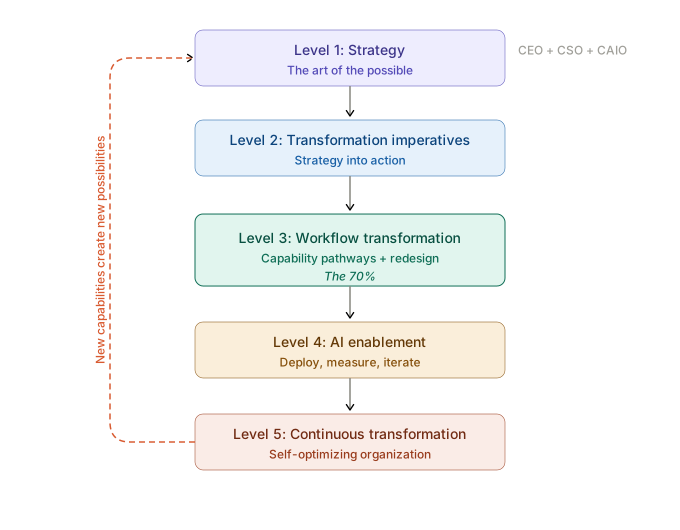
This article is part of a 27-article series on the AI Business Transformation Methodology. This piece opens Level 5—continuous transformation—and describes the self-optimizing organization: what it is, why the research converges on its structure, and how Level 5 produces it.
What is the wrong mental model for AI transformation?
The wrong mental model treats transformation as a series of discrete upheavals — reorganize, stabilize, reorganize again — rather than a capability that runs continuously. Every enterprise executive reading this has lived that treadmill. Major reorganization. Stabilize. Next major reorganization. Stabilize. Each one exhausting. Each one losing momentum before the next begins. The January-February 2026 issue of Harvard Business Review devoted its cover theme to this exact pattern. In the marquee article, Bain argues that the most successful leaders avoid chronic upheaval by continuously strengthening their business systems rather than lurching from transformation to transformation.1 Their anchor case is Boston Scientific, where steady, integrated adjustments have compounded progress over time.
They are describing a general truth. AI business transformation requires exactly this approach, and at an intensity no previous technology shift has demanded. The serial-reorganization pattern does not fail at AI because organizations execute it poorly. It fails because the underlying assumption no longer holds: that transformation is a periodic event followed by a period of operating the new model. The clock speed of the environment has outpaced the clock speed of any governance structure built around periodic transformation events.
This creates a genuine problem for enterprise executives who have been through multiple successful enterprise transformations. The instincts that produced those successes are not wrong. They are incomplete. ERP transformations, digital transformations, operating model transformations, even the substantial reorganizations that follow acquisitions all ended. There was a cutover. There was a stabilization period. There was eventually a next thing, but that next thing was its own discrete initiative with its own defined start and end.
Level 5 of Plaster Group’s methodology is the articulation of what replaces the treadmill for AI business transformation. Levels 1 through 4 build the organization’s capacity to transform. Level 5 names what the organization becomes when that capacity is permanent. It is not “Level 3 and Level 4 running forever.” That would be the treadmill in continuous form, and it would exhaust the organization within a year. It is a structural shift in what the organization IS, not just what it does.
The remainder of this article describes the self-optimizing organization: what it is, why the research converges on its structure, and how Level 5 produces it. Articles 25, 26, and 27 go deeper into the mechanics, the outcomes, and the implications.
How fast is AI capability actually evolving?
AI capability is now evolving fast enough that the pace argument is no longer rhetorical — it rests on empirical benchmark data. Stanford University’s 2026 AI Index, released earlier this month, documents the acceleration with benchmark data that has no precedent in enterprise technology history.2
On SWE-bench Verified, which measures the ability of AI systems to autonomously complete real software engineering tasks, leading models moved from 60 percent to near 100 percent of the human baseline in a single year. On OSWorld, which tests AI agents on real computer tasks across operating systems, the best model jumped from roughly 12 percent success in early 2024 to 66 percent in early 2026, within 6 percentage points of the human baseline. On WebArena, which tests autonomous web agents, success rates climbed from 15 percent in 2023 to 74 percent in early 2026. AI agents handling cybersecurity issues solved problems 93 percent of the time in 2026, up from 15 percent in 2024. United States and Chinese frontier models have traded the leading position multiple times since early 2025, with the current gap measuring in low single digits.
These are not projections. They are benchmark results on standardized tests, released publicly, from a research institution with no commercial interest in overstating the pace.
McKinsey’s April 2026 AI Transformation Manifesto, excerpted from the second edition of Rewired: How Leading Companies Win with Technology and AI, frames the strategic question this pace creates. The authors observe that the half-life of skills is shortening as innovation accelerates, and that the organizations that learn, unlearn, and relearn the fastest have the advantage. Their direct challenge to the reader comes near the end: what are you doing to increase the metabolic rate of your organization?3
That question is the framing the rest of this article extends. enterprises have spent decades optimizing for consistency, predictability, and controlled change. The governance structures, budgeting rhythms, and transformation methodologies that produced that consistency were engineered for a pace of technology evolution measured in years. AI capability evolution is now measured in months, and the gap between those two clock speeds is widening.
The question for Level 5 is not how to run faster transformations. It is how to build an organization whose metabolic rate matches the pace of the environment it operates in.
What are the stakes of falling behind on AI capability?
The performance gap between organizations that have built this capability and those that have not is widening and now measurable across multiple independent research programs.
Accenture’s research into what it calls Total Enterprise Reinvention, based on analysis of thousands of firms across industries, divides the field into three groups. Nine percent are Reinventors that have built the capability for continuous reinvention. Eighty-one percent are Transformers taking many of the right steps but not yet building sustainable capabilities to reinvent continuously. The remaining 10 percent are Optimizers where reinvention is not currently a priority. Between 2019 and 2022, Reinventors increased revenues by 15 percentage points more than the rest. Their average EBITDA margin ran 5.6 percentage points higher. By 2026, the firm projects that the revenue growth gap between Reinventors and the rest will widen to 37 percentage points, a 2.4 times increase in performance differential. Among firms with revenue above 50 billion dollars, the number of Reinventors quadrupled in the past year alone.4
Boston Consulting Group’s research on what they call the widening AI value gap reaches complementary conclusions. BCG’s analysis of 1,250 firms across 41 foundational capabilities places 5 percent in a “future-built” category operating in what BCG describes as a virtuous cycle of compounding advantage, while the majority operate in what BCG describes as a vicious cycle of limited value constraining investment.5 Their subsequent AI Radar 2026 research warns directly that late starters face a compounding disadvantage. Organizations that begin comprehensive reskilling programs this year will already be two to three years behind the leaders, and the gap will continue to widen as AI capabilities accelerate.
The compounding pattern shows up in individual firms operating in this mode. Michelin, in the case study work published by MIT Sloan Management Review, reports AI-driven ROI growing at approximately 40 percent annually, with over 200 use cases generating more than 50 million euros in annual value as of mid-2025, the most recent figures the company has disclosed.6 IBM’s stock gained 38 percent in 2025, more than double the gain of the S&P 500, driven in significant part by productivity gains the company has been capturing through its internal AI transformation; the shares then traded roughly flat through the first half of 2026, reaching an all-time high near $329 on June 2 before pulling back 12 to 14 percent on valuation concerns.7
The research converges on the same observation from different starting points. The organizations that have built continuous AI transformation capability are progressively outpacing the ones that have not, and the gap is accelerating. Article 26 will go deeper into what this compounding actually produces. For the purposes of Level 5’s articulation, the stakes are simply that the reader is not choosing whether to engage with this. The math is running regardless.
What is the Level 5 question?
Levels 1 through 4 of Plaster Group’s methodology build the organization’s capacity to transform. Strategy is co-created across the CEO, CSO, and CAIO. Business transformation imperatives are defined and chartered to domain owners. Capabilities are decomposed, education cascades through the organization, and workflows are redesigned. AI systems are deployed into those redesigned workflows with governance, monitoring, and measurement. Each of these levels has internal logic and produces specific outputs.
Level 5 is different in kind. Its question is structural: given everything the organization has built through Levels 1 to 4, what does the organization need to BE, not just what does it need to do, to continuously absorb AI capability evolution and compound advantage over time?
The research has converged on a recognizable answer. Across the major implementation firms, strategy firms such as McKinsey and BCG, academic institutions including Stanford, MIT Sloan Management Review, and Harvard Business School, and the underlying dynamic capabilities literature, five patterns describe the self-optimizing organization. These patterns are not prescriptive architecture. They are the observable structure of organizations that are actually compounding advantage. They are named by the research, not by us, and the convergence itself is the strongest evidence that these patterns describe something real rather than any one firm’s framework.
The remainder of this article walks through those five patterns.
What are the five patterns of a self-optimizing organization?
Pattern 1: Why must transformation be continuous, not one-time?
The first pattern is the foundational one: the self-optimizing organization does not have transformation initiatives that end. It has transformation capability that runs as a permanent function of the enterprise, alongside finance, legal, and operations.
Accenture’s framing, from their Total Enterprise Reinvention research, states this directly: change is constant, so reinvention never ends, and leaders cannot approach reinvention as a contained effort undertaken every few years.8 Deloitte, in launching its Enterprise AI Navigator in February 2026, used adjacent language: AI transformation is a continuum rather than a binary shift, and as enterprises mature, governance structures, operating models, and compliance frameworks must evolve in parallel. Bain uses the phrase “permanent defining characteristic of the modern enterprise” to describe the same structural reality.
What this means practically for an enterprise executive team is that the governance rhythm for AI business transformation is weekly or monthly, not quarterly or annual. Bain’s two-speed operating model, with “run the business” and “change the business” working simultaneously rather than sequentially, becomes the default. Business functions play roles in both. The transformation steering committee, the workflow redesign teams, the deployment teams, the measurement teams, the change management function: none of these wind down. They evolve.
IBM’s internal transformation, now in its third year, offers the most intense observable version of this pattern. IBM’s CEO and executive team meet weekly to drive the AI transformation agenda forward, supported by a dedicated transformation steering committee, a project management office, a productivity discovery team, and an employee engagement team.9 Weekly executive cadence is the extreme end of what this pattern looks like; most enterprises will operate at a less intense but still dramatically more frequent rhythm than traditional transformation governance allowed. The direction of travel is unambiguous.
One practical implication worth naming: the budgeting structure has to change with the rhythm. Annual budget cycles that assume transformation initiatives have defined end dates produce the exact organizational behavior Level 5 is designed to prevent. Sustained funding tied to results, not projects, is how the research describes the funding model that actually supports continuous transformation.
Pattern 2: Why architectural, not project-based?
The second pattern operates at a different layer: self-optimizing organizations make architectural investments designed to be continuously used, not periodically replaced.
Deloitte’s research distinguishes between Automators and Transformers. Automators focus on process optimization. Transformers rearchitect the enterprise. The distinction is not about ambition. It is about whether the organization’s investments produce reusable architecture or one-off point solutions. Deloitte’s finding, across its 46 key performance indicators, is that Transformers outperform Automators across nearly every measure, and that the gap compounds over time because architectural investment pays dividends that optimization investments do not.10
Capgemini names the equivalent pattern platformization: enterprise-wide deployment on common platforms rather than per-project custom builds.11 Their research on industrial AI observes that manufacturers shifting from reactive decision-making to predictive, adaptive, and increasingly autonomous operations are building on foundations capable of continuous learning and improvement. The foundation is the point. New AI capabilities absorb into the architecture rather than requiring new projects to integrate them.
What this means for the enterprise executive is that the data architecture Article 21 described, the integration architecture Article 19 described, and the deployment patterns Article 20 described are not one-time deliverables. They are the permanent backbone the organization builds on. Each new AI capability the organization absorbs uses the existing architecture rather than requiring a new one. The platform investments made at Level 4 are the investments the organization continues to refine and extend at Level 5.
The structural implication is that Level 5 organizations budget for architecture at levels that look excessive by traditional transformation accounting. Capgemini’s multi-year AI research finds that organizations committed to sustained AI investment are planning over five-year horizons and treating consistent long-term investment as the source of cumulative benefits that late adopters cannot replicate.12 Accenture’s research observes that 16 percent of organizations have reached the highest level of what they call operations readiness, and those organizations are 3.3 times more likely to successfully scale high-value AI work and report 2.5 times higher revenue growth than peers with lower operations readiness.
The pattern is consistent across the firms that studied it: architectural investment, made continuously, is the backbone on which the continuous absorption of AI capability actually happens.
Pattern 3: Why industrialized, not bespoke?
The third pattern is where the work changes character: self-optimizing organizations do not start each new AI initiative from scratch. They start from patterns they have already codified.
Capgemini’s language for this is explicit. Their concept of industrialization has three pillars: standardization of roles, skills, processes, and technology patterns that can be replicated at scale; platformization so the architecture from Pattern 2 is genuinely shared; and governance at scale so compliance, security, ethics, and cost management are built into the platforms rather than retrofitted. Capgemini has gone so far as to establish a dedicated Group Industrialization function inside its own firm. The consulting organization advising clients on continuous transformation has itself organized around it.13
Bain’s framing of the same pattern is operational: iterate the workflow like a product, run modernization as a continuous release cycle rather than a one-time transformation, and aim for steady compounding through small changes shipped frequently, measured, and refined. This is not agile software development applied to business transformation. It is the recognition that when AI capability evolution is continuous, the workflow itself becomes the product, and the product has to be versioned rather than rebuilt.
IBM’s internal practice offers the clearest observable version. The company reports $3.5 billion in productivity improvement over two years across more than 70 business areas, with the best solutions codified into a library of reusable patterns applied to its own next initiatives and ultimately to client engagements. When AskHR automated 94 percent of routine HR tasks, the approach did not stay in HR; the same playbook now puts an internal coding assistant, IBM Bob, in the hands of 80,000 employees, with a claimed average productivity gain of 45 percent.9 This is the industrialization pattern in operation: learning from one domain becomes a reusable pattern for every domain that follows.
For the enterprise executive, the practical implication is that Level 5 requires deliberate investment in codification. The patterns that worked in the first wave of workflow redesigns must be documented, accessible, and genuinely reusable. The AI Technology Strategists in the CAIO’s department, introduced in Article 5, play a role here as curators of the codified patterns. But the discipline of codification has to be built into the workflow redesign and deployment processes themselves. It cannot be bolted on afterwards. Organizations that treat each new workflow redesign as a fresh project never realize the industrialization benefit, even if they have every other Level 5 pattern in place.
Pattern 4: Why learning-enabled, not capability-static?
The fourth pattern is what makes the other four actually produce compounding returns: self-optimizing organizations build learning as a capability, not as a training program.
The research anchor on this is one of the most durable findings in enterprise AI research. MIT Sloan Management Review and Boston Consulting Group, in their joint October 2020 study, reported that only 10 percent of companies obtain significant financial benefits from AI. The distinction between that top cohort and the rest was not technology. It was organizational learning. Only when organizations added the ability to learn with AI did significant benefits become likely. Their strategic focus was organizational learning, not just machine learning. The concentration that 2020 study documented persists in current data: BCG’s September 2025 research found only 5 percent of companies generating substantial AI value while 60 percent report minimal gains, and McKinsey’s State of Organizations 2026 found fewer than 20 percent of organizations seeing meaningful results from AI despite 88 percent actively deploying it.14 McKinsey’s framing in the AI Transformation Manifesto is similar: the organizations that learn, unlearn, and relearn the fastest have the advantage.
This is a more substantive claim than “invest in training.” The organization’s capacity to learn, specifically its ability to ingest new information from its domains, from the market, and from its own operational experience, and to update its operating patterns based on that information, is itself a capability being deliberately built. Training, which Article 22 addressed at length, is necessary but not sufficient. The broader learning infrastructure includes the feedback mechanisms by which domain teams surface what is working and what is failing, the forums in which that information gets synthesized, and the governance by which operating patterns get updated based on what the organization has learned.
There is a failure mode in this pattern that deserves direct attention. Recent academic research on organizational learning with AI, published in late 2025, warns of what it calls the competency trap.15 Heavy reliance on what AI has already learned from an organization’s historical data can lock the organization into yesterday’s patterns. AI trained on historical operating data will, by design, refine what the organization was already doing. Without deliberate injection of novel signals (new AI capabilities the organization has not yet absorbed, market shifts the organization has not yet encountered, domain patterns that deviate from the historical norm), the learning infrastructure produces sophistication in the wrong direction. Level 5 requires combining exploitative learning (refinement of known patterns) with explorative learning (novel signals the AI has not seen). Organizations that build only the exploitative side can be superficially very good at Level 5 while actually trapping themselves.
Michelin’s practice of running an annual AI for Business Day, with over 1,100 participants across its global locations, is one observable mechanism for the explorative side. The event is not a training program. It is deliberate institutional rhythm for surfacing what is new in the external AI ecosystem and what is emerging inside the company’s own operations.16 The specific mechanism matters less than the discipline. Some institutional rhythm for explorative learning is a requirement of Level 5 as surely as exploitative learning infrastructure is.
Pattern 5: Why sensing-and-feeding-back, not command-and-control?
The fifth pattern is what closes the loop back to strategy: self-optimizing organizations operate continuous sensing apparatus, both inward-facing and outward-facing, that routes signal back to the Level 1 triad so the strategic thesis can evolve.
The underlying theoretical framework is the dynamic capabilities literature developed at UC Berkeley’s Haas School of Business over the past three decades. Recent empirical work has specialized this framework for AI adoption. A 2025 study of 257 executives found that AI-enabled dynamic capabilities, described as sensing, shaping, and shifting, significantly enhance firm performance, and that shifting capability specifically plays a critical role in enabling digital transformation during periods of external disruption.17 The language differs across sources. The structure is consistent.
The CAIO department’s role, introduced in Article 5 as connective tissue across all five levels of the methodology, is operationalized most visibly in this pattern. The department runs two continuous sensing streams. The inward stream gathers signal from the domains: where are workflows hitting limits, where is AI capability failing to match what was expected, where are new use cases emerging that were not anticipated when the original workflow was designed. The outward stream monitors the external environment: what new AI capabilities are being released by major vendors, what is happening in the frontier research, what are competitors and peers deploying, what is the ecosystem producing that the organization has not yet engaged with.
Both streams feed the Level 1 triad. The strategic thesis the CEO, CSO, and CAIO co-created at the beginning is not a fixed artifact. It is a living assessment that updates as new capabilities become possible and as the organization’s lived experience reveals what is and is not producing value. When the signal warrants, the strategic thesis evolves, new imperatives get chartered, and the methodology’s lower levels are re-engaged around the updated portfolio. When the signal does not warrant a thesis change, the strategic direction holds and the organization continues executing against it. Either outcome is the system working correctly.
Michelin’s practice of running external innovation events that scan the global AI startup ecosystem, including a 2024 AI challenge event in India specifically designed to engage the Indian AI startup community, is one observable example of the outward sensing function in operation. The organization is deliberately placing itself where new capabilities will become visible earliest, and building the institutional practice of translating what it sees into business implications.18
Article 25 goes deeper into the mechanics of this pattern specifically: how market signals get translated into business implications, how they reach the Level 1 triad, and how updated strategy cascades back down as new imperatives. Article 24’s responsibility is to name the pattern and place the function. The full mechanics are Article 25’s territory.
Why are the five patterns mutually reinforcing?
The five patterns are not a checklist. They are mutually reinforcing, and that is what makes the self-optimizing organization self-optimizing.
Continuous rhythm (Pattern 1) requires architectural investment (Pattern 2) to be sustainable, because an organization operating at weekly cadence without reusable architecture will burn out within a year. Architectural investment enables industrialization (Pattern 3), because the platforms are what make codified patterns actually reusable rather than theoretical. Industrialization produces the patterns worth learning from (Pattern 4), because a meaningful learning infrastructure requires a corpus of codified experience to learn from. Learning requires sensing inputs (Pattern 5), because without continuous signal from the domains and the external environment, the learning infrastructure just gets better at yesterday’s game. And the sensing pattern completes the loop back to strategy, which refreshes the imperatives that drive the continuous rhythm.
Missing any one pattern breaks the others. An organization with intense leadership cadence but no codified patterns to reapply exhausts its people. An organization with strong learning infrastructure but no external sensing becomes sophisticated at the wrong problems. An organization with beautiful architecture but no continuous rhythm treats AI as a set of projects that finish, which is the treadmill in different clothes.
Articles 2 through 23 of this series built the capability for an organization to transform correctly. Article 24 names what the organization becomes when that capability is permanent. Levels 1 through 4 produced the engine. Level 5 is the engine running continuously, compounding advantage with every rotation.
What Comes Next
Article 25 takes the sensing-and-feeding-back pattern and goes deep into its mechanics, specifically the CAIO department’s Level 5 charter, receiving feedback from domains, the pipeline from market signal to Level 1 decision, and how the full feedback loop operates in practice.
Article 26 focuses on what the compounding advantage actually produces: the widening performance gap the research predicts, the competitive reality organizations find themselves in on either side of that gap, and the strategic implications of the math that is running regardless of whether the organization engages with it.
Article 27 closes the series: the moral case from Article 1 fully reconnected, the methodology’s full arc integrated, and the call to action for enterprises making the decisions that will determine where they stand a decade from now.
Sources
- 1.Rigby, Darrell, and Zach First. “Get Off the Transformation Treadmill.” Harvard Business Review, January-February 2026 https://hbr.org/2026/01/get-off-the-transformation-treadmill
- 2.Stanford University Human-Centered AI Institute. “The 2026 AI Index Report.” April 2026 https://hai.stanford.edu/ai-index/2026-ai-index-report
- 3.Lamarre, Eric, Kate Smaje, Robert Levin, Alex Singla, and Alexander Sukharevsky. “The AI Transformation Manifesto: 12 Themes Driving Growth.” McKinsey Quarterly, April 7, 2026. Excerpted from Rewired: How Leading Companies Win with Technology and AI, second edition (Wiley, 2026) https://www.mckinsey.com/capabilities/tech-and-ai/our-insights/the-ai-transformation-manifesto
- 4.Accenture. “Reinvention in the Age of Generative AI.” https://www.accenture.com/us-en/insights/consulting/total-enterprise-reinvention
- 5.Apotheker, Leo, et al. Boston Consulting Group. “The Widening AI Value Gap.” September 2025 https://www.bcg.com/publications/2025/are-you-generating-value-from-ai-the-widening-gap
- 6.Davenport, Thomas H., and Randy Bean. “Accelerating Manufacturing Innovation at Michelin With Data and AI.” MIT Sloan Management Review, August 25, 2025 https://sloanreview.mit.edu/article/accelerating-manufacturing-innovation-at-michelin-with-data-and-ai/
- 7.Kornik, Joe. “How IBM Reinvented Itself With AI.” Newsweek, December 2025 https://www.newsweek.com/nw-ai/how-ibm-reinvented-itself-with-ai-11166112
- 8.Accenture. “Reinvention in the Age of Generative AI.” https://www.accenture.com/us-en/insights/consulting/total-enterprise-reinvention
- 9.IBM. “Enterprise Transformation and Extreme Productivity with AI.” January 2026 https://www.ibm.com/think/insights/enterprise-transformation-extreme-productivity-ai
- 10.Deloitte Insights. “AI Maturity and Digital Value.” March 2026 https://www.deloitte.com/us/en/insights/topics/emerging-technologies/ai-maturity-digital-value.html
- 11.Capgemini. “Top Tech Trends of 2026.” January 2026 https://www.capgemini.com/us-en/insights/research-library/top-tech-trends-of-2026/
- 12.Capgemini Research Institute. “The Multi-Year AI Advantage: Building the Enterprise of Tomorrow.” January 2026 https://www.capgemini.com/insights/research-library/AI-perspectives-2026/
- 13.Capgemini. “Group Industrialization.” https://www.capgemini.com/solutions/group-industrialization/
- 14.Ransbotham, Sam, Shervin Khodabandeh, David Kiron, François Candelon, Michael Chu, and Burt LaFountain. “Expanding AI’s Impact With Organizational Learning.” MIT Sloan Management Review and Boston Consulting Group, October 2020 https://sloanreview.mit.edu/projects/expanding-ais-impact-with-organizational-learning/
- 15.“Organizational Learning with Artificial Intelligence: Balancing New Tensions Between Explorative and Exploitative Learning Through Hybridization.” ScienceDirect, November 2025 https://www.sciencedirect.com/science/article/pii/S026840122500129X
- 16.Davenport, Thomas H., and Randy Bean. “Accelerating Manufacturing Innovation at Michelin With Data and AI.” MIT Sloan Management Review, August 25, 2025 https://sloanreview.mit.edu/article/accelerating-manufacturing-innovation-at-michelin-with-data-and-ai/
- 17.Teece, David J., Gary Pisano, and Amy Shuen. “Dynamic Capabilities and Strategic Management.” Strategic Management Journal, Vol. 18, No. 7 (August 1997), pp. 509-533. Foundational paper on the dynamic capabilities framework at UC Berkeley’s Haas School of Business. See also: “Artificial Intelligence as an Enabler of Dynamic Capabilities: A ‘Sense-Shape-Shift’ Perspective on Digital Transformation During Disruption.” Springer Nature, September 2025 https://link.springer.com/10.1007/978-3-032-06164-5_18
- 18.Davenport, Thomas H., and Randy Bean. “Accelerating Manufacturing Innovation at Michelin With Data and AI.” MIT Sloan Management Review, August 25, 2025 https://sloanreview.mit.edu/article/accelerating-manufacturing-innovation-at-michelin-with-data-and-ai/
Frequently Asked Questions
How is Level 5 different from Levels 3 and 4 running continuously?
Levels 3 and 4 describe how the organization transforms. They are execution levels. Level 5 describes what the organization becomes when transformation is permanent, and it operates at a different layer. A Level 5 organization is not running Level 3 or Level 4 more frequently. It is running them as continuous functions embedded in the organization’s permanent architecture. The rhythm, the governance, the measurement, the funding, and the talent model all differ. Trying to reach Level 5 by increasing the frequency of Level 3 and Level 4 work without making these structural shifts exhausts the organization and produces diminishing returns.
Does every Fortune 500 need all five patterns, or can some be emphasized over others?
All five are required, but they develop at different speeds. Most organizations will make architectural investments (Pattern 2) and establish continuous rhythm (Pattern 1) before they develop mature industrialization (Pattern 3) or robust sensing apparatus (Pattern 5). The research does not show any examples of organizations producing sustained compounding advantage while missing one of the patterns. It does show organizations producing partial advantage while still developing one or more patterns. The practical guidance is to build all five deliberately, accept that they will not mature simultaneously, and avoid the temptation to declare Level 5 complete before the missing pattern is addressed.
How quickly should an organization expect to reach Level 5?
The research across implementation and strategy firms consistently points to multi-year journeys. The fastest observable cases have required at least two years of sustained executive commitment before the pattern became self-sustaining. Organizations currently operating at Level 4 should plan for Level 5 emergence over two to four years, with earlier patterns (continuous rhythm, architectural investment) maturing first and later patterns (industrialization, robust sensing) following.
Who owns Level 5?
The answer is institutional, not individual. The Level 1 triad (CEO, CSO, CAIO) owns the strategic arc of Level 5 in the same way they owned it at Level 1. The CAIO’s department, as connective tissue across the methodology, operates the day-to-day sensing and translation function. Domain owners continue to own their transformation outcomes. The change management function continues to own adoption and capability development. A standing steering committee typically coordinates across these actors, carrying forward the governance infrastructure established during Levels 3 and 4 rather than dissolving when initial deployments complete. No single role owns Level 5 as a whole, and attempts to assign it to one person or one organization produce exactly the kind of ownership bottleneck Level 5 is designed to prevent.
How does Level 5 interact with non-AI transformation work still running in the organization?
Large organizations are rarely doing only one thing. Other transformations, whether operational, cultural, regulatory, or strategic, will be running in parallel. Level 5 does not replace the governance for those transformations. It sits alongside them with its own rhythm and its own governance apparatus, feeding signal into the enterprise strategy process where AI implications intersect with other transformation decisions. Organizations that try to subsume all their transformation work into Level 5 governance typically find that the AI-specific patterns get diluted and the non-AI work gets distorted. The discipline is to let Level 5 be the governance structure for AI business transformation specifically, while ensuring the strategic integration with other enterprise work happens at the Level 1 triad level where it belongs.
What is the single biggest mistake organizations make at Level 5?
Treating Level 5 as a reporting layer rather than an operating layer. Many organizations, after completing their first wave of Level 3 and Level 4 work, create a steering committee, declare the transformation continuous, and believe they have reached Level 5. The steering committee meets monthly, receives updates from domain owners, and files reports. Nothing about the organization’s architecture, rhythm, industrialization, learning infrastructure, or sensing apparatus actually changes. This is the treadmill in disguise. The test of whether an organization has reached Level 5 is whether any of the five patterns of the self-optimizing organization have structurally changed how work happens. Not whether a governance body exists to discuss what happened.
This series addresses “what” to do, not “how” to do it. If you are a business executive and would like help thinking through the “how,” please feel comfortable reaching out.

About the author
Shawn Plaster
Founder & CEO, Plaster Group
Shawn is the author of Plaster Group's five-level AI Business Transformation Methodology and its 27-article Insights series, and leads the firm's enterprise AI transformation work.
Previous: Article 23: Measuring What Matters at Level 4 · Next: Article 25: Feeding the Loop
© 2026 Plaster Group, LLC. All rights reserved. This article may not be reproduced, distributed, or transmitted in any form without prior written permission from Plaster Group. Brief excerpts may be quoted for review or commentary purposes with attribution to the author and a link to the original article.
Ready to move forward?
Let's discuss how your organization can build with AI — securely, strategically, and starting from where you are today.
Start a Conversation