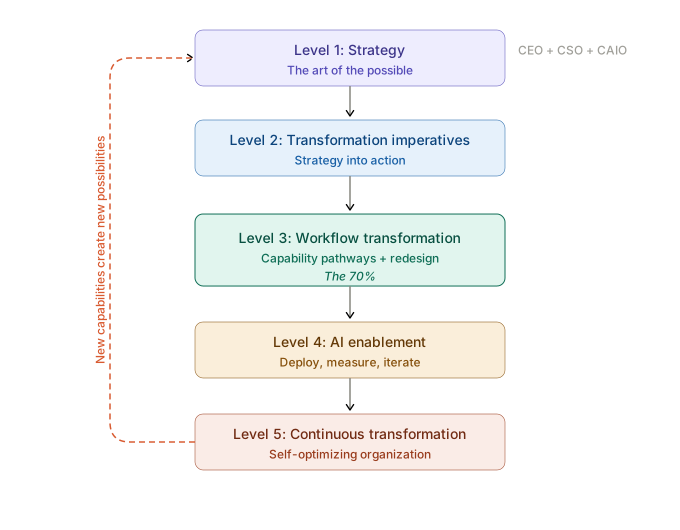
This article goes inside the sensing-and-feedback mechanism that closes the loop from Level 5 back to Level 1. Article 24 named the pattern. Article 25 describes how it operates in practice: what signal flows, how it gets translated, how it reaches the Level 1 triad, and how the strategic thesis cascades back down the methodology refreshed.
What have enterprise leaders already done about AI?
Enterprise CEOs have already made AI their personal responsibility, and the data shows how decisively. Seventy-two percent of the CEOs in BCG’s AI Radar 2026 survey, which polled 2,360 global executives including 640 CEOs, now say they are the main decision-maker on AI at their company, roughly double the share of a year earlier. Half believe their job stability depends on getting AI right. Trailblazer CEOs are spending more than eight hours per week on their own AI upskilling, and twice as much as their peers on upskilling across the organization.1 This is not a future state. This is the center of gravity of large-enterprise leadership right now.
The change is real. Annual strategic planning is no longer where AI strategy gets set at the leading firms. The cadence has compressed. Decision-making has moved up the organization and inside the C-suite rather than down it. For the first time in the arc of enterprise technology, the strategic question is not being delegated.
What is missing is the apparatus underneath the decision-making.
A CEO reviewing AI strategy monthly or weekly, without a sensing and translation function underneath that review, is reviewing the same lagging indicators more often. Frequency alone does not change what the leader sees. It changes how often they see it. Taking over AI strategy at the top without building the machinery that feeds it quality signal at the right time is taking over the decision while starving it of input. The most personally engaged CEOs in the BCG data are the ones who recognize this. The eight hours per week spent on personal AI upskilling is one response to the gap. The structural response is building the apparatus that routes signal to the triad rather than requiring the triad to go find it themselves.
Bain’s Harvard Business Review work earlier this year named four capabilities that define organizations which have moved beyond serial reorganization. Two of those capabilities map directly onto what this article describes: detecting emerging realities through superb market intelligence, and increasing agility by continuously capturing insights and rapidly translating them into adjustments.2 Article 24 used the broader framing to establish why the self-optimizing organization is the structural answer to the treadmill. Article 25 goes inside the machinery that produces those two capabilities.
The sensing-and-feedback pattern named in Article 24 is the last of the five patterns the research converges on as the observable structure of organizations compounding advantage. Continuous cadence, architectural investment, industrialized reuse, and learning infrastructure all feed it. It in turn feeds the others by continuously refreshing what the rest of the methodology is pointed at. Without it, Level 5 is a governance committee meeting more often. With it, Level 5 is the organization’s strategic thesis continuously refreshing in response to a world that will not stop moving.
The CAIO department established in Article 5 is where this function operationally lives. The department was described there as connective tissue across all five levels of the methodology. Article 24 placed its Level 5 role. Article 25 is the mechanics: what the people in the department actually do, what signal flows through them, how translation happens, how the pipeline terminates in decisions at the Level 1 triad, and how the triad’s refreshed thesis cascades back down through Levels 2, 3, and 4 as updated imperatives. Nothing new is being added to the methodology. The machinery that was already there is being made visible.
How does operational reality flow back to the CAIO?
The inward sensing stream continuously routes operational reality back from the domains to the CAIO department. It is the first of the two streams, and it never stops.
What flows through it is specific. Where workflows are hitting the limits of the AI capability they were designed against. Where AI performance is falling short of what the domain team expected when the workflow was redesigned at Level 3. Where domain practitioners are discovering new use cases that were not anticipated when the original imperative was chartered. Where integration boundaries between domains are straining. Where governance classifications made during deployment are producing unintended operational friction. Where human-AI collaboration patterns are producing better or worse outcomes than expected. All of this is signal. None of it is available to the Level 1 triad unless something routes it there.
Who runs the stream matters. The AI-Business Translators introduced in Article 5, embedded in domains as the partnership between the CAIO department and domain leaders, are the conduit. They have the bilingual fluency to recognize what is signal and what is noise. They know the domain well enough to distinguish “this workflow needs iteration” from “this workflow reveals the strategic thesis needs to be reconsidered.” They know AI capability well enough to distinguish “this AI is underperforming” from “this AI is revealing that the underlying capability category is evolving.” Without that dual fluency, either domain teams underreport because they cannot see past their immediate problem, or the CAIO department overreports because every domain frustration becomes a strategic escalation.
The rhythm is continuous at the operational level and synthesized at a monthly cadence. Translators capture signal from their domains in whatever form the organization already uses: retrospectives, standing domain reviews, incident reports, adoption metrics, direct conversations with practitioners. Once a month, the CAIO department convenes its Translators to synthesize across domains. Patterns that appear in one domain alone are typically noise. Patterns that appear across multiple domains are signal. Patterns that appear in one domain and contradict what another domain is experiencing are the most valuable signal of all, because they typically reveal something about where AI capability is evolving unevenly across the enterprise.
What makes this specific to AI business transformation: in prior enterprise transformations, the question of whether a workflow was working or failing was knowable at the point of execution. Either the ERP module processed the transaction or it did not. AI’s probabilistic behavior means that what looks like a local workflow problem can actually be a signal that capability has evolved beyond the original design, or that the capability has not yet reached what the design assumed. The inward stream’s job is specifically to surface that distinction. IBM’s internal practice, now in its third year of what the company describes as a continuous improvement feedback loop, operates at the intensive end of this pattern, with its CEO and business unit leaders meeting weekly to surface what domain teams are encountering and feed the signal up to strategic decision-making.3 Most enterprises will not need weekly intensity at that altitude, but they do need the mechanism.
One useful vocabulary parallel comes from outside AI entirely. Bain’s Net Promoter System, deployed across enterprise customer experience programs for more than a decade, distinguishes between the inner loop (tactical feedback routed to the people who shaped the experience so they can improve immediately) and the outer loop (aggregated signal routed to cross-functional leadership for systemic improvement and strategic decisions).4 The inward sensing stream’s relationship to a specific domain is inner-loop: immediate, operational, focused on what the domain team can adjust. Its relationship to the CAIO department’s monthly synthesis is outer-loop: aggregated, strategic, feeding up to where portfolio decisions get made. The architecture is not new. What is new is applying it to AI capability evolution rather than customer experience, and making it operate at the pace AI requires.
How does external AI capability reach the organization?
The outward sensing stream routes external AI capability reality into the organization. It is the second of the two streams that feed the loop.
What flows through it is broader. New vendor releases and the business capability implications they unlock. Frontier research developments at major labs. Competitor AI deployments, especially where a competitor has achieved an outcome the organization has not yet achieved. Emerging patterns in industries adjacent to the organization’s own, where AI applications are moving from experimental to operational. Shifts in the AI capability market itself: acquisitions, partnerships, platform consolidations, new model releases, new modality capabilities. Regulatory changes and their downstream implications. All of this is signal.
Who runs this stream is also specific. The AI Technology Strategists in the CAIO department, also introduced in Article 5, are the function here. They maintain the capability category taxonomy that was originally developed during Level 3 workflow redesign and that tracks which capability categories the organization depends on, where those categories are mature, and where they are evolving rapidly. When a new capability is released by a major vendor or a major research lab, the Technology Strategists are positioned to evaluate it against the organization’s existing portfolio: what does this unlock that was previously impossible, which current imperatives could benefit, where does this potentially obsolete current investments.
The mechanisms through which the outward stream operates vary, but consistent patterns are visible in the firms operating at this level. Dedicated capability labs are one. Capgemini’s structure includes two specifically labeled labs, AI Futures and AI Robotics & Experiences, whose explicit function is to work ahead of client-facing engagements on the capabilities that will define the next horizon.5 The equivalent inside an enterprise is not necessarily a lab as a physical entity, but a dedicated function whose work is not tied to any specific imperative and whose output feeds the capability taxonomy directly. Strategic partnerships across the AI value chain are another. Capgemini describes a network of roughly 25 strategic partners spanning foundation model providers, data platforms, and specialized tooling; Michelin’s industrial AI ecosystem includes Microsoft, Rockwell Automation, Databricks, and Dataiku in distinct roles.6 These partnerships give the organization early access to capability shifts that would otherwise become visible only after competitors had already moved. Direct vendor briefings and structured engagement with frontier research publications fill in the picture. What matters is not the specific mix. It is the discipline of continuous, institutional exposure to capability evolution from outside the organization.
The language of strategic foresight, horizon scanning, weak signals, and trend radars provides useful vocabulary for what the Technology Strategists do. But the function is narrower than traditional strategic foresight. It is specifically focused on AI capability and its business implications. Broad macro foresight, geopolitical foresight, consumer preference foresight, and competitive strategy foresight all remain the province of their respective functions. The outward AI sensing stream adds one more continuous layer, specialized for the pace at which AI capability evolves.
What makes this AI-specific is the pace. No prior technology category has moved at this rate. Enterprise software capability shifts used to be annual events, announced at vendor conferences months in advance, with implementation timelines measured in quarters. AI capability shifts are now continuous. A major model release can change what is economically viable to automate within a quarter. This is not a volume problem. It is a pace problem. Annual competitive intelligence reviews miss too much. Quarterly reviews miss some. The outward stream has to be continuous because the environment it monitors is continuous.
The output of this stream is not a research report. It is strategic implication. A new capability release is not signal in itself. Signal is the translation of that release into specifics: which currently-deployed imperative has workflow assumptions that may no longer hold, whether a ceiling the organization accepted at design time is a ceiling the new capability can now clear, and whether the imperative’s priority in the portfolio should change as a result. That translation is the subject of the next section.
How does raw signal become strategic input?
Raw signal becomes strategic input only through translation — it is not strategic input on its own. The translation layer is where that conversion happens.
This is the function where sensing becomes decision-ready. It sits between the two streams and the Level 1 triad, and it is where most organizations attempting to build sensing apparatus fail. Not because they cannot gather information, but because they cannot turn information into something the triad can act on.
McKinsey’s AI Transformation Manifesto names the core problem this layer addresses. The latency from insight to decision, and from decision to action, is where organizational advantage is won or lost when AI capability evolves faster than governance rhythms were designed to accommodate.7 The distance between a capability release announcement and a strategic decision is not time alone. It is the work required to frame the announcement in terms the strategic thesis depends on. That latency cannot be reduced by skipping the translation work. It can only be reduced by making the translation work better.
What translation produces, specifically, is a business-framed implication with four elements. What new business capability does this unlock, or what existing capability does this threaten? Which current imperatives are affected, and how? What would it require for the organization to adopt, or to respond? What is the window of action: imminent, near-term, or monitoring only? Raw research reports do not have these elements. A translated implication does.
The CAIO personally owns this function, working with the department’s senior team. This is the one place in the Level 5 apparatus where the CAIO does not delegate. The reason is structural. The CAIO is the only person in the organization who has both a seat at the Level 1 triad and the technical fluency to evaluate capability implications deeply. AI-Business Translators can synthesize inward signal. AI Technology Strategists can synthesize outward signal. Neither role has the combination of strategic authority and technical fluency to translate synthesized signal into framed decisions for the triad to act on. The CAIO has both, and this is where that dual-sided fluency gets used most directly.
The output goes to the Level 1 triad, the CEO, CSO, and CAIO, in advance of decision meetings rather than inside them. A meeting where raw signal is first encountered and strategic implications are first framed in real time produces conversation, not decisions. A meeting where framed implications are discussed because the triad has already absorbed the signal in advance produces decisions. The difference between accelerated decision cadence and accelerated decision theater is whether the translation work happened before the meeting or during it.
This is also where the CEO’s personal capacity interacts with the function’s design. Eight hours per week on AI upskilling, the practice of the Trailblazer cohort in the BCG data, is not the CEO learning AI in order to personally scan capability releases.8 It is the CEO building the capacity to interpret translated implications with confidence and to ask the right follow-up questions. The translation layer’s job is to make that capacity productive. Without good translation, personal upskilling helps less than it should, because the CEO ends up trying to do both the translation and the decision-making inside the meeting itself.
Deloitte’s research frames the practical operating pattern inside organizations that have built this function. As enterprise capabilities continue to evolve, teams revisit priorities, test new scenarios against changed assumptions, and refine their deployment designs based on what has been learned.9 The revisit-test-refine cycle is the translation layer in operation. Organizations that do it as a project do it poorly. Organizations that do it continuously do it well.
Where does the Level 1 triad act on the signal?
The Level 1 triad acts on translated signal in its decision rhythm, and that is where the apparatus either produces strategic adaptation or collapses into bureaucratic noise.
The pattern the research converges on is layered, not single-cadence. No single decision rhythm handles both the month-to-month adjustments and the annual thesis-level review the environment demands. Accenture’s own board governance structure, disclosed in its most recent proxy, illustrates the architecture: an Annual Strategy Retreat anchors the thesis-level conversation, an Ongoing Review cadence between meetings keeps momentum, and Deep-dive Sessions address specific topics as they emerge.10 Three cadences, interlocking, designed to handle different altitudes of strategic question.
For AI business transformation specifically, the layered architecture has four components the research supports.
Monthly sensing-to-strategy synthesis. The CAIO presents the synthesized output of both streams to the triad. Framed implications, not raw signal. The meeting’s output is classification: what requires immediate thesis-level discussion, what needs deeper analysis before the next monthly meeting, what can stay at domain level with CAIO department monitoring, what should be added to the capability taxonomy but requires no imperative change. This is the workhorse cadence. Most signal gets classified here without requiring escalation.
Quarterly thesis-level review. The triad examines whether the strategic thesis itself needs adjustment based on accumulated signal. This is not a decision-making meeting about specific imperatives. It is a conversation about whether what the organization believes about its strategic direction still matches what the accumulated evidence is telling them. Deloitte describes the underlying pattern as a continuum rather than a binary shift, with governance structures, operating models, and compliance frameworks evolving in parallel.11 The quarterly review is where the thesis-level continuum gets examined deliberately.
Annual strategic refresh. This is the full reset moment. The portfolio of imperatives, the strategic thesis, and the framework of how the organization thinks about AI business transformation are all revisited with the accumulated signal of the past year. Most thesis-level changes do not wait for this moment, but the annual refresh is when cumulative direction gets validated and the next year’s portfolio gets confirmed. Accenture’s framing that reinvention is not a destination but a continuous practice, conducted boldly and at speed, captures the posture this annual moment should reinforce rather than undo.12
Trigger-based escalation. Gartner’s research is specific: disruptions, whether competitive, technological, or regulatory, should trigger a strategic review regardless of where the scheduled cadence falls.13 A competitor’s surprise AI deployment, a capability breakthrough from a major lab, a regulatory change that reframes what is permissible, or a major internal learning from a deployed imperative all warrant escalation outside the scheduled rhythm. The trigger criteria should be defined in advance so escalation is disciplined rather than reactive. Without defined triggers, either everything becomes urgent or nothing does, and both outcomes break the cadence.
IBM’s practice of CEO-led weekly reviews with business unit leaders and the controller represents the intensive end of this architecture, where scope tied to profit-and-loss makes the rhythm finance-verifiable every quarter.14 Most enterprises will not operate at weekly intensity at the triad level. But the layered pattern, continuous at the lower altitude, periodic at the higher altitude, and trigger-based when conditions warrant, is what the research consistently shows.
What makes the architecture work is the authority distribution. The Level 1 triad owns the strategic thesis and the portfolio. The CAIO owns the sensing-to-strategy pipeline. Domain owners stay engaged as principals on anything affecting their imperatives. The standing steering committee established during Levels 3 and 4 coordinates across these actors rather than owning Level 5 itself; this continuity from the deployment phase is what Article 24 named as carrying forward into Level 5 rather than dissolving when initial waves complete. No single role owns everything. Every role owns what it is positioned to own.
What makes the architecture fail is conflating the cadences. A monthly sensing review that turns into a thesis debate exhausts the triad and produces no classification. An annual strategic refresh that tries to handle trigger-level escalation arrives too late. The discipline of the architecture is keeping each cadence focused on the altitude of decision it is designed for.
What happens when the strategic thesis evolves?
When the thesis evolves, the methodology’s Level 1 to Level 4 flow runs again, now refreshed. The cascade back down carries the updated thesis through the organization.
This is the part most organizations assume will happen automatically. It almost never does. A thesis update decided at the triad, not cascaded into updated imperatives, new capability decomposition, reengaged workflows, and refreshed governance, is a thesis update that does not touch what the organization actually does. Level 5 is not the closed loop until the cascade is real.
The cascade’s mechanical advantage at Level 5 is that the methodology is already standing. Imperatives exist, capability pathways have been traversed, workflows have been redesigned, AI systems are deployed. When the triad concludes the thesis needs to shift, the shift does not build a new methodology. It updates the existing one. A new imperative is chartered through the Article 4 process. An adjusted imperative is revisited by its domain owner. Article 12’s workflow redesign process is reengaged for the specific workflows affected, using the reengagement trigger mechanism Article 15 established for this purpose.
The capability category taxonomy maintained by the AI Technology Strategists is what makes this faster than it would otherwise be. An updated thesis arrives at Level 2 not as “AI capability has evolved” but as “these specific capability categories have evolved, affecting these specific workflows, with these specific business implications.” Domain owners do not have to re-derive what a strategic shift means for them. The translation has already happened in the CAIO department as part of the sensing-and-translation pipeline. The domain owner receives framed implications and can focus on execution rather than interpretation.
This is the Level 5 to Level 1 loop closing, but it is also the Level 1 to Level 2 to Level 3 flow running fresh. The methodology is not a one-time playbook the organization graduates from. It is the permanent operating system that refreshes itself through this mechanism. Bain’s language for the underlying pattern is a self-renewing system of an organization whose leaders constantly sense shifts, prune unproductive activities, and nurture new growth avenues.15 The MIT Sloan Management Review and Boston Consulting Group joint research on organizational learning with AI named the same pattern more bluntly: the organizations that learn to change also change to learn.16 The cascade is where that statement becomes operational.
What makes the cascade AI-specific is what it refreshes. In prior transformations, a strategic thesis update might take two to three years to propagate through the organization’s imperative portfolio because each domain had to rebuild its understanding of what the update meant. At the pace AI capability now evolves, two-to-three-year cascade timelines would mean the thesis was already stale by the time the organization finished responding. The architecture described in this article is what allows the cascade to happen in quarters rather than years. The capability taxonomy, the Translators embedded in domains, the Technology Strategists monitoring external evolution, the CAIO’s translation function, and the triad’s layered decision rhythm all exist in part to make cascade time survivable.
What does the feedback loop produce?
The Level 5 to Level 1 feedback loop is the methodology’s beating heart — it is what makes the methodology an operating system rather than a playbook.
Organizations that have not built this loop experience what every methodology-based transformation eventually experiences. The initial wave produces real results, then progress slows as the original imperatives get executed and no refreshed signal arrives to trigger the next wave. The organization feels like it is maintaining rather than advancing. Leadership attention drifts because there are no new decisions to make. The methodology, having done its initial work, becomes archaeological.
Organizations that have built this loop experience something structurally different. The strategic thesis never finishes updating, because the environment never finishes changing. New imperatives emerge continuously, but not randomly; they emerge through a disciplined process that routes quality signal to the triad at a pace matched to the environment. The organization advances continuously rather than in project-shaped waves. The capacity for transformation becomes a permanent asset, not a budget line that gets justified and then expires. Capgemini’s framing of the posture required, balancing “transform now” with “build tomorrow” across a multi-year horizon rather than optimizing only the current quarter, captures the dual-horizon discipline the loop makes possible.17
Recent research published by the California Management Review frames the same shift in organizational terms: the move from command-and-control to sense-and-respond as the default operating posture of the AI-era enterprise, supported by a continuous strategy loop powered by AI analytics and market sensing.18 The language is academic. The reality it describes is what Level 5 is meant to produce.
The 2026 research is also specific about what a working loop should be listening for. Harvard Business Review published three refinements across the spring of 2026 that read like a checklist of inward-stream signals: middle managers overloaded by the coordination work AI adoption creates, the accumulated psychological debt that quietly suppresses adoption and returns, and the micro-productivity trap in which individual time savings never aggregate into enterprise results.19 Each of these failure modes surfaces first as weak signal in the domains, and a sensing loop that is not instrumented to detect them will report healthy adoption statistics while the transformation stalls underneath. Gallup’s 2026 State of the Global Workplace adds a leading indicator worth instrumenting directly: apart from technical integration, the strongest predictor of employee AI adoption is whether the direct manager champions it.20
Two further findings sharpen the point. Stanford’s 2026 AI Index documents that public benchmarks are straining as measurement instruments, with invalid-question rates ranging from 2 percent to 42 percent across widely used benchmarks, which is direct evidence that external scorecards cannot substitute for internal sensing.21 And Bain’s Automation and AI Pathfinder Survey, published in June 2026, quantifies what the loop actually feeds on: roughly two-thirds of AI value-creation success comes from data, process, and change management, and only about one-third from the technology itself.22 The signal that matters most is organizational, not technical, and it is visible only from inside.
Article 26 takes up the compounding outcome. Firms that have built the sensing and cascade apparatus this article describes are pulling steadily ahead of firms that have not. Multiple independent research programs now document the divergence. What separates the two groups competitively, and what the separation means strategically, is what Article 26 develops. Article 25’s responsibility has been the mechanism. The loop closes, continuously, with real signal, real translation, and real cascade. What the closing produces over time is where the series goes next.
The center of gravity has already moved. CEOs at the largest enterprises have taken over AI strategy personally. The cadence of strategic review has compressed. The personal engagement of the most invested leaders is real and significant. What the data does not yet show is the second-order effect: which of those leaders have built the apparatus to make their personal engagement productive, and which have not. The organizations that close the loop compound. The organizations that compress the cadence without building the machinery exhaust themselves trying.
The loop is the difference.
Sources
- 1.Boston Consulting Group. “As AI Investments Surge, CEOs Take the Lead.” AI Radar 2026, January 2026 https://www.bcg.com/publications/2026/as-ai-investments-surge-ceos-take-the-lead
- 2.Rigby, Darrell, and Zach First. “Get Off the Transformation Treadmill.” Harvard Business Review, January-February 2026 https://hbr.org/2026/01/get-off-the-transformation-treadmill
- 3.IBM. “Enterprise Transformation and Extreme Productivity with AI.” January 2026 https://www.ibm.com/think/insights/enterprise-transformation-extreme-productivity-ai
- 4.Markey, Rob, Fred Reichheld, and Andreas Dullweber. “Closing the Customer Feedback Loop.” Harvard Business Review, December 2009 https://hbr.org/2009/12/closing-the-customer-feedback-loop
- 5.Capgemini Research Institute. “The Multi-Year AI Advantage: Building the Enterprise of Tomorrow.” January 2026 https://www.capgemini.com/insights/research-library/ai-perspectives-2026/
- 6.Davenport, Thomas H., and Randy Bean. “Accelerating Manufacturing Innovation at Michelin With Data and AI.” MIT Sloan Management Review, August 25, 2025 https://sloanreview.mit.edu/article/accelerating-manufacturing-innovation-at-michelin-with-data-and-ai/
- 7.Lamarre, Eric, Kate Smaje, Robert Levin, Alex Singla, and Alexander Sukharevsky. “The AI Transformation Manifesto: 12 Themes Driving Growth.” McKinsey Quarterly, April 7, 2026. Excerpted from Rewired: How Leading Companies Win with Technology and AI, second edition (Wiley, 2026) https://www.mckinsey.com/capabilities/tech-and-ai/our-insights/the-ai-transformation-manifesto
- 8.Same source as note 1. The BCG data on Trailblazer CEO archetypes spending eight or more hours per week on personal AI upskilling is from the 2026 AI Radar.
- 9.Deloitte. “State of AI in the Enterprise 2026.” February 2026 https://www.deloitte.com/us/en/what-we-do/capabilities/applied-artificial-intelligence/content/state-of-ai-in-the-enterprise.html
- 10.Accenture plc. Proxy Statement (Form DEF 14A), filed December 2025 https://www.sec.gov/Archives/edgar/data/0001467373/000130817925000651/acn-20251210.htm
- 11.Same source as note 9.
- 12.Accenture. “Reinvention in the Age of Generative AI.” https://www.accenture.com/us-en/insights/consulting/total-enterprise-reinvention
- 13.Gartner. “How to Build an AI Strategy and Keep It Current.” October 2025 https://www.gartner.com/en/articles/ai-strategy-for-business
- 14.Same source as note 3.
- 15.Same source as note 2. The four capabilities Bain identifies for organizations that have left the treadmill include detecting emerging realities through superb market intelligence and increasing agility by continuously capturing insights and rapidly translating them into adjustments.
- 16.Ransbotham, Sam, Shervin Khodabandeh, David Kiron, François Candelon, Michael Chu, and Burt LaFountain. “Expanding AI’s Impact With Organizational Learning.” MIT Sloan Management Review and Boston Consulting Group, October 2020 https://sloanreview.mit.edu/projects/expanding-ais-impact-with-organizational-learning/
- 17.Same source as note 5. Capgemini’s dual-horizon framing combines near-term transformation with multi-year foundation-building in a single organizational posture.
- 18.Latifi, Fariba. “Leading and Strategizing in the Age of AI: Navigating the Next Frontier.” California Management Review, UC Berkeley Haas School of Business, November 20, 2025 https://cmr.berkeley.edu/2025/11/leading-and-strategizing-in-the-age-of-ai-navigating-the-next-frontier/
- 19.“AI Adoption Is Overloading Your Middle Managers.” Harvard Business Review, June 2026 https://hbr.org/2026/06/ai-adoption-is-overloading-your-middle-managers
- 20.Gallup. “State of the Global Workplace 2026.” April 2026 https://www.gallup.com/workplace/349484/state-of-the-global-workplace.aspx
- 21.Stanford University Human-Centered AI Institute. “The 2026 AI Index Report.” April 2026 https://hai.stanford.edu/ai-index/2026-ai-index-report
- 22.Bain & Company. “Your AI Budget Is Growing. Your Returns Aren’t. Here’s Why.” Automation and AI Pathfinder Survey, June 2026 https://www.bain.com/insights/your-ai-budget-is-growing-your-returns-arent-heres-why/
Frequently Asked Questions
How is the CAIO department’s Level 5 sensing function different from a traditional competitive intelligence or strategic foresight function?
Traditional competitive intelligence and strategic foresight functions are typically specialized for enterprise strategy at large. They serve the CEO and the strategy function, address macro trends, competitive moves, regulatory shifts, and long-horizon futures, and operate as a support function to strategic planning cycles. The CAIO department’s Level 5 sensing function is narrower and more specialized. It is focused specifically on AI capability evolution and its business implications, and it operates continuously because the environment it monitors is continuous. The two functions should coexist in most enterprises rather than replace each other. Competitive intelligence maintains its enterprise-wide scope. The CAIO department’s function adds one more continuous sensing layer for AI capability specifically, because AI capability evolves faster than any other category that now needs to feed strategic decisions.
How often should the Level 1 triad actually meet to review the AI strategic thesis?
The research supports a layered architecture rather than a single cadence. Monthly for sensing-to-strategy synthesis, where the CAIO presents translated signal and the triad classifies it. Quarterly for thesis-level review, where the strategic direction itself gets examined against accumulated signal. Annually for full strategic refresh, where the portfolio of imperatives is reset. Plus trigger-based escalation outside the cadence when specific events warrant: a major capability breakthrough, a surprise competitive move, a regulatory shift, or a significant internal learning. The monthly cadence is the workhorse and handles most signal. The quarterly and annual cadences handle thesis-level evolution. The trigger mechanism handles situations where waiting for the next scheduled meeting is not acceptable.
What happens when the outward sensing stream surfaces something the inward stream has not encountered yet?
This is one of the most important patterns to monitor for. A new capability becomes available externally that no domain has yet encountered operationally. The AI Technology Strategists will see it in the outward stream. The AI-Business Translators will not see it in the inward stream because no domain has yet been exposed to it. The translation layer has to recognize that this is signal, not noise, and frame the implication before domain teams ask about it. The opposite pattern matters too: a domain encounters a workflow limit that the outward stream has not yet identified as a capability evolution. Both asymmetries are information. Organizations that treat asymmetric signal as the most interesting signal, rather than as gaps to reconcile, consistently identify strategic shifts earlier.
Who decides whether a signal rises to thesis-level review versus stays at domain level?
The CAIO and the department’s senior team make this classification in the monthly sensing-to-strategy synthesis meeting, with the triad’s framing authority on what rises to their attention. The escalation chain is proportionate. Most operational signal stays at the domain level, routed back through the Translator to the domain owner. Cross-domain patterns that do not threaten the thesis get handled in the CAIO department’s ongoing work. Signal that suggests the thesis needs adjustment goes to the monthly triad meeting for classification. Signal that meets the trigger criteria for immediate escalation bypasses the cadence. The design principle is that the triad’s attention is the scarcest resource in the apparatus, and everything in the architecture is built to ensure that attention arrives at signal that is both important and decision-ready.
How does this not become just another layer of bureaucracy?
The risk is real. Any continuous sensing apparatus can degrade into status meetings, reports no one acts on, and governance forums that generate more process than decision. Three disciplines prevent the degradation. First, classification, not accumulation: the monthly meeting’s output is decisions about where signal goes, not an archive of signal received. Second, output, not activity: the Level 1 triad’s decisions and the cascaded imperatives are the function’s measurable output, not meeting frequency or signal volume. Third, trigger clarity: the criteria for escalation outside the cadence are defined in advance so that important signal never gets stuck waiting for the next scheduled meeting. Organizations that operate the function well treat the apparatus as the load-bearing infrastructure of AI strategic decision-making. Organizations that operate it poorly treat it as a reporting layer. The distinction is visible within a quarter of the function becoming operational.
This series addresses “what” to do, not “how” to do it. If you are a business executive and would like help thinking through the “how,” please feel comfortable reaching out.

About the author
Shawn Plaster
Founder & CEO, Plaster Group
Shawn is the author of Plaster Group's five-level AI Business Transformation Methodology and its 27-article Insights series, and leads the firm's enterprise AI transformation work.
Previous: Article 24: Building the Self-Optimizing Organization · Next: Article 26: The Compounding Advantage
© 2026 Plaster Group, LLC. All rights reserved. This article may not be reproduced, distributed, or transmitted in any form without prior written permission from Plaster Group. Brief excerpts may be quoted for review or commentary purposes with attribution to the author and a link to the original article.
Ready to move forward?
Let's discuss how your organization can build with AI — securely, strategically, and starting from where you are today.
Start a Conversation