This article is part of a 27-article series on the AI Business Transformation Methodology. This piece addresses the integration challenge that emerges when multiple domains execute Level 3 transformations simultaneously.
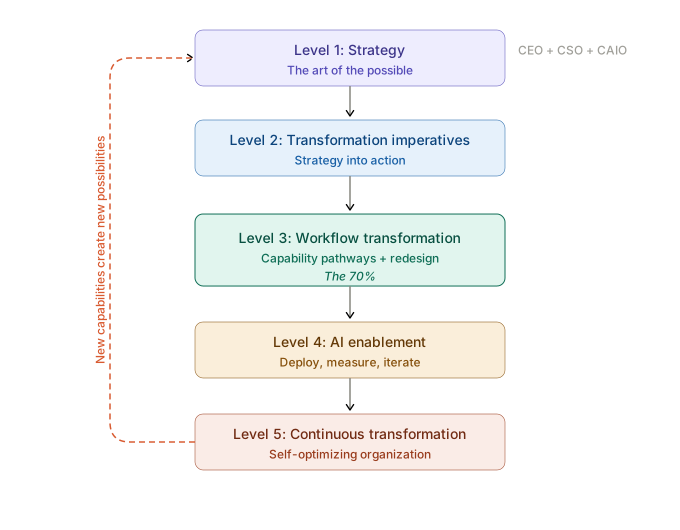
Your workflow redesign teams are producing some of the best work they have ever done. Three months into Level 3, the education cascade has landed. The capability decomposition is sharp. The designs coming out of your departments are genuinely transformative — not incremental improvements bolted onto legacy processes, but reimagined workflows that leverage AI in ways your teams could not have conceived six months ago.
And then someone from the adjacent domain’s team shows up at your weekly review and says: “Your redesigned output format doesn’t match what we need as input.”
Or your customer service redesign assumes real-time access to product data that the product team’s redesign is restructuring into an entirely different architecture. Or your finance team’s redesigned accounts payable workflow no longer aligns with procurement’s redesigned purchasing workflow because both teams designed in parallel without coordinating the handoff. Or a shared customer dataset that three domains depend on is being restructured by a fourth domain that did not know anyone else was using it.
This is not a failure of planning. It is a structural inevitability of how enterprise transformation works. When the Level 2 portfolio executes in waves with multiple charters running simultaneously — which it must, because sequential domain-by-domain transformation takes too long — the connections between those domains become the highest-risk, highest-value points in the entire methodology. And they are the points that most organizations discover too late.
Why does cross-department coordination make or break AI transformation?
The firms that implement AI transformations at enterprise scale have converged on one hard-won conclusion: individual domain redesigns fail at the seams where they connect, not within the domains themselves. These are the firms in the room when the redesigned workflows have to link to each other — not the ones that advise on strategy from a distance — and their experience points to the same lesson.
Accenture, drawing from over 1,500 generative AI projects and thousands of enterprise transformation engagements, found that companies experimenting with AI in siloed functions capture only a fraction of the value available to them. Their research quantifies the gap: organizations that have achieved fully modernized, AI-led end-to-end processes deliver 2.5 times higher revenue growth and 2.4 times greater productivity than their peers. But only 16% of organizations have reached that level.1 The remaining 84% are still optimizing within departmental boundaries, producing local improvements that do not compound into enterprise value.
The reason is not that individual domains are underperforming. It is that the value lives in the connections between domains, and those connections are where most transformations break.
IBM’s internal transformation — what they call “Client Zero” — taught them the same lesson from the inside. When IBM restructured its own operations around AI, it discovered that end-to-end workflow thinking was essential. Processes like quotation-to-cash and source-to-pay span multiple functions, and optimizing any single function without coordinating across the full chain produced marginal improvements at best. Their May 2025 CEO study found that only 25% of AI initiatives achieved expected return on investment, and disconnected technology and processes across organizational boundaries was a primary driver of that gap.2 IBM’s Tony Menezes put it directly: reimagining the way work gets done is the harder part of the discussion, and it is harder precisely because the work does not respect departmental boundaries.3
A year later, IBM’s 2026 CEO Study, released at Think 2026, showed how quickly the market is institutionalizing the coordination structure this article describes. 76% of organizations now have a Chief AI Officer, up from 26% in 2025, and the role is producing measured impact: organizations with a dedicated AI executive report 5% higher return on AI investments, generative AI prototype-to-production success rises from 36% to 44% under CAIO oversight, and CAIO-managed AI projects are roughly twice as likely to remain in production three or more years.8 Cross-functional AI coordination is no longer an organizational novelty. It is becoming the standard structure.
Capgemini’s assessment of the enterprise AI landscape reinforces this from yet another angle. Their conclusion, drawn from extensive client transformation work, was direct: the primary barrier to scaling AI is no longer the technology itself.4 It is the readiness of data, operating models, and organizational structures to support work that crosses functional lines. Integration across systems, functions, and workflows is where most organizations stall — not because the AI does not work, but because the organizational seams between departments were never designed to handle what the redesigned workflows require.
The 2026 research adds two dimensions to this picture. First, the coordination problem is vertical as well as horizontal: Harvard Business Review research published in April 2026 documents a persistent perception gap in which executives experience AI as strategic advantage while the managers inside real workflows confront its flaws, and initiatives stall in the space between them.9 Second, the seams are lagging the ambition: Deloitte’s 2026 Global Human Capital Trends found that 66% of the C-suite say traditional functions must change, but only 7% report progress in changing them.10 Meanwhile, the market has structurally committed to solving the integration problem. With OpenAI’s Frontier Alliance, announced February 23, 2026, all four of the largest consultancies (McKinsey, BCG, Accenture, and Capgemini) entered multi-year partnerships with a model provider specifically to build enterprise agent deployments and reshape multi-agent workflows.4
This is not an abstract concern for your organization. If you have two or more domains executing Level 3 charters simultaneously, you have this problem. The question is whether you discover it during the design phase, when it is manageable, or during deployment, when it is expensive.
Where does cross-domain integration break down?
Integration breakpoints fall into four consistent categories: handoff misalignment, shared data dependencies, upstream/downstream sequencing, and shared process boundaries. This pattern emerges from how implementation firms categorize cross-domain failures and from the practical experience that informs Plaster Group’s Methodology. Your teams will encounter all four. Knowing what to look for is the first step toward handling them before they become deployment failures.
What is handoff misalignment?
Handoff misalignment is when the output of one domain’s redesigned workflow does not match what the next domain’s redesigned workflow expects as input. This is the most common and most visible integration failure.
In the pre-AI world, handoffs between departments were standardized by the enterprise systems that connected them. The ERP system enforced a common data format. The CRM system defined how customer records moved from sales to service. The technology imposed integration whether the departments designed for it or not.
AI-enabled workflow redesign removes that constraint. When each domain designs how work should be done unconstrained by current technology (as Article 12 instructs), the designs naturally optimize for the domain’s own outcomes. The accounts payable team designs a workflow that produces the best possible invoice processing for their department. The procurement team designs a workflow that produces the best possible purchasing process for theirs. Both designs are excellent. But the handoff between them — the point where a purchase order becomes an invoice becomes a payment — was not designed by either team because it lives in the space between them.
Implementation firms see this pattern in virtually every multi-domain transformation. The solution is not to constrain the design teams. It is to identify every cross-domain handoff at the beginning of the design phase and assign explicit ownership of each handoff to one of the two domains involved. Someone has to own the interface. If both domains own it, neither does.
What are shared data dependencies?
Shared data dependencies arise when multiple domains redesign their workflows around the same underlying data, but each domain’s redesign makes different assumptions about that data’s structure, quality, availability, and governance.
Article 13 addressed data readiness as a constraint within a single domain’s redesign. The cross-domain version of this problem is more severe. When the customer service domain’s redesign assumes real-time access to a unified customer profile, and the marketing domain’s redesign assumes the same data organized differently for campaign targeting, and the product domain’s redesign is restructuring the underlying customer data architecture to support AI-enabled personalization — three domains are pulling the same data in three different directions, and none of them may know it.
Accenture’s research on this is instructive. Their concept of “mega processes” — cross-functional workflows that cut across traditional silos — was developed precisely because they observed this pattern repeatedly.5 When data lives in disconnected systems maintained by different departments, the redesign teams in each department naturally design around the data they can see. The result is redesigned workflows that are locally optimal but globally incoherent because they were designed against different versions of the same underlying reality.
The CAIO’s department plays a critical role here. The AI-Business Translators who are embedded in multiple domains can identify shared data dependencies that domain-specific teams cannot see from inside their own transformation. When the same data element appears in two different domain’s workflow designs, that is a coordination signal that needs to be surfaced immediately — not after both designs are approved and moving to Level 4.
What is upstream/downstream sequencing?
Upstream/downstream sequencing failures occur when one domain’s redesign creates requirements or constraints that the adjacent domain has not anticipated, because the upstream domain changed its outputs without coordinating with the downstream domain that depends on them.
This is a sequencing problem, and it is particularly acute in first-wave transformations where the organization has not yet built the muscle for cross-domain coordination. The supply chain domain redesigns its demand forecasting capability and, as part of that redesign, changes how forecast data is structured and delivered. The manufacturing domain, which depends on that forecast data to plan production, is not yet in its own Level 3 transformation and is still operating on the old format. Or it is in its own transformation and has designed its new workflow to consume the old forecast format, not knowing the supply chain team changed it.
The implementation firms handle this through explicit dependency mapping at the portfolio level. Deloitte’s approach to this is worth noting: their Transformation Nerve Center concept is specifically designed to maintain visibility across all active workstreams and identify these dependencies before they become integration failures. As they put it, no single business function is equipped to handle the scope and velocity of managing a comprehensive transformation because the critical capabilities — strategy, risk, change management, communications, finance, technology — are spread across functions.6 The coordination function exists precisely to see what no individual domain can see on its own.
In our methodology, this coordination sits in two places: the Level 1 triad’s monthly portfolio review (Article 4) provides the strategic-level oversight, and the CAIO’s department provides the operational-level connective tissue. But both need a deliberate practice to make the coordination real, which we will address in the next section.
What are shared process boundaries?
Shared process boundaries are the activities that sit at the border between two domains where ownership is ambiguous — not clearly inside either domain’s charter, but essential to both.
Every enterprise has processes that do not fit neatly into a single department’s org chart. Customer onboarding spans sales, operations, legal, and finance. Product launch spans marketing, supply chain, manufacturing, and customer service. Employee lifecycle management spans HR, IT, finance, and the business units themselves. These processes have always been coordination challenges, but in the legacy operating model, they were stabilized by established routines, informal relationships, and shared systems that imposed a common cadence.
When multiple domains redesign simultaneously, those stabilizing routines are disrupted. The informal coordination that held the boundary processes together no longer works because the underlying workflows have changed. And if nobody explicitly owns the boundary process in the new design, it falls through the cracks — beautifully redesigned workflows on both sides, with nothing connecting them.
The practical fix is straightforward but requires a deliberate decision: for every shared boundary process, assign one domain owner as the primary accountable party for the integrated process, with the adjacent domain owner as an explicit coordination partner. The domain owners make this accountability assignment, but the operational coordination of the boundary process is handled by the directors they have chartered as coordination leads. This assignment should happen during or immediately after the capability decomposition (Article 10), before the workflow redesign teams begin their work. Discovering ambiguous ownership during deployment is significantly more expensive than resolving it during design.
How does Plaster Group’s Methodology address cross-domain coordination?
Plaster Group’s Methodology already builds the structural elements for coordination into its design. What has not been made explicit until now is the operational practice that activates those structural elements at Level 3.
What coordination structures are already built into the methodology?
The Level 1 triad’s portfolio review (Article 4) provides the strategic-level coordination already in place. The monthly cadence where the CEO, CSO, and CAIO evaluate the portfolio includes assessing whether in-progress imperatives are creating conflicts, whether competitive developments have changed priorities, and whether new dependencies have surfaced that require portfolio-level decisions. This catches the biggest coordination issues — the ones that require resource reallocation or imperative reprioritization — but it operates at a strategic altitude that may not surface operational integration conflicts until they escalate.
The CAIO’s department (Article 5) serves as connective tissue across domains — but the mechanism for how that connective tissue actually works needs to be more precise than what Article 5 described.
In practice, the CAIO’s department embeds AI-Business Translators in each domain undergoing Level 3 transformation. These translators are sourced through the deliberate talent identification process described in Article 5 — cherry-picked for their combination of deep domain expertise, technical fluency, and the imagination to envision how AI changes what is possible within a specific function. Each translator develops deep familiarity with their domain’s capability requirements, workflow designs, data dependencies, and integration points. They become the resident expert on what AI makes possible within that specific domain’s context.
The cross-domain coordination function works through structured translator-to-translator coordination within the CAIO’s department. Each embedded translator has a chartered responsibility to bring the integration-relevant details of their domain’s work — the outputs being produced, the inputs being consumed, the data being restructured, the handoff formats being designed — to the translators embedded in adjacent domains. Those translators do the same in return. This is not informal knowledge sharing. It is a deliberate, structured practice where the CAIO’s translators serve as the integration radar across the entire portfolio of active transformations.
This translator-to-translator coordination should operate on a weekly cadence within the CAIO’s department, separate from and feeding into the biweekly cross-domain coordination sessions attended by the directors. The translators surface what they are seeing across domains. The CAIO’s department aggregates those observations into a cross-domain dependency view. That view is what prepares the directors’ coordination cadence with specific, actionable integration items rather than open-ended discussion.
This is one of the CAIO department’s highest-value functions at Level 3. The translators are the only people in the organization who combine AI capability expertise with embedded domain knowledge across multiple functions simultaneously. They can see conflicts that no individual domain’s team can see from inside their own transformation — because the conflicts exist in the space between domains, and the translators are the only people who occupy that space professionally. When the finance domain’s translator sees a data format change that will affect the operations domain, and the operations domain’s translator confirms that their workflow design assumes the old format, that conflict gets surfaced weeks before it would have been discovered during deployment. That early detection is what the CAIO department’s connective tissue function is designed to produce.
The domain owner’s charter (Article 9) establishes accountability. Each domain owner is accountable for their transformation outcome. But the charter, as described in Article 9, focuses on the domain’s own imperative. It does not explicitly address the domain owner’s responsibility for coordinating with adjacent domains. This is the gap that the operational practice needs to fill.
What is the operational coordination practice at Level 3?
The Level 3 coordination practice has three components, and none of them require a new organizational structure. All of them require deliberate commitment from the domain owners to charter the right people and stay engaged at the decision points that matter.
First, dependency mapping during capability decomposition. As part of the capability decomposition (Article 10), each domain owner should charter one or two of their strongest directors — people with deep process-level domain knowledge who have been through the education cascade and understand what AI makes possible — as cross-domain coordination leads. These directors are responsible for explicitly identifying every point where their domain’s redesigned capabilities will produce outputs consumed by other domains, consume inputs produced by other domains, share data with other domains, or operate shared boundary processes with other domains. This dependency map is shared with the CAIO’s department and with the coordination leads from the other domains in the same wave. It is the raw material that makes the rest of the coordination practice possible.
Why directors and not the domain owners themselves? At enterprise scale, a COO or CFO overseeing the transformation of an entire function operates at a strategic altitude. They set the vision, allocate resources, and make escalation decisions. But dependency mapping requires process-level domain knowledge — understanding exactly how an invoice flows from procurement to accounts payable, what data format the downstream system expects, which exception-handling rules are undocumented. That knowledge lives at the director level, with the people who understand how the business actually operates at the workflow level. The domain owner’s role is to charter the right directors, ensure they have the authority to represent the domain in coordination sessions, and stay close enough to the output to review and approve what emerges.
This mirrors the accountability chain established in Article 9: the domain owner is accountable for the transformation outcome, directors are accountable for the quality of the work. Cross-domain coordination is an extension of that same pattern.
The timing matters. Dependency mapping done during capability decomposition (Phase 3A) costs days. Dependency discovery during deployment (Level 4) costs months.
Second, a regular cross-domain coordination cadence. The coordination leads (directors) from each domain in the wave should meet on a defined cadence — every two weeks is the right frequency for most organizations during active workflow redesign. The purpose is narrow and practical: surface integration conflicts, resolve handoff ownership, coordinate shared data dependencies, and escalate issues that require portfolio-level decisions to the Level 1 triad. The CAIO’s department facilitates these sessions and prepares them by aggregating what their translators have observed across domains.
This cadence is not a steering committee. It is not a PMO status meeting. It is a working session where directors with process-level domain knowledge and decision-making authority from their domain owners make coordination decisions together. The distinction matters because the moment this cadence operates at too high a level, the participants will not have the operational depth to identify where handoffs actually break. And the moment it operates without sufficient authority, the participants will surface conflicts they cannot resolve, and the cadence stalls. The right directors — chartered by their domain owners with explicit authority to represent the domain on coordination matters — are the people who make this cadence productive.
Third, the CAIO’s department as the integration radar. The translator-to-translator coordination described above is the engine. But it needs to be explicitly chartered, not left to individual initiative. Before embedding translators in domains, the CAIO should brief them on all active domain dependencies identified in the Phase 3A dependency maps. Each translator should know not only their own domain’s integration points but which other domains are affected and who the corresponding translators are. The weekly translator coordination within the CAIO’s department should produce a running cross-domain dependency register that is updated as designs evolve and shared with the directors’ biweekly coordination cadence.
This is an expansion of the CAIO department’s Level 3 mandate as described in Article 5. The department already provides education and workflow design advisory to individual domains. Adding cross-domain integration as an explicit, structured responsibility — with a weekly internal cadence, a dependency register, and chartered translator-to-translator coordination — makes the connective tissue function operational rather than aspirational.
How much cross-domain coordination is the right amount?
The right amount of coordination is enough to preserve coherence without stalling delivery — and the tension between speed and coherence that this balance manages is real. Every domain in a first-wave transformation is under pressure to deliver results. Coordination takes time. The instinct to minimize it is understandable and, if taken too far, expensive.
The opposite extreme is equally dangerous. Organizations that over-coordinate — requiring every design decision to be reviewed by every adjacent domain before proceeding — slow every domain to the pace of the slowest. The workflow redesign teams lose momentum. The education cascade investment begins to decay as teams wait for approvals. The transformation timeline stretches, and organizational confidence erodes.
The calibration principle is: coordinate tightly on interfaces, loosely on internals.
Coordinate tightly on: handoff formats between domains (what data moves, in what structure, at what frequency), shared data dependencies (who owns what, and what happens when requirements conflict), process boundary ownership (who is accountable for the integrated process at each boundary), and deployment sequencing (which domain’s redesigned workflow goes live first when there are dependencies).
Coordinate loosely on: internal workflow design choices (how a domain organizes its own work is that domain’s decision), tool and technology selection within a domain (as long as the interface requirements are met, the tools behind them are the domain owner’s call), team structure and resource allocation within a domain, and iteration timing (each domain iterates at its own pace as long as interface commitments are maintained).
The quality gate described in Article 12 — where directors and senior managers evaluate redesigned workflows before they move to the VP level — should include one additional check for workflows that cross domain boundaries: has the handoff been coordinated with the adjacent domain, and has the adjacent domain confirmed that the interface works for their design? This is a single question that adds minutes to the review and prevents months of rework.
When does a cross-domain conflict need to be escalated?
A cross-domain conflict needs escalation when the coordination leads cannot resolve it in the biweekly cadence — some conflicts require decisions only the domain owners can make, and some require portfolio-level decisions only the Level 1 triad can make. The escalation path is: coordination leads surface the conflict and frame the options, domain owners evaluate whether they can resolve it between themselves, and if not, domain owners escalate to the Level 1 triad through the monthly portfolio review.
Three situations warrant escalation to the monthly portfolio review:
Resource conflicts. Two domains need the same data infrastructure investment, the same specialized talent, or the same CAIO department capacity at the same time, and there is not enough to serve both. The Level 1 triad prioritizes based on strategic impact, not on which domain owner makes the louder case.
Sequencing conflicts. Domain A’s redesign creates a dependency that Domain B needs resolved before it can proceed, but resolving it would delay Domain A’s timeline. Neither domain owner should be asked to sacrifice their own imperative’s timeline for the other’s benefit without a strategic-level decision that accounts for the portfolio as a whole.
Architectural conflicts. Two domains’ redesigns make fundamentally incompatible assumptions about the enterprise data architecture, technology platform, or organizational structure. These cannot be resolved at the domain level because they require enterprise-level architectural decisions that affect every domain, not just the two in conflict.
The escalation path should be clean and fast. The domain owners present the conflict, the options, and the trade-offs. The CAIO provides a feasibility assessment of each option. The CEO makes the decision. The CSO ensures the decision serves the competitive strategy. The decision is communicated back to both domain teams within days, not weeks. Delayed escalation decisions are one of the most reliable ways to stall a multi-domain transformation.
What enterprise value does coordination unlock?
Coordination is the mechanism through which individual domain transformations compound into something greater than the sum of their parts. This article has focused on the risks of poor coordination because those risks are immediate and concrete. But the case for coordination is not merely defensive.
When redesigned workflows connect cleanly across domains, every improvement in one domain multiplies through the others. A redesigned supply chain forecasting capability that feeds a redesigned manufacturing planning workflow that feeds a redesigned distribution optimization workflow produces an outcome that none of those domains could achieve independently. The value is not additive. It is multiplicative. And it only materializes when the connections between domains are designed with the same rigor as the workflows within them.
Accenture’s research supports this directly. Companies with operating models designed to work across functional silos are 1.6 times more likely to achieve profitable growth compared to companies without them. Companies without cross-functional operating models are twice as likely to lag on both profitability and growth.7 The coordination investment is not overhead. It is the mechanism that converts a portfolio of domain-level improvements into the enterprise-level transformation that the Level 2 imperatives were designed to deliver.
BCG’s April 2026 assessment reaches the same conclusion from the top down: work reinvention must be CEO-led precisely because the shifts cut across structures, incentives, and power dynamics that no single domain owns. Roughly 75% of CEOs now describe themselves as their organization’s main AI decision maker, double the share of a year earlier, and AI spending is expected to roughly double in 2026.11
This is the compounding advantage described in Article 2. The organizations that get this right do not just outperform their competitors on individual capabilities. They operate at a level their competitors cannot reach by optimizing within silos, because the advantage is structural — and structural advantages compound in ways that siloed improvements never do.
The cross-domain coordination practice described in this article is how that structural advantage gets built, one handoff, one shared dependency, and one boundary process at a time.
Sources
- 1.Accenture, “Reinventing Enterprise Operations with Gen AI,” October 2024. Based on survey of 2,000 executives across 12 countries and 15 industries https://newsroom.accenture.com/news/2024/new-accenture-research-finds-that-companies-with-ai-led-processes-outperform-peers
- 2.IBM, CEO Study announced at IBM Think 2025, May 2025 https://newsroom.ibm.com/2025-05-06-ibm-accelerates-enterprise-gen-ai-revolution-with-hybrid-capabilities
- 3.Tony Menezes, Global Managing Partner, Business Process Operations, IBM Consulting. Quoted in SiliconANGLE coverage of IBM “AI-Powered Business Operations” event, September 2025 https://siliconangle.com/2025/09/08/inside-ibms-ai-strategy-operationalizing-cross-enterprise-intelligence-ibmaiops/
- 4.Capgemini, OpenAI Frontier Alliance partnership announcement, February 2026 https://www.capgemini.com/us-en/news/press-releases/capgemini-joins-forces-with-openai-to-accelerate-new-era-of-ai-powered-enterprise-transformation-with-frontier-alliance/
- 5.Accenture, “Reinvent Around Mega Processes to Fuel New Growth,” October 2024. Based on over 1,500 generative AI projects https://www.accenture.com/us-en/blogs/consumer-goods-services/reinvent-around-mega-processes-fuel-new-growth
- 6.Deloitte Insights, “Digital Transformation Execution: The Transformation Nerve Center,” June 2025 https://www.deloitte.com/us/en/insights/industry/manufacturing-industrial-products/industry-4-0/digital-transformation-nerve-center.html
- 7.Accenture, “The Tech-Powered Operating Model,” March 2023 https://www.accenture.com/us-en/insights/strategy/tech-powered-operating-model
- 8.IBM, 2026 CEO Study, released at Think 2026, May 4, 2026 (2,000 CEOs and equivalent senior leaders, 33 geographies, 21 industries, with Oxford Economics). 76% of organizations have a Chief AI Officer, up from 26% in 2025; 5% higher return on AI investments with a dedicated AI executive; prototype-to-production success from 36% to 44%; roughly 2x production persistence https://newsroom.ibm.com/2026-05-04-ibm-study-ceos-are-reshaping-c-suite-roles-for-the-ai-era
- 9.Harvard Business Review, “Managers and Executives Disagree on AI, and It’s Costing Companies,” April 2026. Executive-manager perception gap stalls AI initiatives https://hbr.org/2026/04/managers-and-executives-disagree-on-ai-and-its-costing-companies
- 10.Deloitte, “2026 Global Human Capital Trends: From Tensions to Tipping Points,” March 4, 2026 (9,000+ business and HR leaders, 89 countries). 66% of the C-suite say traditional functions must change; only 7% report progress https://www.deloitte.com/us/en/insights/topics/talent/human-capital-trends.html
- 11.BCG, “AI Has Made Work Reinvention a CEO Mandate,” April 16, 2026. About 75% of CEOs identify as their organization’s main AI decision maker, double the prior year; AI spend expected to double from 0.8% to about 1.7% of revenues in 2026 https://www.bcg.com/publications/2026/ai-has-made-work-reinvention-a-ceo-mandate
Frequently Asked Questions
We only have one domain in our first wave. Does this article apply to us?
Not immediately, but it will soon. Even a single-domain transformation creates outputs that flow to domains still operating in their legacy mode. The dependency mapping described in this article should still be done for your first-wave domain to identify where your redesigned workflows will create handoff changes with adjacent domains that have not yet transformed. This mapping becomes invaluable when those domains enter their own Level 3 transformations in subsequent waves, because the interface requirements are already documented rather than discovered during deployment.
How much time does cross-domain coordination require, and from whom?
For the directors chartered as coordination leads, expect the biweekly coordination sessions to run 60-90 minutes, with 30-60 minutes of preparation (reviewing what the CAIO’s translators have surfaced since the last session). During the active workflow redesign phase, this represents approximately 10-15% of their time — a significant but essential commitment. For the domain owners and VPs, the time commitment is lighter: reviewing the dependency map when it is produced, staying briefed on coordination issues through their directors, and engaging directly only when escalation decisions are needed. The alternative, discovering integration failures during deployment, consumes dramatically more time from everyone, including the domain owner personally managing crisis resolution rather than planned coordination.
What if the CAIO’s department is too small to serve as connective tissue across all active domains?
This is a real constraint, particularly in first-wave transformations where the CAIO’s department is still being built. Two mitigations help. First, prioritize translator embedding in the domains with the highest cross-domain dependency risk, which the dependency mapping from Phase 3A will identify. Second, the directors chartered as coordination leads partially compensate for limited translator capacity. They carry domain knowledge into the coordination cadence even without a CAIO translator present. The coordination cadence still functions — it just relies more heavily on the directors’ own cross-domain awareness and less on the translators’ multi-domain visibility. This is less optimal but far better than no coordination practice at all.
Should we create a dedicated integration team or transformation office?
The research supports a coordination function but not necessarily a separate team. Deloitte’s Transformation Nerve Center concept demonstrates the value of having unified visibility across workstreams. However, in our methodology, that visibility already exists in two places: the CAIO’s department at the operational level and the Level 1 triad at the strategic level. What most organizations need is not a new team but a deliberate practice — the dependency mapping, the coordination cadence, and the explicit tasking of the CAIO’s translators described in this article. If the organization’s transformation scope is large enough (five or more domains transforming simultaneously), a dedicated integration coordinator within the CAIO’s department may be warranted. For most first- and second-wave transformations, the practice is sufficient without the structure.
How do we handle coordination with domains that are not yet in their Level 3 transformation?
Your redesigned workflows will produce outputs that flow to domains still operating in legacy mode. The coordination challenge here is ensuring that your new outputs are backward-compatible with the legacy systems and processes in the receiving domain, or that the receiving domain is prepared for the interface change. This is a Level 4 deployment concern more than a Level 3 design concern, but flagging it during design prevents surprises during deployment. Include the receiving domain’s operational leaders in the interface specification review, even if they are not yet in their own transformation. They may not have the AI fluency to evaluate your full design, but they can tell you whether your proposed output format will break their existing operations.
What happens when coordination surfaces a conflict that would require one domain to compromise their design for the benefit of the enterprise?
This is the most difficult coordination decision, and it is the reason the escalation path to the Level 1 triad exists. When a domain owner is asked to accept a suboptimal design in their own domain so that the enterprise integration works, that decision must be made at the portfolio level with full visibility into the trade-offs. The CEO’s judgment, informed by the CSO’s competitive analysis and the CAIO’s feasibility assessment, determines whether the enterprise benefit justifies the domain-level compromise. No domain owner should be expected to make this trade-off unilaterally. And no domain owner should be allowed to refuse the trade-off unilaterally if the enterprise case is clear. The Level 1 triad exists precisely for these moments.
This series addresses “what” to do, not “how” to do it. If you are a business executive and would like help thinking through the “how,” please feel comfortable reaching out.

About the author
Shawn Plaster
Founder & CEO, Plaster Group
Shawn is the author of Plaster Group's five-level AI Business Transformation Methodology and its 27-article Insights series, and leads the firm's enterprise AI transformation work.
Previous: Article 13: Data Readiness as a Practical Constraint · Next: Article 15: Change Management
© 2026 Plaster Group, LLC. All rights reserved. This article may not be reproduced, distributed, or transmitted in any form without prior written permission from Plaster Group. Brief excerpts may be quoted for review or commentary purposes with attribution to the author and a link to the original article.
Ready to move forward?
Let's discuss how your organization can build with AI — securely, strategically, and starting from where you are today.
Start a Conversation