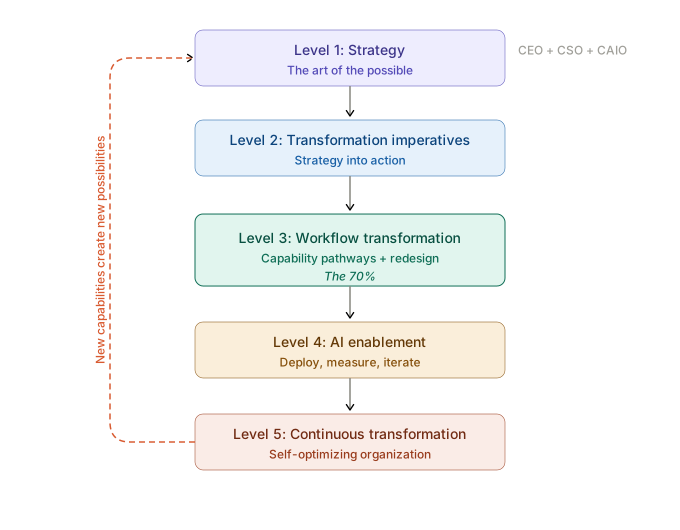
This article is part of a 27-article series on the AI Business Transformation Methodology. This piece addresses the data constraints that workflow redesign teams encounter during Phase 3C and provides practical guidance for handling them.
Your workflow redesign team is three weeks into the design work. They have mapped the current state, identified decision points and handoffs, and begun designing the future-state workflow for the accounts payable department. The redesigned workflow is ambitious: AI agents handle routine invoice matching, flag exceptions for human review, and generate predictive cash flow analysis based on payment patterns across vendors.
Then someone asks the question that changes everything: where does the vendor payment history data come from?
The answer, it turns out, is three different systems that do not talk to each other, maintained by two different departments, with inconsistent formatting and no single owner. The predictive cash flow analysis that looked so promising on the whiteboard requires data integration that does not exist.
This is the discovery moment. Every workflow redesign team hits it. The question is not whether your teams will encounter data constraints. It is whether they are prepared to handle them productively when they do.
Why will workflow redesign inevitably expose data gaps?
Workflow redesign inevitably exposes data gaps because it deliberately asks teams to design how work should be done in an AI-enabled world, unconstrained by current technology limitations. This is the right approach because it produces transformative designs rather than incremental improvements. But it also means the designs will frequently outpace the current data environment’s ability to support them, as described in Article 12.
This is not a failure of the design process. It is a feature of it. One of the most valuable outputs of workflow redesign is the precise identification of data gaps that must be closed for the transformation to succeed. Before the redesign, these gaps were invisible because nobody was asking the data to do what the new workflow requires. The redesign makes them visible, specific, and actionable.
According to IBM’s study of 1,700 Chief Data Officers worldwide, 81% report that their data strategy is now integrated with their technology roadmap, up from 52% in 2023. But only 26% are confident their data can actually support new AI-enabled capabilities.1 That 55-point gap between strategic integration and practical readiness is exactly what workflow redesign teams experience on the ground: the strategy says the data should be ready, but the reality is different.
The industry data keeps confirming the pattern. At its March 2026 Data & Analytics Summit, Gartner reaffirmed its headline prediction that 60% of AI projects will be abandoned through 2026, and made the causal framing explicit: not because the technology failed, but because the data was not ready.4 Only 37% of organizations expressed confidence in their data-management practices for AI, and Gartner projects that the share of AI spending devoted to data readiness will grow sevenfold from 2025 through 2029, with 40% of data-management budgets shifting to multistructured, largely unstructured data by 2027.4 The unstructured-data point pairs with the rest of IBM’s CDO research: 80% of chief data officers are building datasets to train AI agents, but 79% admit they are early in defining how to scale and govern them, and only 26% are confident they can extract business value from unstructured data.1
What kinds of data problems surface during workflow redesign?
The data constraints that surface during workflow redesign fall into three consistent categories. Understanding them before your teams begin the design work helps them recognize what they are encountering and respond with the right protocol rather than treating each discovery as a unique crisis.
Siloed data. The information the redesigned workflow needs exists in the organization, but it is scattered across systems that do not communicate with each other. The customer’s purchase history is in the CRM. Their support interactions are in the ticketing system. Their payment behavior is in the ERP. Their satisfaction scores are in a survey platform. The redesigned workflow needs all of this in one place to make intelligent decisions, but no integration exists.
Accenture’s direct work with enterprise clients surfaces this as the single most cited technical barrier to AI value. Nearly half of C-suite executives identify data readiness, driven primarily by siloed data, as the top challenge in applying AI effectively.2 The redesign team’s job is not to solve the integration problem. It is to document precisely what data needs to be connected, from which systems, in what format, and at what frequency, so that the CIO and CDO’s organization can build the integration as part of the Level 4 enablement work.
Data quality issues. The data exists and is technically accessible, but it is incomplete, inconsistent, outdated, or unreliable. Customer addresses have not been updated in years. Product codes differ between the ordering system and the inventory system. Transaction records have missing fields that experienced employees fill in from memory but that an AI system cannot interpret.
IBM’s research found that more than half of organizations cite data quality as the primary reason AI projects stall.1 The specific quality dimensions that matter most for AI-enabled workflows are completeness (are all the required fields populated?), consistency (do the same data elements mean the same thing across systems?), timeliness (is the data current enough for the workflow’s needs?), and accuracy (does it reflect reality?). Of these, timeliness deserves particular attention because AI-enabled workflows often require data access patterns that differ fundamentally from what the organization has built before. The redesign team should specify whether each data requirement needs real-time access (the AI must see current information as it makes decisions), near-real-time (data refreshed within minutes or hours is sufficient), or batch processing (overnight updates are acceptable). This distinction directly determines what the CIO and CDO’s organization must build at Level 4: real-time data requirements demand streaming pipelines, while batch requirements can use traditional approaches. A workflow design that says “the AI needs vendor payment history” without specifying whether it needs yesterday’s data or this moment’s data leaves the Level 4 team guessing about what to build. The redesign team should assess each data requirement against these four dimensions and document where the gaps are. A workflow that assumes data quality it does not have will fail in deployment.
Governance gaps. Nobody owns the data. There are no standards for how it is entered, maintained, or retired. No lineage tracking exists to trace where the data came from or how it has been transformed. Access permissions are inconsistent. When the redesign team asks “who is responsible for the accuracy of this data?“ the answer is often silence. A related constraint the redesign team will discover as they document the business context that Article 12’s Step 5 prescribes: the business meaning of data may be inconsistent or undocumented across systems. The same entity appears under different names or identifiers in different systems. Business rules that experienced employees apply intuitively when interpreting data have never been written down in any form. Relationships between entities that matter for the workflow exist in people’s knowledge but not in any system. These semantic gaps are a data readiness constraint because AI systems cannot infer business context the way a human employee does. When the redesign team discovers these inconsistencies, they should document them with the same rigor as siloed data or quality issues, because the CDO’s organization at Level 4 will need this documentation to build the semantic infrastructure that makes the enterprise’s data interpretable for AI consumption.
Deloitte’s practitioners see this pattern across industries and offer a direct recommendation: assign specific people, not committees, to own critical data domains.3 When everyone owns the data, nobody is responsible for it. The redesign team should document every data element the new workflow requires and identify whether it has a clear owner. Where it does not, that governance gap becomes a flagged dependency for the CIO/CDO’s organization to resolve.
What are your options when you hit a data constraint?
When the redesign team encounters a data constraint, they have four options — and the right choice depends on the severity of the gap, the criticality of the capability it affects, and the timeline for resolution.
Option 1: Scope the design to current data realities. If the data gap affects a secondary capability rather than the core transformation outcome, scope that portion of the workflow to what the current data can support. Design the workflow so it functions with the data available today, with a documented expansion path for when the data environment improves. This is the right choice when the gap is real but not blocking, and when the core transformation can proceed without it.
For example, if the redesigned accounts payable workflow requires predictive cash flow analysis but the vendor payment data is siloed, you might design the core workflow (AI-enabled invoice matching, exception routing, approval automation) using the data you have, and flag the predictive analytics capability as a Phase 2 expansion that requires data integration. The core transformation delivers value now. The advanced capability comes when the data catches up.
Option 2: Include a data readiness workstream as a prerequisite. If the data gap blocks a critical capability, the design should include a parallel workstream that addresses the data constraint before deployment. This workstream is owned by the CIO/CDO’s organization, not by the workflow redesign team. But the redesign team defines what the workstream needs to deliver: which data, from which systems, at what quality level, by when.
This is the right choice when the capability is central to the imperative’s business outcome and the transformation cannot deliver its intended value without it. The data readiness workstream becomes part of the transformation plan, with its own timeline, resources, and accountability.
Option 3: Escalate the gap through the organizational chain. If the data constraint affects multiple domains rather than just yours, the resolution requires coordination beyond the workflow redesign team’s scope. The first escalation is to the CIO and CDO’s organization, which has the mandate and budget authority for data infrastructure decisions. For cross-domain coordination, the CAIO’s department serves as the connective tissue, identifying where multiple domains have discovered the same constraint and ensuring the resolution serves all of them. If the domain C-level leaders need to agree on priority or sequencing, they make that decision through the governance cadence described in Article 4. Only if the constraint requires a foundational investment that was not anticipated in the Level 2 portfolio should the domain owner escalate to the Level 1 triad for a portfolio-level decision.
This is the right choice when the data constraint is bigger than any single domain’s transformation. If the supply chain domain, the finance domain, and the customer service domain all discover they need the same data integration that does not exist, that is not three domain-level problems. It is an enterprise-level data architecture gap. The CIO and CDO’s organization should resolve it with CAIO coordination. If it requires investment beyond what has already been allocated, the domain owner brings it to the Level 1 triad with a clear description of what is needed and why, because that is a strategic portfolio decision.
Option 4: Use AI to accelerate data readiness. This is a newer option that the implementation firms are increasingly recommending. AI itself can be used to clean, migrate, integrate, and govern data faster than traditional methods. Automated data quality tools can identify and resolve inconsistencies at scale. AI-powered migration tools can accelerate the integration of legacy systems. Intelligent governance platforms can establish lineage tracking and access controls more efficiently than manual approaches.
This is not a replacement for the other three options. It is an accelerator that can be applied alongside any of them. The redesign team should work with the CAIO’s department and the CIO/CDO’s organization to identify where AI-accelerated data readiness could shorten the timeline between discovering the gap and closing it. McKinsey’s April 2026 guidance on scaling agentic AI points in the same direction: identify the high-impact workflows to agentify, modernize the data architecture that feeds them, and evolve the operating model around them, because data readiness is the binding constraint on moving from redesigned workflows to deployed agents.5
One nuance applies specifically to the semantic gaps described above. When the redesign team discovers that business context is inconsistent or undocumented across systems, the resolution requires a different kind of partnership than the other three categories. Siloed data, quality issues, and governance gaps can be resolved primarily by the CIO and CDO’s organization with a clear specification from the business team. Semantic gaps cannot. The domain team is the only group that knows what “customer” actually means in their context, how entities relate to each other within their business processes, and what rules govern those relationships. When a semantic gap is flagged, the resolution workstream must include domain team participation throughout, not just at the specification stage. The CDO’s organization builds the technical infrastructure at Level 4, but the domain team provides the business meaning that makes it accurate.
What is the one response to a data gap you must never choose?
There is one response to data constraints that is never acceptable: designing the workflow as if the data exists when it does not.
This is the fastest path to a failed deployment. The workflow looks brilliant on paper. It passes the quality gate because the directors and senior managers evaluating it do not realize that the data foundation underneath it is missing. It moves to Level 4 for AI enablement, and the technology team begins building to the specification. And then, during deployment, the workflow fails because the data it depends on is not there, not clean, or not accessible. The same failure occurs when the workflow assumes the AI will understand business context that no one has documented. A human accounts payable clerk knows that “vendor” in the procurement system and “supplier” in the ERP refer to the same entity. The AI does not know this unless the business context has been captured and made machine-readable. Designing a workflow that assumes this understanding without documenting it is the semantic equivalent of designing a workflow that assumes data exists when it does not.
The organizational damage extends beyond the failed deployment. Confidence in the entire transformation erodes. Leaders who championed the effort lose credibility. The teams who did the design work are demoralized. And the narrative shifts from “we are transforming“ to “AI does not work for us,“ which is precisely the wrong conclusion. The AI would have worked fine. The data was not ready. But the perception of failure sticks.
Every data requirement in the redesigned workflow should be validated against reality before the design is approved through the quality gate. This is one of the specific things directors and senior managers should check during their review: for each step in the workflow that depends on data, has the team confirmed that the data exists, is accessible, and meets quality requirements? If the answer is no, which of the four options above has been selected, and is the resolution plan documented?
Who resolves the data gaps the business team discovers?
The business team’s role at Level 3 is to discover, document, and flag data constraints; the CIO and CDO’s role is to resolve them. This article is deliberately written for the business teams doing the workflow redesign, not for the CIO or CDO, because that division of responsibility is what keeps the redesign moving.
This is one of the clearest handoff points in the entire methodology. Level 3 (business transformation) produces a precise specification of what data the redesigned workflows need. Level 4 (AI enablement) includes the infrastructure, integration, and governance work that makes that data available. The business team tells the technology organization exactly what they need. The technology organization builds it.
Article 21 in this series will cover the data architecture and CDO’s perspective on data architecture and AI governance in depth. For now, the message to the workflow redesign team is: your job is to surface the constraints with precision and specificity. Document what data you need, from where, at what quality level, and by when. Document the business context the AI needs to interpret that data correctly, including where that context is inconsistent or undocumented across systems. Do not try to solve the data infrastructure problem yourself. Do not design around it without acknowledging it. And do not pretend it does not exist.
The organizations that handle data readiness well at Level 3 are not the ones with perfect data. They are the ones that discover their gaps early, document them clearly, and create actionable plans for closing them before deployment. The data does not have to be perfect at the start of the transformation. It has to be honest.
Sources
- 1.IBM Institute for Business Value, CDO Study, November 13, 2025 (1,700 Chief Data Officers worldwide; still the current edition as of mid-2026). 81% data strategy integrated; 26% confident data supports AI capabilities; 50%+ cite data quality as primary AI project barrier; only 26% confident they can extract business value from unstructured data; 80% building datasets to train AI agents while 79% are early in defining how to scale and govern them https://newsroom.ibm.com/2025-11-13-ibm-study-chief-data-officers-redefine-strategies-as-ai-ambitions-outpace-readiness
- 2.Accenture, enterprise client research, 2025. Nearly 47% of CxOs cite data readiness (primarily siloed data) as top barrier to AI value.
- 3.Deloitte Consulting, data governance advisory. Assign specific people, not committees, to own critical data domains https://www.deloitte.com/au/en/services/consulting/perspectives/ai-data-governance-strategy.html
- 4.Gartner, Inc., prediction that 60% of AI projects will be abandoned through 2026 without AI-ready data, February 2025; reaffirmed at the Gartner Data & Analytics Summit, March 2026, with companion findings: 37% confident in data-management practices for AI; AI-data-readiness spending to grow 7x from 2025 through 2029; 40% of data-management spend shifting to multistructured data by 2027 https://www.gartner.com/en/newsroom/press-releases/2026-03-11-gartner-announces-top-predictions-for-data-and-analytics-in-2026
- 5.McKinsey, “Scaling Agentic AI with Data Transformations,” April 2, 2026. Identify high-impact workflows to agentify; modernize data architecture; evolve the operating model https://www.mckinsey.com/capabilities/mckinsey-technology/our-insights/building-the-foundations-for-agentic-ai-at-scale
Frequently Asked Questions
How do we assess data readiness without involving the CIO/CDO’s team at Level 3?
You should involve them. The assessment does not need to be a formal infrastructure review, but the workflow redesign team should have access to someone from the data organization who can answer practical questions: does this data exist, where is it, who owns it, and what is its quality? Many CIO/CDO organizations assign a data liaison to the transformation effort for exactly this purpose. If that role does not exist, request it through the domain owner. Discovering data constraints without the ability to validate them against reality produces incomplete documentation.
What percentage of workflow redesigns encounter significant data constraints?
Based on the research, virtually all of them. Gartner predicts that 60% of AI projects will be abandoned through 2026 for lack of AI-ready data, a prediction it reaffirmed at its March 2026 Data & Analytics Summit.4 IBM found that more than half of organizations cite data as the primary reason AI projects stall. The question is not whether you will encounter data constraints but how many and how severe. Planning for this reality from the beginning of the redesign process is far more productive than being surprised by it midway through.
Should we delay the workflow redesign until the data is ready?
No. The workflow redesign is what reveals precisely what data readiness means for your specific transformation. Until the redesign is done, “data readiness“ is an abstract concept. After the redesign, it is a specific, actionable list of requirements. The redesign should proceed with the understanding that data constraints will be discovered and handled through the four options described in this article. Waiting for perfect data before designing workflows is like waiting for perfect weather before building a house. You design the house, then you address the site conditions.
How do we prioritize which data gaps to address first?
Prioritize by impact on the imperative’s business outcome. A data gap that blocks the core transformation (the capability that delivers the primary business result) must be resolved before deployment. A data gap that affects a secondary or enhancement capability can be addressed in a later phase. The capability map from Phase 3A (Article 10) provides the priority framework: capabilities that are foundational or that enable other capabilities should have their data gaps resolved first.
What if the CIO/CDO says the data problem cannot be solved within our timeline?
This is a genuine constraint that requires a decision, not a debate. If the data cannot be ready in time, the domain owner and their VPs need to decide: scope the workflow to what the current data supports (Option 1), adjust the timeline to allow for the data readiness workstream (Option 2), or escalate to the Level 1 triad for portfolio-level prioritization (Option 3). The worst response is to proceed with the design as written and hope the data will somehow be ready by deployment. It will not, and the deployment will fail.
This series addresses “what” to do, not “how” to do it. If you are a business executive and would like help thinking through the “how,” please feel comfortable reaching out.

About the author
Shawn Plaster
Founder & CEO, Plaster Group
Shawn is the author of Plaster Group's five-level AI Business Transformation Methodology and its 27-article Insights series, and leads the firm's enterprise AI transformation work.
Previous: Article 12: Workflow Redesign for AI · Next: Article 14: Cross-Department Coordination
© 2026 Plaster Group, LLC. All rights reserved. This article may not be reproduced, distributed, or transmitted in any form without prior written permission from Plaster Group. Brief excerpts may be quoted for review or commentary purposes with attribution to the author and a link to the original article.
Ready to move forward?
Let's discuss how your organization can build with AI — securely, strategically, and starting from where you are today.
Start a Conversation