This article is part of a 27-article series on the AI Business Transformation Methodology. This piece addresses what happens to people’s roles when the workflows they operate within are fundamentally redesigned, and why this work is qualitatively different from any previous technology transformation.
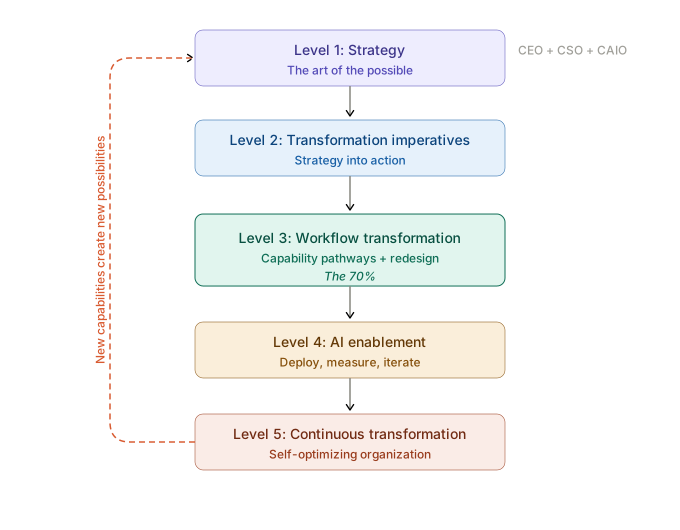
Your workflow redesign teams have been producing exceptional work. Approaching the tail end of Level 3, the redesigned accounts payable workflows are genuinely transformative. AI agents handle routine invoice matching, flag exceptions for human review, and generate predictive cash flow analysis based on vendor payment patterns. The designs passed through the quality gate described in Article 12. The directors signed off. The VP approved.
Now the change management team’s org impact analysts are working through the redesigned workflows, which is exactly what they should be doing. And what they are finding is both more complex and more promising than they expected.
The three-person invoice processing team is not losing roles. The roles are fundamentally evolving. The person who used to spend 80% of their day on manual invoice matching and data entry would now spend that time on vendor relationship analysis, exception investigation, and cash flow pattern recognition. The AI handles the matching. The human handles the judgment: which vendors are reliable, which exceptions signal a deeper problem, which payment patterns suggest an opportunity to renegotiate terms. The role title might stay the same, but the work is more strategic, more analytical, and requires a different set of skills than what the current job description reflects.
A senior manager on the change management team raises a question to their director: the role evolution is clear, but their team needs help understanding what some of the AI-enabled workflow steps actually mean for human responsibilities. Some of the steps are tagged with capability categories they have not worked with before. And the role implications in accounts payable cross into procurement’s redesigned workflows, because the handoffs between the two departments affect how both sets of roles are defined.
The director connects the change management team with the CAIO’s AI-Business Translators, who can help interpret what the AI-enabled workflow steps mean for human roles. The cross-department dimension gets raised at the biweekly coordination cadence from Article 14.
This is the system working. The challenge is that in most organizations, this function was never chartered in the first place. And even where it was, the practitioners were not equipped for the kind of role evolution that AI-enabled workflows produce.
Why is AI job redesign different from every previous transformation?
AI job redesign differs from every previous transformation because the underlying capabilities are flexible, configurable, and continuously evolving rather than fixed. Every enterprise leader reading this has been through at least one large-scale technology transformation — ERP implementations, platform migrations, digital transformations. Each one required some version of job redesign: new systems meant new processes, which meant new roles, which meant new job descriptions and training programs.
This is not that.
In those previous transformations, the technology was rigid. SAP or Oracle dictated the process, and job redesign was essentially figuring out how people’s roles needed to conform to what the system required. The system’s capabilities were known and fixed. The role changes were predictable, bounded, and finite. You redesigned once, trained, went live, and stabilized. The change management team could assess the impact, define the new roles, and move on to the next module.
AI inverts that entire model. The workflow redesign methodology described in Article 12 explicitly instructs teams to design how work should be done unconstrained by current technology. The technology selection comes later, at Level 4. That means the role redesign that follows is not about conforming people to a system. It is about defining what humans contribute within workflows they designed themselves. That is a fundamentally different design problem.
Three characteristics make this qualitatively different from anything that came before.
First, the nature of human contribution is shifting, not just the process. In ERP implementations, people still did the same types of cognitive work (analysis, decision-making, data entry, reporting) in a different system with different screens. The skills changed, but the fundamental nature of the work did not. AI is changing what the work actually is. The consistent pattern across the research is a shift from execution to orchestration and judgment.1 The financial analyst does not learn a new system to build models. The AI builds the models and the analyst validates, interprets, and applies judgment to the results. That is not a process change. It is a role transformation.
Second, the roles keep changing because the capabilities keep evolving. In ERP, once you went live, the system’s capabilities were essentially static until the next upgrade cycle. Job descriptions could be written once and remain stable for years. AI capabilities are advancing continuously. The capability meta-layer tagging described in Article 12 exists precisely because new capabilities will emerge and reshape what is possible at each workflow step. When that happens, the roles defined against those steps change too, a mechanism this article addresses in the reengagement trigger section below.
Third, entirely new role categories are emerging that have no historical precedent. ERP implementations created new roles too, but they were technology support roles (system administrators, functional analysts, basis engineers). The business roles themselves stayed recognizable. AI is creating business roles that did not exist before: AI output validators, agent supervisors, human-AI workflow monitors, exception handlers for AI edge cases.2 The change management practitioners doing the org impact assessment cannot look at a precedent from the last implementation and adapt it. They are defining roles from scratch based on workflow designs that have no historical analog.
Who actually does the job-redesign work?
Job redesign is the organizational impact assessment leg of the change management function, performed by trained practitioners rather than by business leaders between meetings. It is a discipline with its own methods and expertise, not a side task.
In most enterprises, change management practitioners reside in the enterprise program management office, though the function’s organizational home varies. Some companies place it in HR or Learning and Development, some embed it within a dedicated transformation function, and some distribute it across domains in a federated model. External consulting firms frequently augment internal capacity, especially during first-wave transformations when the internal team may not have the scale or the AI-specific experience the work requires.
Research on enterprise AI adoption reinforces that the change management challenge has intensified: the biggest barrier to realizing AI’s potential is no longer the technology itself but bringing people along the journey, and traditional change management models that worked in previous eras are no longer sufficient for the shift in mindset, behaviors, and ways of working that AI requires.3
Regardless of where the function sits organizationally, two coordination relationships are essential in an AI transformation, and both are unique to this context.
The first is coordination with the CAIO’s AI-Business Translators. The Translators understand the technical workflow designs: what the AI-enabled steps actually do, what the capability category tags mean, where the human-AI handoffs create new responsibilities. The change management practitioners understand org impact assessment methodology: how to translate process changes into role definitions, skills requirements, and organizational structure changes. Neither can produce good output without the other’s expertise. The Translators do not do job redesign. The practitioners do not design workflows. But they work hand-in-hand because the practitioner needs the Translator to interpret what the workflow means for human roles, and the Translator needs the practitioner to translate that interpretation into actionable role definitions.
The second is coordination with the domain’s workflow redesign teams. The change management practitioners need access to the redesigned workflows as they are being produced, not after they are finalized. The workflow redesign teams understand the tacit knowledge, the exception handling, and the operational context that shaped their designs. The practitioners need that context to accurately assess what changes for the people who will operate within the new workflows. When the workflow redesign team designed a step where AI handles routine invoice matching and a human reviews exceptions, the practitioners need to understand what “review exceptions” actually means in practice: what judgment calls are involved, what data the human needs access to, what authority they have to override the AI, and what happens when the AI encounters something outside its training.
This three-way coordination, between change management practitioners, the CAIO’s Translators, and the domain’s workflow redesign teams, is the operational mechanism that makes job redesign possible in an AI context. It does not exist in traditional change management because the technology side was always understood through the system itself. In AI transformation, the technology side must be interpreted through people who understand what it means for human work.
What do change management practitioners need to learn about AI workflows?
Change management practitioners already know how to conduct organizational impact assessments, define new role structures, map skills requirements, and design training strategies — what they have not encountered before is the type of workflow that AI transformation produces. The gap is significant: while most organizations have focused on educating employees as their primary talent adjustment for AI, far fewer are re-architecting roles, workflows, and career paths.2
The education cascade described in Article 11 prepared the workflow redesign teams to design ambitiously by building AI fluency before they put pen to paper. The same principle applies here. Before change management practitioners can analyze AI-enabled workflows and accurately assess what they mean for roles, they need enough AI fluency to understand what they are looking at.
This does not mean turning change management practitioners into data scientists. It means building enough understanding that when they encounter a workflow step tagged as “predictive AI” or “agentic AI” from the CAIO’s capability taxonomy, they can assess what that means for the human operating alongside it. What does it mean for a person’s role when an AI agent handles the routine work and the human handles exceptions? What skills does that require? What does oversight of an AI system look like as a daily job function? What is the difference between a role where AI assists the human and a role where the human supervises the AI?
The CAIO’s department is the natural source for this education. The AI-Business Translators who will partner with the practitioners during the assessment work can also prepare them for it. The investment is modest compared to the education cascade that preceded workflow redesign, because the practitioners do not need design fluency. They need assessment fluency: enough understanding to interpret what the redesigned workflows mean for the people who will operate within them.
This is also where the change management discipline itself is evolving. The practitioner who used to assess “you will be using SAP instead of spreadsheets, here is how your daily tasks change” is now assessing “your role is shifting from building the analysis to validating AI-generated analysis and applying judgment to its recommendations.” Their own craft is changing alongside the roles they analyze. Acknowledging this evolution with professional respect, rather than treating it as a trivial adjustment, builds credibility with practitioners who know exactly how different this work feels.
What is the methodology for redesigning jobs around AI?
The methodology is task-level decomposition: decompose jobs into tasks, determine which tasks are substituted, augmented, or transformed by AI, then reconstruct new roles around the remaining and emergent tasks.4 The research consensus across the firms that study and implement this work converges on exactly this approach. It is not a new idea. What is new is applying it to workflows where the AI capabilities are flexible, configurable, and continuously evolving, rather than to rigid systems with fixed functionality.
What our methodology adds to this consensus methodology is the operational mechanism for how it works in practice.
The workflow redesigns from Article 12 already specify, at each step, who or what performs the work, what the handoffs look like, and what triggers human intervention. Each AI-enabled step is already tagged with a capability category from the CAIO’s taxonomy described in Article 5. The capability decomposition from Article 10 identified what the organization needs to be able to do. The data readiness assessment from Article 13 flagged constraints that affect what the workflows can deliver. All of this is input that the change management practitioners draw on as they translate workflow specifications into role definitions.
For each role that touches a redesigned workflow, the practitioners identify which tasks shift to AI entirely, which tasks expand in scope and complexity (judgment, oversight, exception handling), which new tasks emerge that did not exist in the previous workflow (AI output validation, agent supervision, workflow monitoring), and which skills the evolved role requires. The practitioners also document how the role’s performance metrics need to change, because measuring an AI output validator on the same metrics as a manual data entry specialist produces misaligned incentives that undermine the new workflow.
Managers QA this analysis for completeness and consistency. Senior managers review it, resolve what they can, and sign off or escalate to the director when the analysis surfaces issues beyond their authority. When cross-department role implications emerge (and they will, as Article 14 documented), senior managers and managers work directly with their peers in adjacent departments to develop options and solutions, then present those to their directors for decision.
The role definitions, skills requirements, and organizational structure changes described above can be completed based on the workflow redesigns from Article 12 alone. What cannot be completed at Level 3 is the technology-specific dimension of those role definitions. The system-specific job aids, the step-by-step process guides with screenshots, the training materials that show people exactly how to perform their transactions in the new tools — these artifacts require the actual technology to be selected and configured, which happens at Level 4. At that stage, the change management team works alongside the implementation team to create artifacts tied directly to the systems and technologies people will use. The Level 3 analysis gives them the what and the why of their evolved roles. Level 4 gives them the how and the where.
The central theme throughout this work: the shift is from execution to orchestration and judgment. Most roles should not be disappearing. They are evolving to focus on the strategic, analytical, and judgment-based work that AI enables people to do when the repetitive, manual tasks are handled by the technology. Research on the leading organizations in this space confirms that those achieving the best outcomes are actively involving their people in redesigning their work and roles, with three-quarters of these organizations reporting that worker involvement is central to their approach.5 Only 22% of organizations are currently effective at breaking down jobs into tasks, according to research on workforce planning practices.6 The organizations that invest in this discipline gain a structural advantage, because their people understand what is expected of them in the new operating model while their competitors’ employees are left to figure it out on their own.
What caveat does the 2026 evidence add to the “jobs evolve” premise?
The premise that jobs evolve rather than disappear now has the strongest aggregate evidence it has ever had — but the 2026 evidence attaches a qualifier that honest practitioners must carry into every assessment. The premise holds; the caveat is that it does not hold uniformly.
The aggregate evidence first. BCG’s Henderson Institute analysis of roughly 165 million US jobs, published in April 2026, found that 50 to 55% will be substantially reshaped by AI in the next two to three years, while only 10 to 15% face elimination over roughly five years. Reshaping outpaces replacement by a factor of four to five.10 IBM’s 2026 CEO Study points the same direction: between 2026 and 2028, CEOs expect 29% of employees to need reskilling for a different role and 53% to need upskilling for their current one.11 Evolution, not elimination, remains the dominant pattern.
The qualifier is that the evolution is stratified by career stage. Stanford’s Digital Economy Lab, tracking ADP payroll data across more than 730 occupations, reports that as of April 2026, employment for workers ages 22 to 25 in highly AI-exposed roles is contracting at 3.8% annually, even as workers 30 and older in the same fields hold steady or grow.12 BCG’s role archetypes independently corroborate the pattern: its “Divergent” category, covering 12% of US jobs, is defined by senior positions growing while junior positions shrink.10 And PwC’s 2026 Global AI Jobs Barometer, drawn from over one billion job ads across 27 countries, describes a two-track market in which roles where AI magnifies expert judgment see twice the job growth of roles where AI simplifies tasks for non-experts.13
Read correctly, the caveat strengthens rather than weakens the argument this series has made since Article 1. Jobs evolve for the experienced. They are measurably contracting for entry-level workers in exposed occupations. An organization that responds to AI by quietly stopping entry-level hiring is destroying the pipeline that produces the experienced workers whose jobs are evolving. The job redesign work should therefore treat entry-level roles as design objects in their own right: what does the first rung of the ladder look like when AI absorbs the routine tasks that used to train juniors?
What kinds of role changes will practitioners actually find?
When change management practitioners analyze redesigned workflows, the role changes they find will consistently fall into three categories of role evolution. These categories are not an abstract framework. They are the patterns the practitioners will actually encounter, and recognizing them accelerates the assessment because each category has distinct implications for skills requirements, training design, and organizational structure.
Augmented roles. Same title, fundamentally different work. The person shifts from execution to orchestration and judgment. The financial analyst who used to spend days building financial models now validates AI-generated models, interprets their implications for business decisions, and identifies patterns the AI surfaces but cannot contextualize. The accounts payable specialist who used to do manual invoice matching now does vendor relationship analysis, exception investigation, and cash flow pattern recognition. The customer service representative who used to follow scripts now handles the complex, emotionally sensitive cases that AI routes to them because the straightforward inquiries are resolved automatically.
This is the majority of roles in most redesigned workflows, and it is the framing that should dominate the organizational narrative. These roles become more strategic, more analytical, and more interesting. The people in them contribute more value per hour than they did before. The challenge is not that the roles are disappearing. It is that the skills they require are shifting: from processing speed and procedural compliance to judgment, interpretation, and the ability to work effectively alongside AI systems. The reskilling requirement is real but manageable, because most of what people already know remains directly applicable. The skills carry forward, even as the context shifts from execution to judgment.
Consolidated roles. Multiple legacy roles that existed because of sequential handoffs in the old workflow merge into fewer, broader roles. Where the old workflow had four people doing sequential steps, each handling one piece of a process before passing it to the next person, the redesigned workflow has one or two people overseeing an AI-managed process with human intervention at decision points and exceptions. The consolidated role is bigger in scope, requires broader skills, and carries more responsibility. Research on AI-driven workforce strategy supports this pattern, recommending that organizations reduce redundant layers, collapse handoffs, and build smaller, senior-led teams that integrate AI into daily delivery.7
The organizational impact of consolidation requires careful analysis. The practitioners need to determine not just how the roles merge but what happens to the people whose legacy roles are being consolidated. There will be cases where the redesigned workflow genuinely requires fewer people than the old one. That is an honest outcome of well-designed automation, and acknowledging it preserves credibility.
But before any headcount decision is considered, the organization should recognize something that virtually every enterprise underestimates: AI business transformations at enterprise scale are enormous efforts that require far more people than anyone initially anticipates. The person who just went through the workflow redesign and job redesign process in their own department has lived the transformation from the inside. They understand AI capabilities in an operational context. They have seen how redesigned workflows actually function. They know what the change feels like for the people going through it. That experience is extraordinarily valuable when other departments begin their own transformation cycles, and it cannot be replicated by hiring externally. The domain owner’s organization and the CAIO’s department should be actively identifying redeployment opportunities as part of the transformation planning, either directing displaced talent into the broader transformation effort across the enterprise or backfilling other team members who are serving in those roles leaving the department about to undergo transformation short-handed. Exhaust every redeployment opportunity, especially redeployment into the transformation itself, before making any decision to reduce headcount. If the organization has not done that work, it has not earned the basis for a productivity-driven workforce reduction.
Emergent roles. Entirely new roles that did not exist before the workflow was redesigned. These roles are defined by the workflow designs themselves, not by a theoretical exercise about “jobs of the future.” When a redesigned workflow includes AI agents performing complex tasks with human oversight, someone needs to perform that oversight as a defined job function. When AI generates outputs that inform business decisions, someone needs to validate those outputs against operational reality. When multiple AI systems interact across a workflow, someone needs to monitor whether they are producing coherent results.
Research on enterprise AI adoption has identified several of these emergent role categories: AI operations managers who oversee the performance and reliability of AI systems within business workflows, human-AI interaction specialists who design and refine how people and AI systems work together, and quality stewards who ensure AI outputs meet the standards the business requires.2 These roles represent a genuine expansion of the organization’s talent architecture, and they need to be defined with the same rigor as any other role: clear responsibilities, defined skills requirements, performance metrics, career paths, and compensation structures.
The verification and orchestration load is the place to start. Harvard Business Review’s June 2026 research found that in organizations adopting AI without formal job redesign, middle managers silently absorb the new work of validating AI outputs, catching errors, and coaching teams on AI skills, with unchanged delivery pressure and no formal support structures.14 Job redesign done properly reallocates that load explicitly rather than letting it accumulate where no one measures it. Deloitte’s 2026 Global Human Capital Trends describes the manager role itself being redefined from operational coordination to skill orchestration as agentic AI absorbs routine coordination.15 And KPMG’s Global AI Pulse shows the redesign reaching the formal architecture of jobs: organizations expect AI-collaboration competencies in performance reviews and role requirements (39%), more emphasis on distinctly human capabilities (39%), and promotion criteria redefined around AI literacy and effective agent delegation (36%).16
Why replace job descriptions with a skills architecture?
The traditional job description — a static document updated annually that lists responsibilities and qualifications — is not adequate for an operating environment where AI capabilities reshape what roles require on a continuous basis. A skills architecture replaces it because the requirements themselves change continuously.
This is not a theoretical observation. It is already happening in practice. Deloitte announced a complete overhaul of its job title and role architecture in January 2026, describing its existing talent architecture as “outdated” and unable to “support our business of tomorrow,” and the overhaul took effect on schedule: as of June 1, 2026, the new titles are in use, internally and externally, across its entire roughly 181,500-person US workforce.8 The new architecture replaces generic progression levels with specific job families and sub-families that reflect actual skills and work performed, not just seniority. Research on AI-driven workforce transformation reinforces this finding: reshaping workflows with AI puts skills into continual flux, and organizations need dynamic skills architectures rather than static job descriptions to keep pace.7 One honest caveat belongs with the Deloitte example: reporting notes that day-to-day duties, management structures, and compensation philosophy are so far unchanged, and critics call the move partly cosmetic. Treat it as evidence that the largest professional-services employers are re-architecting job taxonomies around skills because of AI, not as proof of completed work redesign.
The capability meta-layer from Article 12 connects directly to this shift. When each AI-enabled workflow step is tagged with a capability category from the CAIO’s taxonomy, and the roles are defined against those steps, the organization has a living map that connects AI capabilities to human skills requirements. When the AI Technology Strategists identify a new capability through their continuous horizon scanning and cross-reference it against tagged workflow designs, the skills implications can be identified immediately: these specific workflow steps, in these specific departments, require these specific skills adjustments.
This is the mechanism that makes skills-based architecture operational rather than aspirational. Without it, “skills-based organization” is a concept that sounds progressive in a strategy presentation but has no operational infrastructure underneath it. With it, the organization has a concrete, updateable connection between AI capability evolution and human skills requirements.
When should job redesign be revisited after go-live?
Job redesign must be revisited continuously rather than treated as a one-time phase that ends at go-live. In every previous technology transformation, you assessed the impact, defined the new roles, trained the people, went live, and moved on. The job descriptions stabilized. The org chart settled. The change management team shifted to the next project.
AI does not work that way.
AI capabilities evolve continuously. The capability landscape six months after deployment will be different from what it was at deployment. A capability that was not production-ready when the workflow was designed may mature to the point where it changes what a workflow step requires. A capability category that did not exist when the taxonomy was built may emerge and create possibilities that the original design did not anticipate.
The mechanism for handling this already exists in our methodology. The AI Technology Strategists described in Article 5 own the capability category taxonomy and continuously scan the AI capability frontier. When they identify a significant new capability, they cross-reference it against the tagged workflow designs across all departments and identify which specific workflow steps are affected. The three-decision governance model determines the strategic response: stay the course and note the capability for the next Level 5 cycle, introduce it into departments that have not yet started their transformation, or (rarely) pause and reassess because the capability is transformative enough to change strategic imperatives.
When workflow steps change, the role definitions change too. The change management practitioners reengage to assess the impact on affected roles: what tasks shift, what skills change, what training is needed. But because the roles are defined against tagged workflow steps, the reassessment is targeted rather than wholesale. The practitioners do not need to review every role in the organization. They review the specific roles tied to the specific steps affected by the specific capability change.
This is what makes job redesign in the AI era a continuous operating discipline rather than a project phase. And it is where our methodology provides something that no single research source has published: the operational architecture that connects AI capability evolution to role reassessment through the capability meta-layer, the taxonomy, and the Technology Strategists’ horizon scanning function.
Can most employees be reskilled for their evolved roles?
Most employees can be reskilled for their evolved roles, and the education cascade infrastructure described in Article 11 is already built — meaning the organization has a delivery mechanism for reskilling, not just a promise. The reskilling challenge in an AI context is different from what most organizations expect. It is not “learn something completely new.” For most roles, it is “learn to apply what you already know in a fundamentally different way.” Research consistently shows that the vast majority of skills employers seek today are used in both automatable and non-automatable work.1 The skills endure. They are applied differently.
The reskilling work itself feeds directly into the training leg of the change management function, the third leg of the stool that Article 22 will address in depth. The role definitions produced by the job redesign work become the direct input to the training strategy: you cannot design training for new roles until the roles are defined. And both the role definitions and the training plans feed Level 4 deployment planning, because you cannot deploy AI into redesigned workflows if you have not defined who does what in those workflows and ensured those people are prepared. This article produces the what. Article 22 produces the how. Level 4 puts it all into production.
But honesty requires acknowledging the limits. Some employees cannot be reskilled into the roles the new operating model requires. The gap between their current capabilities and what the evolved role demands may be too large to bridge through training, or the timeline may be too compressed to allow for development. Organizations owe those employees transparency and transition support, not false promises.
The bar for making that determination was established in Article 1 and applies here without modification: evidence-based criteria requiring the AI system to be deployed in production, proven at scale, and demonstrating reliable performance before any headcount decision is attributed to AI. If the answers to those questions are not grounded in evidence, the conclusion that a person cannot be reskilled is premature.
Research on employee experience during AI transformation adds an important dimension. Employees at organizations undergoing comprehensive AI-driven redesign are more worried about job security than those at organizations in earlier stages of adoption.9 The 2026 data shows the anxiety evolving with the technology: in BCG’s AI at Work 2026 survey, 61% of workers, and 65% of managers and leaders, believe AI agents could do at least half of their job within three years.9 The job redesign process itself can either amplify or alleviate that anxiety, depending on how it is communicated and managed. The communications leg of change management communications, addressed in Article 8, is where that anxiety is addressed directly. But the job redesign work must be conducted with awareness that the people whose roles are being analyzed are watching closely, and the conclusions the practitioners reach will shape whether employees lean into the transformation or resist it. MIT Sloan Management Review’s April 2026 argument sets the standard here: responsible AI programs must assess workforce impact alongside model risk, which is exactly what a disciplined org impact assessment provides.17
What is HR’s role in job redesign?
HR does not own job redesign and does not perform the organizational impact assessment — but HR is the essential downstream partner who operationalizes whatever the change management team and the transformation produce. This clarification prevents a common source of confusion about where the work sits.
Updated employee master data. Revised organizational charts. New job descriptions entered into the talent management system. Adjusted compensation structures that reflect the evolved roles. Skills taxonomy updates in the learning management system. Benefits and compliance adjustments for consolidated or emergent roles. All of this flows through HR.
The change management practitioners define the to-be state. HR makes it real in the enterprise systems and processes that govern how the organization manages its people. This relationship should be clear from the beginning of the transformation, with HR engaged early enough to plan the operational work that follows each wave of job redesign output, not surprised by it after the fact.
In practical terms, HR should be engaged at the beginning of Level 3, not when the first wave of job redesign output lands on their desk. They need visibility into the transformation schedule: which departments are undergoing workflow redesign, in what sequence, and when the change management team expects to produce role definitions for each wave. That visibility allows HR to plan the operational work (system updates, compensation analysis, org chart revisions) in advance rather than scrambling reactively when a batch of revised role definitions arrives. HR and the change management team should agree on a handoff cadence: when the role definitions will be delivered, how much lead time HR needs to operationalize them, and when the organizational changes go live in the enterprise systems.
Sources
- 1.McKinsey Global Institute, “Agents, Robots, and Us: Skill Partnerships in the Age of AI,” November 2025. 70% skills overlap in automatable and non-automatable work; shift from execution to orchestration and judgment; $2.9 trillion US economic value by 2030 https://www.mckinsey.com/mgi/our-research/agents-robots-and-us-skill-partnerships-in-the-age-of-ai
- 2.Deloitte, “The State of AI in the Enterprise 2026,” January 2026 (3,235 leaders). 84% have not redesigned jobs to fit AI; new roles emerging (AI operations managers, human-AI interaction specialists, quality stewards); education is #1 talent adjustment https://www.deloitte.com/us/en/what-we-do/capabilities/applied-artificial-intelligence/content/state-of-ai-in-the-enterprise.html
- 3.Accenture, “Pulse of Change: 2026 Business and Technology Trends,” January 2026 (3,650 C-suite executives, 3,350 workers). Biggest barrier to AI value is no longer technology but alignment with employees https://www.accenture.com/us-en/insights/pulse-of-change
- 4.Ravin Jesuthasan, “Want AI-Driven Productivity? Redesign Work,” MIT Sloan Management Review, 2025. Deconstruct-redeploy-reconstruct methodology; work-backward approach; 59% workload reduction, 40% cost savings case study https://sloanreview.mit.edu/article/want-ai-driven-productivity-redesign-work/
- 5.Accenture, “Work, Workforce, Workers: Reinvented in the Age of Generative AI,” January 2024. 75% of leading organizations actively involve workers in redesigning work and roles; $10.3 trillion potential economic value https://newsroom.accenture.com/news/2024/accenture-report-finds-perception-gap-between-workers-and-c-suite-around-work-and-generative-ai
- 6.Deloitte Insights, “From Jobs to Skills to Outcomes: Rethinking How Work Gets Done,” December 2025. 22% of organizations effective at breaking down jobs into tasks; Unilever 80,000 tasks example https://www.deloitte.com/us/en/insights/topics/talent/future-of-workforce-planning/planning-work-outcomes.html
- 7.BCG, “AI Is Moving Faster Than Your Workforce Strategy. Are You Ready?” October 2025. Redesign roles around hybrid skill sets; reduce redundant layers; build senior-led teams; skills in continual flux https://www.bcg.com/publications/2025/ai-is-outpacing-your-workforce-strategy-are-you-ready
- 8.Deloitte US talent architecture overhaul, announced January 2026, effective June 1, 2026 as scheduled (approximately 181,500 US employees). Existing architecture described as “outdated”; new job families, sub-families, and internal levels now in use internally and externally. Reported by Fortune (January 22, 2026) and HR Brew (January 29, 2026); later reporting notes day-to-day duties and compensation philosophy unchanged.
- 9.BCG, “AI at Work 2025: Momentum Builds, But Gaps Remain,” June 2025 (10,635 employees, 11 countries): 46% job security concern during comprehensive AI-driven redesign vs 34% at less-advanced companies. BCG, “AI at Work: Why Strategy Matters More Than Tools,” June 3, 2026 (11,749 workers, 14 markets): 61% of workers and 65% of managers and leaders believe agents could do at least half their job within three years https://www.bcg.com/publications/2026/ai-at-work-why-strategy-matters-more-than-tools
- 10.BCG Henderson Institute, “AI Will Reshape More Jobs Than It Replaces,” April 2026 (analysis of roughly 165 million US jobs). 50-55% substantially reshaped within 2-3 years versus 10-15% facing elimination over about 5 years; “Divergent” archetype (12% of jobs): senior positions grow while junior positions shrink https://www.bcg.com/publications/2026/ai-will-reshape-more-jobs-than-it-replaces
- 11.IBM, 2026 CEO Study, released at Think 2026, May 4, 2026 (2,000 CEOs and equivalent senior leaders, 33 geographies). 29% of employees expected to need reskilling for a different role and 53% upskilling for their current role between 2026 and 2028 https://newsroom.ibm.com/2026-05-04-ibm-study-ceos-are-reshaping-c-suite-roles-for-the-ai-era
- 12.Stanford Digital Economy Lab, Canaries in the Coal Mine dashboard (Brynjolfsson, Chen, and Chandar; Stanford and ADP payroll data, 730+ occupations), April 2026 data. Employment for workers ages 22-25 in highly AI-exposed roles contracting 3.8% annually; workers 30 and older in the same fields holding or growing https://digitaleconomy.stanford.edu/project/indicators/canaries-dashboard/
- 13.PwC, “2026 Global AI Jobs Barometer,” June 2026 (over 1 billion job ads, 27 countries). Two-track market: “professionalised” roles see 2x job growth and 42% faster salary increases versus “democratised” roles; AI-skills wage premium at 62%; new tasks in AI-exposed roles 2.5x more likely to rely on human skills https://www.pwc.com/gx/en/services/ai/ai-jobs-barometer.html
- 14.Harvard Business Review, “AI Adoption Is Overloading Your Middle Managers,” June 2026. Middle managers absorb AI validation, error-catching, and coaching load with no formal support structures https://hbr.org/2026/06/ai-adoption-is-overloading-your-middle-managers
- 15.Deloitte, “2026 Global Human Capital Trends: From Tensions to Tipping Points,” March 4, 2026 (9,000+ business and HR leaders, 89 countries). Manager role redefined from operational coordination to skill orchestration; skill sets in AI-affected professions changing 66% faster https://www.deloitte.com/us/en/insights/topics/talent/human-capital-trends.html
- 16.KPMG, “Global AI Pulse, Q1 2026” (inaugural global edition), April 2026 (2,100+ senior leaders, 20 countries). AI-collaboration competencies in performance reviews and role requirements (39%); more emphasis on human capabilities (39%); promotion criteria redefined around AI literacy and agent delegation (36%) https://kpmg.com/in/en/insights/2026/04/ai-pulse-q1-2026.html
- 17.MIT Sloan Management Review, “Beyond the Model: Why Responsible AI Must Address Workforce Impact,” April 21, 2026. Responsible AI programs must include workforce impact assessment alongside model risk https://sloanreview.mit.edu/article/beyond-the-model-why-responsible-ai-must-address-workforce-impact/
Frequently Asked Questions
How long does the job redesign assessment take for a typical department?
The timeline varies significantly based on the number of roles affected, the complexity of the redesigned workflows, the maturity of the change management team, and whether the practitioners have the AI fluency needed to assess the workflows accurately. Rather than prescribe a specific duration, the practitioners should work backward from the transformation schedule: understanding when each department’s workflow redesigns will be complete, when the role definitions need to be ready for the downstream training work in Article 22, and what capacity the change management team and the CAIO’s AI-Business Translators have available. The assessment can run in parallel across departments, and the program leadership and change management team should agree on realistic timelines based on their specific organizational context. What matters more than speed is completeness: an assessment that misses cross-department role implications or fails to capture the full scope of skills changes will create problems downstream that take longer to fix than the time saved by compressing the analysis.
What if we do not have internal change management practitioners with AI fluency?
This is common, especially in first-wave transformations. Two approaches help. First, the CAIO’s AI-Business Translators can serve as the AI fluency bridge, partnering closely with practitioners who have strong org impact assessment skills but limited AI experience. The Translator interprets the workflow designs and the practitioner translates the interpretation into role definitions. Second, external consulting firms with AI transformation experience can augment internal capacity for the first wave, with the explicit objective of building internal capability so that subsequent waves require less external support. The first wave is a learning experience for the change management team as much as it is for the rest of the organization.
How do we handle the fear and anxiety employees experience during this process?
Acknowledge it directly rather than pretending it does not exist. The research documents that employees at organizations undergoing comprehensive AI-driven redesign are more worried about job security than those at less advanced organizations.9 That anxiety is rational. But the evidence also shows that for most roles, the outcome is evolution rather than elimination: the same people doing more strategic, more analytical, more judgment-intensive work.1 Lead with that framing, consistently and credibly. The communications leg of change management communications, addressed in Article 8, provides the structured approach for managing this messaging across the organization. What matters most is that the messaging matches reality. If the job redesign work genuinely shows that most roles are evolving rather than disappearing, say so with evidence. If specific roles face genuine headcount implications, address those honestly using the criteria from Article 1.
What if the role analysis reveals genuine headcount implications?
Apply the bar from Article 1 without exception. Before any headcount decision is attributed to AI: Has the AI system been deployed in production? Has it been proven at scale? Has the workflow been redesigned, and are the people operating within the new workflow, or are we projecting based on a design that has not been tested? Can the affected employees be redeployed to the transformation effort or to other parts of the business? If the headcount implication is real, evidence-based, and unavoidable, organizations owe those employees honest communication and meaningful transition support, not euphemistic messaging about “organizational optimization.”
How often should we reassess roles after the initial job redesign?
The reassessment is triggered by capability evolution, not by a calendar. When the AI Technology Strategists identify a new capability that affects tagged workflow steps, the change management practitioners reengage to assess role implications for the specific roles tied to those steps. In practice, this means the team should expect targeted reassessments several times per year, with the scope determined by the magnitude of the capability change. Full-scale reassessment of all roles should occur during the formal Level 5 cycle, when the organization steps back to evaluate the entire transformation and determine what the next cycle of strategic imperatives should address.
When do we create the system-specific training materials and job aids?
At Level 4, when the technology has been selected and is being configured. The role definitions, skills requirements, and organizational structure changes produced at Level 3 are based on the workflow redesigns and can be completed without the specific technology in place. But the job aids with screenshots, the step-by-step process guides showing people how to perform transactions in their new systems, and the role-based training materials tied to specific tools require the actual technology to exist. At Level 4, the change management team pairs with the implementation team to create these artifacts, using the Level 3 role definitions as their foundation. Article 22 addresses the training strategy in detail, including how to design and deliver the system-specific training materials and job aids that prepare people for their evolved roles.
This series addresses “what” to do, not “how” to do it. If you are a business executive and would like help thinking through the “how,” please feel comfortable reaching out.

About the author
Shawn Plaster
Founder & CEO, Plaster Group
Shawn is the author of Plaster Group's five-level AI Business Transformation Methodology and its 27-article Insights series, and leads the firm's enterprise AI transformation work.
Previous: Article 14: Cross-Department Coordination · Next: Article 16: Measuring What Matters at Level 3
© 2026 Plaster Group, LLC. All rights reserved. This article may not be reproduced, distributed, or transmitted in any form without prior written permission from Plaster Group. Brief excerpts may be quoted for review or commentary purposes with attribution to the author and a link to the original article.
Ready to move forward?
Let's discuss how your organization can build with AI — securely, strategically, and starting from where you are today.
Start a Conversation