This article is part of a 27-article series on the AI Business Transformation Methodology. This piece describes why the transition from Level 3 design to Level 4 deployment is structurally different from any design-to-build transition the organization has experienced, and what that means for how leadership approaches it.
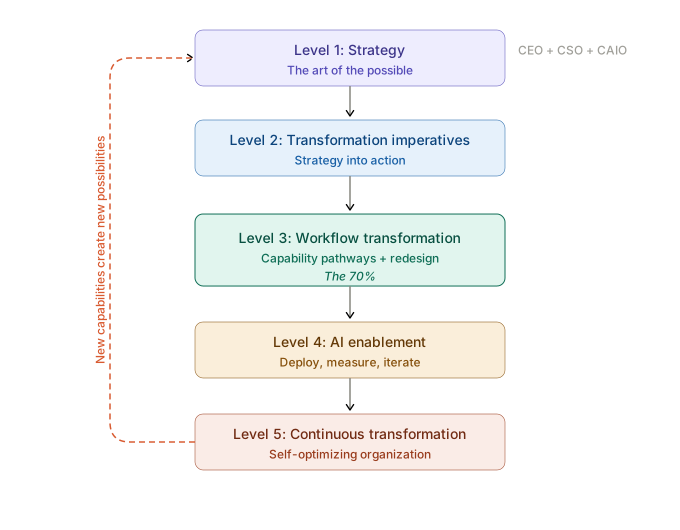
The readiness gate from Article 16 has been passed. The domain owner's Level 3 deliverables are complete, quality-gated, and confirmed by the CIO's team as sufficient to build on. The Level 1 triad has committed the resources. For the first time in the transformation, the CIO's organization is about to become the primary execution engine. Technology budgets have been approved. Implementation teams are being mobilized.
Every executive in the room has been here before. They have managed ERP implementations, digital transformation programs, and large-scale systems deployments. They have navigated the transition from business requirements to technical build dozens of times across their careers. They know what a design-to-build handoff looks like, how systems integrators work, what a fit-gap analysis produces, and how a cutover plan unfolds.
That experience is about to become their most dangerous liability.
The research on AI scaling failures does not point to technology as the primary cause. McKinsey's Rewired research, based on more than 200 at-scale transformations, found that 72% of companies stall at the scaling stage, and the root cause is overwhelmingly organizational rather than technical.1 Gartner's April 2026 survey of infrastructure and operations leaders found that only 28% of AI use cases fully succeed and meet ROI expectations, while 20% fail outright and the rest underdeliver or stall.2 BCG found that 74% of companies have not achieved tangible value from their AI investments, with only 5% generating substantial value at scale.3 These are not organizations that lacked AI technology. They are organizations that applied familiar transformation playbooks to an unfamiliar kind of transformation and discovered too late that the playbook did not fit.
This article explains why.
Why doesn’t the design-to-build playbook from past transformations transfer to AI?
The design-to-build playbook from traditional programs does not transfer because it assumes technology is selected first and then behaves deterministically — neither of which holds for AI. In an ERP implementation, the organization chooses SAP or Oracle, contracts a systems integrator, and then enters a design phase where business requirements are documented and evaluated through fit-gap analysis: which requirements does the selected technology already handle, and which require customization? The design is adapted to the technology’s capabilities. The systems integrator builds what the blueprint specifies. The system behaves deterministically. Testing validates that the configuration matches the design. Training happens on the actual configured system during user acceptance testing. Go-live is a planned cutover event.
This playbook works for ERP because ERP systems are deterministic. Configure an approval workflow with a $10,000 threshold, and every transaction above that threshold triggers the approval. Every time. Predictably. The design-to-build handoff is fundamentally a document transfer: the business team produces the blueprint, the technical team builds to specification, and deviations from the blueprint are defects to be corrected.
Leaders who have succeeded with this playbook naturally default to it. McKinsey's research on ERP transformations documents the pattern: stage-gate reviews, blueprint governance, milestone-based delivery, and systems integrator accountability tied to deliverable completion.1 It is an effective framework for deterministic technology. The problem is that AI is not deterministic technology, and the transition from Level 3 to Level 4 is structurally different in ways that undermine every assumption the traditional playbook depends on.
What makes the AI design-to-deployment transition fundamentally different?
The differences between AI business transformation and traditional transformation at this junction are differences of kind, not degree — six of them, each with practical implications for how leadership approaches Level 4. They are not variations on a familiar process but a fundamentally different transition.
Technology selection follows design, rather than preceding it. In traditional transformations, the technology constrains the design. In this methodology, Level 3 produced workflow designs unconstrained by any specific technology's limitations, because the designs describe what the human-AI collaboration should look like rather than what a particular system can do. The CIO's team now selects technology to serve those designs. This inversion means that technology evaluation at Level 4 must be conducted against the specific workflow specifications Level 3 produced, not against generic capability demonstrations from vendors. The CIO cannot evaluate AI platforms in the abstract. The evaluation criteria come from the workflow designs.
The system produces probabilistic outputs rather than deterministic results. An ERP system does exactly what its configuration specifies. An AI system produces outputs that vary based on inputs, context, and the model's learned patterns. When an AI system reviews a customer's full service history to recommend a retention strategy, it synthesizes patterns across hundreds of interactions and may recommend proactive outreach for one customer and a pricing adjustment for another with similar account profiles, because the AI identified contextual differences that a rules-based system would treat identically. The traditional fit-gap analysis does not translate because you cannot test every possible scenario against a system whose behavior is not predetermined. Evaluating whether an AI technology is sufficient for a workflow design requires judgment about the technology's capabilities in the specific context the workflow demands, which is a fundamentally different kind of assessment than checking configuration against requirements.
Graduated human oversight has no precedent in previous technology deployments. The governance framework established in Article 7 and operationalized into the workflow designs at Level 3 specified different levels of human oversight for different risk classifications. The CIO's implementation team must translate these into technical controls: automated monitoring, escalation triggers, override mechanisms, and audit trails calibrated to the specific risk level of each AI-enabled workflow step. No ERP implementation has ever required this. The governance specifications from Level 3 are direct technical requirements for the implementation team, not aspirational principles to be considered later. The stakes are now quantified: Gartner predicts that by 2027, 40% of enterprises will demote or decommission autonomous AI agents because of governance gaps identified only after production incidents, and warns that applying uniform governance across heterogeneous agents leads to failure.6 McKinsey's 2026 agentic workflow research uses the phrase "governed autonomy" for the same principle: people design and oversee agent networks under defined policies and accountability.7 Differentiated, risk-calibrated oversight is not a methodology preference. It is the emerging survival requirement.
Integration connects AI to systems it must interpret, not merely exchange data with. Traditional system integration connects applications that pass structured data through defined interfaces. AI integration connects to systems where the AI must interpret unstructured or semi-structured information, reason about it, and take actions that may vary based on context. The research identifies integration with legacy systems as the single most cited technical barrier to AI scaling: production environments require connecting to enterprise systems that were never designed to support the kind of interaction AI requires.4 The workflow designs from Level 3 specified what data the AI needs and what actions it takes. The CIO's team must now determine how to provide that access within the constraints of the existing technology estate.
The first deployment will require iteration, and that iteration is expected. In traditional transformations, a gap between the design and the deployed system is a defect. In AI business transformation, the first deployment will reveal differences between how the AI behaves in the workflow design and how it behaves in production with real data, real edge cases, and real user interactions. The Level 3 designs were the best possible designs given what was known at the time. Production will surface what could not be known until the AI system encountered the actual operating environment. This means the domain owner cannot hand off the deliverables and walk away. They must remain engaged through the iteration cycle, because only they can determine whether a proposed adjustment to the original design is an acceptable technical accommodation that preserves the transformation intent or a compromise that undermines it.
Workforce competence means exercising judgment, not following procedures. Operating within an AI-enabled workflow requires a fundamentally different kind of competence than operating within an ERP system. ERP training teaches procedures: enter this data, click this approval, follow this sequence. AI training teaches judgment: evaluate whether this AI output is reliable, decide when to override, understand the boundaries of the AI's capabilities in your specific domain. Every parallel track entering Level 4 must account for this difference. The training that develops system-specific competence, the governance controls that enforce oversight requirements, the security architecture that protects production systems, and the data infrastructure that feeds the AI all must be designed for a workforce that exercises judgment over probabilistic systems rather than follows procedures within deterministic ones.
How does the organization reconfigure at the move into Level 4?
At the move into Level 4, the center of gravity shifts from the domain owner — who led Level 3 with the CAIO’s department as primary advisory partner — to the CIO’s organization, which owns technology selection, integration architecture, deployment, and technical operations. This is a partnership reconfiguration, not a handoff where one side walks away.
The CIO's organization becomes the implementation engine. Articles 18 and 19 cover their Level 4 mandate in detail. What matters at the transition is that the CIO's team approaches Level 4 with the understanding that they are implementing technology to serve workflow designs that were produced through months of careful business transformation work, not building systems from a traditional requirements document.
The domain owner shifts from leading the design work to partnering on implementation. Their ongoing accountability is the iteration decisions that will arise when the deployed AI behaves differently than the design anticipated. The domain owner is the only person who can evaluate whether the transformation's business intent is being preserved through those adjustments. This accountability does not diminish at Level 4. It changes form.
The CAIO's department shifts from leading education and workflow advisory to ensuring cross-domain consistency as implementation proceeds. Their embedded translators, who participated in the domain's Level 3 work, serve as the bridge between the domain owner's business understanding and the CIO's technical execution. During technology selection specifically, the CAIO's team works hand-in-hand with the CIO's organization in an advisory role, helping evaluate whether what AI vendors are demonstrating or claiming is realistic for the specific workflow designs the domain produced at Level 3.
Every parallel track shifts gears simultaneously. Governance moves from framework to technical controls. Data moves from readiness assessment to architecture. Security activates for production. Training shifts from fluency building to system-specific competence development. The transition is not a single handoff between two parties. It is a coordinated shift across the entire transformation infrastructure, and it requires the same deliberate orchestration that Level 3 demanded.
The industry has begun to name the destination. IBM built its entire Think 2026 conference around what it calls the AI Operating Model: the argument that the missing piece in enterprise AI is not technology but a governed system connecting agents, data, automation, and hybrid infrastructure, moving AI from pilots into governed production.5 Bain's independent assessment endorsed the same pilots-to-operating-model framing.5 That operating model is what Level 4 builds, and it is why the quality of the Level 3 foundation this transition inherits matters so much.
Why is iteration expected rather than a sign something went wrong?
The single most important mindset shift for leaders entering Level 4 is accepting that iteration is built into the process rather than being a sign that something went wrong. Iteration is the design, not the exception.
In traditional transformations, the goal is to deploy the system as designed. Deviations trigger change requests, and change requests carry cost and schedule implications that the organization treats as failures to be minimized.
The iteration gap in AI business transformation does not arise because the workflow designs were poorly done. It arises because the workflow redesign teams designed the best possible workflows based on their understanding of what AI capabilities could deliver, and the technology selection process identified solutions whose vendors represented they could meet those requirements. In practice, the technology may not perform the specified capability in the manner the workflow design requires. This is common in the current AI landscape, where vendor claims frequently outpace what the technology can reliably deliver in production at enterprise scale. A capability that performs well in a demonstration environment may struggle with the volume, complexity, or edge cases that the actual workflow encounters. When this gap surfaces, the domain owner and CIO's team must work together to determine whether the workflow can be adjusted to accommodate the technology's actual capabilities without compromising the transformation intent, or whether a different technology solution is needed that can deliver what the workflow requires.
The adoption data explains why this gap is so common. BCG's AI at Work 2026 survey found that 30% of employees report AI agents integrated into their workflows, up from 13% a year earlier, yet 52% still say they have limited understanding of what agents are.8 And Capgemini, now deploying agent platforms at enterprise scale through its OpenAI Frontier Alliance partnership, states the constraint plainly: the limiting factor for AI value is not model intelligence, it is how agents are built and run inside organizations.9 Deployment is scaling faster than understanding, which is exactly why the iteration partnership matters.
The methodology's approach is different. The Level 3 designs represent the organization's best understanding of what the human-AI collaboration should look like. The first deployment tests that understanding against reality. Where reality confirms the design, the implementation proceeds. Where reality reveals that the design assumed AI capabilities or behaviors that do not hold in production, the domain owner and CIO's team adjust together, preserving the transformation intent while accommodating the technical reality. BCG's research on organizations that successfully scale AI reinforces this approach: leaders who succeed "fundamentally redesign workflows" and then iterate based on what deployment reveals, rather than treating the initial design as immutable.3
This iteration partnership between the domain owner and the CIO's team is what prevents the organization from falling into either trap. It is also what makes Level 4 fundamentally different from the traditional build phase, where the systems integrator builds to specification and the business team waits for delivery. In AI business transformation, the business and technology teams work together through deployment because the nature of the technology demands it.
Practitioner tooling for this junction is emerging quickly. MIT Sloan Management Review's "Agentic AI: Nine Essential Questions" reads as a set of gating questions for exactly this transition, and its June 2026 CIO Symposium coverage reported leaders finding a gap between the promise and the reality as AI agents enter actual workflows.10 The leaders who navigate this junction well are the ones who expected that gap and organized to close it.
The transition from Level 3 to Level 4 is the moment when the 70% of the work that determines AI success meets the 30% that makes it operational. The articles that follow describe how to navigate each dimension of Level 4: technology selection, integration architecture, deployment, data architecture, training, and measurement. The research is clear that most organizations fail at this junction. The methodology is designed to ensure yours does not, but only if leadership approaches Level 4 with the understanding that this is a different kind of deployment than anything the organization has done before.
Sources
- 1.McKinsey, Rewired: The McKinsey Guide to Outcompeting in the Age of Digital and AI, 2023 (based on 200+ at-scale AI transformations). 72% stall at scaling; stage gate review process; blueprint governance; design-first organizations outperform https://www.mckinsey.com/capabilities/mckinsey-digital/our-insights/rewired-to-outcompete
- 2.Gartner, "AI Projects in Infrastructure and Operations Stall Ahead of Meaningful ROI Returns," April 7, 2026 (782 infrastructure and operations leaders, fielded November-December 2025). 28% of AI use cases fully succeed and meet ROI expectations; 20% fail outright; the remainder underdeliver or stall https://www.gartner.com/en/newsroom/press-releases/2026-04-07-gartner-says-artificial-intelligence-projects-in-infrastructure-and-operations-stall-ahead-of-meaningful-roi-returns
- 3.BCG, "The Widening AI Value Gap," September 2025 (1,250+ firms). 74% have not achieved tangible value; only 5% generate substantial value at scale; future-built companies deploy in 9-12 months vs 12-18 months; leaders "fundamentally redesign workflows" then iterate https://www.bcg.com/publications/2025/are-you-generating-value-from-ai-the-widening-gap
- 4.McKinsey, "The State of AI in 2025," November 2025 (1,993 participants). Three critical readiness requirements for scaling: standardized executable workflows, modern API interfaces around legacy systems, governance frameworks that make autonomous action observable and interruptible; only 21% have fundamentally redesigned workflows https://www.mckinsey.com/capabilities/quantumblack/our-insights/the-state-of-ai
- 5.IBM, announcements at Think 2026, May 4-7, 2026; Bain & Company, "IBM Think 2026: From AI Pilots to an Operating Model," May 2026. The "AI Operating Model": agents, data, automation, and hybrid infrastructure connected in one governed system https://www.ibm.com/new/announcements/ibm-announcements-at-think-2026
- 6.Gartner, "Applying Uniform Governance Across AI Agents Will Lead to Enterprise AI Agent Failure," May 26, 2026. By 2027, 40% of enterprises will demote or decommission autonomous AI agents due to governance gaps identified after production incidents https://www.gartner.com/en/newsroom/press-releases/2026-05-26-gartner-says-applying-uniform-governance-across-ai-agents-will-lead-to-enterprise-ai-agent-failure
- 7.McKinsey, agentic AI workflow series, April 2026 ("Scaling Agentic AI with Data Transformations," April 2, 2026; "Reinventing Marketing Workflows with Agentic AI," April 21, 2026; "Reimagining Tech Infrastructure for Agentic AI," April 23, 2026). "Governed autonomy": hybrid human-agent workforces under defined policies and accountability https://www.mckinsey.com/capabilities/mckinsey-technology/our-insights/building-the-foundations-for-agentic-ai-at-scale
- 8.BCG, "AI at Work: Why Strategy Matters More Than Tools" (4th annual edition), June 3, 2026 (11,749 workers, 14 markets). 30% report AI agents integrated into workflows, up from 13% in 2025; 52% have limited understanding of what agents are https://www.bcg.com/publications/2026/ai-at-work-why-strategy-matters-more-than-tools
- 9.Capgemini and OpenAI, Frontier Alliance partnership, February 23, 2026. Capgemini: the limiting factor for AI value is not model intelligence but how agents are built and run in organizations https://www.capgemini.com/news/press-releases/capgemini-joins-forces-with-openai-to-accelerate-new-era-of-ai-powered-enterprise-transformation-with-frontier-alliance/
- 10.MIT Sloan Management Review, "Agentic AI: Nine Essential Questions," 2026; "Agentic AI: What Leaders Wish They Knew Sooner" (CIO Symposium video), June 11, 2026. Gating questions for agent deployment; gap between promise and reality as agents enter workflows https://sloanreview.mit.edu/article/agentic-ai-nine-essential-questions/
Frequently Asked Questions
We have been through multiple ERP implementations. What specifically should we unlearn?
Three things. First, unlearn the assumption that technology selection comes first. Your ERP experience tells you to choose the platform, then design around its capabilities. In AI business transformation, the design is done. Technology serves the design, not the other way around. Second, unlearn the assumption that gaps between design and deployed system are defects. In AI deployment, iteration is expected because AI behavior in production is inherently different from behavior in testing. Treating every deviation as a change request to be minimized will either constrain the AI's value or delay the deployment indefinitely. Third, unlearn the assumption that the business team hands off and waits for delivery. The domain owner must remain engaged throughout Level 4 because the iteration decisions require business judgment that the CIO's technical team cannot make alone.
How do we prevent the iteration cycle from becoming scope creep that delays the transformation indefinitely?
The iteration principle does not mean open-ended redesign. It means targeted adjustments where AI behavior in production does not match the assumptions in the workflow design. The boundaries are clear: the transformation intent defined at Level 2 and the workflow designs produced at Level 3 are the anchors. Iteration adjusts how the AI serves those designs, not whether the designs themselves were right. If the iteration reveals that a fundamental assumption in the workflow design was wrong, that is a Tier 2 quality gap that Article 16 should have caught. The domain owner's role in iteration is to hold the line on transformation intent while allowing technical accommodation where the AI's actual capabilities require it.
Can multiple domains transition to Level 4 simultaneously?
Yes, if the CIO's organization has the capacity and the cross-department interfaces from Article 14 are confirmed. The CAIO's department plays a critical coordination role here, ensuring that domains transitioning simultaneously maintain the consistency that Level 3 established. The risk of simultaneous transition is not conceptual but practical: the CIO's implementation team has finite capacity, and spreading that capacity too thin across multiple domains produces shallow implementation in all of them rather than deep implementation in any. The Level 1 triad's portfolio view should inform the sequencing decision.
What happens when the CIO's team says a Level 3 design cannot be implemented as specified?
This is exactly what the iteration partnership exists to resolve. The CIO's team proposes an alternative that is technically achievable. The domain owner evaluates whether that alternative preserves the transformation intent. The CAIO's translator helps both parties understand whether the proposed change affects cross-domain consistency. If the alternative preserves the intent, it proceeds. If it compromises the intent, the domain owner and CIO's team work together to find a different technical approach. If no technical approach can serve the design's intent, the domain owner escalates to the Level 1 triad with a clear description of the tradeoff, because that is a strategic decision about whether to accept reduced transformation value or invest in a different technical solution.
How should the CIO evaluate AI technologies against workflow designs when AI behavior is probabilistic?
The CIO's team cannot evaluate AI platforms in the abstract or based solely on vendor demonstrations. The evaluation must be conducted against the specific workflow designs Level 3 produced: can this technology perform the specific tasks the workflow requires, at the quality level the governance framework demands, with the data that is actually available? This evaluation requires the domain owner's participation because the business context determines what "sufficient" means. A 95% accuracy rate may be excellent for internal document classification but inadequate for customer-facing financial advice. The workflow designs and governance classifications from Level 3 provide the evaluation criteria. Article 18 covers the CIO's technology evaluation process in detail.
This series addresses “what” to do, not “how” to do it. If you are a business executive and would like help thinking through the “how,” please feel comfortable reaching out.

About the author
Shawn Plaster
Founder & CEO, Plaster Group
Shawn is the author of Plaster Group's five-level AI Business Transformation Methodology and its 27-article Insights series, and leads the firm's enterprise AI transformation work.
Previous: Article 16: Measuring What Matters at Level 3 · Next: Article 18: Technology Selection for AI Business Transformation
© 2026 Plaster Group, LLC. All rights reserved. This article may not be reproduced, distributed, or transmitted in any form without prior written permission from Plaster Group. Brief excerpts may be quoted for review or commentary purposes with attribution to the author and a link to the original article.
Ready to move forward?
Let's discuss how your organization can build with AI — securely, strategically, and starting from where you are today.
Start a Conversation