This article is part of a 27-article series on the AI Business Transformation Methodology. This piece establishes the measurement framework for Level 3 and defines the readiness gate that determines when a domain is prepared for Level 4 AI enablement.
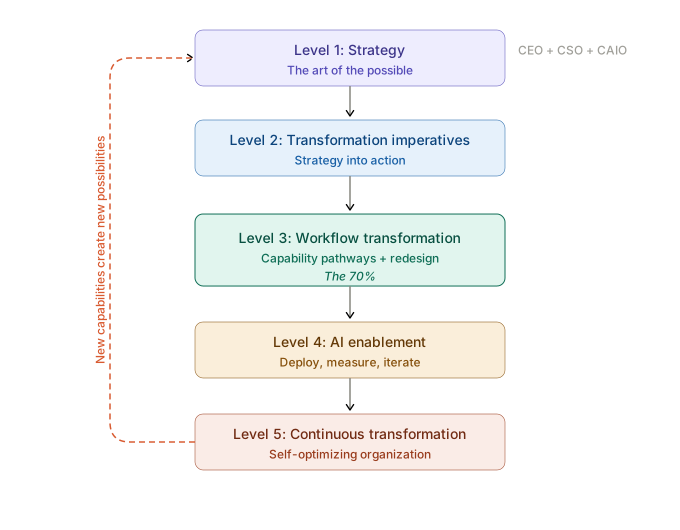
Your domain team continues to develop exceptional Level 3 work. The capability decomposition mapped everything the domain needs to be able to do. The education cascade built genuine AI fluency across the leadership chain. The workflow redesign teams produced designs that passed through the quality gate, designs that are genuinely transformative rather than incremental improvements on legacy processes. The data readiness assessment surfaced constraints with the specificity the CIO's team needs. Cross-department interfaces have been coordinated with adjacent domains. The job redesign analysis defined the three categories of role evolution. The governance framework from Article 7 has been operationalized into every AI-enabled workflow step.
The domain owner is now ready to request Level 4 resources: technology budget, CIO engagement, deployment teams. The Level 1 triad needs to make a consequential resource commitment. On what basis?
This is the moment where most AI transformations go wrong. Not because the Level 3 work was poorly done, but because the organization lacks a structured way to assess whether that work is ready for what comes next. The domain owner says the work is done. The deliverables exist. The schedule says it is time to move forward. And so the organization commits Level 4 resources based on completion rather than readiness, deploying technology onto a foundation it has never formally evaluated.
The research documents what happens next. According to McKinsey, 72% of companies stall at the scaling stage of digital and AI transformation, and the primary cause is not technology failure.1 It is foundational gaps that were not caught before deployment began. Gartner's data is even more direct. Its April 2026 survey of 782 infrastructure and operations leaders found that only 28% of AI use cases fully succeed and meet ROI expectations; 20% fail outright, and the rest underdeliver or stall. Among the leaders reporting failures, 57% blame expecting too much, too fast.2 The pattern is consistent across every major research source: organizations deploy technology before the organizational foundation is ready, and the technology underperforms not because of its own limitations but because of the foundation underneath it.
Level 3 measurement is the methodology's mechanism for breaking this pattern. It is the quality gate between the 70% work that determines whether AI investments produce value and the technology deployment that most organizations rush into prematurely.
How is Level 3 measurement different from measuring AI deployment?
Level 3 measurement assesses the organizational foundation that Level 4 builds on — whether the deliverables are complete, quality-gated, and in a form the CIO’s implementation team can productively build on — not technology performance. No technology has been deployed yet. And it is not whether the workforce is ready to operate in the redesigned workflows: the systems have not been selected, the technology has not been deployed, and the system-specific training that builds operational competence is a Level 4 activity.
This distinction matters enormously because it changes what gets measured and how. The default approach most organizations take is completion tracking: counting deliverables, checking boxes, confirming that the work products exist. This tells you nothing about whether the work products are good enough for the CIO's team to build on, or whether the organizational preparation is sufficient to sustain what Level 4 deploys.
The right approach is a three-tier assessment that evaluates what can actually be known at Level 3: whether the work got done, whether it is good enough, and whether the teams that will build on it at Level 4 can work with what has been produced.
McKinsey's Rewired research, based on more than 200 at-scale AI transformations, describes the mechanism that high-performing organizations use: "Rewired companies take pods responsible for objectives and key results and link them to operational KPIs, tracking the progression of each pod in a disciplined stage gate review process."1 The stage gate concept is precisely what Level 3 measurement provides. It is a structured checkpoint where progression to the next phase requires demonstrating readiness, not just completion.
What are the three tiers of Level 3 measurement?
Tier 1: Output Completion. Did the work get done? This is the minimum bar and the only thing most organizations measure. Were the workflow designs completed? Did the education cascade run? Were the job redesign analyses finished? Was the data readiness assessment conducted? Were cross-department interfaces defined? Was the governance framework operationalized into the designs?
Completion measurement is necessary. Without it, the organization has no visibility into whether Level 3 activities are on track. But completion without quality assessment is how organizations end up deploying technology onto workflow designs that look transformative on paper but are actually incremental improvements dressed in new language. McKinsey's data shows that only 21% of organizations have fundamentally redesigned workflows despite 88% reporting AI usage.3 The gap between those numbers is filled with organizations that completed workflow redesign activities without producing genuinely transformative designs. Completion happened. Quality did not.
Tier 2: Output Quality. Is the work good enough for Level 4 to build on? This is the quality gate that directors and senior managers enforce, and it is the tier that separates organizations that will succeed at Level 4 from those that will stall.
Quality assessment at Level 3 requires evaluating the deliverables against the standards each prior article established. Are the workflow designs genuinely transformative, or do they exhibit the pitfalls Article 12 identified: automating the existing process rather than redesigning it, under-designing because the team did not understand what AI could do, or over-designing because the team assumed capabilities that do not yet exist reliably? Has the education cascade produced genuine operational fluency, or did people attend sessions without developing the working understanding needed to make informed decisions? Are the job redesign analyses complete enough that the training workstream at Level 4 will have the foundation it needs, or are they high-level descriptions that leave the hard role-definition work undone? Have data gaps been surfaced with enough specificity that the CIO and CDO can plan Level 4 data architecture work, or are they vague flags that something is missing without the precision needed to act? Have the security implications of each AI-enabled workflow been identified with enough clarity that the CIO's security team can plan the access controls, data protection measures, and threat monitoring that production deployment will require?
The quality assessment is not a bureaucratic exercise. It is the directors and senior managers doing the job the methodology assigned them: serving as the quality gatekeepers who ensure that what passes through to Level 4 is worth building on. BCG's research on AI high performers is consistent with this approach: organizations that generate real value from AI assess maturity across multiple dimensions rather than tracking surface-level adoption metrics.4 The quality gate applies the same principle to Level 3 deliverables. BCG's 2026 edition sharpens the point into a measurable leading indicator: a clear AI strategy lifts measurable business impact by 25 points, while better tools alone lift it by roughly 5. The gap between those two numbers is precisely what a readiness gate exists to protect.13
Tier 3: Handoff Readiness. Can the CIO's team and implementation organization build on what Level 3 produced? This is the tier that bridges Level 3 and Level 4, and it asks a question that is specific to the transition between design and deployment. Because the CIO's team is the primary consumer of Level 3 deliverables, they should be engaged in the Tier 3 assessment directly. Only the implementation team can confirm whether the specifications are sufficient for what Level 4 requires.
Even if the Level 3 deliverables are complete and high-quality, they may not be in a form that the receiving organization can consume. The CIO's team needs workflow designs specified precisely enough to select technology and design integration architecture. The CDO needs data requirements documented with enough detail to plan data architecture and data quality remediation. The training workstream that activates at Level 4 needs job redesign analyses complete enough to develop system-specific materials once the technology is selected. And the change management function needs to have built sufficient Awareness and Desire, the first two ADKAR stages, so that Level 4 deployment does not encounter a workforce that has not been prepared for what is coming.5
Handoff readiness also includes a focused leadership readiness assessment. The domain owner and their directors need to be prepared for what Level 4 requires of them: partnering with the CIO's implementation team on technology selection informed by the workflow designs, managing the iteration cycles that first deployment involves, and leading their teams through the transition from design to operation. This is not the broad organizational readiness that assesses whether hundreds of employees are prepared to work in new workflows. That assessment happens at Level 4, when the technology exists and system-specific Knowledge and Ability can be developed. Handoff readiness is narrower: are the leaders who will drive Level 4 prepared for their role in it?
Tier 3 also requires that the Level 3 artifacts reach the CIO's organization early enough during Level 3 for the CIO's team to complete their own planning before the gate. The CIO's work begins in earnest at Level 4, but the estimating, capacity assessment, and resource planning that makes Level 4 executable cannot happen at the gate meeting — they require time and the actual artifacts to work from. Workflow designs, capability maps, data requirements, governance specifications, job redesign analyses, and cross-department interface definitions collectively represent the input package the CIO needs to assess what technology selection, integration architecture, and deployment will realistically require in time, cost, and people. Where the CIO's existing team capacity falls short of what the work demands — in AI deployment skills, integration depth, or sheer bandwidth — the CIO needs enough lead time to determine whether that gap is closed through internal reallocation, FTE hiring, or by bringing in implementation partners with the specialized capabilities the work requires. A domain owner who delivers the artifact package to the CIO two weeks before the gate meeting has not satisfied Tier 3. The CIO's readiness to execute Level 4 is part of handoff readiness.
What specific deliverables get measured at Level 3?
Each article in the Level 3 series produced specific deliverables, and the measurement framework evaluates each across all three tiers. This is not an exhaustive checklist but a framework that domain owners and their quality gatekeepers apply to the specific outputs their domain produced.
The capability decomposition from Article 10 produced capability maps that define what the domain needs to be able to do. At Tier 1, the question is whether the maps are complete. At Tier 2, whether they are prioritized, connected to the imperative's business outcome, and specific enough to have informed the workflow redesign. At Tier 3, whether the CIO's team can use them to evaluate technology options that deliver the required capabilities.
The education cascade from Article 11 built AI fluency across the domain's leadership chain. At Tier 1, whether every level went through the engagement. At Tier 2, whether fluency has been assessed rather than assumed. Attendance is not fluency. The director who sat through the engagement but cannot evaluate whether a workflow design leverages AI's actual capabilities has not achieved the operational fluency the education cascade was designed to produce. At Tier 3, whether domain leaders are prepared to partner with implementation teams on technology-informed decisions rather than delegating technology choices entirely to the CIO's organization.
The workflow redesign from Article 12, the centerpiece of Level 3, produced the designs that Level 4 will implement. At Tier 1, whether designs passed through the quality gate. At Tier 2, whether they are tagged with capability categories from the CAIO's taxonomy, whether they account for governance requirements from Article 7, and whether they are genuinely transformative rather than incremental. At Tier 3, whether they are specified precisely enough for the CIO's team to design integration architecture and select technology. This is where the CIO's team should have input: they are the ones who will build on these designs, and their assessment of whether the specifications are sufficient is a critical part of the handoff readiness evaluation.
The data readiness assessment from Article 13 surfaced data constraints. At Tier 1, whether gaps were identified. At Tier 2, whether they are classified by severity and impact on the imperative's business outcome. At Tier 3, whether the CIO and CDO have received specifications clear enough to plan Level 4 data architecture work, confirmed through direct engagement with the CIO's data architecture team. Vague statements that "we need better data" are not actionable. Specific statements that "the redesigned invoice matching workflow requires real-time access to vendor payment history at the transaction level, which currently exists only in monthly batch extracts" give the CIO's team something they can build against.
The cross-department coordination from Article 14 defined interfaces between domains transforming simultaneously. At Tier 1, whether boundary processes have been assigned and integration points identified. At Tier 2, whether adjacent domains have confirmed the interfaces work for their designs. At Tier 3, whether interface specifications are precise enough for the CIO's integration architecture planning.
The job redesign from Article 15 defined the three categories of role evolution: augmented, consolidated, and emergent. At Tier 1, whether role definitions are complete. At Tier 2, whether they account for AI-specific collaboration patterns rather than simply adjusting existing job descriptions. At Tier 3, whether they provide sufficient foundation for the training workstream to develop system-specific materials at Level 4.
And the governance framework from Article 7, operationalized across all workflow designs. At Tier 1, whether risk classifications have been applied. At Tier 2, whether human oversight requirements are specified for each AI-enabled step and accountability structures are defined. At Tier 3, whether the CIO's team has confirmed the governance specifications are clear enough to implement as technical controls at Level 4.
Who measures what at Level 3?
Measurement responsibility follows the organizational chain the framework established from the beginning — each level of the chain owns the assessment of the work reporting into it.
Senior managers and directors serve as the quality gatekeepers. In practice, senior managers perform the hands-on quality evaluation against the criteria each prior Level 3 article established, escalating to their directors when deliverables raise questions that require more senior judgment. Directors review the senior managers' assessments and are ultimately accountable for the quality determination, particularly when the domain owner presents the readiness case at Level 2. This is not a new responsibility. It is the same quality gate role described in Article 12 and reinforced in every subsequent Level 3 article. What Level 3 measurement adds is a structured moment where the cumulative quality of all Level 3 deliverables is assessed together, rather than each deliverable being evaluated in isolation. A workflow design that passes its individual quality gate may reveal gaps when evaluated alongside the data readiness assessment and the cross-department interface specifications. The quality gatekeepers who have been evaluating individual deliverables throughout Level 3 now assess whether the complete package holds together.
Domain owners are accountable for the readiness case. They do not personally evaluate every deliverable. Their directors do that. What the domain owner does is synthesize the assessment across all three tiers and present the case to the Level 1 triad that their domain's Level 3 work is ready for Level 4 investment. This is the domain owner's most consequential accountability moment in the methodology. The domain owner who pushes through a premature readiness case to stay on schedule is making precisely the mistake the research documents: rushing past foundational gaps to meet a timeline.
The CAIO's department provides cross-domain consistency. When multiple domains in the same wave are approaching the readiness gate, the CAIO's embedded translators, who have been participating in each domain's Level 3 work, provide a cross-domain view. Are the measurement standards comparable across domains? Have cross-department interfaces been confirmed from both sides? Is the quality level consistent, or has one domain produced significantly stronger deliverables than others? This cross-domain perspective is one of the CAIO department's highest-value functions, because no individual domain's leadership can see it from inside their own transformation.
The Level 1 triad makes the resource commitment decision. Based on the domain owner's readiness case, the CAIO's cross-domain assessment, and the portfolio-level view of whether the wave is ready for Level 4 investment, the CEO, CSO, and CAIO decide whether to commit the resources. This decision should be informed by the CIO's full picture, not just their assessment of whether the Level 3 deliverables are sufficient. The CIO comes to the gate with two things: a readiness confirmation that the deliverables are specified well enough to build on, and an implementation estimate — the realistic cost, duration, and resourcing picture for what Level 4 will require. That estimate includes the CIO's assessment of where their existing team has the capacity and skills to execute, and where gaps need to be filled through internal reallocation, FTE hiring, or implementation partners with specialized AI deployment expertise. The Level 1 triad is approving both the foundation and the plan to build on it. A readiness confirmation without an implementation estimate is half an answer.
What must be demonstrated at the readiness gate?
The readiness gate is the cumulative assessment across all three tiers that gives the Level 1 triad confidence that Level 4 investment will be productive — not a single meeting or a pass/fail test. The specific metrics are domain-specific, determined by the domain owner and the CAIO’s department based on the imperative’s scope and complexity. But the categories of readiness are consistent across every domain:
Workflow designs are complete, quality-gated, governance-compliant, and specified to a level the CIO's team confirms is sufficient for technology selection and integration planning. Data requirements are documented and communicated to the CIO and CDO with enough specificity for Level 4 data architecture planning. Cross-department interfaces are confirmed by adjacent domains. Job redesign analyses are complete enough to serve as the foundation for Level 4 training development. Change management has built sufficient Awareness and Desire through the communications strategy established in Article 8, so that Level 4 deployment does not encounter a workforce unprepared for what is coming. Accenture's 2026 research found that the biggest barrier to AI value is no longer technology but alignment with employees, and that a 24-percentage-point gap exists between C-suite expectations for change and employee expectations.6 The communications workstream's effectiveness at building awareness is a measurable leading indicator of whether Level 4 will encounter resistance or receptivity. The domain owner and their leadership team are prepared for the Level 4 partnership with the CIO's implementation team. And the domain owner can articulate the business case for Level 4 investment in terms of the imperative's expected outcomes, grounded in what the Level 3 work revealed about feasibility and scope. And the CIO has developed a credible implementation estimate — covering cost, duration, and resourcing for technology selection, integration architecture, and deployment — so that the triad is approving a funded, resourced path forward, not just a ready foundation.
The 2026 research adds four dimensions to the gate, and each is measurable. Expectation calibration: Gartner found that 57% of leaders reporting AI failures blame expecting too much, too fast, so the gate should test whether the domain's Level 4 expectations match what the Level 3 work actually demonstrated.2 Middle-manager capacity: Harvard Business Review's June 2026 research shows middle managers absorbing the invisible work of validating AI outputs, catching errors, and coaching teams, so the gate should confirm that the job redesign explicitly reallocated that load rather than assuming managers will absorb it.10 Workforce impact: MIT Sloan Management Review argues that responsible AI programs must assess workforce impact alongside model risk, and the gate is the natural checkpoint for that assessment.11 And measurement altitude: HBR's April 2026 research documents a persistent perception gap in which executives experience AI as strategic advantage while managers confront its flaws inside real workflows, which means readiness measurement must sample the middle of the organization, not just the top.12
What happens when measurement reveals the work is not ready?
When measurement reveals the work is not ready, that is not failure — it is the methodology working exactly as it was designed to work.
The readiness gate exists to catch gaps before they become expensive Level 4 problems. Iteration at Level 3, where the work involves redesigning processes on paper, redefining roles in analysis documents, and refining data specifications, costs a fraction of what rework costs at Level 4, where technology has been procured, systems have been configured, and deployment teams have been mobilized. McKinsey's Rewired research found that organizations that stall at scaling overwhelmingly stall because they pushed past foundational gaps rather than addressing them.1 The readiness gate is the mechanism that prevents exactly that pattern.
When the assessment reveals gaps, the response depends on which tier the gap appears in. A Tier 1 gap (the work is incomplete) is straightforward: the domain owner reactivates the specific Level 3 workstream that is not finished and brings it to completion. A Tier 2 gap (the work is complete but not good enough) requires the directors and their quality gatekeepers to diagnose why: did the workflow redesign team under-design because the education cascade did not produce sufficient fluency? Did the data readiness assessment lack specificity because the team did not engage the CIO's organization early enough? The diagnosis determines the remediation. A Tier 3 gap (the work is quality-gated but not in a form the CIO's team can build on) may require a working session between the domain's Level 3 team and the CIO's implementation planning team to bridge the gap between what was produced and what is needed.
In every case, the domain owner who brings an honest "we are not ready yet" assessment to the Level 1 triad is performing their accountability better than the one who presents an optimistic case to stay on schedule. The Level 1 triad's role is to support that honesty by treating iteration as evidence that the quality gate is working, not as evidence that the domain owner is underperforming. The organizations that build this culture of honest assessment, where readiness is measured rather than assumed and where gaps are surfaced rather than hidden, are the organizations that avoid the 72% stalling rate the research documents.
The gap between stated ambition and measured readiness is now quantified across the research base, and it is enormous. Deloitte's 2026 Global Human Capital Trends found that 66% of the C-suite say traditional functions must change but only 7% report progress; 85% call workforce adaptability critical but only 7% are leading in it; 60% of executives use AI in decision-making but only 5% say they manage it well; and just 6% of leaders report progress designing human-AI interactions.8 McKinsey's State of Organizations 2026 adds that 86% of leaders say their organization was not prepared to adapt AI into day-to-day operations.9 Roughly 90% of companies have invested in AI; fewer than 40% report measurable gains.7 Readiness cannot be inferred from ambition. It has to be measured.
Deloitte's 2026 State of AI research provides the broader context for why this matters. Only 34% of organizations are truly reimagining their businesses with AI. Another 30% are redesigning key processes. The remaining 37% are using AI at a surface level with little structural change.7 The readiness gate is what ensures an organization's Level 3 work places it in the first group rather than the third. The deliverables either reflect genuine transformation or they do not. The measurement either catches the difference or it does not. And the Level 1 triad either commits Level 4 resources to a strong foundation or to a weak one. That decision, informed by honest measurement, is what determines whether the transformation produces the compounding returns Article 2 described or the pilot-to-production failures the research overwhelmingly documents.
Sources
- 1.McKinsey, Rewired: The McKinsey Guide to Outcompeting in the Age of Digital and AI, 2023 (based on 200+ at-scale AI transformations). Stage gate review process; OKR-to-KPI architecture; 72% of companies stall at scaling stage https://www.mckinsey.com/capabilities/mckinsey-digital/our-insights/rewired-to-outcompete
- 2.Gartner, "AI Projects in Infrastructure and Operations Stall Ahead of Meaningful ROI Returns," April 7, 2026 (782 infrastructure and operations leaders, fielded November-December 2025). 28% of AI use cases fully succeed and meet ROI expectations; 20% fail outright; 57% of reported failures blame expecting too much, too fast; workflow integration named top success factor https://www.gartner.com/en/newsroom/press-releases/2026-04-07-gartner-says-artificial-intelligence-projects-in-infrastructure-and-operations-stall-ahead-of-meaningful-roi-returns
- 3.McKinsey, "The State of AI in 2025," November 2025 (1,993 participants). 88% regular AI use; only 21% have fundamentally redesigned workflows; workflow redesign strongest predictor of EBIT impact out of 31 variables tested https://www.mckinsey.com/capabilities/quantumblack/our-insights/the-state-of-ai
- 4.BCG, "The Widening AI Value Gap," September 2025 (1,250+ firms). 74% of companies have not seen real value from AI investments; 5% generate substantial value at scale; maturity assessed across 41 dimensions https://www.bcg.com/publications/2025/are-you-generating-value-from-ai-the-widening-gap
- 5.Prosci, ADKAR Model and Best Practices in Change Management, 12th Edition. Awareness and Desire precede deployment; Knowledge and Ability require the technology to exist; initiatives with excellent change management 6x more likely to meet objectives https://www.prosci.com/methodology/adkar
- 6.Accenture, "Pulse of Change 2026," January 2026 (3,650 C-suite executives, 3,350 workers). Biggest barrier to AI value is employee alignment, not technology; 24-percentage-point gap between C-suite and employee expectations; only 27% of employees comfortable delegating tasks to AI agents https://www.accenture.com/us-en/insights/pulse-of-change
- 7.Deloitte, "The State of AI in the Enterprise 2026," January 2026 (3,235 leaders). 34% truly reimagining business; 30% redesigning key processes; 37% surface-level AI use; skills gap identified as biggest barrier https://www.deloitte.com/us/en/what-we-do/capabilities/applied-artificial-intelligence/content/state-of-ai-in-the-enterprise.html
- 8.Deloitte, "2026 Global Human Capital Trends: From Tensions to Tipping Points," March 4, 2026 (9,000+ business and HR leaders, 89 countries). 66% say traditional functions must change vs 7% progress; 85% call adaptability critical vs 7% leading; 60% use AI in decisions vs 5% managing it well; 6% report progress designing human-AI interactions https://www.deloitte.com/us/en/insights/topics/talent/human-capital-trends.html
- 9.McKinsey, "The State of Organizations 2026," 2026 (10,000+ senior executives, 15 countries, 16 industries). 86% of leaders say their organization was not prepared to adapt AI into day-to-day operations https://www.mckinsey.com/capabilities/people-and-organizational-performance/our-insights/the-state-of-organizations
- 10.Harvard Business Review, "AI Adoption Is Overloading Your Middle Managers," June 2026. Middle managers absorb AI validation, error-catching, and coaching load without formal support structures https://hbr.org/2026/06/ai-adoption-is-overloading-your-middle-managers
- 11.MIT Sloan Management Review, "Beyond the Model: Why Responsible AI Must Address Workforce Impact," April 21, 2026. Responsible AI programs must include workforce impact assessment alongside model risk https://sloanreview.mit.edu/article/beyond-the-model-why-responsible-ai-must-address-workforce-impact/
- 12.Harvard Business Review, "Managers and Executives Disagree on AI, and It's Costing Companies," April 2026. Executive-manager perception gap; readiness measurement must sample the middle of the organization https://hbr.org/2026/04/managers-and-executives-disagree-on-ai-and-its-costing-companies
- 13.BCG, "AI at Work: Why Strategy Matters More Than Tools" (4th annual edition), June 3, 2026 (11,749 workers, 14 markets). Clear strategy lifts measurable business impact by 25 points versus roughly 5 for better tools alone https://www.bcg.com/publications/2026/ai-at-work-why-strategy-matters-more-than-tools
Frequently Asked Questions
How do we measure education outcomes beyond attendance?
Attendance tracking tells you who was in the room. It tells you nothing about whether they left with the operational fluency the education cascade was designed to produce. Genuine fluency assessment requires evaluating whether participants can apply what they learned to their domain's specific context. Can the director look at a proposed workflow design and evaluate whether it leverages AI's actual capabilities? Can the senior manager distinguish between a design that genuinely transforms a process and one that automates the existing approach? These are observable, assessable competencies. The CAIO's department, which delivered the education engagements, is the natural partner for designing the fluency assessment, because they know what the engagement was designed to produce and can evaluate whether it did.
What happens when one domain in a wave is ready but others are not?
This depends on whether the ready domain's Level 4 work has dependencies on the domains that are not ready. If the domain can proceed independently (its workflows do not depend on cross-department interfaces with the lagging domains), it may make sense to advance that domain to Level 4 while the others complete their Level 3 work. If the domain has significant cross-department dependencies with domains that are not ready, proceeding alone risks building Level 4 systems against interface specifications that may change when the adjacent domains complete their work. The CAIO's cross-domain assessment is the input that informs this decision, because the CAIO's translators have visibility into the dependency structure across the wave.
How do we prevent measurement from becoming bureaucratic overhead that slows the transformation?
The readiness gate is a structured assessment, not a bureaucratic approval process. The deliverables being evaluated already exist because they were produced during Level 3. The quality criteria already exist because they were established in each prior Level 3 article. The assessment is the domain's directors and senior managers evaluating the cumulative package against criteria they have been applying throughout Level 3. If measurement feels like overhead, the likely cause is that the quality gate was not enforced during Level 3 and is now being applied retroactively, which is significantly more work than evaluating quality continuously. The solution is not less measurement but better integration of measurement into the ongoing Level 3 work.
Who decides the specific metrics for each domain — the domain owner or the CAIO's department?
The domain owner determines the domain-specific metrics because they understand what success looks like for their imperative. The CAIO's department ensures cross-domain consistency by establishing the measurement categories (the three tiers) and the minimum standards that every domain must meet. The specific metrics within those categories vary by domain. A supply chain transformation and a customer service transformation will measure different things, but both must demonstrate output completion, output quality, and handoff readiness before requesting Level 4 resources.
What does the Level 4 resource request actually look like when the readiness gate is passed?
The domain owner presents the readiness case to the Level 1 triad: the Level 3 deliverables are complete, quality-gated, and confirmed by the CIO's team as sufficient to build on. The business case for Level 4 investment is articulated in terms of the imperative's expected outcomes, grounded in what Level 3 revealed about feasibility. The resource request specifies what the domain needs from the CIO's organization (technology selection, integration architecture, deployment teams) and from the CAIO's department (continued advisory support during Level 4 iteration). The Level 1 triad evaluates this against the portfolio view: are the resources available, is the timing right relative to other domains in the wave, and does the CAIO's cross-domain assessment support the domain owner's readiness case? Article 17 covers the transition process in detail.
What the answer above describes is the domain owner's half of the gate presentation. The CIO's half is equally consequential. The CIO presents alongside the domain owner, accountable for the implementation estimate that tells the triad what Level 4 will actually require to execute: technology selection, integration architecture, data infrastructure, and deployment, with realistic cost and duration grounded in what the Level 3 artifacts actually specify. That estimate also covers the CIO's resourcing picture: what the existing team can absorb, where FTE capacity needs to grow, and where the work requires specialized AI deployment skills that are most efficiently sourced through implementation partners. This estimate cannot be assembled on the day of the gate. The Level 3 artifact package needs to reach the CIO's team well before the gate to give them the lead time to do this work properly. Domain owners who treat the CIO's resource planning as something that happens after approval are creating the delay they are trying to avoid. The triad approves both the readiness case and the implementation plan in the same meeting. Both have to be ready.
How does the CIO's team confirm that Level 3 deliverables are sufficient for them to build on?
The CIO's team should be engaged in the Tier 3 handoff readiness assessment, not after the fact but as the assessment is being conducted. Their input is whether the workflow designs are specified precisely enough for technology selection and integration architecture, whether the data requirements are documented with sufficient detail for data architecture planning, and whether the governance specifications are clear enough to implement as technical controls. This engagement should not be the first time the CIO's organization sees the Level 3 deliverables. As Article 14 discussed, the CIO's organization should have visibility into the Level 3 work as it progresses, particularly the data readiness and integration dimensions. The Tier 3 assessment formalizes a readiness confirmation that should already be developing through ongoing engagement.
This series addresses “what” to do, not “how” to do it. If you are a business executive and would like help thinking through the “how,” please feel comfortable reaching out.

About the author
Shawn Plaster
Founder & CEO, Plaster Group
Shawn is the author of Plaster Group's five-level AI Business Transformation Methodology and its 27-article Insights series, and leads the firm's enterprise AI transformation work.
Previous: Article 15: Change Management · Next: Article 17: From Design to Deployment
© 2026 Plaster Group, LLC. All rights reserved. This article may not be reproduced, distributed, or transmitted in any form without prior written permission from Plaster Group. Brief excerpts may be quoted for review or commentary purposes with attribution to the author and a link to the original article.
Ready to move forward?
Let's discuss how your organization can build with AI — securely, strategically, and starting from where you are today.
Start a Conversation