This article is part of a 27-article series on the AI Business Transformation Methodology. This piece establishes the CIO's Level 4 mandate and provides the technology selection methodology that makes the methodology's workflow-first approach operational.
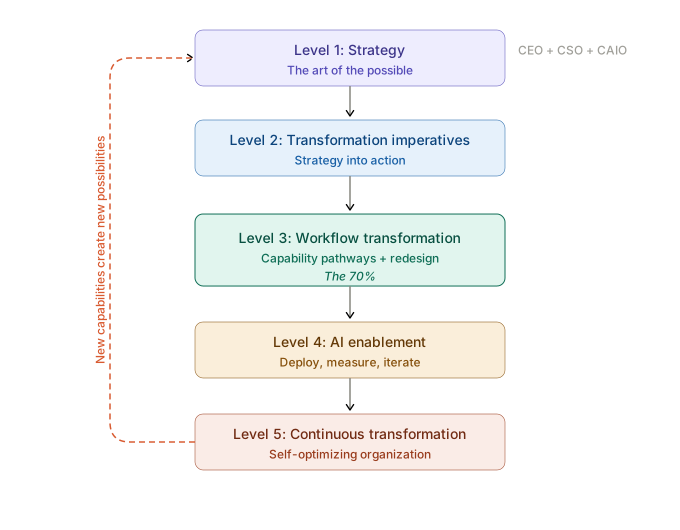
The Level 3 to Level 4 transition is complete. Article 17 established why the traditional playbook does not apply. The domain owner's deliverables have passed the readiness gate. The CIO's organization has confirmed the workflow designs, data requirements, governance specifications, and cross-department interfaces are sufficient to build on. The Level 1 triad has committed the resources.
Now the CIO's organization becomes the implementation engine, and the most consequential decision they will make is the first one: which technologies will serve the workflow designs that Level 3 produced?
This decision looks nothing like the technology selections the CIO's organization has made before. In every previous enterprise transformation, the technology decision was relatively straightforward: evaluate a small number of established platforms, select one, contract a systems integrator, and build. The ERP market has been mature for decades. The evaluation frameworks are well understood. The systems integrators have delivered hundreds of implementations on each platform. The CIO's team knows how to run this process.
AI technology selection in 2026 has none of those characteristics. The landscape is immature and evolving faster than any previous enterprise technology cycle: Gartner's May 2026 forecast puts worldwide AI spending at $2.59 trillion for the year, 47% growth over 2025, and calls 2026 the inflection year for enterprise AI spending.1 The evaluation is not "which platform" but "which combination of technologies across which deployment models for which workflows." The decisions compound: a foundation model choice constrains the agent framework, which constrains the orchestration layer, which constrains the governance tooling.2 And unlike ERP, where you could evaluate the system's capabilities against your requirements with confidence that those capabilities would be stable, AI capabilities are probabilistic, evolving, and behave differently in production than in demonstrations.
The methodology gives the CIO's team one advantage that most organizations lack: completed workflow designs that provide specific evaluation criteria rather than abstract requirements. This article describes how to use that advantage.
What is the CIO’s mandate in AI business transformation?
At Level 4, the CIO’s organization leads technology selection, integration architecture, deployment, and technical operations. In BCG’s formulation, this is the 20% of the transformation that is technology and data infrastructure, serving the 70% that is people, processes, and organizational change completed across the preceding levels.3
But the CIO does not lead alone. The organizational reconfiguration Article 17 described remains in effect throughout Level 4. The domain owner partners on decisions that affect transformation intent. The CAIO's department provides advisory continuity through embedded translators who participated in the Level 3 work and can bridge the business understanding with the technical execution. The CIO's team builds, tests, deploys, and operates, but they do so in service of designs they did not create and against governance requirements they did not set.
This is the mindset shift that separates CIOs who succeed at Level 4 from those who revert to the traditional playbook: the technology serves the business transformation, not the other way around. McKinsey's Global Tech Agenda 2026, based on a survey of more than 600 technology and business leaders, found that the most successful CIOs are not just managing technology but "shaping their companies' futures" by weaving AI into operating models. Top-performing CIOs are collaborators with CEOs in shaping business strategy, and nearly one-third prioritize technology-led business model innovation.4 The methodology positions the CIO to do exactly that, but only if they approach Level 4 as the implementation of business transformation rather than a technology project.
Why is selecting AI technology different from traditional enterprise software selection?
AI technology selection is a different discipline because the platforms are immature, their capabilities are probabilistic rather than deterministic, and no standardized evaluation frameworks or decades of integrator experience exist to draw on. In traditional enterprise technology selection, the CIO’s team evaluates a small number of established platforms against documented business requirements. The platforms are mature, the capabilities are deterministic, the evaluation frameworks are standardized, and the systems integrators who implement them have decades of experience. The process is well understood because it has been repeated thousands of times across every industry.
AI technology selection breaks every one of those assumptions.
The evaluation is not one vendor but many. Most enterprises will use a multi-vendor approach spanning foundation model providers, orchestration and agent frameworks, search and retrieval tools, evaluation and monitoring tooling, and governance platforms.5 The question is not "which AI platform should we buy" but "which combination of technologies supports our specific workflows with the right controls and portability." BCG's research on vendor strategy is direct: the old signs of a safe vendor bet, size, headcount, and long-standing history, no longer hold. In AI, those indicators "can just as easily point to inertia." Value is defined by adaptability.2
The system is probabilistic rather than deterministic. An ERP system does exactly what its configuration specifies. An AI system produces outputs that vary based on inputs, context, and the model's learned patterns. An AI system evaluating the same supplier's financial data for risk assessment may weight different indicators on successive analyses, flagging currency exposure as the primary concern in one evaluation and debt-to-equity concentration in another, both defensible conclusions drawn from the same data, but neither the single predetermined answer that a configured rules-based system would produce. The CIO's team cannot evaluate AI technologies the way they evaluate ERP systems because the system's behavior cannot be fully specified in advance.
The architecture is composable rather than monolithic. Where ERP consolidates everything into one platform, AI requires assembling interoperable components that can be modified and replaced as capabilities evolve. McKinsey's research on enterprise architecture for the agentic era frames this as a deliberate choice between incremental integration (adding AI into existing systems over time) and comprehensive transformation (overhauling the architecture to support agentic workflows). Both paths require composable design, where components can evolve independently without requiring the entire stack to be refactored.6
Vendor lock-in compounds at every layer of the stack. The choice of foundation model and the choice of agent framework are not independent decisions. When agents run on a vendor's proprietary orchestration layer, lock-in accumulates across the model layer, the orchestration layer, the data layer, and the governance layer simultaneously. Organizations that have not defined their architecture strategy are already making a default choice, and that default is usually determined by whichever vendor has the best marketing rather than the best governance posture. Early decisions lock in for longer than CIOs expect: enterprise research with CIOs found that switching AI models requires re-engineering all prompts, instructions, and quality assurance, making model changes "a task that can take a lot of engineering time."7
And the technology landscape is evolving faster than any previous enterprise cycle. Gartner predicts that 40% of enterprise applications will feature task-specific AI agents by the end of 2026, representing an eightfold increase in a single year.8 That figure measures agents embedded in vendor applications, not agents organizations have deployed themselves. The organizational picture is much earlier: Gartner's first Hype Cycle for Agentic AI, published June 2026, places agentic AI at the Peak of Inflated Expectations and reports that only 17% of organizations have deployed AI agents to date, though more than 60% expect to within two years.5 Both numbers can be true at once, and together they describe a market moving faster than its buyers. Forrester identifies a critical gap: while AI technology advances rapidly, "the development of design tools and methods lags," meaning CIOs are making consequential decisions with fewer established evaluation frameworks than any previous technology generation.9 The decisions the CIO makes today will shape the organization's AI architecture for years, and they are being made in a market that is still finding its footing.
How should organizations evaluate AI vendors?
Organizations should evaluate AI technology against the workflow specifications produced at Level 3, not against vendor demonstrations. Most organizations evaluating AI technology start with vendor capabilities and work backward to potential use cases. The methodology does the opposite: the workflow designs from Level 3 provide specific, detailed specifications that become the evaluation criteria. This is where the methodology’s workflow-first approach provides its most concrete advantage.
Each workflow design specifies what the AI system needs to do within that workflow, what data it needs to access, what governance classification applies, what level of human oversight is required, and how the AI's outputs integrate with the human roles defined in the job redesign. These are not abstract requirements. They are operational specifications produced through months of careful work at Level 3, quality-gated by the domain's directors and senior managers, and confirmed by the CIO's team as sufficient for technology selection during the Tier 3 handoff readiness assessment.
The evaluation methodology follows from these specifications. For each workflow design, the CIO's team assesses: can this technology perform the specific tasks the workflow requires, at the quality level the governance framework demands, with the data that is actually available, within the human oversight architecture the design specifies? The domain owner participates in this evaluation because the business context determines what "sufficient" means. A 95% accuracy rate may be excellent for internal document classification but inadequate for customer-facing financial advice. The workflow designs and governance classifications from Level 3 provide the criteria. The domain owner provides the judgment about whether the technology meets them.
This is a fundamentally different evaluation than a traditional vendor selection process. In ERP or CRM selection, the business writes scenarios based on their requirements, the IT organization defines technical architecture criteria, and vendors are asked to demonstrate both. The scenarios are scripted, the evaluation is binary (the system either handles the scenario or it does not), and the system's behavior during the demonstration will be identical to its behavior in production because the system is deterministic. AI workflow designs contain components that this traditional process cannot evaluate. Each workflow step carries a governance classification that specifies the level of human oversight required, and the technology must enforce that oversight as a runtime constraint, not merely support it as a configuration option. The evaluation must test against the actual data the workflow will encounter, including edge cases and inconsistent inputs, because AI accuracy demonstrated with curated data in a controlled environment frequently degrades with real production data. The evaluation must assess not just what the AI does when it performs correctly, but how it fails: whether it produces confidently wrong outputs, how its accuracy changes over time as data patterns shift, and whether those failure modes are manageable within the human oversight architecture the workflow design specifies. And because the governance framework from Article 7 requires audit trails, accountability traceability, and compliance documentation, the technology must support these as technical capabilities, not aspirational features. The CIO's team should insist on evaluating AI technologies against scenarios derived directly from the Level 3 workflow designs, using production-representative data, and testing specifically for the governance enforcement, output quality thresholds, and failure mode characteristics that have no equivalent in traditional vendor selection.
The evaluation must also assess integration feasibility. A technology that performs well in isolation but cannot connect to the organization's existing enterprise systems in the manner the workflow requires is not a viable selection. Deloitte's research identifies legacy system integration as the primary challenge for 60% of organizations scaling AI, and Capgemini found integration complexity is a top barrier for 64% of enterprises.10 The workflow designs from Level 3 specify what data the AI needs from each enterprise system and what actions it takes within those systems. If the selected technology cannot access that data at the speed and governance level the workflow demands, the technology fails regardless of its standalone capabilities. Integration feasibility should be evaluated during selection, not discovered as a constraint during implementation. Article 19 addresses the full integration architecture in detail.
How do you make the build, buy, or partner decision for AI?
The most strategic technology decision at Level 4 is not which vendor to choose but which strategy — build, buy, or partner — to pursue for each workflow, and different workflows within the same domain may require different answers.
Building custom AI solutions, using fine-tuned models or retrieval-augmented generation with proprietary data, makes sense when the workflow requires deep domain-specific knowledge that general-purpose platforms cannot provide, when the data is too sensitive to share with external providers, or when the competitive advantage depends on capabilities no vendor offers. The tradeoff is development time, talent requirements, and ongoing maintenance responsibility.
Buying platform capabilities makes sense when the workflow's requirements are well served by established AI platforms, when speed of deployment matters more than customization, and when the vendor's governance and compliance posture meets the organization's requirements. The tradeoff is dependency on the vendor's roadmap, data sharing implications, and the lock-in risk the previous section described.
Partnering, working with AI labs or systems integrators to co-develop solutions, makes sense when the workflow requires capabilities at the frontier of what is possible, when the organization needs access to expertise it cannot build internally in the required timeframe, or when the deployment requires deep integration with industry-specific systems.
The governance framework from Article 7 is a direct input to this decision. A workflow classified as high-risk under the governance framework may require on-premise deployment with full audit trails and data sovereignty guarantees, which constrains the technology options to self-hosted or private cloud solutions. A workflow classified as lower risk may be well served by a vendor platform with standard security controls. The risk classification does not determine the technology, but it constrains the field of viable options.
The CIO's team should document the build/buy/partner decision for each major workflow and present it as part of the Level 4 implementation plan. This documentation serves two purposes: it makes the rationale transparent to the Level 1 triad, who are approving the technology investment, and it creates a record that the CAIO's governance function can verify against the risk classifications from the governance framework.
Should AI be built on a single platform or a composable architecture?
AI should be built on a composable architecture — interoperable components that can be replaced individually as capabilities evolve — not consolidated onto a single platform the way traditional ERP was. The technology landscape is evolving too rapidly, and the risk of being locked into a vendor whose capabilities fall behind is too high. The research consistently points toward assembling components that can be swapped out as capabilities evolve and the organization’s needs change.
BCG's research identifies five critical dimensions CIOs should evaluate when building their AI technology stack. Modularity: can components be replaced without refactoring the entire system? Interoperability: do the components communicate through standard interfaces? Adaptability: can the architecture accommodate new AI capabilities as they emerge? Governance integration: does the architecture support the monitoring, audit, and oversight requirements the governance framework specifies? Cost transparency: can the organization track the cost of each component independently to make informed decisions about where to invest and where to optimize?2
The practical implication is that the CIO's architecture decisions should preserve optionality. Where possible, the technology stack should use standard interfaces and protocols that allow components to be swapped without rebuilding the workflows that depend on them. This is easier to articulate than to achieve, because many AI vendors design their platforms to create dependency across layers. The CIO's team needs to evaluate each vendor's architecture not just for current capability but for how deeply adoption embeds the organization into that vendor's ecosystem and how difficult extraction would be if a superior alternative emerges.
The direction of the market reinforces the composable choice. McKinsey's April 2026 infrastructure research describes the target state as a modular, mesh-like design in which agents, tools, and enterprise systems connect through a shared orchestration layer, and Capgemini's platformization research reaches the same conclusion from the scaling side: agentic AI cannot scale without modular, composable, AI-native platforms.11 The anti-lock-in argument is now being made by the major vendors themselves. IBM repositioned its watsonx Orchestrate platform at Think 2026 as an agentic control plane built to run agents from any source, and PwC positions its agent OS as a unifying control plane across clouds and vendors.12 When IBM, PwC, and Forrester all converge on vendor-neutral, multi-model control planes, the composable premise has stopped being a contrarian position.
McKinsey frames this as one of the most important decisions a technology leader can make: choosing between incremental integration and comprehensive transformation of the enterprise architecture. Both paths are valid, and the right choice depends on the organization's current technology estate, the scope of the transformation, and the CIO's assessment of how rapidly the AI landscape will evolve.6 What matters for the methodology is that the choice is deliberate rather than accidental, informed by the workflow specifications rather than vendor influence, and documented so that the Level 1 triad understands the architectural direction and its implications.
How does AI governance become technical controls?
At Level 4, the CIO’s organization translates governance from policy into technical controls embedded in the selected technologies. Article 7 established the governance framework. Level 3 operationalized it into the workflow designs. Now the governance specifications become the access controls, guardrails, and enforcement mechanisms built into the deployed systems.
Risk classifications become access control policies and deployment constraints. A workflow step classified as high-risk requires monitoring systems that can detect and flag anomalous AI behavior in real time. A workflow where the AI interacts directly with customers requires audit trails that record every interaction for compliance review. Human oversight requirements become system-level approval workflows: where the governance framework specifies human review before the AI's recommendation is executed, the technical architecture must enforce that review as a system constraint, not a suggestion.
The accountability structures from the governance framework require technical infrastructure that makes accountability traceable. When a multi-step AI workflow produces a negative outcome, the system must be able to reconstruct what happened at each step, what data informed each decision, and where in the chain the outcome diverged from expectations. This is not an afterthought to be added once the system is deployed. It is a technical requirement that shapes which technologies are viable and how they are configured.
The CIO's security team needs the governance specifications from Level 3 as direct technical requirements. The security architecture for AI-enabled workflows differs from traditional application security because the system's behavior is not fully predetermined. Threat monitoring must account for AI-specific vulnerabilities: prompt injection, data poisoning, model drift, and the possibility that the AI system's behavior changes over time as it encounters new data patterns. These are production security requirements that have no equivalent in traditional enterprise systems.
What Comes Next
Technology selection is the foundational decision of Level 4, but it is the beginning of the implementation, not the end. Article 19 addresses how the selected technologies connect to the existing technology estate, the integration architecture challenge that the research identifies as the single most cited technical barrier to AI scaling. Article 20 covers how the AI is deployed into the redesigned workflows, including the iteration cycle where design meets production reality. Article 21 addresses the data architecture at the level of detail the CIO and CDO need. And Article 23 establishes how Level 4 is measured, where the organization can finally assess whether the deployed AI systems are producing the business outcomes the transformation was designed to achieve.
The CIO's team is building something no previous enterprise technology program has required: a technology infrastructure for systems that learn, change behavior, produce probabilistic outputs, require graduated human oversight, and must operate within a governance framework designed for a fundamentally different kind of enterprise capability. The workflow designs from Level 3 make that challenge manageable by providing specific, quality-gated specifications rather than abstract requirements. The technology selection methodology described here makes those specifications operational.
Sources
- 1.Gartner, "Gartner Forecasts Worldwide AI Spending to Grow 47% in 2026," May 19, 2026. Worldwide AI spending of $2.59 trillion forecast for 2026, revised up from the $2.52 trillion January forecast; AI infrastructure over 45% of spend; 2026 called the inflection year for enterprise versus hyperscaler AI spending https://www.gartner.com/en/newsroom/press-releases/2026-05-19-gartner-forecasts-worldwide-ai-spending-to-grow-47-percent-in-2026
- 2.BCG, "Rethinking Vendor Strategy in the Age of AI Acceleration," November 2025. Five critical evaluation dimensions for AI technology; traditional vendor evaluation signals no longer reliable; value defined by adaptability; lock-in compounds at every stack layer https://www.bcg.com/publications/2025/rethinking-vendor-strategy-age-ai-acceleration
- 3.BCG, "The CIO's Role in AI Transformation and Productivity," February 2025. 10-20-70 rule: 10% algorithms, 20% technology stack, 70% processes and change management; CIO playbook for realizing full benefits https://www.bcg.com/publications/2025/cios-role-in-ai-transformation-and-productivity
- 4.McKinsey, "How CIOs Are Shaping Enterprise Strategy and Growth: Global Tech Agenda 2026," February 2026 (632 participants). CIOs becoming strategy architects; top performers prioritize technology-led business model innovation; 28% plan budget increases of 10%+ in 2026 https://www.mckinsey.com/capabilities/mckinsey-technology/our-insights/mckinsey-global-tech-agenda-2026
- 5.Gartner, "Hype Cycle for Agentic AI, 2026," June 2026. Gartner's first agentic AI Hype Cycle; agentic AI at the Peak of Inflated Expectations; per the 2026 Gartner CIO and Technology Executive Survey, 17% of organizations have deployed AI agents while more than 60% expect to within two years; governance, security, and cost-management profiles tracked alongside the core agent technologies https://www.gartner.com/en/articles/hype-cycle-for-agentic-ai
- 6.McKinsey, "Rethinking Enterprise Architecture for the Agentic Era," March 2026. Incremental vs. comprehensive transformation; composable architecture as interoperable building blocks; CIOs must make a deliberate choice between paths; enterprise architectures "are the business" in the agentic era https://www.mckinsey.com/capabilities/mckinsey-technology/our-insights/rethinking-enterprise-architecture-for-the-agentic-era
- 7.Andreessen Horowitz, "How 100 Enterprise CIOs Are Building and Buying Gen AI in 2025," June 2025 (100 enterprise CIOs). LLM budgets grew ~75% year-over-year; switching costs escalating due to prompt tuning and agent QA complexity; multi-model adoption increasing https://a16z.com/ai-enterprise-2025/
- 8.Gartner, August 2025. 40% of enterprise applications will feature task-specific AI agents by end of 2026, up from less than 5% in 2025; 50% of knowledge workers will develop skills to work with AI agents by 2029 https://www.gartner.com/en/newsroom/press-releases/2025-08-26-gartner-predicts-40-percent-of-enterprise-apps-will-feature-task-specific-ai-agents-by-2026
- 9.Forrester, "Announcing Our Evaluation of the Agent Control Plane Market." Three functional planes for AI technology decisions: build, orchestrate, govern; design tools and methods lag behind AI capability advancement; enterprises must treat planes as distinct problem spaces. Forrester launched this formal market evaluation with research questionnaires for a landscape report, the precursor to a Wave, issued in April 2026; no Wave had been published as of mid-2026 https://www.forrester.com/blogs/announcing-our-evaluation-of-the-agent-control-plane-market/
- 10.Deloitte, "Agentic AI Strategy," December 2025 (2025 Emerging Technology Trends study). 60% of organizational leaders cite legacy system integration as primary AI challenge; only 14% have deployable solutions; 11% in production. Capgemini/OpenText, "World Quality Report 2025-26," November 2025. Integration complexity cited as top barrier by 64% of organizations; data privacy risks by 67%; hallucination and reliability concerns by 60%.
- 11.McKinsey, "Reimagining Tech Infrastructure for and with Agentic AI," April 23, 2026. Modular, mesh-like infrastructure design; agents, tools, and enterprise systems connected through a shared orchestration layer https://www.mckinsey.com/capabilities/mckinsey-technology/our-insights/reimagining-tech-infrastructure-for-and-with-agentic-ai
- 12.IBM, "Think 2026: IBM Delivers the Blueprint for the AI Operating Model as the AI Divide Widens," May 5, 2026. Next-generation watsonx Orchestrate in private preview as an agentic control plane; agents from any source (IBM Granite, Anthropic Claude, OpenAI GPT, Mistral, custom) with consistent policy enforcement, auditability, and accountability https://newsroom.ibm.com/2026-05-05-think-2026-ibm-delivers-the-blueprint-for-the-ai-operating-model-as-the-ai-divide-widens
Frequently Asked Questions
How do we evaluate AI capabilities when the technology is evolving so rapidly that today's selection may be obsolete in eighteen months?
This is precisely why composable architecture matters more than individual vendor selection. The CIO's team should evaluate not just current capability but how deeply each choice embeds the organization into a specific ecosystem and how difficult extraction would be. Standard interfaces, modular components, and deliberate avoidance of proprietary orchestration layers where open alternatives exist all preserve the organization's ability to adopt superior technologies as they emerge. The goal is not to select the perfect technology for the next decade. It is to select technology that serves the current workflow designs effectively while preserving the organization's ability to adapt as the landscape evolves.
Should we standardize on one AI platform across all domains, or allow different domains to select different technologies?
The research points toward a middle path. Complete standardization sacrifices the ability to match the best technology to each workflow's specific requirements. Complete fragmentation creates an ungovernable sprawl of platforms, models, and vendors. The CAIO's department plays a critical coordination role here, ensuring that domain-specific technology choices operate within an enterprise-wide architecture standard that the CIO's organization defines. The practical approach is a curated portfolio: a set of approved platforms, models, and frameworks that meet the governance requirements, with flexibility for domains to select within that portfolio based on their workflow specifications.
How does the domain owner participate in technology selection when it is a technical decision?
The domain owner provides the business judgment that determines whether a technology meets the workflow's requirements. The CIO's team evaluates technical capability. The domain owner evaluates whether that capability is sufficient for the business outcome the workflow was designed to produce. A technology that meets every technical specification but cannot achieve the accuracy or reliability the business process demands is not sufficient, and only the domain owner can make that determination. This is the same partnership dynamic Article 17 established for the iteration cycle: the CIO provides technical expertise, the domain owner provides business judgment, and neither can make the decision alone.
What role does the CAIO's department play in technology selection versus the CIO's organization?
The CIO's organization leads the evaluation, makes the technical assessment, and implements the selected technology. The CAIO's department ensures the technology selection is consistent with the governance framework, preserves cross-domain consistency, and remains aligned with the transformation's strategic intent. The CAIO's embedded translators, who participated in the Level 3 workflow design for each domain, are particularly valuable during technology selection because they understand both the business logic behind the workflow designs and the AI capabilities required to serve them. They bridge the gap between the domain owner's business requirements and the CIO's technical evaluation.
How do we manage the cost implications of multi-vendor AI architecture versus single-platform ERP?
AI cost management requires different disciplines than ERP budgeting. AI costs scale non-linearly with usage: compute costs, API call volumes, and data processing fees can grow unpredictably as adoption expands. The CIO's team should build cost transparency into the architecture from the beginning, with the ability to track costs per workflow, per model, and per deployment. This allows the organization to make informed decisions about where to invest and where to optimize. The governance framework's risk classifications also inform cost allocation: higher-risk workflows that require on-premise deployment with dedicated monitoring will cost more than lower-risk workflows on shared platforms, and that differential should be visible in the budgeting.
When should we build custom AI capabilities versus buying platform solutions?
Build when the workflow requires deep domain-specific knowledge that general-purpose platforms cannot provide, when the data is too sensitive for external providers, or when the capability is a competitive differentiator. Buy when established platforms serve the workflow's requirements, when speed matters more than customization, and when the vendor's governance posture meets your standards. Partner when you need frontier capabilities, specialized expertise, or deep industry-specific integration. Different workflows within the same domain may warrant different strategies, and the decision should be documented for each major workflow so the Level 1 triad and the CAIO's governance function can verify alignment with the risk classifications and strategic intent.
This series addresses “what” to do, not “how” to do it. If you are a business executive and would like help thinking through the “how,” please feel comfortable reaching out.

About the author
Shawn Plaster
Founder & CEO, Plaster Group
Shawn is the author of Plaster Group's five-level AI Business Transformation Methodology and its 27-article Insights series, and leads the firm's enterprise AI transformation work.
Previous: Article 17: From Design to Deployment · Next: Article 19: Integration Architecture
© 2026 Plaster Group, LLC. All rights reserved. This article may not be reproduced, distributed, or transmitted in any form without prior written permission from Plaster Group. Brief excerpts may be quoted for review or commentary purposes with attribution to the author and a link to the original article.
Ready to move forward?
Let's discuss how your organization can build with AI — securely, strategically, and starting from where you are today.
Start a Conversation